Questions

2 Marks Questions

🎯

Test yourself on this topic

7 questions · timed · auto-graded

Question 12 Marks
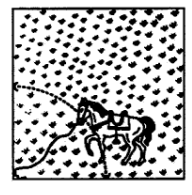
A horse is tied to a peg at one corner of a square shaped grass field of side 15 m by means of a 5 m long rope. Find
i. the area of that part of the field in which the horse can graze.
ii. the increase in the grazing area if the rope were 10 m long instead of 5 m (Use $\pi=3.14$ ).
Image
Answer
i. The area of that part of the field in which the horse can graze if the length of the rope is 5 cm $=\frac{1}{4} \pi r^2=\frac{1}{4} \times 3.14 \times(5)^2=\frac{1}{4} \times 78.5=19.625 m^2$
ii. The area of that part of the field in which the horse can graze if the length of the rope is 10 m $=\frac{1}{4} \pi r^2=\frac{1}{4} \times 3.14 \times(10)^2=78.5 m^2$
$\therefore$ The increase in the grazing area
$
=78.5-19.625=58.875 m^2
$
View full question & answer
Question 22 Marks
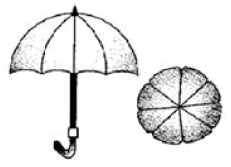
An umbrella has 8 ribs which are equally spaced (see figure). Assuming umbrella to be a flat circle of radius 45 cm, Find the area between the two consecutive ribs of the umbrella..
Image
Answer
Here, $r =45 cm$ and $\theta=\frac{500}{8}=45^{\circ}$
Area between two consecutive ribs of the umbrella $=\frac{\theta}{360^{\circ}} \times \pi r^2$
$
=\frac{45^{\circ}}{360^{\circ}} \times \frac{22}{7} \times 45 \times 45=\frac{22275}{28} cm^2
$
View full question & answer
Question 32 Marks
Prove the trigonometric identity:
$
\frac{\sin A+\cos A}{\sin A-\cos A}+\frac{\sin A-\cos A}{\sin A+\cos A}=\frac{2}{\sin ^2 A-\cos ^2 A}=\frac{2}{2 \sin ^2 A-1}=\frac{2}{1-2 \cos ^2 A}
$
Answer
We have,
L.H.S $=\frac{\sin A+\cos A}{\sin A-\cos A}+\frac{\sin A-\cos A}{\sin A+\cos A}$
$\Rightarrow$ L.H.S $=\frac{(\sin A+\cos A)^2+(\sin A-\cos A)^2}{(\sin A-\cos A)(\sin A+\cos A)}$
$\Rightarrow $ L.H.S $=\frac{\left(\sin ^2 A+\cos ^2 A+2 \sin A \cos A\right)+\left(\sin ^2 A+\cos ^2 A-2 \sin A \cos A\right)}{\sin^2 A-\cos ^2 A}$
$\left[\because(a \pm b)^2=a^2 \pm 2 a b+b^2\right]$
$\Rightarrow $ L.H.S $=\frac{(1+2 \sin A \cos A)+(1-2 \sin A \cos A)}{\sin ^2 A-\cos ^2 A}$
$\Rightarrow $ L.H.S $=\frac{2}{\sin ^2 A-\cos ^2 A}$
$\Rightarrow $ L.H.S $=\frac{2}{\sin ^2 A-\cos ^2 A}=\frac{2}{\sin ^2 A-\left(1-\sin ^2 A\right)}$
$\left[\because \sin ^2 A+\cos ^2 A=1\right]$
$\Rightarrow$ L.H.S $=\frac{2}{2 \sin ^2 A-1}=\frac{2}{2\left(1-\cos ^2 A\right)-1}=\frac{2}{1-2 \cos ^2 A}=$ R.H.S
$\left[\because \sin ^2 A=1-\cos ^2 A  \cos ^2 A=1-\sin ^2 A\right]$
Hence proved.
View full question & answer
Question 42 Marks
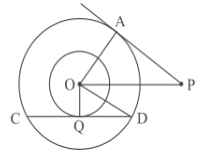
In two concentric circles, the radii are $OA = r \ cm$ and $OQ =6 \ cm,$ as shown in the figure. Chord $CD$ of larger circle is a tangent to smaller circle at $Q . PA$ is tangent to larger circle. If $PA =16 \ cm$ and $OP =20 \ cm,$ find the length $CD.$
Image ​​​​​​​
Answer
Since $\ce{PA \perp OA}$ therefore $OA^2=20^2-16^2=144$
$\Rightarrow \text{OA}=r=12 \ cm$
In $\triangle \ce{OQD, QD^2}=12^2-6^2=108$
$\Rightarrow \text{QD}=6 \sqrt{3} \ cm$
Now $\text{OQ}$ bisects $\text{CD}$
$\Rightarrow \text{CD}=2 \times 6 \sqrt{3}$
$=12 \sqrt{3} \ cm$
View full question & answer
Question 52 Marks
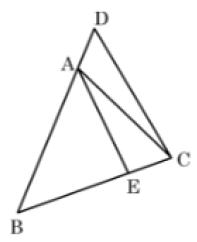
In the given figure, $\angle ABC =\angle ACB$ and $\frac{B C}{B E}=\frac{B D}{A C}$.
Image
Show that $\angle ABE \sim \angle DBC$ and $AE \| DC$.
Answer
It is given that $\frac{B C}{B E}=\frac{B D}{A C}$
$\Rightarrow \frac{B E}{B C}=\frac{A B}{D B}$
$(\because \angle ABC=\angle ACB \Rightarrow AC=AB)$
Also $\angle B$ is common
$\therefore \triangle ABE \sim \triangle DBC \text { (SAS}$ similarity$)$
$\Rightarrow \angle BAE=\angle BDC$
But these are corresponding angles $\therefore AE \| DC$.
View full question & answer
Question 62 Marks
In a $\triangle \text{ABC, AD}$ is the bisector of $\angle A$, meeting side $\text{BC}$ at $D.$ If $\text{AD} =5.6 \ cm, \text{BC} =6 \ cm$ and $\text{BD} =3.2 \ cm$, find $\text{AC.}$
Answer
If is is given that $\text{AB} =5.6 \ cm, \text{BC} =6 \ cm$ and $BD =3.2 \ cm$
In $\triangle \text{ABC, AD}$ is the bisector of $\angle A$, meeting side $\text{BC}$ at $\text{D}$
$\therefore \frac{AB}{AC}=\frac{BD}{DC}$
$\frac{5.6 \ cm}{AC}=\frac{3.2 \ cm}{2.8 \ cm}[\text{DC=BC-BD}]$
$\text{AC}=\frac{5.6 \times 2.8}{3.2} \ cm$
$=4.9\ cm$
View full question & answer
Question 72 Marks
Solve the following pair of equations by substitution method:
$7 \times 15y = 2...(1)$
$x + 2y = 3 ...(2)$
Answer
Step $1:$ By substitution method, we pick either of the equations and write one variable in terms of the other.
$7 x-15 y=2 \ldots(1)$
and $x+2 y=3 \ldots(2)$
Let us consider the Equation $(2):$
$x+2 y=3$
and write it as $x=3-2 y \ldots(3)$
Step $2:$ Now substitute the value of $x$ in Equation $(1)$
We get $7(3-2 y)-15 y=2$
i.e., $21-14 y-15 y=2$
i.e., $-29 y=-19$
Therefore $y =\frac{19}{29}$
Step $3:$ Substituting this value of $y$ in Equation $(3),$ we get
$x=3-2\left(\frac{19}{29}\right)=\frac{49}{29}$
Therefore, the solution is $x=\frac{49}{29}, y=\frac{19}{29}$
View full question & answer
2 Marks Questions - Maths STD 10 Questions - Vidyadip