Questions

3 Marks Question

🎯

Test yourself on this topic

8 questions · timed · auto-graded

Question 13 Marks
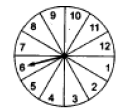
game of chance consists of spinning an arrow which is equally likely to come to rest pointing to one of the numbers $1,2,3, \ldots, 12$ as shown in the figure. What is the probability that it will point to.
Image
i. 6
ii. an even number?
iii. a prime number?
iv. a number which is a multiple of 5?
Answer
The possible outcomes are 1, 2, 3, 4, 5 ..............12.
Number of all possible outcomes = 12
i. Let $E _1$ be the event that the pointer rests on 6 .
Then, number of favorable outcomes $=1$
Probability $=\frac{\text { Number of favourable outcome }}{\text { Total Number of outcomes }}$
Therefore, $P ($ arrow pointing at 6$)= P \left( E _1\right)=\frac{1}{12}$
ii. Out of the given numbers, the even numbers are $2,4,6,8,10$ and 12
Let $E_2$ be the event of getting an even number.
Then, number of favorable outcomes $=6$
Probability $=\frac{\text { Number of favourable outcome }}{\text { Total Number of outcomes }}$
Therefore, P (arrow pointing at an even number) $= P \left( E _2\right)=\frac{6}{12}=\frac{1}{2}$
iii. Out of the given numbers, the prime numbers are $2,3,5,7$ and 11 . Let $E_3$ be the event of the arrow pointing at a prime number.
Then, number of favorable outcomes $=5$
Probability $=\frac{\text { Number of favourable outcome }}{\text { Total Number of outcomes }}$
Therefore, P (arrow pointing at a prime number) $= P \left( E _3\right)=\frac{5}{12}$
iv. Out of the given numbers, the numbers that are multiple of 5 are 5 and 10 only. Let $E _4$ be the event of the arrow pointing at a multiple of 5 .Then, number of favorable outcomes $=2$
Probability $=\frac{\text { Number of favourable outcome }}{\text { Total Number of outcomes }}$
Therefore, $P ($ arrow pointing at a number that is a multiple of 5$)= P \left( E _4\right)=\frac{2}{12}=\frac{1}{6}$
View full question & answer
Question 23 Marks
If $\sin \theta+\cos \theta= p$ and $\sec \theta+\operatorname{cosec} \theta= q$, show that $q \left( p ^2-1\right)=2 p$
Answer
Given, $\sin \theta+\cos \theta=p$
And, $\sec \theta+\operatorname{cosec} \theta= q \ldots (2)$
Now, $\text{L.H.S}$
$=q\left(p^2-1\right)$
$=(\sec \theta+\operatorname{cosec} \theta)\left[(\sin \theta+\cos \theta)^2-1\right] [$ from $(1) \ (2) ]$
$=\left[\frac{1}{\cos \theta}+\frac{1}{\sin \theta}\right]\left[\sin ^2 \theta+\cos ^2 \theta+2 \cos \theta \sin \theta-1\right]$
$=\left[\frac{\sin \theta+\cos \theta}{\cos \theta \sin \theta}\right][1+2 \cos \theta \sin \theta-1]\left(\because \sin ^2 \theta+\cos ^2 \theta=1\right)$
$=\frac{\sin \theta+\cos \theta}{\cos \theta \sin \theta} \times 2 \cos \theta \sin \theta$
$=2(\sin \theta+\cos \theta)$
$=2 p(\because \sin \theta+\cos \theta=p)$
$=\text {R.H.S }$
Hence, proved.
View full question & answer
Question 33 Marks
Prove that $\frac{\sin \theta-\cos \theta+1}{\sin \theta+\cos \theta-1}=\frac{1}{\sec \theta-\tan \theta}$, using identity $\sec ^2 \theta=1+\tan ^2 \theta$.
Answer
We have to prove that, $\frac{\sin \theta-\cos \theta+1}{\sin \theta+\cos \theta-1}=\frac{1}{\sec \theta-\tan \theta}$ using identity $\sec ^2 \theta=1+\tan ^2 \theta$
$\text { LHS }=\frac{\sin \theta-\cos \theta+1}{\sin \theta+\cos \theta-1}=\frac{\tan \theta-1+\sec \theta}{\tan \theta+1-\sec \theta}$
$[$ dividing the numerator and denominator by $\cos \theta .]$
$=\frac{(\tan \theta+\sec \theta)-1}{(\tan \theta-\sec \theta)+1}$
$=\frac{\{(\tan \theta+\sec \theta)-1\}(\tan \theta-\sec \theta)}{\{(\tan \theta-\sec \theta)+1\}(\tan \theta-\sec \theta)}$
$[$ Multiplying and dividing by $(\tan \theta-\sec \theta)]$
$=\frac{\left(\tan \theta-\sec ^2 \theta\right)-(\tan \theta-\sec \theta)}{\{(\tan \theta-\sec \theta)+1\}(\tan \theta-\sec \theta)}\left[\because(a-b)(a+b)=a^2-b^2\right]$
$=\frac{-1-\tan \theta+\sec \theta}{(\tan \theta-\sec \theta+1)(\tan \theta-\sec \theta)}\left[\because \tan ^2 \theta-\sec ^2 \theta=-1\right]$
$=\frac{-(\tan \theta-\sec \theta+1)}{(\tan \theta-\sec \theta+1)(\tan \theta-\sec \theta)}$
$=\frac{-1}{\tan \theta-\sec \theta}$
$=\frac{1}{\sec \theta-\tan \theta}=\text { RHS }$
Hence Proved.
View full question & answer
Question 43 Marks
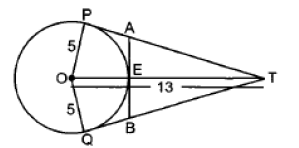
In figure $,O$ is the centre of a circle of radius $5 \ cm . \ T$ is a point such that $OT =13 \ cm$ and $OT$ intersects circle at $E$. If $A B$ is a tangent to the circle at $E,$ find the length of $A B$. where $TP$ and $TQ$ are two tangents to the circle.
Image
Answer
According to the question,
$O$ is the centre of a circle of radius $5 \ cm. \ T $ is a point such that $OT = 13 \ cm$ and $OT$ intersects circle at $E$..
Image
$\because OP \perp TP \ [$Radius from point of contact of the tangent$]$
$\therefore \angle OPT=90^{\circ}$
In right $ \triangle OPT$
$OT^2=OP^2+PT^2$
$\Rightarrow(13)^2=(5)^2+PT^2$
$ \Rightarrow PT=12 \ cm$
Let $ AP=x \ cm AE=AP$
$\Rightarrow AE=x \ cm$
and $ AT=(12-x) \ cm$
$TE=OT-OE$
$=13-5=8 \ cm$
$\because OE \perp AB \ [$Radius from the point of contact$]$
$\therefore \angle AEO=90^{\circ}$
$\Rightarrow \angle AET=90^{\circ}$
In right $\triangle AET$,
$ AT ^2= AE ^2+ ET ^2$
$(12-x)^2=x^2+8^2$
$\Rightarrow 144+x^2-24 x=x^2+64$
$\Rightarrow 24 x=80 $
$\Rightarrow x=\frac{80}{24}$
$=\frac{10}{3} \ cm$
Also $ BE = AE $
$=\frac{10}{3} \ cm$
$\Rightarrow A B=\frac{10}{3}+\frac{10}{3}$
$=\frac{20}{3} \ cm$
View full question & answer
Question 53 Marks
Use elimination method to find all possible solutions of the following pair of linear equations $a x+b y-a+b=0$ and $bx - ay - a - b =0$
Answer
Given pair of linear equation is $a x+b y-a+b=0$
and $b x-a y-a-b=0$
$(ii)$ Multiplying $a x+b y-a+b=0$ by $a$ and $b x-a y-a-b=0$ by $b,$ and adding them, we get
$a^2 x+aby-a^2+ab=0$ and $b^2 x-aby-ab-b^2=0$
$\left(a^2 x+aby-a^2+ab\right)+\left(b^2 x-aby-ab-b^2\right)=0$
$a^2 x+aby-a^2+ab+b^2 x-aby-ab-b^2=0$
$a^2 x+b^2 x-a^2-b^2=0$
$\Rightarrow\left(a^2+b^2\right) x=\left(a^2+b^2\right)$
$\Rightarrow x=\frac{\left(a^2+b^2\right)}{\left(a^2+b^2\right)}=1$
On putting $x=1$ in first equation, we get
$a x+b y-a+b=0$
$a+b y=a-b$
$\Rightarrow y=-\frac{b}{b}=-1$
Hence, $x=1$ and $y=-1$,
which is the required unique solution.
View full question & answer
Question 63 Marks
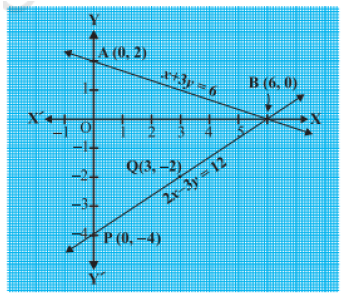
Check graphically whether the pair of equations $x+3 y=6$ and $2 x-3 y=12$ is consistent. If so, solve them graphically.
View full question & answer
Question 73 Marks
If one zero of the polynomial $2 x^2+3 x+\lambda$ is $\frac{1}{2}$, find the value of $\lambda$ and other zero.
Answer
Let $P(x)=2 x^2+3 x+\lambda$
Its one zero is $\frac{1}{2}$ so $P\left(\frac{1}{2}\right)=0$
$P\left(\frac{1}{2}\right)=2 \times\left(\frac{1}{2}\right)^2+3\left(\frac{1}{2}\right)+\lambda=0$
$\Rightarrow 2 \times \frac{1}{4}+3 / 2+\lambda=0$
$\Rightarrow \frac{1}{2}+\frac{3}{2}+\lambda=0$
$\Rightarrow \frac{4}{2}+\lambda=0$
$\Rightarrow 2+\lambda=0$
$\Rightarrow \lambda=-2$
Let the other zero be $\alpha$
Then $\alpha+\frac{1}{2}=-\frac{3}{2}$
$\Rightarrow \alpha=-\frac{3}{2}-\frac{1}{2}$
$=-\frac{4}{2}$
$=-2$
View full question & answer
Question 83 Marks
Prove that $7 \sqrt{5}$ is irrational.
Answer
We can prove $7 \sqrt{5}$ irrational by contradiction.
Let us suppose that $7 \sqrt{5}$ is rational.
It means we have some co$-$prime integers $a$ and $b(b \neq 0)$ such that
$7 \sqrt{5}=\frac{a}{b}$
$\Rightarrow \sqrt{5}=\frac{a}{7 b}$
$\ce{R.H.S}$ of $(1)$ is rational but we know that $\sqrt{5}$ is irrational.
It is not possible which means our assumption is wrong.
Therefore, $7 \sqrt{5}$ cannot be rational.
Hence, it is irrational.
View full question & answer
3 Marks Question - Maths STD 10 Questions - Vidyadip