Questions

M.C.Q (1 Marks)

🎯

Test yourself on this topic

18 questions · timed · auto-graded

MCQ 11 Mark
The median of first $8$ prime numbers is
  • $9$
  • B
    $11$
  • C
    $13$
  • D
    $7$
Answer
Correct option: A.
$9$
First $8$ prime numbers are follows:
$2,3,5,7,11,13,17,19$
$N=8 ($even$)$
$\therefore \text { Median }=\frac{\left(\frac{8}{2}\right)^{\text {th }} \text { value }+\left(\frac{8}{2}+1\right)^{\text {th }} \text { value }}{2}$
$=\frac{4^{\text {th }} \text { value }+5^{\text {th }} \text { value }}{2}$
$=\frac{7+11}{2}$
$=\frac{18}{2}$
$=9$
View full question & answer
MCQ 21 Mark
A sphere of diameter $18 \ cm$ is dropped into a cylindrical vessel of diameter $36 \ cm,$ partly filled with water. If the sphere is completely submerged then the water level rises by
  • A
    $4 \ cm$
  • B
    $5 \ cm$
  • $3 \ cm$
  • D
    $6 \ cm$
Answer
Correct option: C.
$3 \ cm$
Increase in volume of water $=$ volume of the sphere
$\Rightarrow \pi \times 18 \times 18 \times h$
$=\frac{4}{3} \pi \times 9 \times 9 \times 9$
$\Rightarrow h=\left(\frac{4}{3} \times \frac{9 \times 9 \times 9}{18 \times 18}\right) \ cm$
$=3 \ cm$
View full question & answer
MCQ 31 Mark
In the formula $\bar{X}= a + h \left(\frac{1}{N} \sum f_i u_i\right)$ for finding the mean of grouped frequency distribution $u _{ i }=$
  • A
    $\frac{x_i+a}{2 h}$
  • B
    $h\left(x_i-a\right)$
  • $\frac{x_i-a}{h}$
  • D
    $\frac{x_i+a}{h}$
Answer
Correct option: C.
$\frac{x_i-a}{h}$
(C) $\frac{x_i-a}{h}$
Explanation:  Given $\overline{ x }= a + h \left(\frac{1}{N} \Sigma f_i u_i\right)$
Above formula is a step deviation formula, where
$u _{ i }=\frac{x_i-a}{h}$
View full question & answer
MCQ 41 Mark
In a survey, it is found that every fifh person has a vehicle. The probability of a person $\text{NOT}$ having a vehicle, is
  • A
    $\frac{1}{5}$
  • $\frac{4}{5}$
  • C
    $5 \%$
  • D
    $95 \%$
Answer
Correct option: B.
$\frac{4}{5}$
Explanation: Out of $5$ persons $, 1$ person possess a vehicle
$P(\text { possessing vehicle })=\frac{1}{5}$
Using Probability of the Complement
$P(\text { not } A)=1-P(A)$
$P(\text { not possessing vehicle })=1-P(\text { possessing vehicle })$
$P(\text { not possessing vehicle })=1-\frac{1}{5}$
$\Rightarrow P(\text { not possessing vehicle })=\frac{4}{5}$
View full question & answer
MCQ 51 Mark
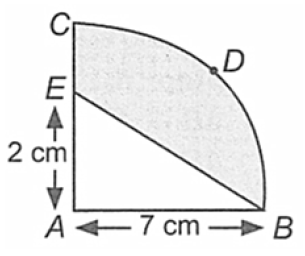
In the figure, ABDCA represents a quadrant of a circle of radius 7 cm a with centre A. Find the area of the shaded portion.
Image
  • A
    $14 cm^2$
  • $31.5 cm^2$
  • C
    $24.5 cm^2$
  • D
    $38.5 cm^2$
Answer
Correct option: B.
$31.5 cm^2$
(B) $31.5 cm^2$
Explanation:  Area of quadrant $=\frac{1}{4} \pi r^2$
$
=\frac{1}{4} \times \frac{22}{7} \times(7)^2=\frac{77}{2} cm^2=38.5 cm^2
$
Area of $\triangle BAE =\frac{1}{2} \times$ base $\times$ height
$
=\frac{1}{2} \times AB \times AE=\frac{1}{2} \times 7 \times 2=7 cm^2
$
Hence, area of the shaded portion $=$ Area of the quadrant $ABDCA -$ Area of $\triangle BAE$ $=(38.5-7) cm ^2=31.5 cm^2$
View full question & answer
MCQ 61 Mark
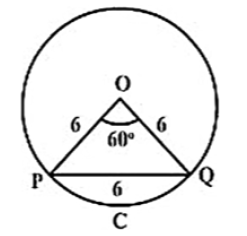
$PQ$ is a chord of a circle with centre $O$ and radius $6 \ cm. PQ $is of length $6 \ cm$ and divides the circle into two segments. The area of the minor segment is
Image
  • $(6 \pi-9 \sqrt{3}) cm ^2$
  • B
    $(6 \pi+\sqrt{3}) cm ^2$
  • C
    $(\pi-3) cm ^2$
  • D
    $\left(\frac{8 \pi}{3}+\sqrt{3}\right) cm ^2$
Answer
Correct option: A.
$(6 \pi-9 \sqrt{3}) cm ^2$
Area of the minor segment $=$ Area of sector $\text{OPCQ} -$ area of $\triangle \text{OPQ}$
Area of the minor segment $=\left\{\frac{\theta}{360^{\circ}} \times \pi r^2-\frac{\sqrt{3}}{4} \times r^2\right\} \ cm ^2$
$=\left\{\frac{60^{\circ}}{360^{\circ}} \times \pi \times(6)^2-\frac{\sqrt{3}}{4}(6)^2\right\} . .\left(\theta=60^{\circ}, r=6 \ cm\right)$
$=\left\{\frac{1}{6} \times \pi \times 36-\frac{1}{2} \times \frac{\sqrt{3}}{2} \times 36\right\}$
$=(6 \pi-9 \sqrt{3}) \ cm^2$
Hence, the area of minor segment $=(6 \pi-9 \sqrt{3}) \ cm ^2$
View full question & answer
MCQ 71 Mark
If $\operatorname{cosec} \theta-\sin \theta=1$ and $\sec \theta-\cos \theta=m$, then $l^2 m^2\left(l^2+m^2+3\right)=.........$
  • $1$
  • B
    $2 \sin \theta$
  • C
    $2$
  • D
    $\sin \theta \cos \theta$
Answer
Correct option: A.
$1$
We have, $l ^2 m^2\left( l ^2+ m ^2+3\right)$
$=(\operatorname{cosec} \theta-\sin \theta)^2(\sec \theta-\cos \theta)^2\left\{(\operatorname{cosec} \theta-\sin \theta)^2+(\sec \theta-\cos \theta)^2+3\right\}$
$=\left(\frac{1}{\sin \theta}-\sin \theta\right)^2\left(\frac{1}{\cos \theta}-\cos \theta\right)^2\left\{\left(\frac{1-\sin ^2 \theta}{\sin \theta}\right)^2+\left(\frac{1-\cos ^2 \theta}{\cos \theta}\right)^2+3\right\}$
$=\frac{\cos ^4 \theta}{\sin ^2 \theta} \times \frac{\sin ^4 \theta}{\cos ^2 \theta}\left\{\frac{\cos ^4 \theta}{\sin ^2 \theta}+\frac{\sin ^4 \theta}{\cos ^2 \theta}+3\right\}$
$=\cos ^6 \theta+\sin ^6 \theta+3 \cos ^2 \theta \sin ^2 \theta \times 1$
$=\left\{\left(\cos ^2 \theta\right)^3+\left(\sin ^2 \theta\right)^3+3 \cos ^2 \theta \sin ^2 \theta\left(\sin ^2 \theta+\cos ^2 \theta\right)\right\}$
$=\left(\cos ^2 \theta+\sin ^2 \theta\right)^3=1$
View full question & answer
MCQ 91 Mark
If $8 \tan x = 15,$ then $\sin x - \cos x$ is equal to
  • A
    $\frac{17}{7}$
  • B
    $\frac{8}{17}$
  • $\frac{7}{17}$
  • D
    $\frac{1}{17}$
Answer
Correct option: C.
$\frac{7}{17}$
$8 \tan x =15$
$\Rightarrow \tan x=\frac{15}{8}=\frac{\text { Perpendicular }}{\text { Base }}$
By Pythagoras Theorem,
$(\text { Hyp. })^2=(\text { Base })^2+(\text { Perp. })^2$
$=(8)^2+(15)^2$
$=64+225=289=(17)^2$
$\therefore \text { Hyp. }=17 \text { units }$
$\therefore \sin x=\frac{\text { Perpendicular }}{\text { Hypotenuse }}=\frac{15}{17}$
$\cos x=\frac{\text { BBase }}{\text { Hypotenuse }}=\frac{8}{17}$
$\sin x-\cos x=\frac{15}{17}-\frac{8}{17}$
$=\frac{15-8}{17}$
$=\frac{7}{17}$
View full question & answer
MCQ 101 Mark
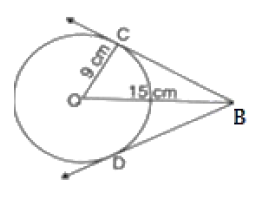
In the adjoining figure, If $OC = 9 \ cm$ and $OB = 15 \ cm,$ then $BC + BD$ is equal to
Image
  • $24 \ cm$
  • B
    $18 \ cm$
  • C
    $12 \ cm$
  • D
    $36 \ cm$
Answer
Correct option: A.
$24 \ cm$
Here $\angle C=90^{\circ} [$Angle between tangent and radius through the point of contact$]$
Now, in right angled triangle $\text{OBC,}$
$\ce{OB^2=OC^2 + BC^2}$
$\Rightarrow(9)^2=(15)^2+BC^2$
$\Rightarrow \ce{BC^2}=225-81=144$
$\Rightarrow \text{BC}=12 \ cm$
But $\text{BC = BD} [$Tangents from one point to a circle are equal$]$
Therefore, $\text{BD} =12 \ cm$
Then $\text{BC + BD} =12+12=24 \ cm$
View full question & answer
MCQ 111 Mark
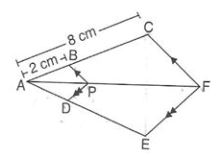
In the given figure if $B P\|C F, D P\| E F$, then $AD : DE$ is equal to
Image
  • $1:3$
  • B
    $1:4$
  • C
    $3:4$
  • D
    $2:3$
Answer
Correct option: A.
$1:3$
Explanation:
Since $BP \| CF$,
Then, $\frac{ AP }{ PF }=\frac{ AB }{ BC } \ [$Using Thales Theorem$]$
$\Rightarrow \frac{AP}{PF}=\frac{2}{6}=\frac{1}{3}$
Again, since $DP \| EF,$
Then, $\frac{ AP }{ PF }=\frac{ AD }{ DE } \ [$Using Thales Theorem$]$
$\Rightarrow \frac{AD}{DE}=\frac{1}{3}$
$\Rightarrow AD: DE=1: 3$
View full question & answer
MCQ 121 Mark
In $\triangle \text{LMN}$ and $\triangle \text{PQR,} \angle L=\angle P, \angle N=\angle R$ and $\text{MN =2 QR}$. Then the two triangles are
  • Similar but not congruent
  • B
    Congruent but not similar
  • C
    Congruent as well as similar
  • D
    neither congruent nor similar
Answer
Correct option: A.
Similar but not congruent
$\because \angle L=\angle P($ given $)$
$\angle N=\angle R($ given $)$
$\Rightarrow \triangle \text{LMN} \sim \triangle \text{PQR}($ by $\text{AA}$ Sim. rule $)$
But Not Congurent because
given $\text{MN=2 QR}$
i.e. Sides are proportional Not equal.
View full question & answer
MCQ 131 Mark
In what ratio does x-axis divide the line segment joining the points A(2, -3) and B(5, 6)?
  • 1: 2
  • B
    3:5
  • C
    2:1
  • D
    2:3
Answer
Correct option: A.
1: 2
(A) $1: 2$
Explanation: Let the x axis cut AB at $P ( x , 0)$ in the ratio $K : 1$
Then $\frac{6 k-3}{k+1}=0 \Rightarrow 6 k-3-0 \Rightarrow 6 k=3 \Rightarrow k=\frac{1}{2}$
required ratio $=\left(\frac{1}{2}: 1\right)=1: 2$
View full question & answer
MCQ 141 Mark
For what values of $k,$ the equation $kx2 - 6x - 2 = 0$ has real roots?
  • $k \geq \frac{-9}{2}$
  • B
    $k \leq-5$
  • C
    $k \leq-2$
  • D
    $k \leq \frac{-9}{2}$
Answer
Correct option: A.
$k \geq \frac{-9}{2}$
For real roots, we must have, $b^2-4 a c \geq 0$.
$(-6)^2-4 \times k \times(-2) \geq 0$
$\Rightarrow 36+8 k \geq 0$
$\Rightarrow 8 k \geq-36$
$\Rightarrow k \geq \frac{-9}{2}$
View full question & answer
MCQ 151 Mark
The pair of equations $ax + 2y = 9$ and $3x + by = 18$ represent parallel lines, where $a, b$ are integers, if:
  • A
    $a = b$
  • B
    $2a = 3b$
  • C
    $3a = 2b$
  • $ab = 6$
Answer
Correct option: D.
$ab = 6$
for Parallel lines,
$\frac{a_1}{a_2}=\frac{b_1}{b_2} \neq \frac{c_1}{c_2}$
$\frac{a}{3}=\frac{2}{b} \neq \frac{-9}{-18}$
$ab=6$
View full question & answer
MCQ 161 Mark
If $p = -7$ and $q = 12$ and $x^2 + px + q = 0,$ Then the value of $x$ is
  • $3$ and $4$
  • B
    $3$ and $-4$
  • C
    $-3$ and $-4$
  • D
    $-3$ and $4$
Answer
Correct option: A.
$3$ and $4$
Putting the values of $p$ and $q$ in given equation$,$ we get
$x^2+(-7) x+12=0$
$\Rightarrow x^2-7 x+12=0$
$\Rightarrow x^2-4 x-3 x+12=0$
$\Rightarrow x(x-4)-3(x-4)=0$
$\Rightarrow(x-3)(x-4)=0$
$\Rightarrow x-3=0$ and $x-4=0$
$\Rightarrow x=3$ and $x=4$
View full question & answer
MCQ 171 Mark
The product of two numbers is $1600$ and their $\text{HCF}$ is $5.$ The $\text{LCM}$ of the numbers is
  • A
    $1600$
  • B
    $8000$
  • C
    $1605$
  • $320$
Answer
Correct option: D.
$320$
Let the two numbers be $x$ and $y.$
It is given that : $x \times y =1600$
$\text{HCF}=5$
We know, $\text{HCF} \times \text{LCM} = x \times y$
$\Rightarrow 5 \times  \text{LCM}=1600$
$\therefore \text { LCM }=\frac{1600}{5}=320$
View full question & answer
MCQ 181 Mark
The HCF of the smallest 2-digit number and the smallest composite number is
  • A
    4
  • B
    10
  • C
    20
  • 2
Answer
Correct option: D.
2
(D) 2
Explanation:  Smallest two digit number is 10 and smallest composite number is 4. Clearly, 2 is the greatest factor of 4 and 10, so their H.C.F. is 2.
View full question & answer
M.C.Q (1 Marks) - Maths STD 10 Questions - Vidyadip