Questions

2 Marks Questions

🎯

Test yourself on this topic

7 questions · timed · auto-graded

Question 12 Marks
From a circular piece of carboard of radius $3 \ cm$ two sectors of $90^\circ$ have been cut off. Find the perimeter of the remaining portion nearest hundredth centimeters. $($Take $\pi=22 / 7 ).$
Answer
Radius of the circular piece of cardboard$(r) =3 \ cm$
$\therefore$ Two sectors of $90^{\circ}$ each have been cut off
$\therefore$ We get a semicircular cardboard piece
$\therefore$ Perimeter of arc $ACB$
$=\frac{1}{2}(2 \pi r)=\pi r$
$=\frac{22}{7} \times 3$
$=\frac{66}{7}$
$=9.428 \ cm$
View full question & answer
Question 22 Marks
Prove that: $\tan ^2 \theta-\sin ^2 \theta=\tan ^2 \theta \sin ^2 \theta$
Answer
$\tan ^2 \theta-\sin ^2 \theta=\tan ^2 \theta \sin ^2 \theta$
$\text { R.H.S. }=\tan ^2 \theta \cdot \sin ^2 \theta$
$=\tan ^2 \theta\left(1-\cos ^2 \theta\right)\left[\because \sin ^2 \theta=1-\cos ^2 \theta\right]$
$=\tan ^2 \theta-\tan ^2 \theta \cos ^2 \theta$
$=\tan ^2 \theta-\frac{\sin ^2 \theta}{\cos ^2 \theta} \cdot \cos ^2 \theta\left[\because \tan ^2 \theta=\frac{\sin ^2 \theta}{\cos ^2 \theta}\right]$
$=\tan ^2 \theta-\sin ^2 \theta$
$=\text { L.H.S. }$
Hence proved.
View full question & answer
Question 32 Marks
Find the diameter of the circle whose area is equal to the sum of the areas of two circles having radii $4 \ cm$ and $3 \ cm.$
Answer
Let the radius of the large circle be $R .$
Then, we have
Area of large circle of radius $R =$ Area of a circle of radius $4 \ cm+$ Area of circle of radius $3 \ cm$
$\Rightarrow \pi R^2=\left(\pi \times 4^2+\pi \times 3^2\right)$
$\Rightarrow \pi R^2=(16 \pi+9 \pi)$
$\Rightarrow \pi R^2=25 \pi$
$\Rightarrow R^2=25$
$\Rightarrow R=5 \ cm$
$\Rightarrow \text { Diameter }=2 R=10 \ cm$
View full question & answer
Question 42 Marks
Prove the trigonometric identity: $\frac{1}{1-\sin \theta}+\frac{1}{1+\sin \theta}=2 \sec ^2 \theta$
Answer
$\frac{1}{1-\sin \theta}+\frac{1}{1+\sin \theta}=2 \sec ^2 \theta$
$\text { L.H.S. }=\frac{1}{1-\sin \theta}+\frac{1}{1+\sin \theta}$
$=\frac{1+\sin \theta+1-\sin \theta}{(1-\sin \theta)(1+\sin \theta)}=\frac{2}{1-\sin ^2 \theta}$
$=\frac{2}{\cos ^2 \theta}\left[\because 1-\sin ^2 \theta=\cos ^2 \theta\right]$
$=2 \sec ^2 \theta\left[\because \sec (x)=\frac{1}{\cos (x)}\right]$
$=\text { R.H.S. Proved }$
View full question & answer
Question 52 Marks
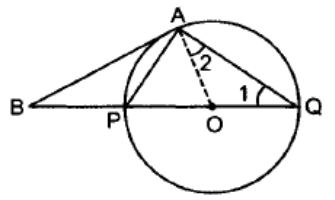
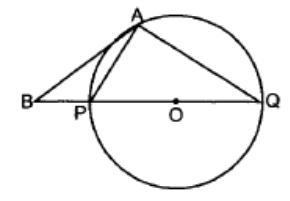
The tangent at a point $A$ of a circle with centre $O$ intersects the diameter $PQ$ of the circle$($when extended$)$ at the point $B.$ If $\angle \text{BAQ}=105^{\circ}$, find $\text{APQ}$.
Image
Answer
According to the question,
Image
$\text{PAQ}=90^{\circ}[$Angle in semicircle$]$
$\therefore \angle \text{APQ} +\angle 1=90^{\circ} [$ Sum of acute angels of right angle $\triangle ]$
$\left.\Rightarrow \angle \text{APQ}+\angle 2=90^{\circ} \text { [OA = OQ} \therefore \angle 1=\angle 2\right]$
$\Rightarrow \angle \text{APQ} +(\angle \text{BAQ} -\angle \text{BAO} )=90^{\circ}$
$\Rightarrow \angle \text{APQ}+\left(105^{\circ}-90^{\circ}\right)=90^{\circ}[\because OA \perp AB ]$
$\Rightarrow \angle \text{APQ} =90^{\circ}-15^{\circ}=75^{\circ}$
View full question & answer
Question 62 Marks
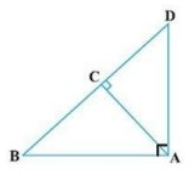
$\triangle ABD$ is a right triangle right $-$ angled at $A$ and $AC \perp BD$. Show that $\frac{A B^2}{A C^2}=\frac{B D}{D C}$
Answer
Given: $\triangle ABD$ is a right triangle right angled at $A$ and $AC \perp BD$.
To Prove: $\frac{A B^2}{A C^2}=\frac{B D}{D C}$
Image
Proof: We know that if a perpendicular is drawn from the vertex of the right angle to the hypotenuse then the triangles on both sides of the perpendicular are similar to the whole triangle and to each other.
So, $\triangle B A D \sim \triangle B C A............(i)$
and $\triangle A C B \sim \triangle D C A.............(ii)$
If two triangles are similar, then the ratio of their corresponding sides are equal.
$\frac{B A}{B C}=\frac{B D}{B A}\ [$from $(i)]$
$BA^2=BC \times BD........(iii)$
Also, $\frac{A C}{D C}=\frac{B C}{A C} \ [$from $(ii)]$
$AC ^2= DC \times BC ........... (iv)$
Hence $\frac{A B^2}{A C^2}=\frac{C B \times B D}{D C \times B C}$
$\frac{A B^2}{A C^2}=\frac{B D}{D C}$
Hence proved.
View full question & answer
Question 72 Marks
Find by prime factorisation the $\text{LCM}$ of the numbers $18180$ and $7575.$ Also, find the $\text{HCF}$ of the two numbers.
Answer
$18180=2^2 \times 3^2 \times 5 \times 101$
$7575=3 \times 5^2 \times 101$
$\text{LCM}=2^2 \times 3^2 \times 5^2 \times 101=90900$
$\text{HCF}=3 \times 5 \times 101=1515$
View full question & answer
2 Marks Questions - Maths STD 10 Questions - Vidyadip