Questions

3 Marks Question

🎯

Test yourself on this topic

8 questions · timed · auto-graded

Question 13 Marks
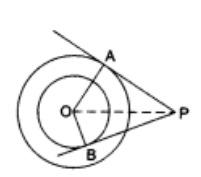
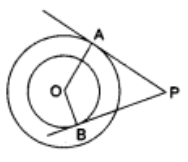
Tangents $PA$ and $PB$ are drawn from an external point $P$ to two concentric circles with centre $O$ and radii $8 \ cm$ and $5 \ cm$ respectively, as shown in the figure. If $AP = 15 \ cm$ then find the length of $BP$.
Image
Answer
Image
We have
$O A \perp A P$ and $O B \perp B P \ [$. the tangent at any point of a circle is perpendicular to the radius through the point of contact$]$.
Join $OP$.
In right $\triangle OAP$,
we have
$OA =8 \ cm, AP =15 \ cm$.
$\therefore OP ^2= OA ^2+ AP ^2\ [$ by Pythagoras' theorem $]$
$\Rightarrow OP =\sqrt{O A^2+A P^2}$
$=\sqrt{8^2+15^2} \ cm$
$=\sqrt{289} \ cm=17 \ cm$
In right $\triangle OBP$,
we have
$OB=5 \ cm$
$OP=17 \ cm$
$\therefore OP ^2= OB ^2+ BP ^2 \ [$by Pythagoras' theorem$]$
$\Rightarrow BP=\sqrt{O P^2-O B^2}$
$=\sqrt{17^2-5^2} \ cm$
$=\sqrt{264} \ cm$
Thus, the length of $BP =\sqrt{264} \ cm$
$=16.25 \ cm \ ($approx$)$
View full question & answer
Question 23 Marks
If we add $1$ to the numerator and subtract $1$ from the denominator, a fraction reduces to $1$ . It becomes $\frac{1}{2}$ if we only add $1$ to the denominator. What is the fraction? Solve the pair of the linear equation obtained by the elimination method.
Answer
Let the fraction be $\frac{x}{y}$
Then, according to the question,
$\frac{x+1}{y-1}=1 \ldots \ldots .(1)$
$\frac{x}{y+1}=\frac{1}{2} \ldots \ldots \ldots (2)$
$\Rightarrow x+1=y-1 ..........(3)$
$2 x=y+1 \ldots \ldots \ldots (4)$
$\Rightarrow x-y=-2 \ldots . . (5)$
$2 x-y=1 \ldots \ldots \ldots .(\wedge)$
Substituting equation $(5)$ from equation $(6),$ we get $x=3$
Substituting this value of $x$ in equation $(5),$ we get
$3-y=-2$
$\Rightarrow y=3+2$
$\Rightarrow y=5$
Hence, the required fraction is $\frac{3}{5}$
Verification: Substituting the value of $x=3$ and $y=5$,
we find that both the equations $(1)$ and $( 2 )$ are satisfied as shown below:
$\frac{x+1}{y-1}=\frac{3+1}{5-1}=\frac{4}{4}=1$
$\frac{x}{y+1}=\frac{3}{5+1}=\frac{3}{6}=\frac{1}{2}$
Hence, the solution is correct.
View full question & answer
Question 33 Marks
Find the median of the following frequency distribution:
Weekly wages $($in $₹)$ $60-69$ $70-79$ $80-89$ $90-99$ $100-109$ $110-119$
No. of days $5$ $15$ $20$ $30$ $20$ $8$
Answer
Here, the frequency table is given in inclusive form.
So, we first transform it into exclusive form by subtracting and adding $\frac{h}{2}$ to the lower and upper limits respectively of each class,
where $h$ denotes the difference of lower limit of a class and the upper limit of the previous class.
Here, $h =1$
So, $\frac{h}{2}=0.5$
Transforming the above table into exclusive form and preparing the cumulative frequency table, we get$:-$
Weekly wages $($in $₹)$ No of workers Cumulative frequency
$59.5-69.5$ $5$ $5$
$69.5-79.5$ $15$ $20$
$79.5-89.5$ $20$ $40$
$89.5-99.5$ $30$ $70$
$99.5-109.5$ $20$ $90$
$109.5-119.5$ $8$ $98$
    $N =\Sigma f_i=98$
We have, $N ($ Total frequency $)=98$ ,Or $\frac{h}{2}=49$
The cumulative frequency just greater than $\frac{h}{2}$ is $70$ and the corresponding class is $89.5-99.5$.
So, $89.5-99.5$ is the median class.
Now,
$l=89.5($lower limit of median class$),$
$h =10 ($length of interval of median class$),$
$f =30 ($frequency of median class$)$
$F =40 ($cumulative frequency of the class just preceding the median class$)$
Now, Median is given by$:-$
$=l+\frac{\frac{N}{2}-f}{F} \times h$
$=89.5+\frac{49-40}{30} \times 10$
$=89.5+3$
$=92.5$
View full question & answer
Question 43 Marks
If $\sin \theta+\cos \theta= p$ and $\sec \theta+\operatorname{cosec} \theta= q$, show that $q \left( p ^2-1\right)=2 p$.
Answer
We have, $p =\sin \theta+\cos \theta$ and $q =\sec \theta+\operatorname{cosec} \theta$
$\therefore \text { LHS }=q\left(p^2-1\right)=(\sec \theta+\operatorname{cosec} \theta)\left\{(\sin \theta+\cos \theta)^2-1\right\}$
$=\left(\frac{1}{\cos \theta}+\frac{1}{\sin \theta}\right)\left\{\sin ^2 \theta+\cos ^2 \theta+2 \sin \theta \cos \theta-1\right\}$
$=\left(\frac{\sin \theta+\cos \theta}{\cos \theta \sin \theta}\right)(1+2 \sin \theta \cos \theta-1)$
$=\left(\frac{\sin \theta+\cos \theta}{\cos \theta \sin \theta}\right)(2 \sin \theta \cos \theta)$
$=2(\sin \theta+\cos \theta)$
$=2 p=\text { RHS }$
View full question & answer
Question 53 Marks
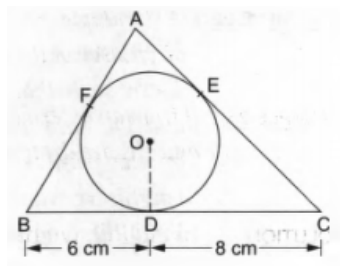
In the given figure, a triangle $\text{ABC}$ is drawn to circumscribe a circle of radius $3 \ cm ,$ such that the segments $BD$ and $D C$ into which $B C$ is divided by the point of contact $D$ are of lengths $6 \ cm$ and $8 \ cm$ respectively. Find the side $A B$, if the area of $\triangle A B C$ is $63 \ cm^2$
Image<
Answer
We know that the lengths of tangents drawn from an exterior point to a circle are equal
$\therefore AE=AF=x \ cm \ ($say$)$
$BD=BF=6 \ cm ;$
$CD=CE=8 \ cm$
And so, $AB = AF + BF $
$=( x +6) \ cm ; BC = BD + CD =14 \ cm$;
$CA=CE+AE=(x+8) \ cm$
Join $OE$ and $OF$ and also $OA, OB$ and $OC$.
$\therefore \operatorname{ar}(\triangle A B C)=\operatorname{ar}(\triangle O A B)+\operatorname{ar}(\triangle O B C)+\operatorname{ar}(\triangle O C A)$
$\Rightarrow 63=\left(\frac{1}{2} \times A B \times O F\right)+\left(\frac{1}{2} \times B C \times O D\right)+\left(\frac{1}{2} \times C A \times O E\right)$
$\Rightarrow 63=\left\{\frac{1}{2} \times(x+6) \times 3\right\}+\left(\frac{1}{2} \times 14 \times 3\right)+\left\{\frac{1}{2} \times(x+8) \times 3\right\}$
$\Rightarrow 63=\frac{3}{2} \times(2 x+28) $
$\Rightarrow x=7$
$\therefore A B=(x+6) \ cm$
$=(7+6) \ cm=13 \ cm$
View full question & answer
Question 63 Marks
Solve the pair of linear equations $3x + 4y = 10$ and $2x – 2y = 2$ by elimination and substitution method.
Answer
$1.$ By Elimination method,
The given system of equation is :
$3 x+4 y=10 \ldots\ldots(1)$
$2 x-2 y=2 \ldots\ldots(2)$
Multiplying equation $(2)$ by $2,$ we get
$4 x-4 y=4\ldots\ldots(2)$
Adding equation $(1)$ and equation $(3),$ we get
$7 x =14$
$\therefore x=\frac{14}{7}=2$
Substituting this value of $x$ in equation $(2),$ we get
$2(2)-2 y=2$
$\Rightarrow 4-2 y=2$
$\Rightarrow 2 y=4-2$
$\Rightarrow 2 y=2$
$\Rightarrow y=\frac{2}{2}=1$
So, the solution of the given system of equation is
$x=2, y=1$
$2.$ By Substitution method,
The given system of equation is:
$3 x+4 y=10\ldots\ldots(1)$
$2 x -2 y =2\ldots\ldots(2)$
From equation $(1)$
$3 x=10-4 y$
$x=\left(\frac{10-4 y}{3}\right)$
Put value of $x$ in equation $(2),$
$2 x-2 y=2$
$2\left(\frac{10-4 y}{3}\right)-2 y=2$
$\frac{2(10-4 y)-2 y(3)}{3}=2$
$20-8 y-6 y=6$
$-14 y=-14$
$y=1$
Putting value of $y=1$ in equation $(2)$
$2 x-2=2$
$x=2$
Therefore, $x =2, y =1$ is the solution.
Verification: Substituting $x=2, y=1$,
we find that both the equation $(1)$ and $(2)$ are satisfied shown below:
$3 x+4 y=3(2)+4(1)=6+4=10$
$2 x-2 y=2(2)-2(1)=4-2=2$
Hence, the solution is correct.
View full question & answer
Question 73 Marks
Find the zeroes of the quadratic polynomial $7 y^2-\frac{11}{3} y-\frac{2}{3}$ and verify the relationship between the zeroes and the coefficients.
Answer
$ p ( y )=7 y ^2-\frac{11}{3} y -\frac{2}{3}$
$=\frac{1}{3}\left(21 y ^2-11 y -2\right)$
$=\frac{1}{3}\left(21 y ^2-14 y +3 y -2\right)$
$=\frac{1}{3}[7 y (3 y -2)+1(3 y -2)]$
$=\frac{1}{3}[(7 y +1)(3 y -2)]$
$\therefore $ Zeroes are $\frac{2}{3},-\frac{1}{7}$
Sum of Zeroes $=\frac{2}{3}-\frac{1}{7}=\frac{11}{21}$
$\frac{-b}{a}=\frac{11}{21}$
$\therefore $ sum of zeroes $=\frac{-b}{a}$
Product of Zeroes $=\left(\frac{2}{3}\right)\left(-\frac{-1}{7}\right)=-\frac{2}{21}$
$\frac{c}{a}=-\frac{2}{3}\left(\frac{1}{7}\right)=-\frac{2}{21}$
$\therefore $ Product  $=\frac{c}{a}$
View full question & answer
Question 83 Marks
In a school there are two sections, namely $A$ and $B,$ of class $X.$ There are $30$ students in section $A$ and $28$ students in section $B.$ Find the minimum number of books required for their class library so that they can be distributed equally among students of section $A$ or section $B.$
Answer
As per question, the required number of books are to be distributed equally among the students of section $A$ or $B .$
There are $30$ students in section $A$ and $28$ students in section $B.$
So, the number of these books must be a multiple of $30$ as well as that of $28.$
Consequently, the required number is $\operatorname{LCM}(30,28)$.
Now, $30=2 \times 3 \times 5$
and $28=2^2 \times 7$.
$\therefore \operatorname{LCM}(30,28)=$ product of prime factors with highest power
$=2^2 \times 3 \times 5 \times 7$
$=4 \times 3 \times 5 \times 7$
$=420$
Hence, the required number of books $=420$.
View full question & answer
3 Marks Question - Maths STD 10 Questions - Vidyadip