Questions

3 Marks Question

🎯

Test yourself on this topic

8 questions · timed · auto-graded

Question 13 Marks
The pilot of an aircraft flying horizontally at a speed of $1200 \ km/h$r. observes that the angle of depression of a point on the ground changes from $30^\circ$ to $45^\circ$ in $15$ seconds. Find the height at which the aircraft is flying.
Answer
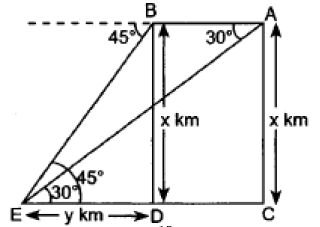
Distance covered in $15$ seconds $=A B$
Speed $=1200 \ km / hr$.
Image
$\therefore AB=1200 \times \frac{15}{3600}=5 \ km$
$A B=D C=5 \ km$
Let height $= x \ km$
In rt. $\triangle BDE,$
$\frac{B D}{E D}=\tan 45^{\circ} $
$\Rightarrow \frac{x}{y}=1 $
$\Rightarrow x=y$
In $rt. \triangle ACE$,
$\frac{A C}{E C}=\tan 30^{\circ} $
$\Rightarrow \frac{x}{y+5}=\frac{1}{\sqrt{3}}$
$\Rightarrow \frac{x}{x+5}=\frac{1}{\sqrt{3}}$
$\Rightarrow \sqrt{3} x=x+5 $
$\Rightarrow(\sqrt{3}-1) x=5$
$\therefore x=\frac{5}{\sqrt{3}-1}$
$=\frac{5(\sqrt{3}+1)}{2}$
$=6.83 \ km$
View full question & answer
Question 23 Marks
Prove that: $\frac{1}{\operatorname{cosec} A-\cot A}-\frac{1}{\sin A}=\frac{1}{\sin A}-\frac{1}{\operatorname{cosec} A+\cot A}$.
Answer
We have,
$\Rightarrow \frac{1}{\operatorname{cosec} A-\cot A}-\frac{1}{\sin A}=\frac{1}{\sin A}-\frac{1}{\operatorname{cosec} A+\cot A}$
$\Rightarrow \frac{1}{\operatorname{cosec} A-\cot A}+\frac{1}{\operatorname{cosec} A+\cot A}=\frac{1}{\sin A}+\frac{1}{\sin A}$
$\Rightarrow \frac{1}{\operatorname{cosec} A-\cot A}+\frac{1}{\operatorname{cosec} A+\cot A}=\frac{2}{\sin A}$
$\ce{LHS} =\frac{1}{\operatorname{cosec} A-\cot A}+\frac{1}{\operatorname{cosec} A+\cot A}$
$\Rightarrow \frac{\operatorname{cosec} A+\cot A+\operatorname{cosec} A-\cot A}{(\operatorname{cosec} A-\cot A)(\operatorname{cosec} A+\cot A)}$
$\Rightarrow \frac{2 \operatorname{cosec} A}{\operatorname{cosec}^2 A-\cot ^2 A}$
$\Rightarrow \frac{\frac{2}{\sin A}}{1}=\frac{2}{\sin A}=\text { RHS. }$
Hence proved
View full question & answer
Question 33 Marks
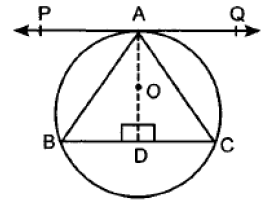
If $\text{ABC}$ is isosceles with $AB = AC,$ prove that the tangent at $A$ to the circumcircle of $\text{ABC}$ is parallel to $BC$.
Answer
Draw $AD \perp BC$
Image
In $\text{ADB}$ and $\text{ADC}$
$A B=A C\ [$Given$]$
$A D=A D$
$\text{ADB} =\text{ADC} \ [$ Each $90^{\circ}]$
$\therefore \triangle ADB \cong \triangle ADC$
$\Rightarrow B D=C D$
$\therefore AC$ passes through $O,$ centre of the circle
$\therefore$ Perpendicular bisector of the chord passes through the centre of the circle
Now $OA \perp PQ$
$($radius through the point of contact$)$
$\therefore \angle PAO=90^{\circ}$
Also $\text{ADB} =90^{\circ}$
$\therefore \angle PAO+\angle ADB=180^{\circ}$
$\therefore AP \| BC$
View full question & answer
Question 43 Marks
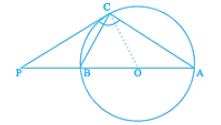
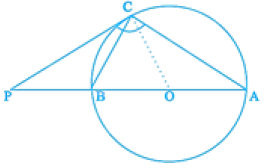
The tangent at a point $C$ of a circle and a diameter $AB$ when extended intersect at $P$ . If $\angle PCA =110^{\circ}$, find $\angle C B A$.
$[$Hint: Join $C$ with centre $O]$.
Image
If $\text{ABC}$ is isosceles with $AB = AC,$ prove that the tangent at $A$ to the circumcircle of $\text{ABC}$ is parallel to $BC$.
Answer

Image
Let $D$ be the centre of the circle.
$A , D , B , P$ all are on the same line and $P$ and $C$ are points on the tangent.
Now, $\angle BCA$ is inscribed in a semi $-$ circle, $\angle B C A=90^{\circ}$
$C$ is the point on the circle where the tangent touches the circle.
So $, \angle DCP=90^{\circ}$
$\angle PCA=\angle PCD+\angle DCA$
$\Rightarrow 110^{\circ}=90^{\circ}+\angle DCA$
$\Rightarrow \angle D C A=20^{\circ}$
$\text { In } \triangle ADC \text {, }$
$AD=DC \ldots .\ ($Radii of the same circle$)$
$\Rightarrow \angle D C A=\angle C A D=20^{\circ}$
$\text { In } \triangle ABC \text {, }$
$\angle BCA =90^{\circ}, \angle CAB =20^{\circ}$
So, $\angle C B A=70^{\circ}$
View full question & answer
Question 53 Marks
The hypotenuse of a grassy land in the shape of a right triangle is $1$ metre more than twice the shortest side. If the third side is $7$ metres more than the shortest side, find the sides of the grassy land.
Answer
Let the length of the shortest side be $x$ metres.
As per given condition
The hypotenuse of a grassy land in the shape of a right triangle is $1$ metre more than twice the shortest side.
So, Hypotenuse $=(2 x+1)$ metres
And if the third side is $7$ metres more than the shortest side
So, third side $=(x+7)$ metres.
By Pythagoras theorem, we have
$($Hypotenuse$) ^2=$ Sum of the squares of the remaining two sides
$\Rightarrow(2 x+1)^2=x^2+(x+7)^2$
$\Rightarrow 4 x^2+4 x+1=x^2+x^2+14 x+49$
$\Rightarrow 4 x^2+4 x+1=2 x^2+14 x+49$
$\Rightarrow 2 x^2-10 x-48=0$
$\Rightarrow x^2-5 x-24=0$
$\Rightarrow x^2-8 x+3 x-24=0$
$\Rightarrow x(x-8)+3(x-8)=0$
$\Rightarrow(x-8)(x+3)=0$
$\Rightarrow x=8,-3$
$\Rightarrow x=8[\because x=-3$ is not possible $]$
Hence, the lengths of the sides of the grassy land are $8$ metres, $17$ metres and $15$ metres.
View full question & answer
Question 63 Marks
Solve the quadratic equation by factorization: $\frac{1}{2 a+b+2 x}=\frac{1}{2 a}+\frac{1}{b}+\frac{1}{2 x}$
Answer
$\text { Consider } \frac{1}{2 a+b+2 x}=\frac{1}{2 a}+\frac{1}{b}+\frac{1}{2 x}$
$\Rightarrow \frac{1}{2 a+b+2 x}-\frac{1}{2 x}=\frac{1}{2 a}+\frac{1}{b}$
$\Rightarrow 2 ab(2 x-2 a-b-2 x)=(2 a+b) 2 x(2 a+b+2 x)$
$\Rightarrow 2 ab(-2 a-b)=2(2 a+b)\left(2 ax+bx+2 x^2\right)$
$\Rightarrow-ab=2 ax+bx+2 x^2$
$\Rightarrow 2 x^2+2 ax+bx+ab=0$
$\Rightarrow 2 x(x+a)+b(x+a)=0$
$\Rightarrow(2 x+b)(x+a)=0$
$\Rightarrow x=-a,-\frac{b}{2}$
Hence the roots are $-a,-\frac{b}{2}$.
View full question & answer
Question 73 Marks
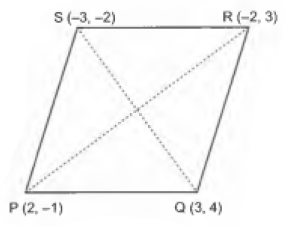
If $P(2,-1), Q(3,4), R(-2,3)$ and $S(-3,-2)$ be four points in a plane, show that $P Q R S$ is a rhombus but not a square.Find the area of the rhombus.
Answer
The given points are $P(2,-1), Q(3,4), R(-2,3)$ and $S(-3,-2)$.
We have,
Image
$P Q=\sqrt{(3-2)^2+(4+1)^2}=\sqrt{1^2+5^2}=\sqrt{26}$ units
$Q R=\sqrt{(-2-3)^2+(3-4)^2}=\sqrt{25+1}=\sqrt{26}$ units
$R S=\sqrt{(-3+2)^2+(-2-3)^2}=\sqrt{1+25}=\sqrt{26}$ units
$S P=\sqrt{(-3-2)^2+(-2+1)^2}=\sqrt{26}$ units
and $Q S=\sqrt{(-3-3)^2+(-2-4)^2}=\sqrt{36+36}=6 \sqrt{2}$ units
$\therefore PQ = QR = RS = SP =\sqrt{26}$ units
$
P R=\sqrt{(-2-2)^2+(3+1)^2}=\sqrt{16+16}=\sqrt{32}
$
Therefore, $P R \neq Q S$
This means that PQRS is a quadrilateral whose sides are equal but diagonals are not equal.
Thus, PQRS is a rhombus but not a square.
Now, Area of rhombus PQRS $=\frac{1}{2} \times$ (Product of lengths of diagonals) $=\frac{1}{2} \times(P R \times Q S)=\left(\frac{1}{2} \times 4 \sqrt{2} \times 6 \sqrt{2}\right)$ sq. units $=24$ sq. units
View full question & answer
Question 83 Marks
Mr. Patil has three classes. Each class has 28, 42 and 56 students respectively. Mr Patil wants to divide each class into groups so that every group in every class has the same number of students and there are no students left over. What is the maximum number of students Mr. Patil can put into each group?
Answer
For maximum number of students to put into each group Mr patil sir should have to take H.C.F of 28, 42 and 56 SO
maximum number of students Mr. Patil can put into each group is 14.
View full question & answer
3 Marks Question - Maths STD 10 Questions - Vidyadip