Questions

5 Marks Questions

🎯

Test yourself on this topic

6 questions · timed · auto-graded

Question 15 Marks
The sum of the first $9$ terms of an $AP$ is $81$ and that of its first $20$ terms is $400.$ Find the first term and the common difference of the $AP.$
Answer
Let a be the First term and $d$ be the common difference of given $AP.$
Then, we have
$\Rightarrow \frac{9}{2}[2 a+8 d]=81$
$\Rightarrow \frac{9 \times 2}{2}[a+4 d]=81$
$\Rightarrow a+4 d=9 \ldots \text {...(i) }$
Also, $S _{20}=400$
$\Rightarrow \frac{20}{2}[2 a+19 d]=400$
$\Rightarrow 10[2 a+19 d]=400$
$\Rightarrow 2 a+19 d=40 \ldots(ii)$
Multiplying equation $(i)$ by $2$ , we get
$2 a+8 d=18...(iii)$
Subtracting $(iii)$ from $(ii),$ we get
$11 d=22$
$\Rightarrow d=2$
$\Rightarrow a=9-4(2)=9-8=1$
Thus, the first term is $1$ and the common difference is $2 .$
View full question & answer
Question 25 Marks
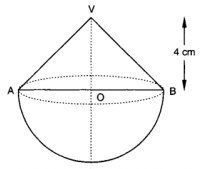
A solid toy is in the form of a hemisphere surmounted by a right circular cone. The height of cone is $4 \ cm$ and the diameter of the base is $8 \ cm.$ Determine the volume of the toy. If a cube circumscribes the toy, then find the difference of the volumes of cube and the toy. Also, find the total surface area of the toy.
Answer
Image
Volume of toy $=$ volume of cone $+$ volume of hemisphere
$=\frac{1}{3} \pi r^2 h+\frac{2}{3} \pi r^3$
$=\frac{1}{3} \pi r^2(h+2 r)$
$=\frac{1}{3} \times \frac{22}{7} \times 4 \times 4(4+2 \times 4)$
$=201.14 \ cm^3$
If a cube circumscribes the toy then,
Volume of cubi $=(\text { side })^3$
Volume $=512 \ cm^3$
Difference of the volume of cube and toy
$=512-201.14$
$=310.86 \ cm^3$
Total surface Area of toy $=$ Curved surface area of cone $+$ Curved surface area of hemisphere
$l=\sqrt{h^2+r^2}$
$l=\sqrt{4^2+4^2}$
$l=\sqrt{32}$
$l=4 \sqrt{2}$
$l=5.64 \ cm$
Total surface area of toy $=\pi rl +2 \pi r ^2$
$=\pi r(l+2 r)$
$=\frac{22}{7} \times 4(5.64+2 \times 4)$
Total surface area of toy $=171.47 \ cm^2$
View full question & answer
Question 35 Marks
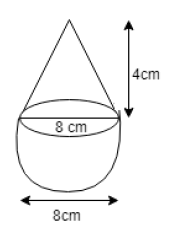
A solid is in the form of a right circular cone mounted on a hemisphere. The radius of the hemisphere is $3.5 \ cm$ and the height of the cone is $4 \ cm.$ The solid is placed in a cylindrical tub, full of water, in such a way that the whole solid is submerged in water. If the radius of the cylinder is $5 \ cm$ and its height is $10.5 \ cm,$ find the volume of water left in the cylindrical tub. $\left(\right.$ Use $\left.\pi=\frac{22}{7}\right)$
Answer
We have, radius of the hemisphere $= 3.5 \ cm$
Height of the cone $= 4 \ cm$
Radius of the cylinder $= 5 \ cm$
Height of the cylinder $= 10.5 \ cm$
We have to find out the volume of water left in the cylindrical tub
Image
$\therefore$ Volume of the solid $=$ Volume of its conical part $+$ Volume of its hemispherical part
$=\left\{\frac{1}{3} \times \frac{22}{7} \times(3.5)^2 \times 4+\frac{2}{3} \times \frac{22}{7} \times(3.5)^3\right\} \ cm^3$
$=\frac{1}{3} \times \frac{22}{7} \times(3.5)^2\{4+2 \times 3.5\} \ cm^3$
$=\left\{\frac{1}{3} \times \frac{22}{7} \times\left(\frac{7}{2}\right)^2 \times 11\right\} \ cm^3$
Clearly, when the solid is submerged in the cylindrical tub the volume of water that flows out of the cylinder is equal to the volume of the solid.
Hence,
Volume of water left in the cylinder $=$ Volume of cylinder $-$ Volume of the solid
$=\left\{\frac{22}{7} \times(5)^2 \times 10.5-\frac{1}{3} \times \frac{22}{7} \times\left(\frac{7}{2}\right)^2 \times 11\right\} \ cm^3$
$=\left\{\frac{22}{7} \times 25 \times \frac{21}{2}-\frac{1}{3} \times \frac{22}{7} \times \frac{7}{2} \times \frac{7}{2} \times 11\right\} \ cm^3$
$=\left(11 \times 25 \times 3-\frac{1}{3} \times 11 \times \frac{7}{2} \times 11\right) \ cm^3$
$=(825-141.16) \ cm^3$
​​​​​​​$=683.83 \ cm^3$
View full question & answer
Question 45 Marks
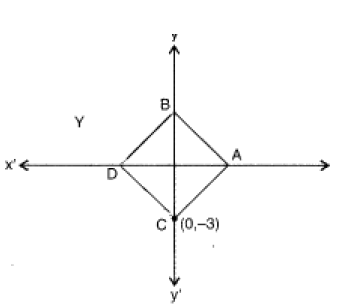
The base $\text{BC}$ of an equilateral triangle $\text{ABC}$ lies on $y-$axis. The co$-$ordinates of point $C$ are $(0,3).$ The origin is the mid$-$point of the base. Find the co$-$ordinates of the point $A$ and $B.$ Also find the co$-$ordinates of another point $D$ such that $\text{BACD}$ is a rhombus.
Answer
Image
Co$-$ordinates of point $B$ are $(0,3)$
$\therefore \text{BC}=6 \text { unit }$
Let the co$-$ordinates of point $A$ be $( x , 0$ )
or, $\text{AB}=\sqrt{x^2+9}$
$\because \text{AB=BC}$
$\therefore x^2+9=36$
or, $x ^2=27$ or, $x = \pm 3 \sqrt{3}$
Co$-$ordinates of point $A =(3 \sqrt{3}, 0)$
Since $\text{ABCD}$ is a rhombus
or, $\text{AB = AC = CD = DB}$
$\therefore$ Co$-$ordinate of point $D =(-3 \sqrt{3}, 0)$
View full question & answer
Question 55 Marks
A man travels $370 \ km,$ partly by train and partly by car. If he covers $250 \ km$ by train and the rest by car, it takes him $4$ hours. But, if he travels $130 \ km$ by train and the rest by car, he takes $18$ minutes longer. Find the speed of the train and that of the car.
Answer
Let the speed of the train be $x \ km / hr$ and that of the car be $y \ km / hr$.
Case I Distance covered by train $=250 \ km$.
Distance covered by car $=(370-250) \ km =120 \ km$.
Time taken to cover $250 \ km$ by train $=\frac{250}{x}$ hours
Time taken to cover $120 \ km$ by car $=\frac{120}{y}$ hours
Total time taken $=4$ hours
$\therefore \frac{250}{x}+\frac{120}{y}=4 $
$\Rightarrow \frac{125}{x}+\frac{60}{y}=2$
Case II Distance covered by train $=130 \ km$.
Distance covered by car $=(370-130) \ km =240 \ km$.
Time taken to cover $130 \ km$ by train $=\frac{130}{x}$ hours
Time taken to cover $240 \ km$ by car $=\frac{240}{y}$ hours
Total time taken $=4 \frac{18}{60}$ hours $=4 \frac{3}{10}$ hours $=\frac{43}{10}$ hours
$\therefore \frac{130}{x}+\frac{240}{y}=\frac{43}{10} $
$\Rightarrow \frac{1300}{x}+\frac{2400}{y}=43$
Putting $\frac{1}{x}= u$ and $\frac{1}{y}= v$, equations $(i)$ and $(ii)$ become
$125 u+60 v=2 \ldots \text { (iii)}$ and $ 1300 u+2400 v=43 \ldots \text { (iv) }$
On multiplying $(iii)$ by $40$ and subtracting $(iv)$ from the result, we get
$5000 u-1300 v=80-43$
$ \Rightarrow 3700 u=37$
$\Rightarrow u=\frac{37}{3700}=\frac{1}{100} $
$\Rightarrow \frac{1}{x}=\frac{1}{100} $
$\Rightarrow x=100$
Putting $u =\frac{1}{100}$ in $(iv),$ we get
$\left(1300 \times \frac{1}{100}\right)+2400 v=43$
$ \Rightarrow 2400 v=43-13=30$
$\Rightarrow v=\frac{30}{2400}=\frac{1}{80} $
$\Rightarrow \frac{1}{y}=\frac{1}{80} $
$\Rightarrow y=80$
$\therefore x=100$ and $ y=80$
Hence, the speed of the train is $100 \ km / hr$ and that of the car is $80 \ km / hr$
View full question & answer
Question 65 Marks
A train covered a certain distance at a uniform speed. If it were $6 \ km/h$ faster, it would have taken $4$ hours less than the scheduled time. And, if the train were slower by $6 \ km/h,$ it would have taken $6$ hours more than the scheduled time. Find the length of the journey.
Answer
Let the actual speed of the train be $x \ km / hr$ and the actual time taken be $y$ hours.
Then,
Distance covered $=(x y) \ km \ldots (i)\ [\because$ Distance $=$ Speed $\times$ Time $]$
If the speed is increased by $6 \ km / hr$, then time of journey is reduced by $4$ hours
i.e., when speed is $(x+6) \ km / hr$, time of journey is $( y -4)$ hours.
$\therefore $ Distance covered $=(x+6)(y-4)$
$\Rightarrow x y=(x+6)(y-4)\ [$ Using $(i)]$
$\Rightarrow-4 x+6 y-24=0$
$\Rightarrow-2 \cdot x+3 y-12=0 \ldots \text { (ii) }$
When the speed is reduced by $6 \ km / hr$, then the time of journey is increased by $6$ hours
i.e., when speed is $( x -6) \ km / hr$, time of journey is $(y+6)$ hours.
$\therefore$ Distance covered $=(x-6)(y+6)$
$\Rightarrow xy=(x-6)(y+6)\ [$ Using $(i)]$
$\Rightarrow 6 x-6 y-36=0$
$\Rightarrow x-y-6=0 \ldots \text { (iii) }$
Thus, we obtain the following system of equations:
$-2 x+3 y-12=0$
$x-y-6=0$
By using cross $-$ multiplication, we have,
$\frac{x}{3 \times-6-(-1) \times-12}=\frac{-y}{-2 \times-6-1 \times-12}$
$=\frac{1}{-2 \times-1-1 \times 3}$
$\Rightarrow \frac{x}{-30}=\frac{-y}{24}=\frac{1}{-1}$
$\Rightarrow x=30$ and $ y=24$
Putting the values of $x$ and $y$ in equation $(i),$ we obtain
Distance $=(30 \times 24) \ km =720 \ km$.
Hence, the length of the journey is $720 \ km .$
View full question & answer
5 Marks Questions - Maths STD 10 Questions - Vidyadip