Questions

M.C.Q (1 Marks)

🎯

Test yourself on this topic

18 questions · timed · auto-graded

MCQ 11 Mark
The marks obtained by $9$ students in Mathematics are $59, 46, 30, 23, 27, 40, 52, 35$ and $29.$ The median of the data is
  • A
    $29$
  • $35$
  • C
    $40$
  • D
    $30$
Answer
Correct option: B.
$35$
Arranging the given data in ascending order, we get
$23,27,29,30,35,40,46,52,59$
Here, $n=9$, which is odd.
$\therefore \text { Median }=\left(\frac{n+1}{2}\right)^{t h} \text { term }$
$=\left(\frac{9+1}{2}\right)^{t h} \text { term }$
$=\left(\frac{10}{2}\right)^{t h} \text { term }$
$=5^{th}\text {term }$
$=35$
View full question & answer
MCQ 21 Mark
Two dice are rolled together. What is the probability of getting a sum greater than 10?
  • A
    $\frac{5}{18}$
  • B
    $\frac{1}{9}$
  • C
    $\frac{1}{6}$
  • $\frac{1}{12}$
Answer
Correct option: D.
$\frac{1}{12}$
(D) $\frac{1}{12}$
Explanation: Total number of outcomes $=36$
Favorable outcomes for sum greater than 10 are $\{(5,6),(6,5),(6,6)\}$
Number of favorable outcomes $=3$
$
P=\frac{3}{36}=\frac{1}{12}
$
View full question & answer
MCQ 31 Mark
In a family of 3 children, the probability of having at least one boy is
  • A
    $\frac{1}{8}$
  • $\frac{7}{8}$
  • C
    $\frac{3}{4}$
  • D
    $\frac{5}{8}$
Answer
Correct option: B.
$\frac{7}{8}$
(B) $\frac{7}{8}$
Explanation: All possible outcomes are BBB, BBG, BGB, GBB, BGG, GBG, GGB, GGG.
Number of all possible outcomes $=8$.
Let $E$ be the event of having at least one boy.
Then, E contains GGB, GBG, BGG, BBG, BGB, GBB, BBB.
Number of cases favourable to $E=7$.
Therefore,required probability $= P ( E )=\frac{7}{8}$
View full question & answer
MCQ 51 Mark
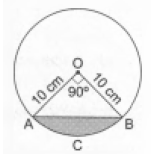
A chord of a circle of radius $10 \ cm$ subtends a right angle at the centre. The area of the minor segments $($given, $\pi=3.14 )$ is
  • A
    $32.5 \ cm^2$
  • B
    $34.5 \ cm^2$
  • C
    $30.5 \ cm^2$
  • $28.5 \ cm^2$
Answer
Correct option: D.
$28.5 \ cm^2$
$\operatorname{ar}($ minor segment $\text{ACBA} )=\operatorname{ar}($ sector $\text{OACBO}) -\operatorname{ar}(\Delta \text{OAB})$
$=\left(\frac{\pi r^2 \theta}{360}-\frac{1}{2} \times r \times r\right)$ ,
Image
$=\left(\frac{3.14 \times 10 \times 10 \times 90}{360}-\frac{1}{2} \times 10 \times 10\right) \ cm ^2$
$=(78.5-50) \ cm ^2$
$=28.5 \ cm^2$
View full question & answer
MCQ 61 Mark
The angles of depression of two ships from the top of a lighthouse are $45$ deg and $30$ deg towards east. If the ships are $100 m$ apart, the height of the lighthouse is
  • A
    $50(\sqrt{3}-1) m$
  • $50(\sqrt{3}+1) m$
  • C
    $\frac{50}{\sqrt{3}+1} m$
  • D
    $\frac{50}{\sqrt{3}-1} m$
Answer
Correct option: B.
$50(\sqrt{3}+1) m$
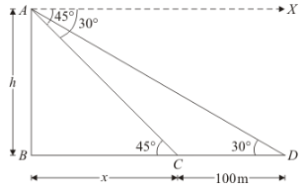
Let $AB = h$ be the lighthous
The given situation can be represented as,
Image
It is clear that $\angle C =45^{\circ}$ and $\angle D =30^{\circ}$
Again, let $BC=x$ and $CD=100 m$ is given.
Here, we have to find the height of lighthouse.
So we use trigonometric ratios.
In a triangle $\text{ABC},$
$\Rightarrow \tan C=\frac{A B}{B C}$
$\Rightarrow \tan 45^{\circ}=\frac{h}{x}$
$\Rightarrow 1=\frac{h}{x}$
$\Rightarrow h=x$
Again in a triangle $\text{ABD}$,
$\Rightarrow \tan D=\frac{A B}{B C+C D}$
$\Rightarrow \tan 30^{\circ}=\frac{h}{x+100}$
$\Rightarrow \frac{1}{\sqrt{3}}=\frac{h}{x+100}$
$\Rightarrow \sqrt{3} h=x+100$
Put $x=h$
$\Rightarrow \sqrt{3} h= h +100$
$\Rightarrow h(\sqrt{3}-1)=100$
$\Rightarrow h=\frac{100}{\sqrt{3}-1}$
$\Rightarrow h=\frac{100}{\sqrt{3}-1} \times \frac{\sqrt{3}+1}{\sqrt{3}+1}$
$\Rightarrow h=50(\sqrt{3}+1)$

 
View full question & answer
MCQ 71 Mark
$2-\sqrt{3}$ is
  • an irrational number
  • B
    an integer
  • C
    a rational number
  • D
    a whole number
Answer
Correct option: A.
an irrational number
Explanation:
Let $2-\sqrt{3}$ be rational number
$2-\sqrt{3}=\frac{p}{q}$ where $p$ and $q$ are composite numbers
$\sqrt{3}=\frac{p}{q}+2$
$\sqrt{3}=\frac{(p+2 q)}{q}$
since $p , q$ are integers, so $\frac{(p+2 q)}{q}$ is rational
$\therefore \sqrt{3}$ is an irrational number
it shows our supposition was wrong
hence $2-\sqrt{3}$ is an irrational number.
View full question & answer
MCQ 81 Mark
$\sec ^4 A-\sec ^2 A$ is equal to
  • A
    $\tan ^2 A-\tan ^4 A$
  • B
    $\tan ^4 A-\tan ^2 A$
  • C
    $\tan ^2 A+\tan ^3 A$
  • $\tan ^4 A+\tan ^2 A$
Answer
Correct option: D.
$\tan ^4 A+\tan ^2 A$
We have, $\sec ^4 A-\sec ^2 A$
$=\sec ^2 A\left(\sec ^2 A-1\right)$
$=\left(1+\tan ^2 A\right) \tan ^2 A$
$=\tan ^2 A+\tan ^4 A$
$=\tan ^4 A+\tan ^2 A$
View full question & answer
MCQ 91 Mark
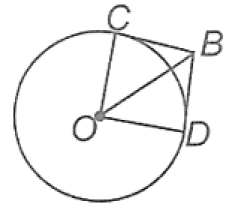
Two tangents BC and BD are drawn to a circle with centre O such that $\angle CBD =120^{\circ}$. Then $OB =$
Image
  • 2BC
  • B
    $\frac{B C}{2}$
  • C
    BC
  • D
    3BC
Answer
Correct option: A.
2BC
(A) 2BC
Explanation:  Since, tangents from an external point B to a circle are equally inclined to OB .
$
\therefore \angle CBO=\frac{1}{2} \angle CBD=\frac{1}{2} \times 120^{\circ}=60^{\circ}
$
Also, $\angle OCB 90^{\circ}[\because$ OC $\perp CB ]$
$
\text { In } \triangle OCB, \frac{B C}{O B}=\cos 60^{\circ}=\frac{1}{2} \Rightarrow OB=2 BC
$
View full question & answer
MCQ 101 Mark
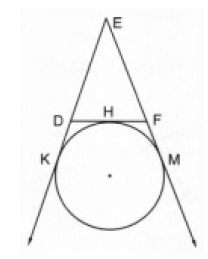
In Figure, a circle touches the side $\text{DF}$ of $\triangle \text{EDF}$ at $H$ and touches $\text{ED}$ and $\text{EF}$ produced at $K$ and $M$ respectively If $\text{EK} =9 \ cm$, then the perimeter of $\triangle \text{EDF}$ is
Image
  • $18 \ cm$
  • B
    $13.5 \ cm$
  • C
    $9 \ cm$
  • D
    $12 \ cm$
Answer
Correct option: A.
$18 \ cm$
Image
In $\triangle \text{DEF}$
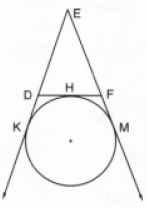
DF touches the circle at $H$ and circle touches $\text{ED}$ and $\text{EF}$ Produced at $K$ and $M$ respectively
$\text{EK }=9 \ cm$
$\text{EK}$ and $\text{EM}$ are the tangents to the circle
$\text{EM=EK}=9 \ cm$
Similarly $\text{DH}$ and $\text{DK}$ are the tangent
$\text{DH = DK}$ and $\text{FH}$ and $\text{FM}$ are tangents
$\text{FH=FM}$
Now, perimeter of $\triangle \text{DEF}$
$=\text{ED+DF+EF}$
$=\text{ED+DH+FH+EF}$
$=\text{ED+DK+FM+EF}$
$=\text{EK+EM}$
$=9+9$
$=18 \ cm$
View full question & answer
MCQ 111 Mark
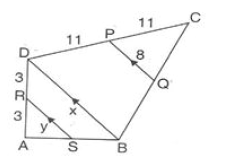
In the adjoining figures $R S\|D B\| P Q$. If $C P=P D=$ and $D R=R A=3$. Then,
Image
  • A
    x = 14, y = 6.
  • x = 16, y = 8.
  • C
    x = 10, y = 7.
  • D
    x = 12, y = 10.
Answer
Correct option: B.
x = 16, y = 8.
(B) $x =16, y =8$.
Explanation:  In $\triangle PCQ \sim \Delta DCB$ (AA similarity) $\Rightarrow \frac{11}{22}=\frac{8}{x} \Rightarrow x =16$
In $\Delta SAR \sim \Delta BAD$ (AA similarity) $\Rightarrow \quad \frac{3}{6}=\frac{y}{16} \Rightarrow y =8$
or
mid-point Theorem
View full question & answer
MCQ 121 Mark
If one zero of the polynomial $6x^2+ 37x - (k-2)$ is reciprocal of the other$,$ then what is the value of $k$?
  • A
    $6$
  • $-4$
  • C
    $-6$
  • D
    $4$
Answer
Correct option: B.
$-4$
Let one zero be $x$ and other zero be $\frac{1}{x}$
$\therefore$ Product of zeroes $=\frac{c}{a}$
$\Rightarrow x \times \frac{1}{x}=\frac{-(k-2)}{6}$
$\Rightarrow 1=\frac{2-k}{6}$
$\Rightarrow 6=2-k$
$\Rightarrow k=2-6=-4$
View full question & answer
MCQ 131 Mark
If the point $(x, 4)$ lies on a circle whose centre is at the origin and radius is $5$ then $x =$
  • A
    $0$
  • $\pm 3$
  • C
    $\pm 4$
  • D
    $\pm 5$
Answer
Correct option: B.
$\pm 3$
Point $A(x, 4)$ is on a circle with centre $O(0,0)$ and radius $=5$
$\therefore OA=\sqrt{(x-0)^2+(4-0)}=\sqrt{x^2+16}$
$\therefore \sqrt{x^2+16}=5$
$\Rightarrow x^2+16=25$
Squaring on both sides, we get
$\Rightarrow x^2=25-16=9=( \pm 3)^2$
$\therefore x= \pm 3$
View full question & answer
MCQ 141 Mark
If the nth term of an $A.P.$ is $2n + 1,$ then the sum of first $n$ terms of the $A.P.$ is
  • A
    $n (n + 1)$
  • B
    $n (n-2)$
  • C
    $n (n-1)$
  • $n (n + 2)$
Answer
Correct option: D.
$n (n + 2)$
$a_n=2 n+1$
$a$ or $a_1=2 \times 1+2=2+1=3$
$a_2=2 \times 2+1=4+1=5$
$\therefore d=a_2-a_1=5-3=2$
$\therefore S_n=\frac{n}{2}[2 a+(n-1) d]$
$=\frac{n}{2}[2 \times 3+(n-1) \times 2]$
$=\frac{n}{2}[6+2 n-2]$
$=\frac{n}{2}[2 n+4]$
$=n(n+2)$
View full question & answer
MCQ 151 Mark
The positive value of $k$ for which the equation $x^2 + kx + 64 = 0$ and $x^2 - 8x + k = 0$ will both have real roots, is
  • A
    $12$
  • B
    $4$
  • C
    $8$
  • $16$
Answer
Correct option: D.
$16$
In the equation $x ^2+ kx +64=0$
$a=1, b=k, c=64$
$D=b^2-4 a c=k^2-4 \times 1 \times 64$
$=k^2-256$
$\because$ The roots are real
$\therefore D \geq 0 \Rightarrow k^2 \geq( \pm 16) 2$
$\Rightarrow k \geq 16 \ldots . .(i)$
Only positive value is taken.
Now in second equation
$x 2-8 x+k=0$
$D=(-8) 2-4 \times 1 \times k=64-4 k$
$\because$ Roots are real
$\therefore D \geq 0$
$\Rightarrow 64-4 k \geq 0$
$\Rightarrow 64 \geq 4 k$
$16 \geq k \ldots \ldots \ldots \text {.(ii) }$
From $(i)$ and
$16 \geq k \geq 16$
$\Rightarrow k=16$
View full question & answer
MCQ 161 Mark
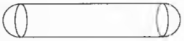
A medicine capsule is in the shape of a cylinder of diameter $0.5 \ cm$ with two hemispheres stuck to each of its ends. The length of the entire capsule is $2 \ cm.$ The capacity of the capsule is
  • A
    $0.33\ cm^3$
  • B
    $0.34 \ cm^3$
  • $0.36\  cm^3$
  • D
    $0.35\  cm^3$
Answer
Correct option: C.
$0.36\  cm^3$
Image
Radius of capsule $=\frac{0.5}{2} \ cm=0.25 \ cm$
Let the length of cylindrical part be $x \ cm .$
Then$, 0.25+x+0.25=2$
$\Rightarrow x+0.5=2$
$\Rightarrow x=1.5 \ cm$.
$\text { Capacity of the capsule }=\left(\frac{2}{3} \pi r^3 \times 2\right)+\pi r^2 h$
$=\frac{4}{3} \times \frac{22}{7} \times(0.25)^3+\frac{22}{7} \times(0.25)^2 \times 1.5$
$=\left(\frac{4}{3} \times \frac{22}{7} \times \frac{1}{4} \times \frac{1}{4} \times \frac{1}{4}\right)+\left(\frac{22}{7} \times \frac{1}{4} \times \frac{1}{4} \times \frac{15}{10}\right)$
$=\frac{11}{168}+\frac{33}{112}=\left(\frac{22+99}{336}\right)=\frac{121}{336}=0.36 \ cm^3$
View full question & answer
MCQ 171 Mark
The roots of the quadratic equation $\frac{x^2-8}{x^2+20}=\frac{1}{2}$ are
  • A
    $\pm 3$
  • B
    $\pm 4$
  • C
    $\pm 2$
  • $\pm 6$
Answer
Correct option: D.
$\pm 6$
(D) $\pm 6$
Explanation:  We have, $\frac{x^2-8}{x^2+20}=\frac{1}{2}$
$\Rightarrow 2 x^2-16=x^2+20 \Rightarrow x^2=36 \Rightarrow x= \pm 6$
View full question & answer
MCQ 181 Mark
Cards marked with numbers 2 to 101 are placed in a box and mixed thoroughly. One card is drawn from the box. The probability that the number on the card is a prime number less than 20 is
  • A
    $\frac{8}{25}$
  • B
    $\frac{4}{25}$
  • C
    $\frac{12}{25}$
  • $\frac{2}{25}$
Answer
Correct option: D.
$\frac{2}{25}$
(D) $\frac{2}{25}$
Explanation: Prime numbers less than 20 are 2, 3, 5, 7, 11, 13, 17, $19=8$
Number of possible outcomes $=8$
Number of total outcomes $=100$
$\therefore$ Required Probability $=\frac{8}{100}=\frac{2}{25}$
View full question & answer
M.C.Q (1 Marks) - Maths STD 10 Questions - Vidyadip