Questions

3 Marks Question

🎯

Test yourself on this topic

8 questions · timed · auto-graded

Question 13 Marks
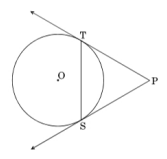
In the given figure, $\text{PT}$ and $\text{PS}$ are tangents to a circle with centre $O$ ,from a point $P$ , such that $\text{PT} =4 \ cm$ and $\angle \text{TPS} =60^{\circ}$ Find the length of the chord $\text{TS.}$ Also, find the radius of the circle.
Image
Answer
$\because \text{PT = PS} ($tangents from an external point $P )$
$\therefore \angle \text{PTS} =\angle \text{PST}$
Using Angle Sum Property in $\triangle \text{PTS}$
$\angle \text{PTS}+\angle \text{PST}+\angle \text{TPS}=180^{\circ}$
$2 \angle \text{PTS}=180-60=120^{\circ}$
$\angle \text{PTS}=60^{\circ}$
$\Rightarrow \text{PTS}$ Is a equilateral triangle
So, $\text{TS} =4 \ cm$
Now, In $\triangle \text{PTO}$
As $\text{PO}$ is angle bisector of $\angle \text{TPS} , \angle \text{OTP} =90^{\circ}$
$\tan 30^{\circ}=\frac{O T}{T P}$
$\frac{1}{\sqrt{3}}=\frac{O T}{4}$
$\text { OT }=\frac{4}{\sqrt{3}}$
$\text { OT }=\frac{4 \sqrt{3}}{3} \ cm$
$\therefore$ radius of circle $=\frac{4 \sqrt{3}}{3} \ cm$
View full question & answer
Question 23 Marks
At $t$ minutes past $2\ pm$ the time needed by the minutes hand of a clock to show $3\ pm$ was found to be $3$ minutes less than $\frac{t^2}{4}$ minutes. Find $t .$
Answer
Since, there are $60$ minutes gap between $2 PM\ \ 3 PM.$
Time needed by minutes hand after $t$ minutes past $2 PM$ to show $3\ PM =(60- t )$ minutes
According to the question ;
$60-t=\frac{t^2}{4}-3$
$\Rightarrow 63=\frac{t^2}{4}+t$
$\Rightarrow 63=\frac{t^2+4 t}{4}$
$\Rightarrow 252=t^2+4 t$
$\Rightarrow t^2+4 t-252=0$
$\Rightarrow t^2+18 t-14 t-252=0$
$\Rightarrow t(t+18)-14(t+8)=0$
$\Rightarrow(t+18)(t-14)=0$
$\Rightarrow t+18=0$ or $t-14=0$
$\Rightarrow t=-18$ or $t=14$
Since time cannot be negative, $t \neq-18$
Hence, $t =14$ minutes.
View full question & answer
Question 33 Marks
Find the mean of the following frequency distribution:
$\text{Class}$ $\text{Frequency}$
$0-10$ $12$
$10-20$ $18$
$20-30$ $27$
$30-40$ $20$
$40-50$ $17$
$50-60$ $6$
Answer
$\text{Class interval}$ $\text{Frequency}$ $\text{Midpoint}$ $f_ix_i$
$0-10$ $12$ $5$ $60$
$10-20$ $18$ $15$ $270$
$20-30$ $27$ $25$ $675$
$30-40$ $20$ $35$ $700$
$40-50$ $17$ $45$ $765$
$50-60$ $6$ $55$ $330$
Total $\sum f_i=100$   $\sum f_i x_i=2800$
Mean $=\frac{\sum f_i x_i}{\sum f_i}=\frac{2800}{100}=28$
View full question & answer
Question 43 Marks
If $\sec \theta+\tan \theta= p$, show that $\frac{p^2-1}{p^2+1}=\sin \theta$
Answer
We have,
$\text { LHS }=\frac{p^2-1}{p^2+1}=\frac{(\sec \theta+\tan \theta)^2-1}{(\sec \theta+\tan \theta)^2+1}$
$\Rightarrow \text { LHS }=\frac{\sec ^2 \theta+\tan ^2 \theta+2 \sec \theta \tan \theta-1}{\sec ^2 \theta+\tan ^2 \theta+\sec \theta \tan \theta+1}$
$\Rightarrow \text { LHS }=\frac{\left(\sec ^2 \theta-1\right)+\tan ^2 \theta+2 \sec \theta \tan \theta}{\sec ^2 \theta+2 \sec \theta \tan \theta+\left(1+\tan ^2 \theta\right)}$
$\Rightarrow \text { LHS }=\frac{\tan ^2 \theta+\tan^2 \theta+2 \sec \theta \tan \theta}{\sec ^2 \theta+2 \sec \theta \tan \theta+\sec ^2 \theta}$
$\Rightarrow \text { LHS }=\frac{2 \tan ^2 \theta+2 \tan \theta \sec \theta}{2 \sec ^2 \theta+2 \sec \theta \tan \theta}$
$=\frac{2 \tan \theta(\tan \theta+\sec \theta)}{2 \sec \theta(\sec \theta+\tan \theta)}$
$=\frac{\tan \theta}{\sec \theta}$
$=\frac{\sin \theta}{\cos \theta \cdot \sec \theta}$
$=\sin \theta$
$=\text { RHS }$
View full question & answer
Question 53 Marks
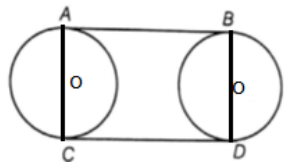
If radii of the two circles are equal, prove that AB = CD where AB and CD are common tangents.
View full question & answer
Question 63 Marks
Solve: $\frac{1}{2 x-3}+\frac{1}{x-5}=1 \frac{1}{9}, x \neq \frac{3}{2}, 5$
Answer
The given equation is:
$\frac{1}{2 x-3}+\frac{1}{x-5}=\frac{10}{9}$
$\Rightarrow \frac{x-5+2 x-3}{(2 x-3)(x-5)}=\frac{10}{9}$
$\Rightarrow \frac{3 x-8}{(2 x-3)(x-5)}=\frac{10}{9}$
$\Rightarrow 27 x-72=10[(2 x-3)(x-5)] \text { ( By cross multiplication method) }$
$\Rightarrow 27 x-72=10\left[2 x^2-10 x-3 x+15\right]$
$\Rightarrow 27 x-72=10\left[2 x^2-13 x+15\right]$
$\Rightarrow 27 x-72=20 x^2-130 x+150$
$\Rightarrow 20 x^2-157 x+222=0$
Here $, a =20, b=-157, c =222$
Therefore, by quadratic formula we have:
$x=\frac{-b \pm \sqrt{b^2-4 a c}}{2 a}$
$\Rightarrow x=\frac{157 \pm \sqrt{(-157)^2-4(20)(222)}}{40}$
$\Rightarrow x=\frac{157 \pm \sqrt{24649-17760}}{40}$
$\Rightarrow x=\frac{157 \pm \sqrt{6889}}{40}$
$\Rightarrow x=\frac{157 \pm 83}{40}$
$\Rightarrow x=\frac{157+83}{40} \text { or } x=\frac{157-83}{40}$
$\Rightarrow x=6 \text { or } x=\frac{37}{20}$
View full question & answer
Question 73 Marks
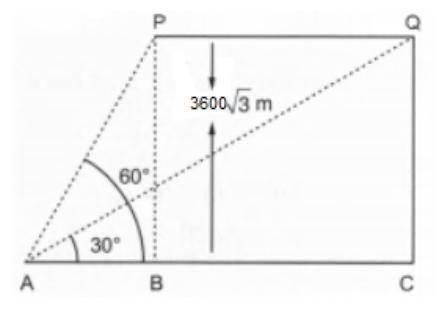
The angle of elevation of a jet plane from a point $A$ on the ground is $60^{\circ}$. After a flight of $30$ seconds, the angle of elevation changes to $30^{\circ}$. If the jet plane is flying at a constant height of $3600 \sqrt{3} m$, find the speed of the jet plane.
Answer
Let $P$ and $Q$ be the two positions of the plane and let A be the point of observation. Let $\text{ABC}$ be the horizontal line through A . It is given that angles of elevation of the plane in two positions $P$ and $Q$ from point $A$ are $60^{\circ}$ and $30^{\circ}$ respectively.
$\therefore \angle PAB =60^{\circ}, \angle QAB =30^{\circ}$. It is also given that $PB =3600 \sqrt{3}$ metres
In $\triangle ABP$, we have
$\tan 60^{\circ}=\frac{B P}{A B}$
$\Rightarrow \sqrt{3}=\frac{3600 \sqrt{3}}{A B}$
$\Rightarrow AB=3600 m$
In $\triangle A C Q$, we have
$\tan 30^{\circ}=\frac{C Q}{A C}$
Image
$\Rightarrow \frac{1}{\sqrt{3}}=\frac{3600 \sqrt{3}}{A C}$
$\Rightarrow A C=3600 \times 3=10800 m$
$\therefore PQ=BC=AC-AB=10800-3600=7200 m$
Thus, the plane travels $7200 m$ in $30$ seconds.
Hence, Speed of plane $=\frac{7200}{30}=240 m / \sec =\frac{240}{1000} \times 60 \times 60=864 \ km / hr$
View full question & answer
Question 83 Marks
On morning walk, three persons step off together and their steps measure $40 \ cm, 42 \ cm$ and $45 \ cm,$ respectively. What is the minimum distance each should walk so that each can cover the same distance in complete steps?
Answer
Since, the three persons start walking together.
$\therefore$ The minimum distance covered by each of them in complete steps $= \text{LCM}$ of the measures of their steps
$40=8 \times 5=2^3 \times 5$
$42=6 \times 7=2 \times 3 \times 7$
$45=9 \times 5=3^2 \times 5$
Hence $\text{LCM} (40,42,45)$
$=2^3 \times 3^2 \times 5 \times 7$
$=8 \times 9 \times 5 \times 7$
$=2520$
$\therefore$ The minimum distance each should walk so that each can cover the same distance
$=2520 \ cm$
$=25.20 \text { meters. }$
View full question & answer
3 Marks Question - Maths STD 10 Questions - Vidyadip