Questions

5 Marks Questions

Take a timed test

6 questions · self-marked practice — reveal the answer and mark yourself.

Question 15 Marks
If the ratio of the sum of the first $n$ terms of two $APs$ is $(7n +1): (4n + 27)$ then find the ratio of their $9^{th}$ terms.
Answer
Let $a_1$ and $a_2$ be the first terms and $d_1$ and $d_2$ be the common difference of the two $APs$ respectively.
Let $S_n$ and $S_n^{\prime}$ be the sums of the first $n$ terms of the two $APs$ and $T_n$ and $T_n^{\prime}$ be their nth terms respectively.
Then, $\frac{S_n}{S_n^{\prime}}=\frac{7 n+1}{4 n+27}$
$\Rightarrow \frac{\frac{n}{2}\left[2 a_1+(n-1) d_1\right]}{\frac{n}{2}\left[2 a_2+(n-1) d_2\right]}=\frac{7 n+1}{4 n+27}$
$\Rightarrow \frac{2 a_1+(n-1) d_1}{2 a_2+(n-1) d_2}=\frac{7 n+1}{4 n+27}$
To find the ratio of mth terms, we replace $n$ by $(2 m-1)$ in the above expression.
Replacing $n$ by $(2 \times 9-1)$,
i.e., $17$ on both sides in $(i)$, we get
$\frac{2 a_1+(17-1) d_1}{2 a_2+(17-1) d_2}=\frac{7 \times 17+1}{4 \times 17+27}$
$\Rightarrow \frac{2 a_1+16 d_1}{2 a_2+16 d_2}=\frac{120}{95}$
$\Rightarrow \frac{a_1+8 d_1}{a_2+8 d_2}=\frac{24}{19}$
$\Rightarrow \frac{a_1+(9-1) d_1}{a_2+(9-1) d_2}=\frac{24}{19}$
$\Rightarrow \frac{T_9}{T_9^{\prime}}=\frac{24}{19}$
$\therefore$ required ratio $=24: 19$
View full question & answer
Question 25 Marks
Ved travels $600 \ km$ to his home partly by train and partly by car. He takes $8$ hours if he travels $120 \ km$ by train and the rest by car. He takes $20$ minutes longer if he travels $200 \ km$ by train and the rest by car. Find the speed of the train and the car.
Answer
Suppose the speed of the train be $x \ km/hr$ and the speed of the car be $y \ km/hr.$
CASE $I$
Distance covered by car is $(600-120) \ km =480 \ km$.
Now, Time taken to cover $480 \ km$ by train $\frac{120}{x} hr/s \left[\because\right.$ Time $\left.=\frac{\text { Distance }}{\text { Speed }}\right]$
Time taken to cover $480 \ km$ by car $=\frac{480}{y} hr/ s$
$\therefore \frac{120}{x}+\frac{480}{y}=8$
$\Rightarrow 8\left(\frac{15}{x}+\frac{60}{y}\right)=8$
$\Rightarrow \frac{15}{x}+\frac{60}{y}=1$
$\Rightarrow \frac{15}{x}+\frac{60}{y}-1=0..............(1)$
CASE $II$
Distance travelled by car is $(600-200) \ km =400 \ km$
Now, Time taken to cover $200 \ km$ by train $=\frac{200}{x} hr/s$
Time taken to cover $400 \ km$ by train $=\frac{400}{y} hrs$
In this case the total time of journey is $8$ hour $20 $ minutes
$\therefore \frac{200}{x}+\frac{400}{y}=8 hr/s\ 20$ minutes
$\Rightarrow \frac{200}{x}+\frac{400}{y}=8 \frac{1}{3}\left[\because 8 hr/s \ 20 \text { minutes }=8 \frac{20}{60} hr/s =8 \frac{1}{3} hr/s \right]$
$\Rightarrow \frac{200}{x}+\frac{400}{y}=\frac{25}{3}$
$\Rightarrow 25\left(\frac{8}{x}+\frac{16}{y}\right)=\frac{25}{3}$
$\Rightarrow \frac{8}{x}+\frac{16}{y}=\frac{1}{3}$
$\Rightarrow \frac{24}{x}+\frac{48}{y}=1$
$\Rightarrow \frac{24}{x}+\frac{48}{y}-1=0.................(ii)$
Putting $\frac{1}{x}=u$ and $\frac{1}{y}=v$ in equations $(i)$ and $(ii),$ we get
$15 u+60 v-1=0............(iii)$
$24 u+48 v-1=0..............(iv)$
By using cross $-$ multiplication, we have
$\frac{u}{60 \times 1-48 \times-1}=\frac{-v}{15 \times-1-24 \times-1}$
$=\frac{1}{15 \times 48-24 \times 60}$
$\Rightarrow \frac{u}{-60+48}$
$=\frac{-v}{-15+24}=\frac{1}{720-1440}$
$\Rightarrow \frac{u}{-12}=\frac{v}{-9}=\frac{1}{-720}$
$\Rightarrow u=\frac{-12}{-720}=\frac{1}{60} $ and $ v=\frac{-9}{-720}=\frac{1}{80}$
Now $,  u=\frac{1}{x} $
$\Rightarrow \frac{1}{60}=\frac{1}{x}$
$ \Rightarrow x=60$
and $,  v=\frac{1}{y} $
$\Rightarrow \frac{1}{80}=\frac{1}{y} $
$\Rightarrow y=80$
Speed of train $=60 \ km / hr$
Speed of car $=80 \ km / hr$.
View full question & answer
Question 35 Marks
The following table shows the ages of the patients admitted in a hospital during a month:
$\text{Age(in years)}$ $6 - 15$ $16 - 25$ $26 - 35$ $36 - 45$ $46 - 55$ $56 - 65$
$\text{Number of patients}$ $6$ $11$ $21$ $23$ $14$ $5$
Find the mode and the mean of the data given above. Compare and interpret the two measures of central tendency.
Answer
Class Interval Frequency $f_i$ Class marks $x_i$ ${c}u_i=\frac{\left(x_i-A\right)}{h} \\ =\frac{\left(x_i-40.5\right)}{10}$ $f_iu_i$
$5.5 - 15.5$ $6$ $10.5$ $-3$ $-18$
$15.5 - 25.5$ $11$ $20.5$ $-2$ $-22$
$25.5 - 35.5$ $21$ $30.5$ $-1$ $-21$
$35.5 - 45.5$ $23$ $40.5 = A$ $0$ $0$
$45.5 - 55.5$ $14$ $50.5$ $1$ $14$
$55.5 - 65.5$ $5$ $60.5$ $2$ $10$
$\text{Total}$ $\Sigma f _{ i }=80$     $\Sigma f _{ i } u _{ i }=-37$
$A=40.5, h=10$
we know that, Mean$, \bar{x}=A+\left\{h \times \frac{\Sigma f_i u_i}{\Sigma f_i}\right\}$
$=40.5+\left\{10 \times \frac{(-37)}{80}\right\}$
$=40.5-\frac{37}{8}$
$=40.5-4.63=35.87$
The modal class of the given data is $35.5 - 45.5.$
$\therefore x_{k}=35.5, h=10, f_{k}=23, f_{k-1}=21, f_{k+1}=14$
we know that, Mode$ ,M _{ o }=x_k+\left\{h \times \frac{\left(f_k-f_{k-1}\right)}{\left(2 f_k-f_{k-1}-$f_{k+1}\right)}\right\}$
$=35.5+\left\{10 \times \frac{(23-21)}{(2 \times 23-21-14)}\right\}$
$=35.5+\left(\frac{10 \times 2}{11}\right)$
$=35.5+1.82=37.32$
Clearly, mode $>$ mean.
View full question & answer
Question 45 Marks
The sum of four consecutive numbers in $A.P$. is $32$ and the ratio of the product of the first and last terms to the product of two middle terms is $7 : 15.$ Find the number.
Answer
Let the four parts be $(a-3d), ( a - d ),( a + d )$ and $( a +3 d)$.
Then, $(a-3 d)+(a-d)+(a+d)+(a+3 d)=32$
$\Rightarrow 4 a=32$
$\Rightarrow a=8$
It is given that
$\frac{(a-3 d)(a+3 d)}{(a-d)(a+d)}=\frac{7}{15}$
$\Rightarrow \frac{a^2-9 d^2}{a^2-d^2}=\frac{7}{15}$
$\Rightarrow \frac{64-9 d^2}{64-d^2}=\frac{7}{15}$
$\Rightarrow 960-135 d^2=448-7 d^2$
$\Rightarrow 128 d^2=512$
$\Rightarrow d^2=4$
$\Rightarrow d= \pm 2$
When $d =2$,
$a-3 d=8-3(2)=2$
$a-d=8-2=6$
$a+d=8+2=10$
$a+3 d=8+3(2)=14$
when $d =-2$,
$a-3 d=8-3(-2)=14$
$a-d=8-(-2)=10$
$a+d=8+(-2)=6$
$a+3 d=8+3(-2)=2$
Thus, the four parts are $2,6,10,14$ or $14,10,6,2$
View full question & answer
Question 55 Marks
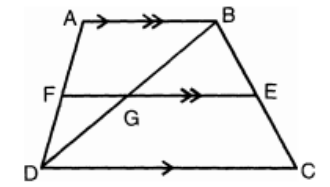
In a trapezium $ABCD , AB \| DC$ and $DC =2 AB . EF \| AB$, where $E$ and $F$ lie on $BC$ and $AD$ respectively such that $\frac{B E}{E C}=\frac{4}{3}$. Diagonal $DB$ intersects $EF$ at $G$ . Prove that, $7 EF =11 AB$.
Answer
Image
In a trapezium $A B C D, A B\|D C, . E F\| A B$ and $C D=2 A B$
and also $\frac{B E}{E C}=\frac{4}{3}.............(1)$
$AB \| CD$ and $AB \| EF$
$\therefore \frac{A F}{F D}=\frac{B E}{E C}=\frac{4}{3}$
In $\Delta B G E$ and $\Delta B D C$
$\angle B E G=\angle B C D \text { ( } \because \text { corresponding angles) }$
$\angle G B E=\angle D B C \text { (Common) }$
$\therefore \Delta B G E \sim \Delta B D C \text { [ By $AA$ similarity] }$
$\Rightarrow \frac{E G}{C D}=\frac{B E}{B C}...............(2)$
Now, from (1) $\frac{B E}{E C}=\frac{4}{3}$
$\Rightarrow \frac{E C}{B E}=\frac{3}{4}$
$\Rightarrow \frac{E C}{B E}+1=\frac{3}{4}+1$
$\Rightarrow \frac{E C+B E}{B E}=\frac{7}{4}$
$\Rightarrow \frac{B C}{B E}=\frac{7}{4} \text { or } \frac{B E}{B C}=\frac{4}{7}$
from equation (2), $\frac{E G}{C D}=\frac{4}{7}$
So $E G=\frac{4}{7} C D .............(3)$
Similarly, $\Delta D G F \sim \Delta D B A$ (by AA similarity)
$\Rightarrow \frac{D F}{D A}=\frac{F G}{A B}$
$\Rightarrow \frac{F G}{A B}=\frac{3}{7}$
$\Rightarrow F G=\frac{3}{7} A B \ldots(4)$
$\because \frac{A F}{A D}=\frac{4}{7}=\frac{B E}{B C}$
$\Rightarrow \frac{E C}{B C}=\frac{3}{7}=\frac{D E}{D A} ]$
Adding equations $(3)$ and $(4)$, we get,
$E G+F G=\frac{4}{7} C D+\frac{3}{7} A B$
$\Rightarrow E F=\frac{4}{7} \times(2 A B)+\frac{3}{7} A B$
$=\frac{8}{7} A B+\frac{3}{7} A B=\frac{11}{7} A B$
$\therefore 7 E F=11 A B$
View full question & answer
Question 65 Marks
Points $A$ and $B$ are $70 \ km$. apart on a highway. $A$ car starts from $A$ and another car starts from $B$ simultaneously. If they travel in the same direction, they meet in $7$ hours, but if they travel towards each other, they meet in one hour. Find the speed of the two cars.
Answer
Suppose, $P$ and $Q$ be the cars starting from $A$ and $B$ respectively and let their speeds be $x \ km/hr$ and $y \ km/hr$ respectively.
Case $I$ :
When the cars $P$ and $Q$ move in the same direction.
Distance covered by the car $P$ in $7$ hours $= 7x \ km$
Distance covered by the car $Q$ in $7$ hours $= 7y \ km$
Let the cars meet at point $M$.
Image
$\therefore A M=7 x \ km$ and $ B M=7 y \ km$
$\therefore A M-B M=A B$
$\Rightarrow 7 x-7 y=70$
$\Rightarrow 7(x-y)=70$
$\Rightarrow x-y=10 \ldots \ldots . . .(i)$
Case $II$ :
When the cars $P$ and $Q$ move in the opposite directions.
Distance covered by the car $P$ in $1$ hour $= x\ km$
Distance covered by the car $Q$ in $1$ hour $= y \ km$
In this case, let the cars meet at the point $N$
Image
$\therefore A N=x \ k m$ and $ B N=y\ k m$
$\therefore A N+B N=A B$
$\Rightarrow x+y=70 \ldots \ldots . .(ii)$
Adding $(i)$ and $(ii),$ we get
$2 x=80$
$\Rightarrow x=40$
Putting $x=40$ in $(i),$ we get
$40-y=10$
$\Rightarrow y=(40-10)=30$
$\therefore x=40, y=30$
Speed of car starting from point $A =40 \ km / hr$.
Speed of car Starting from point $B =30 \ km / hr$.
View full question & answer
5 Marks Questions - Maths STD 10 Questions - Vidyadip

