Question 14 Marks
Read the following text carefully and answer the questions that follow:
Some students were asked to list their favourite colour. The measure of each colour is shown by the central angle of a pie chart given below:
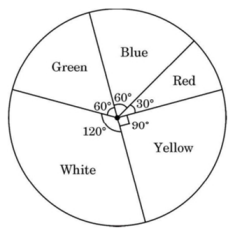
$i$. If a student is chosen at random, then find the probability of his/her favourite colour being white? $(1)$
$ii$. What is the probability of his/her favourite colour being blue or green? $(1)$
$iii.$ If $15$ students liked the colour yellow, how many students participated in the survey? $(2)$
OR
What is the probability of the favourite colour being red or blue? $(2)$
Some students were asked to list their favourite colour. The measure of each colour is shown by the central angle of a pie chart given below:
$i$. If a student is chosen at random, then find the probability of his/her favourite colour being white? $(1)$
$ii$. What is the probability of his/her favourite colour being blue or green? $(1)$
$iii.$ If $15$ students liked the colour yellow, how many students participated in the survey? $(2)$
OR
What is the probability of the favourite colour being red or blue? $(2)$
Answer
View full question & answer→$i$. Since, Total angle in a pie chart is $360^{\circ}$
So, Total no. of Sample Space $=360$
Let $'E\ '$ be the event of having 'White' as favourite colour.
$P(E)=\frac{\text { favourable outcome }}{\text { Total Outcome }}$
$=\frac{120}{360}$
$=\frac{1}{3}$
$ii. P ($ Blue or Green $)=\frac{60+60}{360}$
$=\frac{120}{360}=\frac{1}{3}$
$ii$. Since, Yellow represent $90^{\circ}$ in the Pie Chart
$90^{\circ}=15$ Students
$360^{\circ}=\frac{15}{90} \times 360=60$ students
Hence, $60$ Students participated in the survey.
$OR$
$P($ Red or Blue$)=\frac{30+60}{360}$
$=\frac{90}{360}=\frac{1}{4}$
So, Total no. of Sample Space $=360$
Let $'E\ '$ be the event of having 'White' as favourite colour.
$P(E)=\frac{\text { favourable outcome }}{\text { Total Outcome }}$
$=\frac{120}{360}$
$=\frac{1}{3}$
$ii. P ($ Blue or Green $)=\frac{60+60}{360}$
$=\frac{120}{360}=\frac{1}{3}$
$ii$. Since, Yellow represent $90^{\circ}$ in the Pie Chart
$90^{\circ}=15$ Students
$360^{\circ}=\frac{15}{90} \times 360=60$ students
Hence, $60$ Students participated in the survey.
$OR$
$P($ Red or Blue$)=\frac{30+60}{360}$
$=\frac{90}{360}=\frac{1}{4}$