Questions

M.C.Q (1 Marks)

Take a timed test

18 questions · 17 auto-graded MCQ + 1 self-marked written.

MCQ 11 Mark
The marks obtained by $9$ students in Mathematics are $59, 46, 31, 23, 27, 40, 52, 35$ and $29.$ The mean of the data is
  • A
    $30$
  • B
    $41$
  • C
    $23$
  • $38$
Answer
Correct option: D.
$38$
Given: $59, 46, 31, 23, 27, 40, 52, 35$ and $29$
$\text { Mean }=\frac{\text { Sum of all observations }}{\text { Number of observations }}$
$=\frac{59+46+31+23+27+40+52+35+29}{9}$
$=\frac{342}{9}$
$=38$
View full question & answer
MCQ 21 Mark
If a letter of English alphabet is chosen at random, then the probability of this letter to be a consonant is:
  • A
    $\frac{11}{13}$
  • B
    $\frac{10}{13}$
  • $\frac{21}{26}$
  • D
    $\frac{5}{26}$
Answer
Correct option: C.
$\frac{21}{26}$
(c) $\frac{21}{26}$
Explanation : We have,
Number of vowels $=5( a , e , i , o , u )$
Number of consonants $=21(26-5=21)$
Number of possible outcomes $=21$
Number of total outcomes $=26$
$\therefore$ Required Probability $=\frac{21}{26}$
View full question & answer
MCQ 31 Mark
In a family of two children, the probability of having at least one girl is:
  • A
    $\frac{1}{2}$
  • B
    $\frac{2}{5}$
  • $\frac{3}{4}$
  • D
    $\frac{1}{4}$
Answer
Correct option: C.
$\frac{3}{4}$
(c) $\frac{3}{4}$
Explanation: $\frac{3}{4}$
View full question & answer
MCQ 41 Mark
A piece of wire $20 \ cm$ long is bent into the form of an arc of a circle subtending an angle of $60^{\circ}$ at its centre. The radius of the circle is
  • A
    $\frac{20}{6+\pi} cm$
  • B
    $\frac{30}{6+\pi} cm$
  • $\frac{60}{\pi} cm$
  • D
    $\frac{15}{6+\pi} cm$
Answer
Correct option: C.
$\frac{60}{\pi} cm$
Given: Length of arc $=20 \ cm$
$\Rightarrow \frac{\theta}{360^{\circ}} \times 2 \pi r=20$
$\Rightarrow \frac{60^{\circ}}{360^{\circ}} \times 2 \pi r=20$
$\Rightarrow \frac{\pi r}{3}=20$
$\Rightarrow r\left(\frac{\pi}{3}\right)=20$
$\Rightarrow r=\frac{60}{\pi} \ cm$
View full question & answer
MCQ 51 Mark
Find the area of the sector of a circle having radius $6 \ cm$ and of angle $30^{\circ}$.
  • A
    $8.42 \ cm^2$
  • B
    $9 \ cm^2$
  • $9.42 \ cm^2$
  • D
    $9.52 \ cm^2$
Answer
Correct option: C.
$9.42 \ cm^2$
Radius of a circle $= r =6 \ cm$
$\text { Central angle }=\theta=30^{\circ}$
$\therefore \text { Area of the sector }=\frac{\pi r^2 \theta}{360}$
$=\left(\frac{3.14 \times 6 \times 6 \times 30^{\circ}}{360^{\circ}}\right) \ cm^2$
$=9.42 \ cm^2$
View full question & answer
MCQ 61 Mark
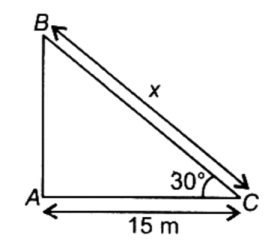
The top of a broken tree has its top end touching the ground at a distance $15 m$ from the bottom, the angle made by the broken end with the ground is $30^{\circ}$. Then length of broken part is
  • A
    $10 m$
  • $10 \sqrt{3} m$
  • C
    $\sqrt{3} m$
  • D
    $5 \sqrt{3} m$
Answer
Correct option: B.
$10 \sqrt{3} m$
Let the length of broken part $(BC)=x$
Image
In $\triangle \text{ABC},$
$\cos 30^{\circ}=\frac{15}{x}$
$\Rightarrow x \times \frac{\sqrt{3}}{2}=15$
$\Rightarrow x =5 \sqrt{3} \times 2=10 \sqrt{3} m$
View full question & answer
MCQ 71 Mark
$\frac{\sin \theta}{1-\cot \theta}+\frac{\cos \theta}{1-\tan \theta}$ is equal to
  • $\sin \theta+\cos \theta$
  • B
    $\sin \theta-\cos \theta$
  • C
    $0$
  • D
    $1$
Answer
Correct option: A.
$\sin \theta+\cos \theta$
We have, $\frac{\sin \theta}{1-\cot \theta}+\frac{\cos \theta}{1-\tan \theta}=\frac{\sin \theta}{1-\frac{\cos \theta}{\sin \theta}}+\frac{\cos \theta}{1-\frac{\sin \theta}{\cos \theta}}$
$=\frac{\sin \theta \times \sin \theta}{\sin \theta-\cos \theta}+\frac{\cos \theta \times \cos \theta}{\cos \theta-\sin \theta}$
$=\frac{\sin ^2 \theta}{\sin \theta-\cos \theta}-\frac{\cos ^2 \theta}{\sin \theta-\cos \theta}$
$=\frac{\sin ^2 \theta-\cos ^2 \theta}{\sin \theta-\cos \theta}$
$=\frac{(\sin \theta+\cos \theta)(\sin \theta-\cos \theta)}{\sin \theta-\cos \theta}$
$=\sin \theta+\cos \theta$
View full question & answer
MCQ 81 Mark
If $x=a \cos \theta$ and $y=b \sin \theta$, then the value of $b^2 x^2+a^2 y^2$ is
  • A
    $a + b$
  • $a^2 b^2$
  • C
    $a - b$
  • D
    $ab$
Answer
Correct option: B.
$a^2 b^2$
Given: $x = a \cos \theta$ and $y = b \sin \theta$
$\therefore b^2 x^2+a^2 y^2$
$=b^2(a \cos \theta)^2+a^2(b \sin \theta)^2$
$=b^2 a^2 \cos ^2 \theta+a^2 b^2 \sin ^2 \theta$
$\Rightarrow b^2 x^2+a^2 y^2$
$=a^2 b^2\left(\cos ^2 \theta+\sin ^2 \theta\right)$
$=a^2 b^2$
${\left[\because \sin ^2 \theta+\cos ^2 \theta=1\right]}$
View full question & answer
MCQ 91 Mark
How many tangents can be drawn to a circle from a point on it?
  • Two
  • B
    Zero
  • C
    Infinite
  • D
    One
Answer
Correct option: A.
Two
(a) Two
Explanation : Two
View full question & answer
MCQ 101 Mark
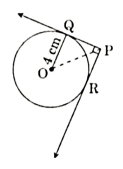
In the given figure, from an external point $P$, two tangents $P Q$ and $P R$ are drawn to a circle of radius 4 cm with centre $O$. If $\angle Q P R=90^{\circ}$, then length of $P Q$ is:
Image
  • A
    3 cm
  • 4 cm
  • C
    2 cm
  • D
    $2 \sqrt{2} cm$
Answer
Correct option: B.
4 cm
(b) 4 cm
Explanation : Join OR & OQ
Now PQOR becomes a quadrilateral
$\angle QPR =90^{\circ}$ (given)
$PQ = PR (\because$ tangent from external point $)$
$OQ = OR =$ (radius of same circle)
$\angle OQP =\angle ORP =90^{\circ}(\because$ tangents and radius are perpendicular $)$
$\therefore \angle QOR =360^{\circ}-\angle OQP -\angle QPR -\angle ORP$
$\angle Q O R=360^{\circ}-90-90-90$
$\angle QOR =90^{\circ}$
$\therefore$ PQOR becomes a square
sides of a square are same
$\therefore P Q=4 cm$
View full question & answer
MCQ 111 Mark
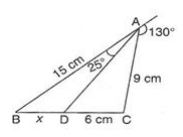
Find the value of a given figure.
Image
  • A
    $12 \ cm.$
  • B
    $6 \ cm.$
  • $10 \ cm.$
  • D
    $15 \ cm.$
Answer
Correct option: C.
$10 \ cm.$
Explanation :
Here, $\angle CAD =180^{\circ}-\left(130^{\circ}+25^{\circ}\right)=25^{\circ}$
Now, since $\angle CAD =\angle DAB$,
therefore, the $AD$ is the bisector of $\angle BAC$.
Since the internal bisector of an angle of a triangle divides the opposite side internally in the ratio of the sides containing the angle.
$\therefore \frac{BD}{DC}=\frac{AB}{AC} $
$\Rightarrow \frac{x}{6}=\frac{15}{9}$
$\Rightarrow x=\frac{15 \times 6}{9}=10 \ cm$
View full question & answer
MCQ 121 Mark
If the point $C(k, 4)$ divides the join of the points $.4(2,6)$ and $B(5,1)$ in the ratio $2: 3$ then the value of $k$ is
  • A
    16
  • B
    $\frac{28}{5}$
  • C
    $\frac{8}{5}$
  • $\frac{16}{5}$
Answer
Correct option: D.
$\frac{16}{5}$
(d) $\frac{16}{5}$
Explanation : By Section Formula,
The X-coordinate of $C =\frac{2(5)+3(2)}{2+3}$
$\Rightarrow K =\frac{16}{5}$
View full question & answer
MCQ 131 Mark
The distance of a point from the x-axis is called
  • A
    due point
  • B
    origin
  • C
    abscissa
  • ordinate
Answer
Correct option: D.
ordinate
(d) ordinate
Explanation : The distance of a point from the x-axis is the y (vertical) coordinate of the point and is called ordinate
View full question & answer
MCQ 141 Mark
If the sum of $n$ terms of an $A.P.$ is $3 n^2+5 n$ then which of its term is $164 ?$
  • $27^{th}$
  • B
    none of these.
  • C
    $28^{th}$
  • D
    $26^{th}$
Answer
Correct option: A.
$27^{th}$
Sum of $n$ terms of an $A.P =3 n^2+5 n$
Let a be the first term and $d$ be the common difference
$S_n=3 n^2+5 n$
$\therefore S_1=3(1)^2+5 \times 1=3+5=8$
$S_2=3(2)^2+5 \times 2=12+10=22$
$\therefore$ First term $(a) =8$
$a_2=S_2-S_1=22-8=14$
$\therefore d=a_2-a_1=14-8=6$
Now $a _{ n }= a +( n -1) d$
$\Rightarrow 164=8+(n-1) \times 6$
$\Rightarrow 6 n-6=164-8=156$
$\Rightarrow 6 n=156+6=162$
$\Rightarrow n=\frac{162}{6}=27$
$\therefore 164$ is $27^{\text {th }}$ term
View full question & answer
MCQ 151 Mark
The product of two consecutive even integers is 528. The quadratic equation corresponding to the above statement, is
  • A
    x (x + 2) = 528
  • B
    2x (2x + 1) = 528
  • C
    (1 + x) 2x = 528
  • D
    2x (x + 4) = 528
Answer
$x(x+2)=528$
Explanation : Let the first number $= x$
Second number $= x +2$
According to question
$x(x+2)=528$
View full question & answer
MCQ 161 Mark
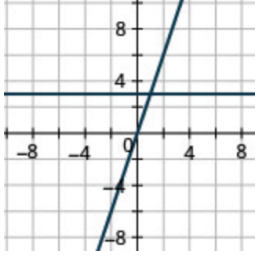
The number of solutions of two linear equations representing intersecting lines is/are
Image
  • $1$
  • B
    $2$
  • C
    $0$
  • D
    $\infty$
Answer
Correct option: A.
$1$
(a) 1
Explanation: The number of solutions of two linear equations representing intersecting lines is 1 because two linear equations representing intersecting lines has a unique solution.
View full question & answer
MCQ 171 Mark
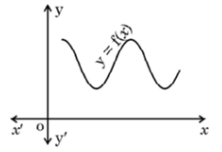
The graph of y = f(x) is shown in the figure for some polynomial f(x).
Image
The number of zeroes of f(x) is
  • A
    $3$
  • B
    $4$
  • $0$
  • D
    $2$
Answer
Correct option: C.
$0$
(c) 0
Explanation: Here $y=f(x)$ is not intersecting or touching the X -axis.
$\therefore$ Number of zeroes of $f(x)=0$
View full question & answer
MCQ 181 Mark
The number $\frac{\sqrt{5}+\sqrt{2}}{\sqrt{5}-\sqrt{2}}$ is
  • an irrational number
  • B
    an integer
  • C
    not a real number
  • D
    a rational number
Answer
Correct option: A.
an irrational number
$=\frac{\sqrt{5}+\sqrt{2}}{\sqrt{5}-\sqrt{2}}$
$=\frac{\sqrt{5}+\sqrt{2}}{\sqrt{5}-\sqrt{2}} \times \frac{\sqrt{5}+\sqrt{2}}{\sqrt{5}+\sqrt{2}}$
$=\frac{(\sqrt{5}+\sqrt{2})^2}{(\sqrt{5})^2-(\sqrt{2})^2}$
$=\frac{(\sqrt{5})^2+(\sqrt{2})^2+2 \times \sqrt{5} \times \sqrt{2}}{5-2}$
$=\frac{5+2+2 \sqrt{10}}{3}$
$=\frac{7+2 \sqrt{10}}{3}$
Here $\sqrt{10}=\sqrt{2} \times \sqrt{5}$
Since $\sqrt{2}$ and $\sqrt{5}$ both are an irrational number
Therefore, $\frac{\sqrt{5}+\sqrt{2}}{\sqrt{5}-\sqrt{2}}$ is an irrational number.
View full question & answer
M.C.Q (1 Marks) - Maths STD 10 Questions - Vidyadip