Questions

3 Marks Question

🎯

Test yourself on this topic

8 questions · timed · auto-graded

Question 13 Marks
Weekly income of $600$ families is given below:
Income $($in $Rs)$ $0-1000$ $1000-2000$ $2000-3000$ $3000-4000$ $4000-5000$ $5000-6000$
No. of Families $250$ $190$ $100$ $40$ $15$ $5$
 Find the median.yuj
Answer
Income No. of Families $c.f$
$0-1000$ $250$ $250$
$1000-2000$ $190$ $250+190= 440$
$2000-3000$ $100$ $440+100=540$
$3000-4000$ $40$ $540+40=580$
$4000-5000$ $15$ $580+15=595$
$5000-6000$ $5$ $595+5=600$
Here, $N =600$
$\Rightarrow$ Median $=\frac{N}{2}^{th}$ term
$=\frac{600}{2}=300^{th}$ term
So, Median class $=1000-2000$
$l=1000, h=1000, c . f .=250, f=190$
Median $=l+\left(\frac{\frac{N}{2}-c . f}{f}\right) \times h$
Median $=1000+\left(\frac{300-250}{190}\right) \times 1000$
$=1000+\frac{50}{190} \times 1000$
$=1000+\frac{5000}{19}$
$=1000+263.16$
$=1263.16$
Median $= Rs.1263.16$
View full question & answer
Question 23 Marks
If $\operatorname{cosec} A+\cot A=m$. show that $\frac{m^2-1}{m^2+1}=\cos A$.
Answer
Given: $\operatorname{cosec} A +\cot A = m$
$\Rightarrow(\operatorname{cosec} A+\cot A)^2=(m)^2 \text { [squaring both sides ] }$
$\Rightarrow \operatorname{cosec}^2 A+\cot ^2 A+2 \operatorname{cosec} A \cot A=m^2 \ldots \ldots . .(1)$
Now, $\ce{LHS}$
$=\frac{m^2-1}{m^2+1}$
$=\frac{\operatorname{cosec}^2 A+\cot ^2 A+2 \operatorname{cosec} A \cot A-1}{\operatorname{cosec}^2 A+\cot ^2 A+2 \operatorname{cosece} A \cdot \cot A+1} \cdot[\text { From (1)] }$
$=\frac{\cot ^2 A+\cot ^2 A+2 \operatorname{cosec} A \cdot \cot A}{\operatorname{cosec}^2 A+\operatorname{cosec}^2 A+2 \operatorname{cosec} A \cdot \cot A}\left[\text { Since, } \operatorname{Cosec}^2 A-\operatorname{Cot}^2 A=1\right]$
$=\frac{2 \cot ^2 A+2 \operatorname{cosec} A \cot A}{2 \operatorname{cosec} A+2 \operatorname{cosec} A \cot A}$
$=\frac{2 \cot A(\cot A+\operatorname{cosec} A)}{2 \operatorname{cosec} A(\operatorname{cosec} A+\cot A)}$
$=\frac{\cot A}{\operatorname{cosec} A}$
$=\frac{\frac{\cos A}{\sin A}}{\frac{1}{\sin A}}$
$=\frac{\cos A}{\sin A} \times \frac{\sin A}{1}$
$=\cos A=\text { RHS }$
Hence, Proved.
View full question & answer
Question 33 Marks
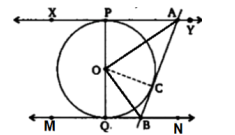
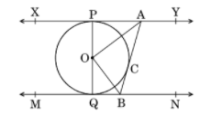
In the figure, $X Y$ and $M N$ are two parallel tangents to a circle with centre $O$ and another tangent $A B$ with point of contact $C$ intersecting $XY$ at $A$ and $MN$ at $B$ . Prove that $\angle AOB =90^{\circ}$.
Image
Answer

Image
To prove $\angle A O B=90^{\circ}$
Proof $-$ In $\triangle AOP$ and $\triangle AOC,$
$OA = OA \ [$ Common$]$
$OP = OC \ [$ Both radii$]$
$AP = AC$ [tangents from external point $A ]$
Therefore by $\text{SSS}$ congruence $\triangle AOP \cong \triangle AOC$
and by $ \text{CPCT}, \angle P A O=\angle O A C$
$\Rightarrow \angle P A C=2 \angle O A C \ldots \text { (i) }$
Similarly, from $\triangle OBC$ and $\triangle OBQ$, we get;
$\angle QBC=2 \angle OBC \ldots \text { (ii) }$
Adding eq. $(i)$ and eq. $(ii)$
$\angle PAC+\angle QBC=180$
$2(\angle OBC+\angle OAC)=180$
$(\angle OBC+\angle OAC)=90$
Now, in $\angle OAB$,
Sum of interior angle is $180$
$\text { So, } \angle OBC+\angle OAC+\angle AOB=180$
$\therefore \angle AOB=90$
hence proved.
View full question & answer
Question 43 Marks
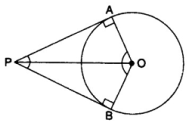
Prove that the angle between the two tangents drawn from an external point to a circle is supplementary to the angle subtended by the line$-$segment joining the points of contact at the centre.
Answer
$\angle \text{OAP} =90^{\circ}$
$(1) [$Angle between tangent and radius through the point of contact is $90^{\circ} ]$
$\angle \text{OBP} =90^{\circ}$
$(2) [$Angle between tangent and radius through the point of contact is $90^{\circ} ] \text{OAPB}$ is quadrilateral
Image
$\therefore \ce{\angle APB +\angle AOB +\angle OAP +\angle OBP} =360^{\circ} [$ Angle sum property of a quadrilateral $]$
$\Rightarrow \ce{\angle APB +\angle AOB} +90^{\circ}+90^{\circ}=360^{\circ}[$ From $(1)$ and $(2)]$
$\Rightarrow \ce{\angle APB +\angle AOB} =180^{\circ}$
$\Rightarrow \angle \text{APB}$ and $\angle \text{AOB}$ are supplementary
View full question & answer
Question 53 Marks
If the $m ^{\text {th }}$ term of an $A.P$. is $\frac{1}{n}$ and $n ^{\text {th }}$ term be $\frac{1}{m},$ then show that its $( mn )^{\text {th }}$ term is $1$ .
Answer
Let a and $d$ be the first term and common difference respectively of the given $A.P$.
Then
$a_{n}=a+(n-1) d$
$\frac{1}{n}=m^{\text {th }}$ term 
$\Rightarrow \frac{1}{n}=a+(m-1) d \ldots$
$\frac{1}{m}= n ^{th}$ term 
$\Rightarrow \frac{1}{m}=a+(n-1) d \ldots$
On subtracting equation $(ii)$ from equation $(i),$ we get
$\frac{1}{n}-\frac{1}{m}=[a+(m-1) d]-[a+(n-1) d]$
$=a+md-d-a-nd+d$
$=(m-n) d$
$\Rightarrow \frac{m-n}{m n}=(m-n) d$
$\Rightarrow d=\frac{1}{m n}$
Putting $d =\frac{1}{m n}$ in equation $(i),$ we get
$\frac{1}{n}=a+\frac{(m-1)}{m n}$
$\Rightarrow \frac{1}{n}=a+\frac{1}{n}-\frac{1}{m n}$
$\Rightarrow a=\frac{1}{m n}$
$\therefore(mn)^{th}$ term $=a+(mn-1) d$
$=\frac{1}{m n}+(m n-1) \frac{1}{m n}\left[\because a=\frac{1}{m n}=d\right]$
$=\frac{1}{m n}+\frac{m n}{m n}-\frac{1}{m n}$
$=1$
View full question & answer
Question 63 Marks
Find the value of $a , b$ and $c$ such that the numbers $a , 7, b, 23$ and $c$ are in $A.P.$
Answer
$a, 7, b, 23$ and $c$ are in $A.P.$
Let the common difference be $d.$
$a+d=7 \ldots \text { (i) }$
$a+3 d=23 ...(ii)$
From $(i)$ and $(ii),$ we get
$2 d=16$
$d=8$
Put $d=8$ in $(1)$ we get
$a+8=7$
$a=-1$
$b=a+2 d$
$b=-1+2 \times 8$
$\text { or, } b=-1+16$
$\text { or, } b=15$
$c=a+4 d$
$=-1+4 \times 8$
$=-1+32$
$c=31$
$\therefore a=-1, b=15, c=31$
View full question & answer
Question 73 Marks
One zero of the polynomial $x^2-2 x-(7 p+3)$ is $-1 ,$ find the value of $p$ and the other zero.
Answer
Let $p ( x )= x ^2-2 x -(7 p +3)$
Since $-1$ is a zero of $p(x)$.
Therefore, $p(-1)=0$
$(-1)^2-2(-1)-(7 p+3)=0$
$1+2-7 p-3=0$
$3-7 p-3=0$
$7 p=0$
$p=0$
Thus, $p(x)=x^2-2 x-3$
For finding zeros of $p ( x )$, we put,
$p(x)=0$
$x^2-2 x-3=0$
$x^2-3 x-x-3=0$
$x(x-3)+1(x-3)=0$
$(x-3)(x+1)=0$
Put $x-3=0$ and $x+1=0$, we get,
Thus, $x=3,-1$
Thus, the other zero is $3 .$
View full question & answer
Question 83 Marks
Prove that $(3+\sqrt{2})$ is irrational.
Answer
If possible let $3+\sqrt{2}$ is rational number, and we take another rational number 3 for our calculation $\Rightarrow(3+\sqrt{2})-3=\sqrt{2}$ (difference of two rational number is a rational number)
$\therefore \sqrt{2}$ is rational
This contradicts the fact that $\sqrt{2}$ is irrational
Since the contradiction arises by assuming that $3+\sqrt{2}$ is rational.
Hence, $3+\sqrt{2}$ is irrational.
View full question & answer
3 Marks Question - Maths STD 10 Questions - Vidyadip