Question types

MODEL PAPER 8 (STANDARD) question types

44 questions across 6 question groups — pick any mix to generate a Maths paper with step-by-step answer keys.

44
Questions
6
Question groups
5
Question types
Sample Questions

MODEL PAPER 8 (STANDARD) questions

One sample from each question group in this chapter. Select any group above to see the full set with answer keys.

In the formula $\bar{x}=a+\frac{\sum f_i d_i}{\sum f_i}$ for finding the mean of grouped data $d_i^{\prime} s$ are deviations from $a$ of
  • A
    upper limits of the classes
  • B
    lower limits of the classes
  • mid points of the classes
  • D
    frequencies of the class marks

Answer: C.

View full solution
Cards marked with numbers 1, 2, 3, ..., 25 are placed in a box and mixed thoroughly and one card is drawn at random from the box. The probability that the number on the card is a multiple of 3 or 5 is
  • A
    $\frac{8}{25}$
  • $\frac{12}{25}$
  • C
    $\frac{4}{25}$
  • D
    $\frac{1}{5}$

Answer: B.

View full solution
A chord of a circle of radius $10 \ cm$ subtends a right angle at the centre. The area of the minor segments $($given, $\pi$
$=3.14)$ is
  • A
    $32.5 \ cm^2$
  • B
    $34.5 \ cm^2$
  • C
    $30.5 \ cm^2$
  • $28.5 \ cm^2$

Answer: D.

View full solution
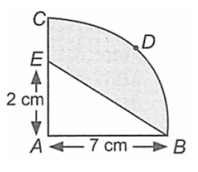
In the figure, $\text{ABDCA}$ represents a quadrant of a circle of radius $7 \ cm$ a with centre A. Find the area of the shaded portion.
Image
  • A
    $14 \ cm^2$
  • $31.5 \ cm^2$
  • C
    $24.5 \ cm^2$
  • D
    $38.5 \ cm^2$

Answer: B.

View full solution
Assertion $(A):$ Three consecutive terms $2 k+1,3 k+3$ and $5 k-1$ form an $AP$ than $k$ is equal to $6 .$
Reason $(R):$ In an $AP\ a , a + d , a +2 d, \ldots$ the sum to $n$ terms of the $AP$ be $S _{ n }=\frac{n}{2}(2 a+(n-1) d)$
  • A
    Both $A$ and $R$ are true and $R$ is the correct explanation of $A.$
  • Both $A$ and $R$ are true but $R$ is not the correct explanation of $A.$
  • C
    $A$ is true but $R$ is false.
  • D
    $A$ is false but $R$ is true.

Answer: B.

View full solution
  • Both A and R are true and R is the correct explanation of A.
  • B
    Both A and R are true but R is not the correct explanation of A.
  • C
    A is true but R is false.
  • D
    A is false but R is true.

Answer: A.

View full solution
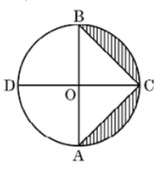
In the given figure, $\text{AB}$ and $\text{CD}$ are the diameters of a circle with centre $\text{O}$, perpendicular to each other. If $\text{OA}=7 \ cm$ find the area of the shaded region.
Image
View full solution
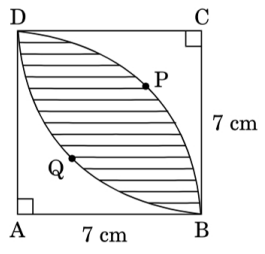
Calculate the area of the shaded region common between two quadrants of circles of radius $7 \ cm$ each $($as shown in Figure$).$​​​​​​​
Image
View full solution
Q 133 Marks Question3 Marks
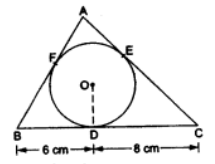
A triangle $\text{ABC}$ is drawn to circumscribe a circle of radius $4 \ cm$ such that the segments $BD$ and $DC$ into which $BC$ is divided by the point of contact $D$ are of lengths $6 \ cm$ and $8 \ cm$ respectively. Find the lengths of the sides $AB$ and $AC.$​​​​​​​
Image
View full solution
Q 153 Marks Question3 Marks
As observed from the top of a light-house, $100 m$  high above sea level, the angle of depression of a ship, sailing directly towards it, changes from $30^{\circ}$ to $60^{\circ}$. Determine the distance travelled by the ship during the period of observation. $($ Use $\sqrt{3}=1.732)$
View full solution
Q 173 Marks Question3 Marks
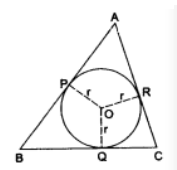
In the given figure, the sides $AB , BC$ and $CA$ of a triangle $ABC$ touch a circle with center $O$ and radius $r$ at $P , Q$ and R respectively. Prove that.
$a. AB + CQ = AC + BQ$
$b.$ area $(\Delta A B C)=\frac{1}{2}$ (perimeter of $\left.\Delta A B C\right) \times r$.
Image
View full solution
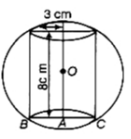
A building is in the form of a cylinder surmounted by a hemispherical dome. The base diameter of the dome is equal to $\frac{2}{3}$ of the total height of the building. Find the height of the building, if it contains $67 \frac{1}{21} m^3$ of air.
View full solution
A train covered a certain distance at a uniform speed. If it were $6 \ km/h$ faster, it would have taken $4$ hours less than the scheduled time. And, if the train were slower by $6 \ km/h,$ it would have taken $6$ hours more than the scheduled time. Find the length of the journey.
View full solution
If the sum of the first $p$ terms of an $A.P.$ is $q$ and the sum of the first $q$ terms is $p$; then show that the sum of the first $(p+q)$ terms is $\{-(p+q)\}$.
View full solution
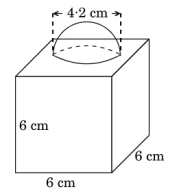
In Figure, a decorative block is shown which is made of two solids, a cube and a hemisphere. The base of the block is a cube with edge $6 \ cm$ and the hemisphere fixed on the top has a diameter of $4.2 \ cm .$ Find
a. the total surface area of the block.
b. the volume of the block formed. $($Take $\pi=\frac{22}{7}$ )
Image
View full solution
Points $P, Q$ and $R$ in order are dividing a line segment joining $A(1, 6)$ and $B(5, -2)$ in four equal parts. Find the coordinates of $P, Q$ and $R$
View full solution
Read the following text carefully and answer the questions that follow:
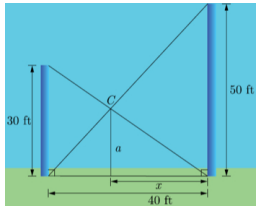
Two poles, $30$ feet and $50$ feet tall, are $40$ feet apart and perpendicular to the ground. The poles are supported by wires attached from the top of each pole to the bottom of the other, as in the figure. $A$ coupling is placed at $C$ where the two wires cross.
Image
$i$. What is the horizontal distance from $C$ to the taller pole? $(1)$
$ii$. How high above the ground is the coupling? $(1)$
$iii.$ How far down the wire from the smaller pole is the coupling? $(2)$
OR
Find the length of line joining the top of the two poles. $(2)$
View full solution
View full solution
Read the following text carefully and answer the questions that follow:
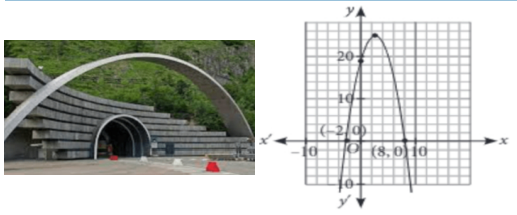
Rachna and her husband Amit who is an architect by profession, visited France. They went to see Mont Blanc Tunnel which is a highway tunnel between France and Italy, under the Mont Blanc Mountain in the Alps, and has a parabolic cross-section. The mathematical representation of the tunnel is shown in the graph.

Image
$i.$ What will be the expression of the polynomial given in diagram$?\ (1)$
$ii.$ What is the value of the polynomial, represented by the graph, when $x=4\ ?\ (1)$
$iii.$ If the tunnel is represented by $-x^2+3 x-2$. Then what is its zeroes$?\ (2)$
OR
What is sum of zeros and product of zeros for $-x^2+3 x-2\ ?\ (2)$
View full solution

Generate a MODEL PAPER 8 (STANDARD) paper free

Pick question groups from the list above, set marks and difficulty, and export a branded PDF with step-by-step answer keys. First 3 chapters free — no signup.

Download App