Questions

3 Marks Question

🎯

Test yourself on this topic

8 questions · timed · auto-graded

Question 13 Marks
Peter throws two different dice together and finds the product of the two numbers obtained. Rina throws a die and squares the number obtained. Who has the better chance to get the number $25$ ?
Answer
The person having higher probability of getting the number $25$ has the better chance.
When a pair of dice is thrown, there are $36$ elementary events which are as follows:
$(1,1),(1,2),(1,3),(1,4),(1,5),(1,6)$
$(2,1),(2,2),(2,3),(2,4),(2,5),(2,6)$
$(3,1),(3,2),(3,3),(3,4),(3,5),(3,6)$
$(4,1),(4,2),(4,3),(4,4),(4,5),(4,6)$
$(5,1),(5,2),(5,3),(5,4),(5,5),(5,6)$
$(6,1),(6,2),(6,3),(6,4),(6,5),(6,6)$
Therefore, the product of numbers on two dice can take values $1,2,3, \ldots, 36$.
We observe that the product of two numbers on two dice will be $25$ if both the dice show number $5$ .
Therefore, there is only one elementary event, viz., $(5, 5)$, which is favourable for getting $25$.
$p_1=$ Probability that Peter throws $ 25=\frac{1}{36}$
Rina throws a die on which she can get any one of the six numbers $1,2,3,4,5,6$ as an outcome.
If she gets number $5$ on the upper face of the die thrown, then the square of the number is $25$ .
$P _2=$ Probability that the square of number obtained is $25=\frac{1}{6}$
Therefore, $p _2> p _1$. Therefore, Rina has better chance to get the number $25$ .
View full question & answer
Question 23 Marks
If $\sin (A-B)=\frac{1}{2}, \cos (A+B)=\frac{1}{2}, 0^{\circ} < A+B \leqslant 90^{\circ}, A > B,$ find the values of $A$ and $B$ .
Answer
It is given that $\sin (A-B)=\frac{1}{2}, \cos (A+B)=\frac{1}{2}, 0^{\circ} < A+B \leqslant 90^{\circ}, A > B,$
we have to find the values of $A$ and $B$ .
Now, $\sin (A-B)=\frac{1}{2}$
$\Rightarrow \sin (A-B)=\sin 30^{\circ} \quad\left[\because \sin 30^{\circ}=\frac{1}{2}\right]$
On equating both sides, we get
$A-B=30^{\circ} \ldots$
Also, $\cos (A+B)=\frac{1}{2}$
$\Rightarrow \cos (A+B)=\cos 60^{\circ}\left[\because \cos 60^{\circ}=\frac{1}{2}\right]$
On equating both sides, we get
$A+B=60^{\circ} . .$
On Adding Eq $(i)$ and Eq $(ii),$ we get
$2 A=90^{\circ}$
$\Rightarrow A=45^{\circ}$
From Eq $(i),$ we get $45^{\circ}-B=30^{\circ}$
$\Rightarrow B=45^{\circ}-30^{\circ}$
$\therefore B=15^{\circ}$
Hence, $A=45^{\circ}$ and $B=15^{\circ}$
View full question & answer
Question 33 Marks
Prove the identity: $\frac{(1+\cot A+\tan A)(\sin A-\cos A)}{\sec ^3 A-\operatorname{cosec}^3 A}=\sin ^2 A \cos ^2 A$
Answer
We have,
$\text{LHS}=\frac{\left(1+\frac{\cos A}{\sin A}+\frac{\sin A}{\cos A}\right)(\sin A-\cos A)}{\left(\frac{1}{\cos ^3 A}-\frac{1}{\sin ^3 A}\right)}$
$\Rightarrow \text{LHS}=\frac{\left(1+\frac{\cos ^2 A+\sin ^2 A}{\sin A \cos A}\right)(\sin A-\cos A)}{\left(\frac{\sin ^3 A-\cos ^3 A}{\sin ^3 A \cos ^3 A}\right)}$
$\Rightarrow \text{LHS}=\frac{\left(1+\frac{1}{\sin A \cos A}\right)(\sin A-\cos A) \sin ^3 A \cos ^3 A}{\left(\sin ^3 A-\cos ^3 A\right)}$
$\Rightarrow \text{LHS}=\frac{(\sin A \cos A+1)\left(\sin A-\cos ^2\right) \sin ^2 A \cos ^2 A}{(\sin A-\cos A)\left(\sin ^2 A+\cos ^2 A+\sin A \cos A\right)}$
$\left[\because a^3-b^3=(a-b)\left(a^2+b^2+ab\right)\right]$
$\Rightarrow \text{LHS}=\frac{(\sin A \cos A+1) \sin ^2 A \cos ^2 A}{(1+\sin A \cos A)}$
$=\sin ^2 A \cos ^2 A$
$=\text{RHS}$
View full question & answer
Question 43 Marks
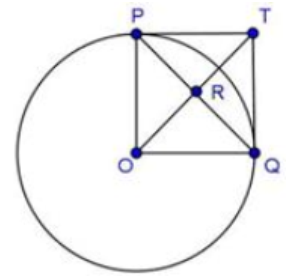
In figure $P O \perp Q O$. The tangents to the circle at $P$ and $Q$ intersect at a point $T$ . Prove that $PQ$ and $OT$ are right bisectors of each other.
Image
Answer
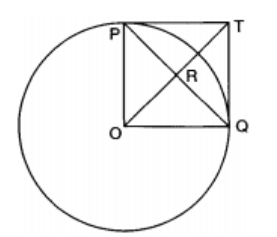
Given, $PO \perp QO$ and The tangents to the circle at $P$ and $Q$ intersect at a point $T .$
Image
Consider, $\triangle T P O$ and $\triangle T Q O$
PT $=$ TQ $[\because$ Tangets from external point are equal in length $]$
$OT = OT [$ Common]
$\angle T P O=\angle T Q O=90^{\circ}$
So, by RHS rule, we have
$\Delta T P O \cong \triangle T Q O$
$\Rightarrow \angle P T O=\angle Q T O \ldots \text { (i) [C.P.C.T.] }$
Now, In $\triangle PTR$ and $\Delta QTR$
PT $=$ TQ $[\because$ Tangents from external point are equal in length $]$
$\angle P T O=\angle Q T O[\text { By equation (i) }]$
$\text { TR }=\text { TR [Common }]$
So, by $\text{SAS}$ rule, we have
$\Delta P T R \cong \triangle Q T R$
$\therefore PR=RQ \ldots \text { (ii) }$
$\text { And, } \angle T R P=\angle T R Q$
$\text { But, } \angle T R P+\angle T R Q=180^{\circ}$
$\Rightarrow 2 \angle T R P=180^{\circ}$
$\Rightarrow \angle T R P=90^{\circ}$
Therefore, $PQ$ and $OT$ are right bisectors of each other.
View full question & answer
Question 53 Marks
A part of monthly hostel charge is fixed and the remaining depends on the number of days one has taken food in the mess. When Swati takes food for $20$ days, she has to pay $Rs.3,000$ as hostel charges whereas Mansi who takes food for $25$ days pays $Rs.3,500$ as hostel charges. Find the fixed charges and the cost of food per day.
Answer
Let fixed charge be $Rs.x$ and charge taken per day for food be $Rs.y$
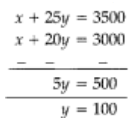
$ x+20 y=3000$
$x+25 y=3500 $
Subtracting $(i)$ from $(ii)$
Image
Substituting this value of $y$ in $(i)$
$x+20(100)=3000$
$x=1000$
$x=1000$ and $y=100$
Fixed charge and cost of food per day are $Rs.1000$ and $Rs.100$
View full question & answer
Question 63 Marks
Five years ago, Nuri was thrice as old as Sonu. Ten years later, Nuri will be twice as old as Sonu. How old are Nuri and Sonu? Solve the pair of the linear equation obtained by the elimination method.
Answer
Let the present age of Nuri and Sonu be $x$ years and $y$ years respectively.
Then, according to the question,
$x-5=3(y-5)$
$\Rightarrow x-5=3 y-15$
$\Rightarrow x-3 y=-10 \ldots (1)$
$x+10=2(y+10)$
$x+10=2 y+20$
$\Rightarrow x-2 y=10\ldots (2)$
Subtracting equation $(2)$ from equation $(1),$ we get
$-y=-20$
$\Rightarrow y=20$
Subtracting equation $(2)$ from equation $(1),$ we get
$x-2(20)=10$
$\Rightarrow x-40=10$
$\Rightarrow x=40+10$
$\Rightarrow x=50$
Hence, Nuri and Sonu are $50$ years and $20$ years old respectively at present.
Verification.Subtracting the value of $x=50$ and $y=20$,
we find that both the eqations $(1)$ and $(2)$ are satisfied as shown below:
$x-3 y=50-3(20)=50-60=-10$
$x-2 y=50-2(20)=50-40=10$
Hence,the solution is correct.
View full question & answer
Question 73 Marks
Find the zeroes of the polynomial $7 y^2-\frac{11}{3} y-\frac{2}{3}$ by factorisation method and verify the relationship between the zeroes and coefficient of the polynomial.
Answer
$7 y^2-\frac{11}{3} y-\frac{2}{3}$
$=\frac{1}{3}\left(21 y^2-11 y-2\right)$
$=\frac{1}{3}\left(21 y^2-14 y+3 y-2\right)$
$=\frac{1}{3}[7 y(3 y-2)+1(3 y-2)]$
$=\frac{1}{3}(3 y-2)(7 y+1)$
$\Rightarrow y=\frac{2}{3}, \frac{-1}{7} $ are zeroes of the polynomial. 
If Given polynimoal is $7 y^2-\frac{11}{3} y-\frac{2}{3}$
Then $a =7, b=-\frac{11}{3}$ and $c =-\frac{2}{3}$
Sum of zeroes $=\frac{2}{3}+\frac{-1}{7}$
$=\frac{14-3}{21}=\frac{11}{21}$
Also, $\frac{-b}{a}=\frac{-\left(\frac{-11}{3}\right)}{7}=\frac{11}{21}$
From $(i)$ and $(ii)$
Sum of zeroes $=\frac{-b}{a}$
Now, product of zeroes $=\frac{2}{3} \times \frac{-1}{7}=\frac{-2}{21}$
Also, $\frac{c}{a}=\frac{\frac{-2}{3}}{7}=\frac{-2}{21} \ (iv)$ From $(iii)$ and $(iv)$
Product of zeroes $=\frac{c}{a}$
View full question & answer
Question 83 Marks
Show that $5-\sqrt{3}$ is irrational.
Answer
Let us assume, to the contrary, that $5-\sqrt{3}$ is rational.
That is, we can find coprime numbers a and $b \left( b \neq 0\right.$ ) such that $5-\sqrt{3}=\frac{a}{b}$
Therefore, $5-\frac{a}{b}=\sqrt{3}$
Rearranging this equation, we get $\sqrt{3}=5-\frac{a}{b}=\frac{5 b-a}{b}$
Since a and b are integers, we get $5-\frac{a}{b}$ is rational, and so $\sqrt{3}$ is rational.
But this contradicts the fact that $\sqrt{3}$ is irrational
This contradiction has arisen because of our incorrect assumption that $5-\sqrt{3}$ is rational.
So, we conclude that $5-\sqrt{3}$ is irrational.
View full question & answer
3 Marks Question - Maths STD 10 Questions - Vidyadip