Question 13 Marks
If all the sides of a parallelogram touch a circle, show that the parallelogram is a rhombus.
Answer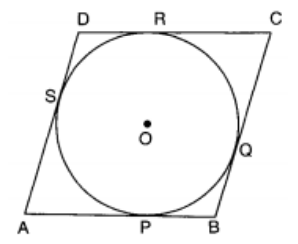
Let $\text{ABCD}$ be a parallelogram such that its sides touch a circle with centre $O$.
We know that the tangents to a circle from an exterior point are equal in length.
Therefore $,AP = AS \ [$From $A] ...(i)$
$BP = BQ \ [$ From $B ] \ldots (ii)$
$CR = CQ\ [$ From $C ] \ldots...iii)$
and $, DR = DS\ [$From $D] ...(iv)$
Adding $(i), (ii), (iii)$ and $(iv),$ we get,
$AP+BP+CR+DR$
$=AS+BQ+CQ+DS$
$\Rightarrow(AP+BP)+(CR+DR)$
$=(AS+DS)+(BQ+CQ)$
$\Rightarrow AB+CD=AD+BC$
$\Rightarrow 2 AB=2 BC$
$\Rightarrow AB=BC$
Therefore, $AB = BC = CD = AD$
Thus, $\text{ABCD}$ is a rhombus.
View full question & answer→Let $\text{ABCD}$ be a parallelogram such that its sides touch a circle with centre $O$.
We know that the tangents to a circle from an exterior point are equal in length.
Therefore $,AP = AS \ [$From $A] ...(i)$
$BP = BQ \ [$ From $B ] \ldots (ii)$
$CR = CQ\ [$ From $C ] \ldots...iii)$
and $, DR = DS\ [$From $D] ...(iv)$
Adding $(i), (ii), (iii)$ and $(iv),$ we get,
$AP+BP+CR+DR$
$=AS+BQ+CQ+DS$
$\Rightarrow(AP+BP)+(CR+DR)$
$=(AS+DS)+(BQ+CQ)$
$\Rightarrow AB+CD=AD+BC$
$\Rightarrow 2 AB=2 BC$
$\Rightarrow AB=BC$
Therefore, $AB = BC = CD = AD$
Thus, $\text{ABCD}$ is a rhombus.