Question 14 Marks
Read the following text carefully and answer the questions that follow:
The law of reflection states that when a ray of light reflects off a surface, the angle of incidence is equal to the angle of reflection.
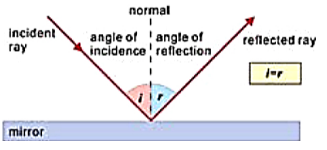
Suresh places a mirror on level ground to determine the height of a pole $($with traffic light fired on it$)$. He stands at a certain distance so that he can see the top of the pole reflected from the mirror. Suresh's eye level is $1.5 m$ above the ground. The distance of Suresh and the pole from the mirror are $1.8 m$ and $6 m$ respectively.

$i$. Which criterion of similarity is applicable to similar triangles? $(1)$
$ii$. What is the height of the pole? $(1)$
$iii$. If angle of incidence is $i,$ find tan i. $(2)$
OR
Now Suresh move behind such that distance between pole and Suresh is $13$ meters.He place mirror between
him and pole to see the reflection of light in right position. What is the distance between mirror and Suresh? $(2)$
The law of reflection states that when a ray of light reflects off a surface, the angle of incidence is equal to the angle of reflection.
Suresh places a mirror on level ground to determine the height of a pole $($with traffic light fired on it$)$. He stands at a certain distance so that he can see the top of the pole reflected from the mirror. Suresh's eye level is $1.5 m$ above the ground. The distance of Suresh and the pole from the mirror are $1.8 m$ and $6 m$ respectively.
$i$. Which criterion of similarity is applicable to similar triangles? $(1)$
$ii$. What is the height of the pole? $(1)$
$iii$. If angle of incidence is $i,$ find tan i. $(2)$
OR
Now Suresh move behind such that distance between pole and Suresh is $13$ meters.He place mirror between
him and pole to see the reflection of light in right position. What is the distance between mirror and Suresh? $(2)$
Answer
View full question & answer→$i. AA$ criterion
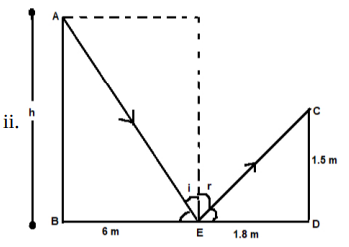
$\triangle ABE \sim \triangle CDE \ ($by $AA$ criteria$)$
$\frac{A B}{C D}=\frac{B E}{D E}$
$h=\frac{6 \times 1.5}{1.8}$
$h=5$
i.e., height of pole $=5 m$.
$iii. \tan i =\frac{6}{5}$
OR
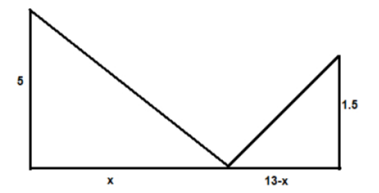
$\frac{1.5}{5}=\frac{13-x}{x}$
$1.5 x=65-5 x$
$6.5 x=65$
$x=\frac{65}{6.5}$
$=10$
$\therefore$ distance of Suresh from mirror
$=13-x$
$=13-10$
$=3 m$
$\triangle ABE \sim \triangle CDE \ ($by $AA$ criteria$)$
$\frac{A B}{C D}=\frac{B E}{D E}$
$h=\frac{6 \times 1.5}{1.8}$
$h=5$
i.e., height of pole $=5 m$.
$iii. \tan i =\frac{6}{5}$
OR
$\frac{1.5}{5}=\frac{13-x}{x}$
$1.5 x=65-5 x$
$6.5 x=65$
$x=\frac{65}{6.5}$
$=10$
$\therefore$ distance of Suresh from mirror
$=13-x$
$=13-10$
$=3 m$