Questions

M.C.Q (1 Marks)

Take a timed test

18 questions · 17 auto-graded MCQ + 1 self-marked written.

MCQ 11 Mark
In a data, if $l =40, h=15, f _1=7, f _0=3, f _2=6$, then the mode is
  • A
    $82$
  • $62$
  • C
    $52$
  • D
    $72$
Answer
Correct option: B.
$62$
$=l+\left(\frac{f_1-f_0}{2 f_1-f_0-f_2}\right) \times h$
$=40+\frac{7-3}{7 \times 2-3-6} \times 15$
$=40+\frac{4}{5} \times 15$
$=40+12$
$=52$
View full question & answer
MCQ 21 Mark
Two dice are thrown simultaneously. The probability that the product of the numbers appearing on the dice is $7$ is
  • A
    $7$
  • B
    $2$
  • $0$
  • D
    $1$
Answer
Correct option: C.
$0$
Elementary events are
$(1,1),(1,2),(1,3),(1,4),(1,5),(1,6)$
$(2,1),(2,2),(2,3),(2,4),(2,5),(2,6)$
$(3,1),(3,2),(3,3),(3,4),(3,5),(3,6)$
$(4,1),(4,2),(4,3),(4,4),(4,5),(4,6)$
$(5,1),(5,2),(5,3),(5,4),(5,5),(5,6)$
$(6,1),(6,2),(6,3),(6,4),(6,5),(6,6)$
$\therefore$ Number of Total outcomes $=36$
And Number of possible outcomes (product of numbers appearing on die is $7 ) $$=0$
$\therefore \text { Required Probability }=\frac{0}{36}=0$
View full question & answer
MCQ 31 Mark
A letter is chosen at random from the letters of the word ASSOCIATION. Find the probability that the chosen letter is a vowel.
  • $\frac{6}{11}$
  • B
    $\frac{7}{11}$
  • C
    $\frac{5}{11}$
  • D
    $\frac{3}{11}$
Answer
Correct option: A.
$\frac{6}{11}$
(a) $\frac{6}{11}$
Explanation : Total number of letters in 'ASSOCIATION' $=11$
Vowels are A, O, I, A, I, O, i.e, 6 in numbers.
$\therefore$ Probability of getting a vowel $=\frac{6}{11}$
View full question & answer
MCQ 41 Mark
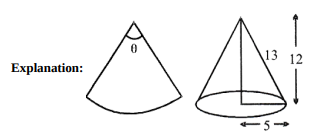
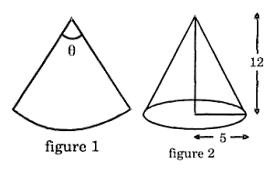
A piece of paper in the shape of a sector of a circle $($see figure $1)$ is rolled up to form a right$-$circular cone $($see figure $2).$ The value of angle $\theta$ is:
Image
  • A
    $\frac{5 \pi}{13}$
  • B
    $\frac{6 \pi}{13}$
  • $\frac{10 \pi}{13}$
  • D
    $\frac{9 \pi}{13}$
Answer
Correct option: C.
$\frac{10 \pi}{13}$
Image
$\therefore$ Slant height $=13$
As, $\theta=\frac{S}{r}$
$\Rightarrow S=r \theta$
$\Rightarrow 2 \pi(5)=13 \theta$
$\Rightarrow \theta=\frac{10 \pi}{13}$
View full question & answer
MCQ 51 Mark
In a circle of radius $21 \ cm ,$ an arc subtends an angle of $60^{\circ}$ at the centre. The area of the sector formed by the arc is:
  • $231 cm^2$
  • B
    $250 cm^2$
  • C
    $220 cm^2$
  • D
    $200 cm^2$
Answer
Correct option: A.
$231 cm^2$
The angle subtended by the arc $=60^{\circ}$
So, area of the sector $=\left(\frac{60^{\circ}}{360^{\circ}}\right) \times \pi r ^2 \ cm^2$
$=\left(\frac{441}{6}\right) \times\left(\frac{22}{7}\right) \ cm^2$
$=231 \ cm^2$
View full question & answer
MCQ 61 Mark
The tops of two towers of heights $x$ and $y$, standing on a level ground subtend angles of $30^{\circ}$ and $60^{\circ}$ respectively at the centre of the line joining their feet. Then, $x : y$ is
  • $1: 3$
  • B
    $2: 1$
  • C
    $1: 2$
  • D
    $3: 1$
Answer
Correct option: A.
$1: 3$
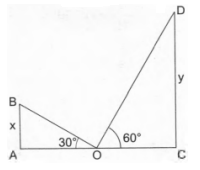
Let $AB$ and $CD$ be the given pillars and $O$ be the midpoint of $AC .$
Then, $A B=x, C D=y, \angle A O B=30^{\circ}$ and $\angle C O D=60^{\circ}$.
From right $\triangle OAB$, we have
$\frac{O A}{A B}=\cot 30^{\circ} \Rightarrow \frac{O A}{x}=\sqrt{3}$
$\Rightarrow OA=x \sqrt{3} \ldots \ldots \text { (i) }$
From right $\triangle O C D$, we have
$\frac{O C}{C D}=\cot 60^{\circ}$
$\Rightarrow \frac{O C}{y}=\frac{1}{\sqrt{3}}$
$\Rightarrow O C=\frac{y}{\sqrt{3}}\ldots\ldots(ii)$
But, $OA = OC$
$\therefore x \sqrt{3}=\frac{y}{\sqrt{3}}$
$\Rightarrow 3 x=y$
$\Rightarrow \frac{x}{y}=\frac{1}{3}$
$\Rightarrow x: y=1: 3$

Image
View full question & answer
MCQ 71 Mark
If the HCF of 72 and 234 is 18, then the LCM (72, 234) is:
  • 936
  • B
    836
  • C
    234
  • D
    324
Answer
Correct option: A.
936
(a) 936
Explanation : $\operatorname{LCM}(72,234)=\frac{(72 \times 234)}{18}=936$
Therefore, the LCM of $(72,234)$ is 936.
View full question & answer
MCQ 81 Mark
If a $\sin \theta+b \cos \theta=c$, then the value of $a \cos \theta-b \sin \theta$ is
  • $\sqrt{a^2+b^2-c^2}$
  • B
    $\sqrt{a^2+b^2+c^2}$
  • C
    $\sqrt{a^2-b^2+c^2}$
  • D
    $\sqrt{a^2-b^2-c^2}$
Answer
Correct option: A.
$\sqrt{a^2+b^2-c^2}$
Given: $a \sin \theta+ b \cos \theta= c$
Squaring both sides, we get
$\Rightarrow a ^2 \sin ^2 \theta+ b ^2 \cos ^2 \theta+2 ab \sin \theta \cos \theta= c ^2$
$\Rightarrow a ^2\left(1-\cos ^2 \theta\right)+ b ^2\left(1-\sin ^2 \theta\right)+2 ab \sin \theta \cos \theta= c ^2$
$\Rightarrow a ^2- a ^2 \cos ^2 \theta+ b ^2- b ^2 \sin ^2 \theta+2 ab \sin \theta \cos \theta= c ^2$
$\Rightarrow a ^2 \cos ^2 \theta- b ^2 \sin \theta-2 ab \sin \theta \cos \theta= a ^2+ b ^2- c ^2$
$\Rightarrow( a \cos \theta- b \sin \theta)^2= a ^2+ b ^2- c ^2$
$\Rightarrow a \cos \theta- b \sin \theta=\sqrt{a^2+b^2-c^2}$
View full question & answer
MCQ 91 Mark
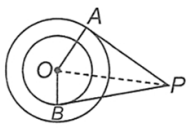
In the given figure, $O$ is the centre of two concentric circles of radii $5 \ cm$ and $3 \ cm.$ From an external point $P,$ tangents $PA$ and $PB$ are drawn to these circles. If $PA = 12 \ cm,$ then $PB =$​​​​​​​
Image
  • A
    $3 \sqrt{5} cm$
  • B
    $5 \sqrt{2} cm$
  • C
    $5 \sqrt{10} cm$
  • $4 \sqrt{10} cm$
Answer
Correct option: D.
$4 \sqrt{10} cm$
In right $\triangle \text{PAO , PA} =12 \ cm$ and $\text{OA} =5 \ cm$
$\therefore$ By Pythagoras theorem,
$\ce{OP^2=OA^2+PA^2}=5^2+(12)^2=25+144=169$
$\Rightarrow \text{OP}=\sqrt{169}=13 \ cm$
In right $\triangle \ce{PBO ,PB^2= OP^2 - OB ^2}$
$=13^2-3^2=169-9=160$
$\Rightarrow PB=\sqrt{160} \ cm=4 \sqrt{10} \ cm$
View full question & answer
MCQ 101 Mark
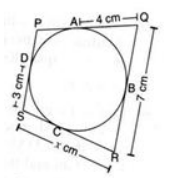
In the given figure, if AQ = 4 cm, QR = 7 cm, DS = 3 cm, then x is equal to
Image
  • 6 cm
  • B
    10 cm
  • C
    11 cm
  • D
    8 cm
Answer
Correct option: A.
6 cm
(a) 6 cm
Explanation : Here $A Q=4 cm$
$\therefore QB = AQ =4 cm$ [Tangents from an external point]
$\therefore B R=7-4=3 cm$
$\therefore BR = CR =3 cm$ [Tangents from an external point]
Also $SD = SC =3 cm$ [Tangents from an external point]
Therefore, $x=C S+C R=3+3=6$ units
View full question & answer
MCQ 111 Mark
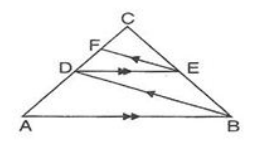
We have, $AB\|DE$ and $BD \| EF$ .Then
Image
  • A
    $B C^2=A B \cdot C E$
  • B
    $A C^2=B C \cdot D C$
  • C
    $A B^2=A C \cdot D E$
  • $D C^2=C F \times A C$
Answer
Correct option: D.
$D C^2=C F \times A C$
In $\triangle ABC$, using Thales theorem,
$\frac{DC}{AC}=\frac{CE}{BC}[A B \| D E]\ldots(i)$
And in triangle BCD, using Thales theorem,
$\frac{CF}{DC}=\frac{CE}{BC}[B D \| E F]\ldots(ii)$
From eq. $(i)$ and $(ii)$, we have
$\frac{DC}{AC}=\frac{CF}{DC}$
$\Rightarrow D C^2=C F \times A C$
View full question & answer
MCQ 121 Mark
The zeros of the quadratic polynomial $x^2+88 x+125$ are
  • both negative
  • B
    both positive
  • C
    both equal
  • D
    one positive and one negative
Answer
Correct option: A.
both negative
Given; $x^2+88 x+125=0$
$D=(88)^2-4(1)(125)$
$D=7244$
Now,
$x=\frac{-(88) \pm \sqrt{7244}}{2(1)}$
$\Rightarrow x=\frac{-88+2 \sqrt{1811}}{2}$
There roots are $x=-44+\sqrt{1811},-44-\sqrt{1811}$
Which are both negative.
View full question & answer
MCQ 131 Mark
The distance between the points $(0, 0)$ and $(a - b, a + b)$ is
  • A
    $2 \sqrt{a b}$
  • $\sqrt{2 a^2+2 b^2}$
  • C
    $2 \sqrt{a^2+b^2}$
  • D
    $\sqrt{2 a^2+a b}$
Answer
Correct option: B.
$\sqrt{2 a^2+2 b^2}$
distance between the point. $(0,0)$ and $( a - b , a + b )$ is
$=\sqrt{(a-b-0)^2+(a+b-0)^2}$
$=\sqrt{(a-b)^2+(a+b)^2}$
$=\sqrt{a^2+b^2-2 a b+a^2+b^2+2 a b}$
$=\sqrt{2\left(a^2+b^2\right)}$
$=\sqrt{2 a^2+2 b^2} \text { units. }$
View full question & answer
MCQ 141 Mark
The $11th$ term of the $AP: -5, \frac{-5}{2}, 0, \frac{5}{2}, \ldots$ is
  • A
    $-30$
  • B
    $-20$
  • C
    $30$
  • $20$
Answer
Correct option: D.
$20$
First term, $a =-5$
Common difference, $d=\frac{5}{2}-0=\frac{5}{2}$
$n =11$
As we know, nth term of an AP is
$a_n=a+(n-1) d$
where $a =$ first term
$a_n$ is nth term
$d$ is the common difference
$a_{11}=-5+(11-1)(5 / 2)$
$a_{11}=-5+25=20$
View full question & answer
MCQ 151 Mark
If one root of the equation $a(b-c) x^2+b(c-a) x+c(a-b)=0$ is 1 , then the other root is __________.
  • A
    $\frac{a(b-c)}{c(a-b)}$
  • B
    $\frac{c(a-b)}{a(b-c)}$
  • C
    $\frac{b(c-a)}{a(b-c)}$
  • D
    $\frac{a(b-c)}{b(c-a)}$
Answer
(b) $\frac{c(a-b)}{a(b-c)}$
Explanation : Given equation is
$a(b-c) x^2+b(c-a) x+c(a-b)=0$
Let $\alpha$ be the other root, then
Product of roots $=\alpha \times 1=\frac{c(a-b)}{a(b-c)}$
$\Rightarrow \alpha=\frac{c}{a}\left(\frac{a-b}{b-c}\right)$

View full question & answer
MCQ 161 Mark
The volume of the largest right circular cone that can be cut out from a cube of edge $4.2 \ cm$ is
  • A
    $58.2 \ cm^3$
  • $19.4 \ cm^3$
  • C
    $9.7 \ cm^3$
  • D
    $77.6 \ cm^3$
Answer
Correct option: B.
$19.4 \ cm^3$
$R =\frac{4.2}{2}$
$=2.1 \ cm$
$h =4.2 \ cm$
Volume of cone $=\frac{1}{3} \pi r^2 h$
$\frac{1}{3} \times \frac{22}{7} \times 2.1 \times 2.1 \times 4.2$
$=19.404 \ cm^3$
View full question & answer
MCQ 171 Mark
If $\left(a^2+b^2\right) x^2+2(a c+b d) x+c^2+d^2=0$ has no real roots, then
  • A
    $ab = cd$
  • B
    $ad=bc$
  • $ad \neq bc$
  • D
    $ac = bd$
Answer
Correct option: C.
$ad \neq bc$
$\left( a ^2+ b ^2\right) x ^2+2( ac + bd ) x + c ^2+ d ^2=0$
Here $A=a^2+b^2, B=2(a c+b d), C=c^2+d^2$
$D=B^2-4 A C=[2(a c+b d)]^2-4\left(a^2+b^2\right)\left(c^2+d^2\right)$
$=4\left[a^2 c^2+b^2 d^2+2 a b c d\right]-4\left[a^2 c^2+a^2 d^2+b^2 c^2+b^2 d^2\right]$
$=4 a^2 c^2+4 b^2 d^2+8 a b c d-4 a^2 c^2-4 a^2 d^2-4 b^2 c^2-4 b^2 d^2$
$=-4 a^2 d^2-4 b^2 c^2+8 a b c d$
$=-4\left(a^2 d^2+b^2 c^2-2 a b c d\right)$
$=-4(a d-b c)^2$
$\because$ Roots are not real
$\therefore D<0$
$\therefore-4(a d-b c)^2<0 \Rightarrow(a d-b c)^2<0$
$\Rightarrow a d-b c<0 \text { or } a d \neq b c$
View full question & answer
MCQ 181 Mark
The probability of getting a bad egg in a lot of $400$ is $0.035.$ The number of bad eggs in the lot is
  • A
    $21$
  • B
    $7$
  • C
    $28$
  • $14$
Answer
Correct option: D.
$14$
Probability of getting bad eggs $=\frac{\text { No. of bad eggs }}{\text { Total no. of eggs }}$
$\Rightarrow 0.035=\frac{\text { No. of badeggs }}{400}$
$\Rightarrow$ No. of bad eggs $=0.035 \times 400=14$
View full question & answer
M.C.Q (1 Marks) - Maths STD 10 Questions - Vidyadip