Question 13 Marks
Solve by elimination $3 x=y+5$ and $5 x-y=11$
Answer$3 x=y+5$
$\Rightarrow 3 x-y=5 \ldots \ldots(i)$
And
$5 x-y=11 \ldots \ldots(ii)$
Subtracting $(i)$ from $(ii)$
$5 x-y=11$
$3 x-y=5$
$\frac{-\quad+-}{2 x=6}$
$\Rightarrow x=3$
Substituting in $(ii)$
$5(3)-y=11$
$15-y=11$
$-y=11-15$
$-y=-4$
$y=4$
Thus, the solution is given by
$x=3 \text { and } y=4$
View full question & answer→Question 23 Marks
Solve for $x : \frac{2 x}{x-3}+\frac{1}{2 x+3}+\frac{3 x+9}{(x-3)(2 x+3)}=0, x \neq 3,-\frac{3}{2}$
Answer$\frac{2 x}{x-3}+\frac{1}{2 x+3}+\frac{3 x+9}{(x-3)(2 x+3)}=0$
$\Rightarrow \frac{2 x(2 x+3)+(x-3)+3 x+9}{(x-3)(2 x+3)}=0$
$\Rightarrow 4 x^2+6 x+x-3+3 x+9=0$
$\Rightarrow 4 x^2+10 x+6=0$
Solving by splitting the middle term,
$\Rightarrow 4 x^2+4 x+6 x+6=0$
$\Rightarrow 4 x(x+1)+6(x+1)=0$
$\Rightarrow(x+1)(4 x+6)=0$
$\Rightarrow x+1=0 \text { or } 4 x+6=0$
$\Rightarrow x=-1, \frac{-3}{2}$
As given in the question, $x \neq \frac{-3}{2}$
Hence, the solution of the given equation is $x=-1$.
View full question & answer→Question 33 Marks
Solve for $x$ and $y$ :
$\frac{2}{x-1}-\frac{1}{y-1}=4$
$\frac{4}{x-1}-\frac{1}{y-1}=10$
AnswerLet $\frac{1}{x-1}=u$ and $\frac{1}{y-1}=v$
Then we have,
$2 u-v=4$
$4 u-v=10$
Subtract $(i)$ from $(ii)$ we have,
$4 u-v-(2 u-v)=10-4$
$\Rightarrow 4 u-v-2 u+v=6$
$\Rightarrow 2 u=6$
$\Rightarrow u=\frac{6}{2}=3$
Substitute $u=3$ in $(i)$ we have,
$2(3)-v=4$
$\Rightarrow 6-v=4$
$\Rightarrow 6-4=v$
$\Rightarrow v=2$
Back Substituting $\frac{1}{x-1}=u$ we get,
$\frac{1}{x-1}=3$
$\Rightarrow 3(x-1)=1$
$\Rightarrow 3 x-3=1$
$\Rightarrow 3 x=4$
$\Rightarrow x=\frac{4}{3}$
Also, $\frac{1}{y-1}=v$
$\Rightarrow \frac{1}{y-1}=2$
$\Rightarrow 2(y-1)=1$
$\Rightarrow 2 y-2=1$
$\Rightarrow 2 y=3$
$\Rightarrow y=\frac{3}{2}$
Hence, $x=\frac{4}{3}$ and $y=\frac{3}{2}$.
View full question & answer→Question 43 Marks
Determine graphically whether the following pair of linear equations
$2 x-3 y=8$
$4 x-6 y=16$ has
$(i)$ A unique solution
$(ii)$ Infinitely many solutions
$(iii)$ No solution
Answer$2 x-3 y=8$
$\Rightarrow 3 y=2 x-8$
$\Rightarrow y=\frac{2 x-8}{3}$
Substituting arbitrary values of $x$ to get corresponding $y$ values we get,
| $x$ |
$y$ |
| $4$ |
$0$ |
| $0$ |
$-\frac{8}{3}$ |
| $7$ |
$2$ |
Now $4 x-6 y=16$
$\Rightarrow 6 y=4 x-16$
$\Rightarrow y=\frac{4 x-16}{6}$
Again substituting arbitrary values of $x$ to get corresponding $y$ values we get,
| $x$ |
$y$ |
| $4$ |
$0$ |
| $0$ |
$-\frac{8}{3}$ |
| $7$ |
$2$ |
Plotting these points we obtain the graph as:
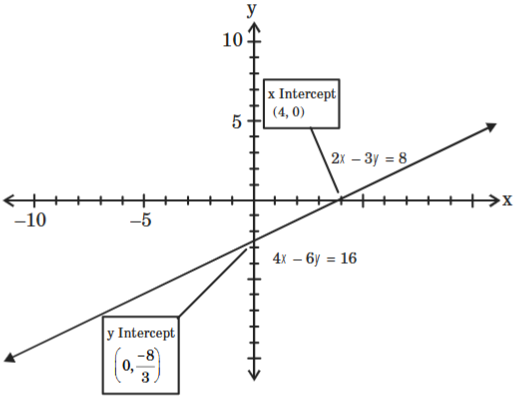
Since the graph is a pair of coincident lines.
Each point on the lines is a solution and
so the pair of equations have infinitely many solutions.
Hence, the correct option is $(ii).$ View full question & answer→Question 53 Marks
Solve the equation, $\frac{4}{x}-3=\frac{5}{2 x+3} ; x \neq 0, \frac{-3}{2}$, for $x$.
Answer$\frac{4}{x}-3=\frac{5}{2 x+3} ; x \neq 0, \frac{-3}{2}$
Solving the given equation
$\frac{4-3 x}{x}=\frac{5}{2 x+3}$
$(4-3 x)(2 x+3)=5 x$
$-6 x^2+8 x-9 x+12=5 x$
$-6 x^2-6 x+12=0$
Divide the above equation by $-6 ,$
$x^2+x-2=0$
Splitting the middle term,
$x^2+2 x-x-2=0$
$(x+2)(x-1)=0$
$(x+2)=0$
$\text { or }(x-1)=0$
$\Rightarrow x=-2$ or $x=1$
Thus, the solution of the given equation is $x=-2$ or $x=1$.
View full question & answer→Question 63 Marks
Solve the following pair of equations: $49 x+51 y=499 \text { and } 51 x+49 y=501$
Answer$49 x+51 y=499 \ldots \ldots(1)$
$51 x+49 y=501 \ldots \ldots(2)$
Multiplying eq $(1)$ by $51$ and eq $( 2 )$ by $49$
$\Rightarrow 49 x \times 51+51 y \times 51=499 \times 51$
$\Rightarrow 51 \times 49 x+51^2 y=499 \times 51 \ldots \ldots(3)$
$\Rightarrow 51 x \times 49+49 y \times 49=501 \times 49$
$\Rightarrow 49 \times 51 x+49^2 y=501 \times 49 \ldots \ldots(4)$
Subtracting eq $(4)$ from eq $(3)$
$\Rightarrow 51 \times 49 x-49 \times 51 x+51^2 y-49^2 y=499 \times 51$
$-501 \times 49$
$\Rightarrow 51^2 y-49^2 y=25449-24549$
$\Rightarrow y\left(51^2-49^2\right)=25449-24549$
$\Rightarrow y(51+49)(51-49)=900$
$\qquad \quad\left(\text { Using } a^2-b^2=(a+b)(a-b)\right)$
$\Rightarrow y(100)(2)=900$
$\Rightarrow 200 y=900$
$\Rightarrow y=\frac{9}{2}=4.5$
Now substituting the value of $y$ in eq $(1),$
$\Rightarrow 49 x+51 \times 4.5=499$
$\Rightarrow 49 x+229.5=499$
$\Rightarrow 49 x=499-229.5$
$\Rightarrow 49 x=269.5$
$\Rightarrow x=\frac{269.5}{49}=5.5$
Hence solution for the given equation is $x=5.5 \ y=4.5$.
View full question & answer→Question 73 Marks
Check graphically whether the following pair of linear equations is consistent. If yes, solve it graphically
$
2 x-5=0 \text { and } x+y=0
$
AnswerTo plot $2 x-5=0$, set of points we have,
$
x=\frac{5}{2}
$
for all values of $y$
To plot $x+y=0$, set of points we have,
Plot the points to obtain the graph. Graph we have is:

As we can see from the graph the lines intersect each other at point, hence they are consistent and have a unique solution $\left(\frac{5}{2},-\frac{5}{2}\right)$.
Hence the system is consistent and the solution is $x=\frac{5}{2}, y=-\frac{5}{2}$. View full question & answer→Question 83 Marks
Solve for $x$ and $y$
$\frac{5}{x-1}+\frac{1}{y-2}=2 ; \frac{6}{x-1}-\frac{3}{y-2}=1 ;[x \neq 1 y \neq 2 ]$
AnswerWe have,
$\frac{5}{x-1}+\frac{1}{y-2}=2 .....(1)$
$\frac{6}{x-1}-\frac{3}{y-2}=1.....(2)$
Multiply equation $2$ by $3$ , we get,
$3\left(\frac{5}{x-1}+\frac{1}{y-2}\right)=2 \times 3$
$\Rightarrow \frac{15}{x-1}+\frac{3}{y-2}=6.......(3)$
Adding equation $(2)$ and equation $(3),$ we get,
$\frac{6}{x-1}-\frac{3}{y-2}=1$
$+ \frac{15}{x-1}+\frac{3}{y-2}=6$
$\frac{6}{x-1}+\frac{15}{x-1}=7$
$\Rightarrow \frac{21}{x-1}=7$
Solving for $x$, we get,
$21=7(x-1)$
Divide the above equation by $3 ,$
$\Rightarrow x-1=3$
Add $1$ to both sides of above equation,
$\Rightarrow x=4$
Putting $x=4$ in equation $2,$ we get,
$\frac{6}{4-1}-\frac{3}{y-2}=1$
$\Rightarrow 2-\frac{3}{y-2}=1$
Subtract $2$ from both sides of above equation,
$\Rightarrow y=5$
Hence, the solution is
$x=4$ and $y=5$
View full question & answer→Question 93 Marks
Draw the graphs of the equations $x-y+1=0$ and $3 x+2 y-12=0$. Write the co$-$ordinates of the vertices of the triangle formed by these lines and the $x -$axis and shade the corresponding triangular region.
Answer$x-y+1=0 \text { Or }$
$x=y-1$
| $ X$ |
$0$ |
$1$ |
$2$ |
| $Y$ |
$1$ |
$2$ |
$3$ |
$3 x+2 y-12=0$
$\Rightarrow 3 x=12-2 y$
Divide the above equation by $3,$
$x=\frac{12-2 y}{3}$
| $x$ |
$4$ |
$2$ |
$0$ |
| $y$ |
$0$ |
$3$ |
$6$ |
Hence, the graphic representation is as follows:
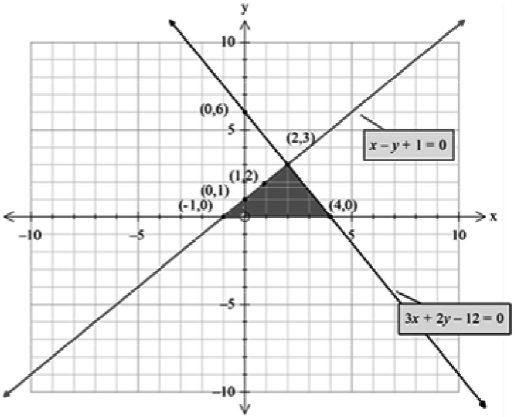
From the figure, it can be observed that these lines are intersecting each other at point $(2,3)$ and $x -$ axis at $(-1,0)$ and $(4,0)$.
Therefore the vertices of the triangle are $(2,3),(-1,0)$ and $(4,0)$ View full question & answer→Question 103 Marks
The sum of digits of a two$-$digit number is $7.$ If the digits are reversed, the new number decreased by $2$ equals twice the original number. Find the number.
AnswerLet the digit at tens place be $x$ and digit at ones place be $y$,
so number is given by
Given that the sum of digits of a two$-$digit number is $7.$
So, $x+y=7 \ldots \ldots(i)$
Subtract $x$ on both the sides of equation,
we get; $y=7-x \ldots \ldots(ii)$
Also, if the digits are reversed, the new number decreased by $2$ equals twice the original number.
Therefore, $(10 y+x)-2=2(10 x+y)$
$\Rightarrow 10 y+x-2=20 x+2 y$
Subtract $10 y+x$ from both the sides of the equation.
We get: $-2=19 x-8 y$
$\Rightarrow 19 x-8 y=-2 \ldots \ldots(iii)$
Put value of $y$ from equation $(ii)$ in equation $(iii)$
$\Rightarrow 19 x-8(7-x)=-2$
$\Rightarrow 19 x-56+8 x=-2$
Or, $27 x-56=-2$
Add $56$ on both the sides of equation;
$\Rightarrow 27 x=54$
Divide both sides by $27 ,$
$x=2$
Also, put value of $x$ in equation $(ii),$
we get; $y=7-2$
$\Rightarrow y=5$
We know that the number is $10 x+y$.
Put the value of $x$ and $y$ in this equation,
we get; $10 \times(2)+5=20+5=25$
So, the number is $25 .$
View full question & answer→Question 113 Marks
For which value of $k$ will the following pair of linear equations have no solution? $3 x+y=1,(2 k-1) x+(k-1) y=2 k+1$
AnswerConsider $3 x+y=1$ and
$(2 k-1) x+(k-1) y=2 k+1$
Compare the above two equations with $a x+b y=c, $ we get,
$a_1=3, b_1=1, c_1=1$
$a_2=2 k-1, b_2$
$=k-1, c_2=2 k+1$
We know that for no solution,
$\frac{a_1}{a_2}=\frac{b_1}{b_2} \neq \frac{c_1}{c_2}$
Or, $\frac{3}{2 k-1}=\frac{1}{k-1} \neq \frac{1}{2 k+1}$
Consider
$\frac{3}{2 k-1}=\frac{1}{k-1}$
$\Rightarrow 3(k-1)=2 k-1$
Applying distributive property,
Or $3 k -3=2 k -1$
Subtract $2 k$ on both sides and then, we get,
$\Rightarrow 3 k-2 k-3$
$=2 k-2 k-1$
$\Rightarrow k-3=-1$
Now add 3 on both sides,
$\Rightarrow k-3+3=-1+3$
$k=2$
Hence, for $k=3$ the equations have no solution.
View full question & answer→Question 123 Marks
Places $A$ and $B$ are $100 \ km$ apart on a highway. One car starts from $A$ and another from $B$ at the same time. If the cars travel in the same direction at different speeds, they meet in $5$ hours. If they travel towards each other they meet in $1$ hour. What are the speeds of the two cars?
AnswerAssume the speeds of the cars to be $\times \ km / hr$ and $y \ km/hr$
When the cars are traveling in the same direction
Relative speed $=x-y$
Distance $=100 \ km$
Apply Time $=\frac{\text { Distance }}{\text { Speed }}$
$\text { Time }=\frac{100}{x-y}=5 hrs$
$\Rightarrow x-y=\frac{100}{5}$
$x-y=20 \ldots \ldots(i)$
When the cars are going in the opposite direction
Relative speed $=x+y$
Time $=\frac{100}{x+y}=1$
$\Rightarrow x+y=100 \ldots \ldots(ii)$
Add equations $(i)$ and $(ii),$
$2 x=120$
Divide by $2 ,$
$x=60$
Substitute in $(ii),$
$60+y=100$
$\Rightarrow y=100-60$
$\Rightarrow y=40$
Hence the speeds of the cars are $60 \ km / hr$ and $40 \ km / hr$
View full question & answer→Question 133 Marks
Solve for $x$ and $y$.
$99 x+101 y=1499$
$101 x+99 y=1501$
AnswerAdd the two given equations,
$99 x+101 y=1499$
$101 x+99 y=1501$
$200 x+200 y=3000$
Divide by $200,$
$x+y=15 \ldots \ldots(i)$
Subtract the two given equations,
$99 x+101 y =1499$
$-(101 x+99 y) =-1501$
$-\overline{2 x+2 y} =-2$
Divide by $-2 ,$
$x-y=1$
$\Rightarrow x=y+1$
Substitute the above value of $x$ in $(i)$
$y+1+y=15$
$2 y+1=15$
$\Rightarrow 2 y=14$
Divide by $2 ,$
$y=\frac{14}{2}=7$
Also, $x=y+1$
$\Rightarrow x=7+1=8$
The speed of cureent $=7 \ km / hr$
The speed of boat is still water $=8 \ km / hr$
View full question & answer→Question 143 Marks
If $2 x+y=23$ and $4 x-y=19,$ find the value of $(5 y-2 x)$ and $\left(\frac{y}{x}-2\right)$.
Answer$2 x+y=23 \ldots \ldots(i)$
$4 x-y=19 \ldots \ldots(ii)$
Equation $(i)$ and $(ii)$
$\Rightarrow 2 x+y=23$
$4 x-y=19$
$\Rightarrow 6 x=42$
$x=7$
From $(i),$
$y =23-2 x$
$ =23-2 \times 7$
$ =23-14$
$\Rightarrow y =9$
$\therefore 5 y-2 x $
$=5 \times 9-2 \times 7$
$ =45-14$
$ =31$
$\frac{y}{x}-2 =\frac{9}{7}-2$
$ =\frac{9-14}{7}$
$ =\frac{-5}{7}$
View full question & answer→Question 153 Marks
If we add 1 to the numerator and subtract 1 from the denominator, a fraction reduces to 1 . It becomes $\frac{1}{2}$ if we only add 1 to the denominator. What is the fraction?
AnswerLet the fraction be $\frac{x}{y}$
According to the question, $\frac{x+1}{y-1}=1$
$
\begin{array}{cc}
\Rightarrow & x-y=-2 \\
& \frac{x}{y+1}=\frac{1}{2} \\
\Rightarrow & 2 x-y=1
\end{array}
$
Subtracting equation (i) from equation (ii), we get
$
x=3
$
Putting this value in equation (i), we get
$
\begin{array}{cc}
& 3-y=-2 \\
\Rightarrow & -y=-5 \\
\Rightarrow & y=5
\end{array}
$
Hence, the fraction is $=\frac{3}{5}$.
View full question & answer→Question 163 Marks
Solve for $x$ and $y :\frac{2}{x}+\frac{3}{y}=13 \text { and } \frac{5}{x}-\frac{4}{y}=-2$
Answer$\frac{2}{x}+\frac{3}{y}=13 \text { and } \frac{5}{x}-\frac{4}{y}=-2$
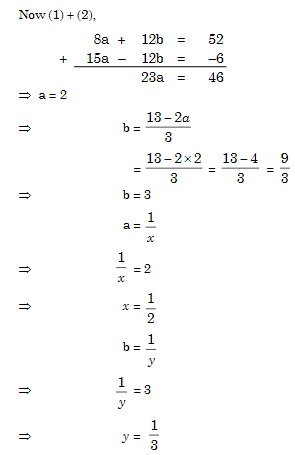
$\text { Let } \frac{1}{x}= a \text { and } \frac{1}{y}= b$
$\Rightarrow 2 a +3 b=13$ and $\times 4$
$5 a -4 y =-2\times 3$
Now $(1) +(2)$,
View full question & answer→Question 173 Marks
The difference between two numbers is $26$ and the larger number exceeds thrice of the smaller number by $4 .$ Find the numbers
Answer$x-y=26$
$\Rightarrow x=26+y \ldots \ldots(i)$
$x-3 y=4$
$\Rightarrow 26+y-3 y=4 ($Using $(1))$
$\Rightarrow 22-2 y=0$
$\Rightarrow 2 y=22$
$\Rightarrow y=11$
$($Using $(1))$Using $(1), x=26+11$
$x=37$
View full question & answer→Question 183 Marks
A train travels a distance of 480 km at a uniform speed. If the speed had been $8 km / hr$ less, then it would have taken 3 hours more to cover the same distance. Find the usual speed of the train.
View full question & answer→