Questions

5 Marks Questions

🎯

Test yourself on this topic

14 questions · timed · auto-graded

Question 15 Marks
Solve for $x$ & $y.$
$\frac{1}{3 x+y}+\frac{1}{3 x-y}=\frac{3}{4} \text { and } \frac{1}{2(3 x+y)}-\frac{1}{(3 x-y)}=\frac{-1}{8}$
Answer
Let $\frac{1}{3 x+y}=p$ and $\frac{1}{3 x-y}=q$
Now, the reduced equations are
$\begin{array}{c}p+q=\frac{3}{4} \\\Rightarrow 4 p+4 q=3 \quad \quad \ldots \ldots(i)\end{array}$
Also,
$\begin{array}{l}\frac{p}{2}-q=\frac{-1}{8} \\\Rightarrow 4 p-8 q=-1 \quad \quad \ldots \ldots(ii)\end{array}$
We will use elimination method to solve these Eqn. (i) and (ii)
Subtracting Eqn. (ii) from (i)
$\begin{array}{c}4 p+4 q=3 \\4 p-8 q=-1 \\\frac{(-) \quad(+) \quad(+)}{12 q=4} \\\Rightarrow q=\frac{4}{12} \\\Rightarrow q=\frac{1}{3}\end{array}$
Substituting value of $q$ in Eqn. (i)
$\begin{array}{l}p+\frac{1}{3}=\frac{3}{4} \\\Rightarrow p=\frac{3}{4}-\frac{1}{3}=\frac{5}{12}\end{array}$
Now we need to find out the values of $x$ and $y$,
As assumed, $\frac{1}{3 x+y}=p$ and $\frac{1}{3 x-y}=q$
$\Rightarrow \frac{1}{3 x+y}=\frac{5}{12}$ and $\frac{1}{3 x-y}=\frac{1}{3}$
$\Rightarrow 3 x+y=\frac{12}{5}\ldots\ldots (iii)$ and $3 x-y=3\ldots\ldots (iv)$
Using elimination method, adding equation (iii) and (iv).
$\begin{array}{l}3 x+y=\frac{12}{5} \\3 x-y=3 \\6 x \quad=\frac{27}{5} \\\Rightarrow x=\frac{9}{10}\end{array}$
Putting the value of $x$ in Eqn. (iv), we get
$\begin{array}{l}\Rightarrow 3\left(\frac{9}{10}\right)-y=3 \\\Rightarrow \frac{27}{10}-y=3 \\\Rightarrow y=\frac{27}{10}-3 \\\Rightarrow y=-\frac{3}{10}\end{array}$
So, the value of $x$ is $\frac{9}{10}$ and value of $y$ is $-\frac{3}{10}$.
View full question & answer
Question 25 Marks
The sum of the digits of two digits number is 9. Also 9 times the number is twice the number obtain by reversing the order of digits. Find the numbers.
Answer
Let the one's digit of the number $=x$
And the ten's digit of the number $=y$
Sum of the digits of two digits number is 9
$\begin{array}{l}x+y=9 \\\Rightarrow y=9-x \quad \quad \ldots \ldots(i)\end{array}$
Now, the value of number will be $=10(9-x)+x$
After reversing the digits, the number will be $=10(x)+(9-x)$
According to the question,
$9\{10(9-x)+x\}=2\{10(x)+(9-x)\}$
We will proceed with simplifying the equation,
$\begin{array}{l}\Rightarrow 9(90-10 x+x)=2(10 x+9-x) \\\Rightarrow 9(90-9 x)=2(9 x+9) \\\Rightarrow 810-81 x=18 x+18 \\\Rightarrow 810-18=18 x+81 x \\\Rightarrow 792=99 x\end{array}$
Divide the above equation by 99,
$\begin{array}{l}\Rightarrow x=\frac{792}{99} \\\Rightarrow x=8\end{array}$
Substituting value of $x$ in Eqn. (i), we get,
$y=9-8=1$
So the required number is 18.
View full question & answer
Question 35 Marks
The ratio of income of two persons is $9: 7$ and the ratio of their expenditure is $4: 3$ if each of them manages to save Rs. 2000/month. Find their monthly incomes.
Answer
Given ratio of income of two persons $=9: 7$
The ratio of their expenditure $=4: 3$
Let income of person $A =9 x$, income of person $B=7 x$
And expenditure of person $A=4 y$, expenditure of person $B=3 y$
We know that Income $-$ Expenditure $=$ Saving
According to the question,
$\begin{array}{l}9 x-4 y=2000 \ldots\ldots (i)\\7 x-3 y=2000\ldots\ldots (ii)\end{array}$
Solve both the equations by elimination method
Multiply equation (i) by 3
$\begin{array}{l}\Rightarrow 3(9 x-4 y=2000) \\\Rightarrow 27 x-12 y=6000\ldots\ldots (iii)\end{array}$$\qquad$
Multiply equation (ii) by 4
$\begin{array}{l}\Rightarrow 4(7 x-3 y=2000) \\\Rightarrow 28 x-12 y=8000\ldots\ldots (iv)\end{array}$
Subtracting Eqn. (iv) from (iii)
$\begin{array}{l}27 x-12 y=6000 \\28 x-12 y=8000\end{array}$
$\begin{array}{l}\frac{(-) \quad(+) \quad(-)}{-x \quad=-2000} \\\Rightarrow x=2000\end{array}$
Substituting value of $x$ in Eqn. (i)
$9(2000)-4 y=2000$
$\begin{array}{l}\Rightarrow 18000-4 y=2000 \\\Rightarrow 4 y=16000\end{array}$
Divide above equation by 4,
$\Rightarrow y=4000$
Now, Income of person  $A=9 \times 2000=$ Rs. 18,000
And Income of person $B=7 \times 2000=$ Rs. 14,000
Hence, monthly income of two persons are Rs. 18,000 and Rs. 14,000
View full question & answer
Question 45 Marks
Speed of a boat in still water is $15 km / h$. It goes 30 km upstream and returns back at the same point in 4 hours 30 minutes. Find the speed of the stream.
Answer
Assume the speed of the boat to be $15 km / h$
$\therefore$ Upstream speed of boat $=$ Speed of boat in still water $-$ Speed of the stream $=(15-x) km / h$
Also, Downstream speed of boat $=$ Speed of boat in still water $+$ Speed of the stream $=$ $(15+x) km / h$
Apply Time $=\frac{\text { Distance }}{\text { Speed }}$
Time for upstream $=\frac{30}{15-x}$
Time for downstream $=\frac{30}{15+x}$
4 hours 30 minutes $=4 \frac{1}{2}$ hours
$\begin{array}{l}\text { Total time }=\frac{30}{15-x}+\frac{30}{15+x}=4 \frac{1}{2} \\\Rightarrow 30\left[\frac{15+x+15-x}{(15-x)(15+x)}\right]=\frac{9}{2}\end{array}$
Divide the above equation by 3,
$\Rightarrow 10\left[\frac{30}{225-x^2}\right]=\frac{3}{2}$
Divide the above equation by 3,
$\begin{array}{l}\Rightarrow 10\left[\frac{10}{225-x^2}\right]=\frac{1}{2} \\\Rightarrow 200=225-x^2 \\\Rightarrow x^2=225-200=25\end{array}$
Taking square root,
$\Rightarrow x= \pm 5$
The speed cannot be negative. So, the speed of stream is $5 km / h$.
View full question & answer
Question 55 Marks
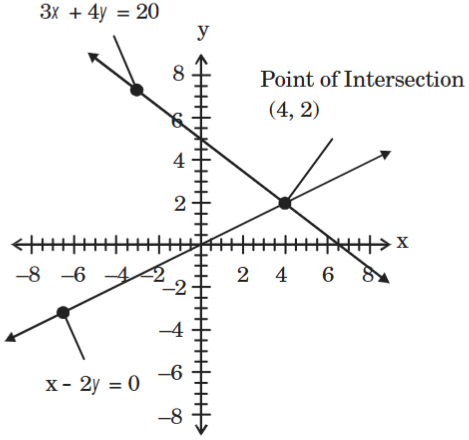
Find the graphically solution of $x-2 y=0$ and $3 x+4 y=20$
View full question & answer
Question 65 Marks
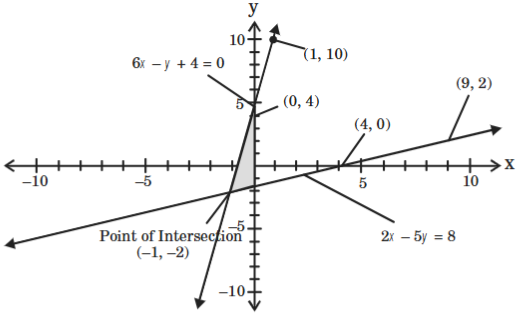
Solve the following pair of linear equations graphically $6 x-y+4=0$ and $2 x-5 y=8$. Shade the region bounded by the lines and $y$-axis.
View full question & answer
Question 75 Marks
Raghav scored 70 marks in a test getting 4 marks for each right answer and losing 1 mark for each wrong answer. Had 5 marks been awarded for each correct answer and 2 marks been deducted for each wrong answer, then Raghav would have scored 80 marks. How many questions were there in the test?
Which value would Raghav violate if he resorts to unfair means?
Answer
Let numbers of incorrect answered question $=y$
Let numbers of correct answered question $=x$
Given,
Raghav scored 70 marks in a test getting 4 marks for each right answer and losing 1 mark for each wrong answer.
$4 x-y=70 \quad \quad \ldots \ldots(i)$
Had 5 marks been awarded for each correct answer and 2 marks been deducted for each wrong answer, then Raghav would have scored 80 marks.
$5 x-2 y=80 \quad \quad \ldots \ldots(ii)$
Now multiply (i) by 2
$8 x-2 y=140 \quad \quad \ldots \ldots(iii)$
Subtract (i) from (iii)
$\begin{array}{l}(8 x-2 y=140)-(5 x-2 y=80) \\8 x-5 x-2 y+2 y=140-80 \\3 x=60\end{array}$
Divide both sides by 3
$\begin{array}{l}\frac{3 x}{3}=\frac{60}{3} \\x=20\end{array}$
Put value $x=20$ in (i)
$\begin{array}{l}4 \times 20-y=70 \\80-y=70 \\80-70=y \\y=10\end{array}$
Total number of questions in the test
$=x+y=20+10=30$
The total number of questions in test are 30.
Raghav would violate the principle of honesty if he resorts to unfair means.
View full question & answer
Question 85 Marks
4 chairs and 3 tables cost Rs 2100 and 5 chairs and 2 tables cost Rs 1750. Find the cost of one chair and one table separately.
Answer
Let cost of 1 chair be Rs $x$.
Let cost of 1 table be Rs $y$.
Given:
4 chairs and 3 tables cost Rs 2100
$4 x+3 y=2100 \quad \quad \ldots \ldots(i)$
5 chairs and 2 tables cost Rs 1750
$5 x+2 y=1750 \quad \quad \ldots \ldots(ii)$
Solving equation (i) and (ii)
$\begin{array}{l}4 x+3 y=2100 \ldots(i) \times 2 \\\Rightarrow 8 x+6 y=4200 \ldots(i i i) \\5 x+2 y=1750 \ldots .(i i) \times 3 \\\Rightarrow 15 x+6 y=5250 \ldots .(i v)\end{array}$
Now, (iii) - (iv)
$\begin{array}{l}\Rightarrow(8 x+6 y=4200)-(15 x+6 y=5250) \\\Rightarrow 8 x+6 y-15 x-6 y=4200-5250 \\\Rightarrow-7 x=-1050\end{array}$
Dividing both sides by 7
$\begin{array}{l}\Rightarrow \frac{7 x}{7}=\frac{1050}{7} \\\Rightarrow x=150 \\\text { Put } x=150 \text { in (ii), } \\5 x+2 y=1750 \quad \ldots .(\text { ii }) \\\Rightarrow 5 \times 150+2 y=1750 \\\Rightarrow 750+2 y=1750\end{array}$
Subtracting both sides by 750
$\begin{array}{l}\Rightarrow 750+2 y-750=1750-750 \\\Rightarrow 2 y=1000\end{array}$
Dividing both sides by 2
$\begin{array}{l}\Rightarrow \frac{2 y}{2}=\frac{1000}{2} \\\Rightarrow y=500\end{array}$
Therefore, Cost of 1 chair Rs $x= Rs 150$ and cost of 1 table is Rs $y= Rs 500$
View full question & answer
Question 95 Marks
A train travels at a certain average speed for a distance of 54 km and then travels a distance of 63 km at an average speed of $6 km / h$ more than the first speed. If it takes 3 hours to complete the total journey, what is its first speed?
Answer
Let $x$ be the initial speed of the bus for a distance of 54 km.
Then $x+6$ is the speed of bus for a distance of 63 km.
We know that, Time $=\frac{\text { Distance }}{\text { Speed }}$
The total time taken for the journey is 3 hours.
$\begin{array}{l}\text { So, } \frac{54}{x}+\frac{63}{x+6}=3 \\\frac{54(x+6)+63 x}{x(x+6)}=3 \\\Rightarrow 54(x+6)+63 x=3 x(x+6) \\\Rightarrow 54 x+324+63 x=3 x^2+18 x \\\Rightarrow 3 x^2-99 x-324=0\end{array}$
Divide the above equation by 3,
$\Rightarrow x^2-33 x-108=0$
Splitting the middle term,
$\begin{array}{l}\Rightarrow x^2-36 x+3 x-108=0 \\x(x-36)+3(x-36)=0 \\\Rightarrow(x+3)(x-36)=0 \\\Rightarrow x=36 \text { or } x=-3\end{array}$
Speed cannot be in negative, hence ignore $x=-3$. Hence, the first speed is $36 \text {km / hr}$.
View full question & answer
Question 105 Marks
The difference of two natural numbers is 5 and the difference of their reciprocals is $\frac{1}{10}$. Find the numbers.
Answer
Let the two natural numbers ne $N$ and $N+5$.
The difference of their reciprocals is $\frac{1}{10}$.
$\begin{array}{l}\Rightarrow \frac{1}{N}-\frac{1}{N+5}=\frac{1}{10} \\\Rightarrow \frac{N+5-N}{N(N+5)}=\frac{1}{10} \\\Rightarrow \frac{5}{N(N+5)}=\frac{1}{10} \\\Rightarrow N(N+5)=50 \\\Rightarrow N^2+5 N-50=0\end{array}$
Splitting the middle term,
$\begin{array}{l}\Rightarrow N^2+10 N-5 N-50=0 \\\Rightarrow N(N+10)-5(N+10)=0 \\\Rightarrow(N-5)(N+10)=0\end{array}$
Applying zero product rule property,
$\begin{array}{l}\Rightarrow(N-5)=0 \operatorname{Or} (N+10)=0 \\\Rightarrow N=5 \text { or } N=-10\end{array}$
$N$ cannot be negative since it is a natural number.
$\therefore N=5$
Hence the numbers $N$ and $N+5$ are 5 and 10.
View full question & answer
Question 115 Marks
In a flight of 2800 km, an aircraft was slowed down due to bad weather. Its average speed is reduced by $100 km / h$ and time increased by 30 minutes. Find the original duration of the flight.
Answer
Let us suppose that the average speed of the flight is $x km / h$.
Total distance covered by the flight in the journey $=2800 km$
$\therefore$ The duration of the flight $=\frac{2800}{x} hr$
Now, it is given that, the average speed is reduced by $100 km / h$ and the duration of the flight is increased by 30 minutes, due to bad weather in the journey.
$\therefore$ New speed $=x-100 km / h$
$\Rightarrow$ New duration of the flight $=\frac{2800}{x-100} hrs$
Now, according to the question,
New duration of the flight - Original duration of the flight $=30$ minutes $=\frac{1}{2} hr$
$\begin{array}{l}\Rightarrow \frac{2800}{x-100}-\frac{2800}{x}=\frac{1}{2} \\\Rightarrow 2800\left[\frac{1}{x-100}-\frac{1}{x}\right]=\frac{1}{2} \\\Rightarrow 2800\left[\frac{x-x+100}{(x-100) x}\right]=\frac{1}{2} \\\Rightarrow 2800\left[\frac{100}{x^2-100 x}\right]=\frac{1}{2} \\\Rightarrow \frac{100}{x^2-100 x}=\frac{1}{5600} \\\Rightarrow x^2-100 x=560000 \\\Rightarrow x^2-100 x-560000=0 \\\Rightarrow(x-800)(x+700)=0\end{array}$
Equating each factor to zero,
$\Rightarrow x=800 \text { or } x=-700$
Now. Since speed can't be negative, so we ignore
$x=-700$
Therefore, the original average speed of the flight $=800 km / h$
Thus, the original duration of the flight
$=\frac{2800}{800}=3.5 \text { hours }$
Hence, original duration of flight is 3.5 hours.
View full question & answer
Question 125 Marks
The numerator of a fraction is 3 less than its denominator. If 1 is added to the denominator, the fraction is decreased by $\frac{1}{15}$. Find the fraction.
Answer
Let the denominator of the fraction be $x$. Then, the numerator of the fraction will be $x-3$.
Thus, the fraction is $\frac{x-3}{x}$.
When 1 is added to the denominator, the fraction gets decreased by $\frac{1}{15}$.
$\begin{array}{l}\therefore \frac{x-3}{x}-\frac{1}{15}=\frac{x-3}{x+1} \\\Rightarrow \frac{x-3}{x}-\frac{x-3}{x+1}=\frac{1}{15} \\\Rightarrow \frac{(x-3)[x+1-x]}{x(x+1)}=\frac{1}{15} \\\Rightarrow \frac{x-3}{x^2+x}=\frac{1}{15} \\\Rightarrow x^2+x=15 x-45 \\
\Rightarrow x^2-14 x+45=0 \\\Rightarrow(x-9)(x-5)=0 \\\Rightarrow x=9 \text { or } x=5\end{array}$
When $x=9$, the fraction will be
$\frac{x-3}{x}=\frac{9-3}{9}=\frac{6}{9}$
When $x=5$, the fraction will be
$\frac{x-3}{x}=\frac{5-3}{5}=\frac{2}{5}$
The fractions are $\frac{6}{9}$ and $\frac{2}{5}$.
View full question & answer
Question 135 Marks
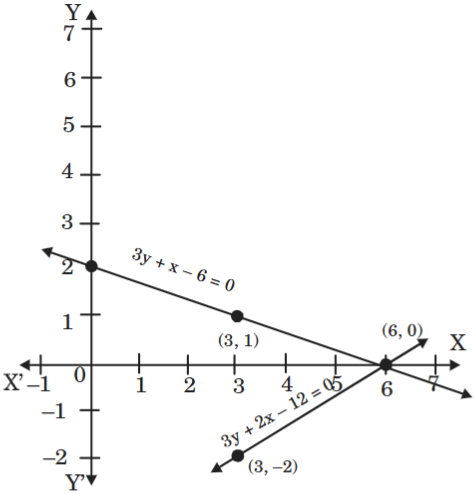
Check graphically, whether the pair of sequence is consistent. If so, then solve them graphically.
$\begin{array}{l}x+3 y=6 \\2 x-3 y=12\end{array}$
View full question & answer
Question 145 Marks
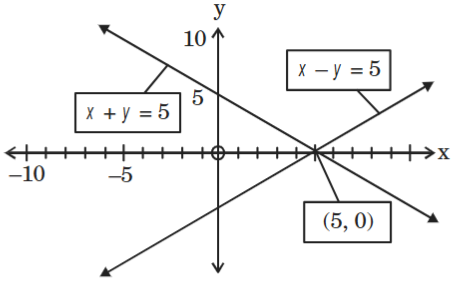
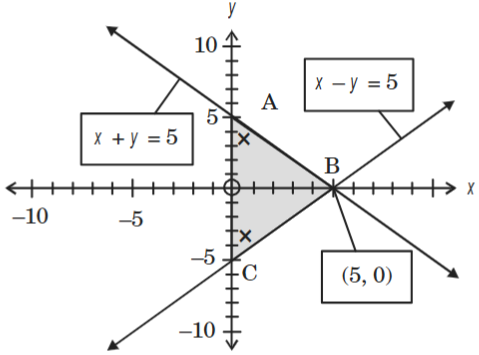
Draw the graphs of the following equations:
$\begin{array}{l}x+y=5 \\x-y=5\end{array}$
(i) Find the solution of the equations from the graph.
(ii) Shade the triangular region formed by the lines and the $y$-axis.
View full question & answer
5 Marks Questions - Maths STD 10 Questions - Vidyadip