Questions

M.C.Q (1 Marks)

Take a timed test

13 questions · auto-graded multiple-choice test.

MCQ 11 Mark
Choose the correct answer from the given four options:
The pair of equations x = a and y = b graphically represents lines which are:
  • A
    Parallel.
  • B
    Intersecting at (b, a).
  • C
    Coincident.
  • Intersecting at (a, b).
Answer
Correct option: D.
Intersecting at (a, b).
By graphically in every condition. if a, b >> 0; a, b < 0, a > 0, b < 0; a < 0, b > 0 but $\text{a}=\text{b}\neq0.$
The pair of equations x = a and y = b graphically represents lines which are interesectin at (a, b). If a, b > 0.
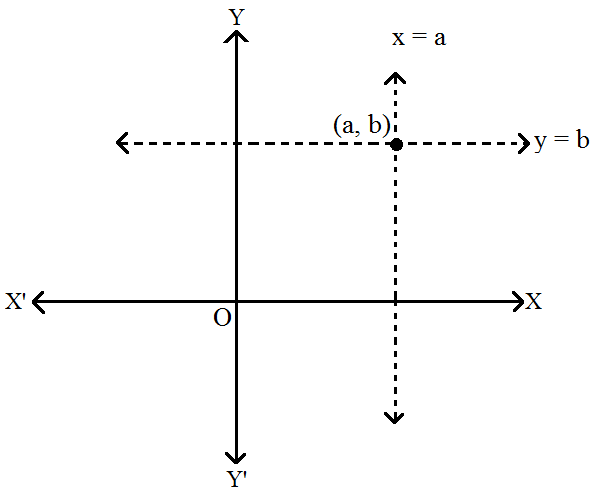
Similarly, in all cases two lines intersect at (a, b).
View full question & answer
MCQ 21 Mark
Choose the correct answer from the given four options:
The father's age is six times his son’s age. Four years hence, the age of the father will be four times his son’s age. The present ages, in years, of the son and the father are, respectively:
  • A
    4 and 24.
  • B
    5 and 30.
  • 6 and 36.
  • D
    3 and 24.
Answer
Correct option: C.
6 and 36.
Let x yr be the present age of father and y yr br the present afe of son.
Four years hence, it has relation by given condition,
(x + 4) = 4(y + 4)
⇒ x - 4y = 12 .....(i)
and x = 6y .....(ii)
on putting the value of x from Eq. (ii) in Eq. (i), we get
6y - 4y = 12
⇒ 2y = 12
⇒ y = 6
When y = 6, then x = 36
Hence, present age of father is 36 yr and age of son is 6 yr.
View full question & answer
MCQ 31 Mark
Choose the correct answer from the given four options:
Aruna has only Rs. 1 and Rs. 2 coins with her. If the total number of coins that she has is 50 and the amount of money with her is Rs. 75, then the number of Rs. 1 and Rs. 2 coins are, respectively:
  • A
    35 and 15.
  • B
    35 and 20.
  • C
    15 and 35.
  • 25 and 25.
Answer
Correct option: D.
25 and 25.
Let number of Rs. 1 coins = x
and number of Rs. 2 coins = y
Now, by given conditions x + y = 50 .....(i)
also, x × 1 + y × 2 = 75
⇒ x + 2y = 75 .....(ii)
On subtracting Eq. (i) From Eq. (ii), we get
(x + 2y)-(x + y) = 75 - 50
⇒ y = 25
When y = 25, thne x = 25.
View full question & answer
MCQ 41 Mark
Choose the correct answer from the given four options:
The value of c for which the pair of equations cx - y = 2 and 6x - 2y = 3 will have infinitely many solutions is:
  • A
    3.
  • B
    -3.
  • -12.
  • D
    No value.
Answer
Correct option: C.
-12.
Condition for infinitely many solutions,
$\frac{a_1}{a_2}=\frac{b_1}{b_2}=\frac{c_1}{c_2}$
The given lines are $c x-y=2$ and $6 x-2 y=3$
Here, $a_1=c, b_1=-1, c_1=-2$
and $a_2=6, b_2=-2, c_2=-3$
From Eq. (i), $\frac{c}{6}=\frac{-1}{-2}=\frac{-2}{-3}$
Here, $\frac{c}{6}=\frac{1}{3}$ and $\frac{c}{6}=\frac{2}{3}$
$\Rightarrow c =3$ and $c =4$
Since, c has different values.
Hence, for no value of c the pair of equations will have infinitely many solutions.
View full question & answer
MCQ 51 Mark
Choose the correct answer from the given four options:
Graphically, the pair of equations
6x – 3y + 10 = 0
2x – y + 9 = 0
represents two lines which are:
  • A
    Intersecting at exactly one point.
  • Intersecting at exactly two points.
  • C
    Coincident.
  • D
    Parallel.
Answer
Correct option: B.
Intersecting at exactly two points.
The given equations are6x - 3y + 10 = 0
$\Rightarrow\ 2\text{x}-\text{y}+\frac{10}{3}=0$ [dividing by 3] .....(i)
and 2x - y + 9 = 0 .....(ii)
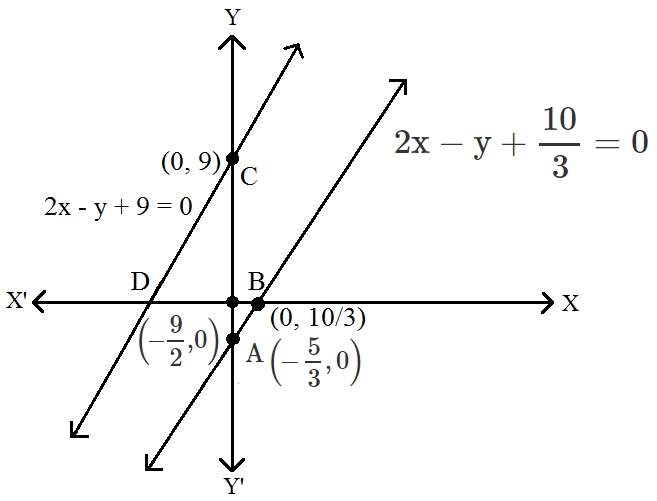
Now, table for $2\text{x}-\text{y}+\frac{10}{3}=0$
x
0
$-\frac{9}{2}$
$\text{y}=2\text{x}+\frac{10}{3}$
$\frac{10}{3}$
0
Points
A
B
and teble of 2x - y + 9 = 0,
x
0
$-\frac{9}{2}$
y = 2x + 9
9
0
Points
C
D

Hence, the pair of equations represents two parallel lines.
View full question & answer
MCQ 61 Mark
Choose the correct answer from the given four options:
A pair of linear equations which has a unique solution x = 2, y = -3 is:
  • A
    x + y = -1, 2x - 3y = -5.
  • 2x + 5y = -11, 4x + 10y = -22.
  • C
    2x - y = 1, 3x + 2y = 0.
  • D
    x - 4y -14 = 0, 5x - y - 13 = 0.
Answer
Correct option: B.
2x + 5y = -11, 4x + 10y = -22.
If x = 2, y = -3 is a unique solution of any pair of equation, then these values must satisfy that pair of equations.From option (b), LHS = 2x + 5y = 2(2) + 5(-3) = 4 -15 = -11 = RHS
and LHS = 4x + 10y = 4(2) + 10(-3) = 8 - 30 = -22 = RHS​​​.
View full question & answer
MCQ 71 Mark
Choose the correct answer from the given four options:
If x = a, y = b is the solution of the equations x - y = 2 and x + y = 4, then the values of a and b are, respectively:
  • A
    3 and 5.
  • B
    5 and 3.
  • 3 and 1.
  • D
    -1 and -3.
Answer
Correct option: C.
3 and 1.
Since, x = a and y = b is the solution of the equations x - y = 2 and x + y = 4, then tha values will satisfy that equationsa - b = 2 .....(i)
and a + b = 4 .....(ii)
on adding Eqs. (i) and (ii), we get
2a = 6
a = 3 and b = 1.
View full question & answer
MCQ 81 Mark
Choose the correct answer from the given four options:
The pair of equations x + 2y + 5 = 0 and –3x – 6y + 1 = 0 have:
  • A
    A unique solution.
  • B
    Exactly two solutions.
  • C
    Infinitely many solutions.
  • No solution.
Answer
Correct option: D.
No solution.
Given, equations are x + 2y + 5 = 0 and -3x - 6y + 1 = 0Here, $a_1=1, b_1=2, c_1=5$ and $a_2=-3, b_2=-6, c_2=1$
$\therefore\ \frac{\text{a}_1}{\text{a}_1}=-\frac{1}{3},\frac{\text{b}_1}{\text{b}_2}=-\frac{2}{6}=-\frac{1}{3},$
$\frac{\text{c}_1}{\text{c}_2}=\frac{5}{1}$
$\therefore\ \frac{\text{a}_1}{\text{a}_2}=\frac{\text{b}_1}{\text{b}_2}\neq\frac{\text{c}_1}{\text{c}_2}$
Hence, the pair of equations has no solution.
View full question & answer
MCQ 91 Mark
Choose the correct answer from the given four options : One equation of a pair of dependent linear equations is $-5x + 7y = 2$. The second equation can be:
  • A
    $10x + 14y + 4 = 0.$
  • B
    $-10x - 14y + 4 = 0.$
  • C
    $-10x + 14y + 4 = 0.$
  • $10x - 14y + 4 = 0.$
Answer
Correct option: D.
$10x - 14y + 4 = 0.$
$\frac{\text{a}_1}{\text{a}_2}=\frac{\text{b}_1}{\text{b}_2}=\frac{\text{c}_1}{\text{c}_2}=\frac{1}{\text{k}}\ .....(\text{i})$
Given equation of line is, $-5 x+7 y-2=0$
Here, $a_1=-5, b_1=7, c_1=-2$
From Eq. $(i), -\frac{5}{ a _2}=\frac{7}{b_2}=-\frac{2}{ c _2}=\frac{1}{ k }\ [$say$]$
$\Rightarrow a_2=-5 k, b_2=7 k, c_2=-2 k$
Where $, k$ is any arbitrary constant.
Putting $k =2$, then $a _2=-10, b_2=14$
and $c_2=-4$
$\therefore$ the requaired equation of lien becomes
$a_2 x+b_2 y+c_2=0$
$\Rightarrow-10 x+14 y-4=0$
$\Rightarrow 10 x-14 y+4=0$
View full question & answer
MCQ 101 Mark
Choose the correct answer from the given four options:
If a pair of linear equations is consistent, then the lines will be:
  • A
    Parallel.
  • B
    Always coincident.
  • Intersecting or coincident.
  • D
    Always intersecting.
Answer
Correct option: C.
Intersecting or coincident.
Condition for a consistent pair of linear equations.
$\frac{\text{a}_1}{\text{a}_1}\neq\frac{\text{b}_1}{\text{b}_2}$ [intersecting lines having unique solution]
and $\frac{\text{a}_1}{\text{a}_2}=\frac{\text{b}_1}{\text{b}_2}=\frac{\text{c}_1}{\text{c}_2}$ [coincident or dependent]
View full question & answer
MCQ 111 Mark
Choose the correct answer from the given four options:The pair of equations y = 0 and y = –7 has:
  • A
    One solution.
  • B
    Two solutions.
  • C
    Infinitely many solutions.
  • No solution.
Answer
Correct option: D.
No solution.
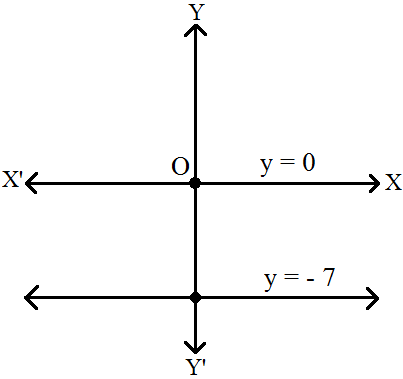
The given pair of equations are y = 0 and y = -7.

By graphically, both lines are parallel and having no solution.
View full question & answer
MCQ 121 Mark
Choose the correct answer from the given four options:
For what value of k, do the equations 3x - y + 8 = 0 and 6x - ky = -16 represent coincident lines?
  • A
    $\frac{1}{2}$
  • B
    $-\frac{1}{2}$
  • $2$
  • D
    $-2$
Answer
Correct option: C.
$2$
Condition for coincident lines is
$\frac{a_1}{a_2}=\frac{b_1}{b_2}=\frac{c_1}{c_2}$
Given lines, $3 x-y+8=10$
and $6 x-6 y+16=0$
Here, $a_1=3, b_1=-1, c_1=8$
and $a_2=6, b_2=-6, c_2=16$
From Eq. (i), $\frac{3}{6}=\frac{-1}{- k }=\frac{8}{16}$
$\Rightarrow \frac{1}{k}=\frac{1}{2}$
$\therefore k=2$
View full question & answer
MCQ 131 Mark
Choose the correct answer from the given four options:
If the lines given by 3x + 2ky = 2 and 2x + 5y + 1 = 0 are parallel, then the value of k is:
  • A
    $\frac{-5}{4}$
  • B
    $\frac{2}{5}$
  • $\frac{15}{4}$
  • D
    $\frac{3}{2}$
Answer
Correct option: C.
$\frac{15}{4}$
Condition for parallel lines is
$\frac{a_1}{a_2}=\frac{b_1}{b_2} \neq \frac{c_1}{c_2}$
Given lines $3 x+2 k y-2=0$
and $2 x+5 y-1=0$
Here, $a_1=3, b_1=2 k, c_1=-2$
and $a_2=2, b_2=5, c_2=-1$
From Eq. (i), $\frac{3}{2}=\frac{2 k }{5}$
$\therefore k=\frac{15}{4}$
View full question & answer
M.C.Q (1 Marks) - Maths STD 10 Questions - Vidyadip