MCQ 11 Mark
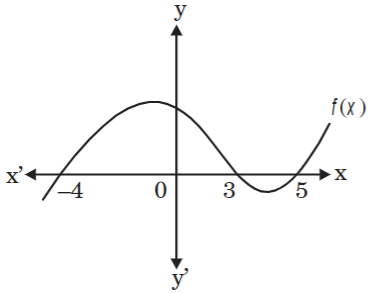
In the given figure, the number of zeroes of the polynomial $f(x)$ are:
Answer(c)
From the graph we can say that the number of times the graph touches the x -axis is 3 .
So, the number of zeroes of the polynomial is 3 .
Hence the correct option is (c).
View full question & answer→MCQ 21 Mark
The polynomial whose zeroes are -5 and 4 is:
- A
$x^2-5 x+4$
- B
$x^2+5 x-4$
- ✓
$x^2+x-20$
- D
$x^2-9 x-20$
AnswerCorrect option: C. $x^2+x-20$
(c)
Let $a=-5$ and $b=4$
Sum of zeroes
$
\Rightarrow a+b=-5+4=-1\quad \quad \ldots \ldots(1)
$
Product of zeroes
$
\Rightarrow a \times b=-5 \times 4=-20 \quad \quad \ldots \ldots(2)
$
The general equation of the quadratic is:$
x^2-(a+b) x+a b=0
$
Substituting values from equation 1 and 2 , we get,$
x^2+x-20=0
$
Hence, The polynomial whose zeroes are -5 and 4 is (c).
View full question & answer→MCQ 31 Mark
The graph of the polynomial $p(x)$ intersects the x -axis three times in distinct points, then which of the following could be an expression for $p(x)$ :
- ✓
$4-4 x-x^2+x^3$
- B
$3 x^2+3 x-3$
- C
$3 x+3$
- D
$x^2-9$
AnswerCorrect option: A. $4-4 x-x^2+x^3$
(a)
It is given that graph of the polynomial $p(x)$ intersects the $x$-axis three times in distinct points, so the number of zeroes for the polynomial is 3 and it is a third degree polynomial of the form $a x^3+b x^2+c x+d=0$ where $a \neq 0$.
From the given options, the one option matching with the standard equation of a third degree polynomial is $4-4 x-x^2+x^3=x^3-x^2-4 x+4$. Hence, the correct option is (a).
View full question & answer→MCQ 41 Mark
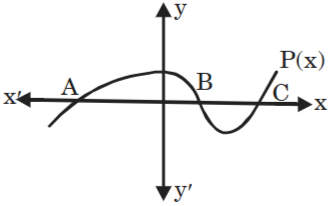
In figure, the graph of a polynomial $P (x)$ is shown. The number of zeroes of $P (x)$ is
Answer(c)
According to the property of the polynomials,Number of zeroes $=$ Number of points at which graph intersects the x -axis.
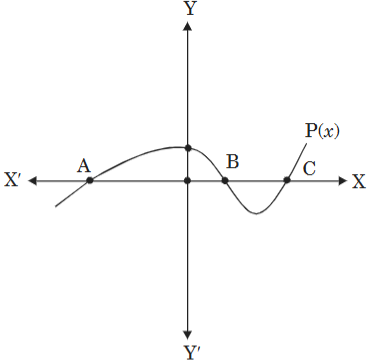
From the figure it is clear that the graph intersects X -axis at three different points. Therefore, the polynomial has 2 zeroes. View full question & answer→MCQ 51 Mark
The graph of a polynomial $P (x)$ cuts the $x$-axis at 3 points and touches it at 2 other points. The number of zeroes of $P (x)$ is
Answer(d)
According to the property of the polynomials,Number of zeroes $=$ Number of points at which graph intersects the $x$-axis.
It is mentioned in the question that, the graph intersects $x$-axis at 3 points and it touches it at 2 further points.
This means that the graph intersects the $x$-axis at 5 different points.
Therefore, number of zeroes $=5$.
View full question & answer→MCQ 61 Mark
If $p(x)=x^2+5 x+6$, then $p(-2)$ is:
Answer(b)
$
\begin{aligned}
P(-2) & =(-2)^2+5(-2)+6 \\
& =4-10+6 \\
& =0
\end{aligned}
$
View full question & answer→MCQ 71 Mark
If the zeroes of the quadratic polynomial $x^2+(a+1) x+b$ are 2 and -3 , then
- A
$a =-7, b=-1$
- B
$a=5, b=-1$
- C
$a =2, b=-6$
- ✓
(a=0, b=-6$
AnswerCorrect option: D. (a=0, b=-6$
(d)
$x ^2+( a +1) x + b$ is the quadratic polynomial.2 and -3 are the zeros of the quadratic polynomial.
2 and -3 are the zeros of the quadratic polynomial.
Thus, $
2+(-3)=\frac{-(a+1)}{1}
$
$
\begin{array}{rlrl}
\Rightarrow \frac{(a+1)}{1} =1 \\
\Rightarrow a+1 =1 \\
\Rightarrow a =0 \\
\text { Also, } 2 \times(-3) =b \\
\Rightarrow b =-6
\end{array}
$
View full question & answer→MCQ 81 Mark
If $\alpha$ and $\beta$ are the zeroes of the polynomial $x^2-1$, then the value of $(\alpha+\beta)$ is
Answer(d)
$x^2-1=(x-1)(x+1)$
So, ' 1 ' and ' -1 ' are zeroes of given polynomial$
\begin{aligned}
\therefore \quad \alpha+\beta & =1+(-1) \\
& =1-1=0
\end{aligned}
$
View full question & answer→MCQ 91 Mark
The number of quadratic polynomials having zeroes -5 and -3 is
MCQ 101 Mark
The zeroes of the polynomial $x^2-3 x-m(m+3)$ are
- A
$m , m +3$
- ✓
$- m , m +3$
- C
$m ,-( m +3)$
- D
$- m ,-( m +3)$
AnswerCorrect option: B. $- m , m +3$
$x^2-3 x-m(m+3)=0$
$\Rightarrow x^2-(m+3) x+m x-m(m+3)=0$
$\Rightarrow x(x-m-3)+m(x-m-3)=0$
$\Rightarrow(x+m)(x-m-3)=0$
$\Rightarrow x=-m, m+3$
View full question & answer→MCQ 111 Mark
The zeroes of quadratic polynomial $x^2+99 x+127$ are
- ✓
- B
- C
one positive and one negative
- D
one positive and one negative
Answer(a)
$p(x)=x^2+99 x+127$Here, sum of zeroes $=\frac{- b }{ a }=-99$ and product of zeroes $=\frac{ c }{ a }=127$
Since, product of zeroes is positive and sum is negative, it is possible only when both the zeroes are negative.
Therefore, both the zeroes are negative.
View full question & answer→MCQ 121 Mark
Zeroes of a quadratic polynomial $x^2-5 x+6$ are
- A
$-5,1$
- B
$5,1$
- ✓
$2,3$
- D
$-2,-3$
Answer$p(x)=x^2-5 x+6=0$
$\Rightarrow x ^2-3 x -2 x +6=0($splitting the middle term$)$
$\Rightarrow x(x-3)-2(x-3)=0$
$\Rightarrow(x-3)(x-2)=0 $
$\Rightarrow x=3.2$
View full question & answer→MCQ 131 Mark
A quadratic polynomial whose sum and product of zeroes are 2 and -1 respectively is :
- A
$x^2+2 x+1$
- ✓
$x^2-2 x-1$
- C
$x^2+2 x-1$
- D
$x^2-2 x+1$
AnswerCorrect option: B. $x^2-2 x-1$
(b)
$x^2-($ Sum of zeroes) $x+$ Product of zeroes
View full question & answer→MCQ 141 Mark
If $\alpha, \beta$ and $\gamma$ are the zeroes of a cubic polynomial $f(x)=a x^3+b x^2+c x+d$, then, $\alpha \beta \gamma=$
- A
$\frac{ b }{ a }$
- B
$\frac{ c }{ a }$
- C
$\frac{ d }{ a }$
- ✓
$-\frac{ d }{ a }$
AnswerCorrect option: D. $-\frac{ d }{ a }$
(d)
$\alpha \beta \gamma=\frac{- \text { constant term }}{\text { coefficient of } x ^3}=-\frac{ d }{ a }$
View full question & answer→MCQ 151 Mark
If $\alpha, \beta$ and $\gamma$ are the zeroes of a cubic polynomial $f(x)=a x^3+b x^2+c x+d$, then, $\alpha \beta+\beta \gamma+\gamma \alpha=$
- A
$\frac{ d }{ a }$
- ✓
$\frac{ c }{ a }$
- C
$\frac{ b }{ a }$
- D
$-\frac{ d }{ a }$
AnswerCorrect option: B. $\frac{ c }{ a }$
(b)
$\alpha \beta+\beta \gamma+\gamma \alpha=\frac{\text { coefficient of } x }{\text { coefficient of } x ^3}=\frac{ c }{ a }$
View full question & answer→MCQ 161 Mark
Given that one of the zeroes of the cubic polynomial $ax ^3+ bx ^2+ cx + d$ is zero, the product of the other two zeroes is
- A
$-\frac{ c }{ a }$
- ✓
$\frac{ c }{ a }$
- C
$0$
- D
$-\frac{ b }{ a }$
AnswerCorrect option: B. $\frac{ c }{ a }$
Let $\alpha, \beta, 0$ be the zeroes of $a x^3+b x^2+c x+d$.
Then, sum of the product of zeroes, taken two at a time is given by.
$\alpha \beta+\beta \times 0+\alpha \times 0=\frac{c}{a}$
$\Rightarrow \alpha \beta=\frac{c}{a}$
Hence, the product of the two other zeroes $=\frac{ c }{ a }$
View full question & answer→MCQ 171 Mark
The polynomial which when divided by $-x^2+x+1$ gives a quotient $x-2$ and remainder 3 , is
- A
$x^3-3 x^2+3 x-5$
- B
$-x^3-3 x^2-3 x-5$
- ✓
$-x^3+3 x^2-3 x+5$
- D
$x^3-3 x^2-3 x+5$
AnswerCorrect option: C. $-x^3+3 x^2-3 x+5$
(c)
Polynomial $=\left(-x^2+x-1\right) \times(x-2)+3$
$=-x^3+x^2-x+2 x^2-2 x+2+3$
$
=-x^3+3 x^2-3 x+5
$
Hence, required polynomial
View full question & answer→MCQ 181 Mark
What should be subtracted to the polynomial $x ^2-16 x +30$, so that 15 is the zero of the resulting polynomial?
Answer(c)
$\because 15$ is the zeroes of polynomial $f(x)=x^2-16 x+$ 30
$\therefore$ subtracted values $= f (15)$
$=(15)^2-16 \times 15+30$
$
=225-240+30=15
$
View full question & answer→MCQ 191 Mark
The product of zeroes of $3 x+4 x^2+x-6$ is
Answer$f(x)=x^3+4 x^2+x-6$
Product of zeroes
$=\frac{- \text { constant term }}{\text { coefficient of } x^3}$
$=\frac{-(-6)}{1}$
$=6$
View full question & answer→MCQ 201 Mark
If two zeroes of $x^3+x^2-5 x-5$ are $\sqrt{5}$ and $-\sqrt{5}$, then its third zero is
AnswerLet $f(x)=x^3+x^2-5 x-5$
Since $\sqrt{5}$ and $-\sqrt{5}$ are the zeroes of $f ( x )$
$\therefore( x -\sqrt{5})( x +\sqrt{5})$ are the factor of $f ( x )\left( x ^2-5\right)$ are the factor of $f(x)$
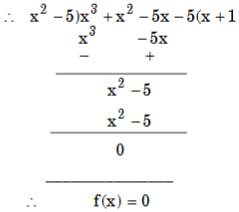
$\left(x^2-5\right)(x+1)=0$
$(x-\sqrt{5})(x+\sqrt{5})(x+1)=0$
for third zeroes
$\Rightarrow x +1=0$
$x=-1$
Hence third zeroes $=-1$ View full question & answer→MCQ 211 Mark
If the polynomial $f(x)=a x^3+b x-c$ is divisible by the polynomial $g(x)=x^2+b x+c$ then $a b=$
- ✓
$1$
- B
$\frac{1}{ c }$
- C
$-1$
- D
$-\frac{1}{ c }$
AnswerSince $f(x)$ is divisible by $g(x)$, the remainder will be $0$ .
On dividing $f ( x )$ by $g( x )$ using long division,
we can get the remainder in terms of $a$ and $b,$ which is
$(a b-a c+b) x+a b c-c$
Since the remainder is $0$
$\therefore(a b-a c+b) x+a b c-c=0 x+0$
$\Rightarrow a b c-c=0$
$\Rightarrow a b c=c$
$\Rightarrow a b=\frac{c}{c}$
$a b=1$
View full question & answer→MCQ 221 Mark
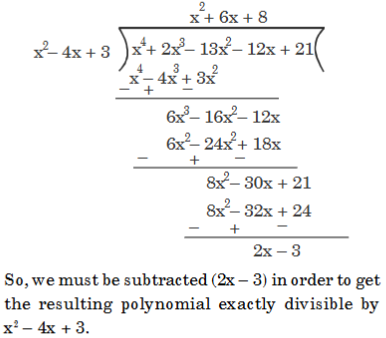
What must be subtracted from the polynomial $x ^4+2 x ^3-13 x ^2-12 x +21$, so that the resulting polynomial is exactly divisible by $x^2-4 x+3$ ?
- A
$2 x -3$
- B
$2 x -2$
- C
$2 x +3$
- D
$2 x -6$
View full question & answer→MCQ 231 Mark
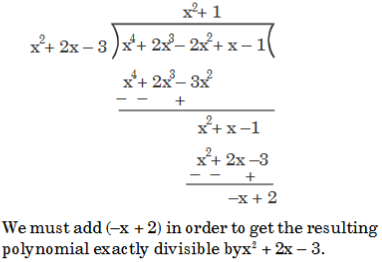
What must be added to the polynomial $f(x)=x^4+$ $2 x ^3-2 x ^2+ x -1$ so that the resulting polynomial is exactly divisible by $x^2+2 x-3$ ?
- ✓
$- x +2$
- B
$x +2$
- C
$x +3$
- D
$x -3$
AnswerCorrect option: A. $- x +2$
(a)
View full question & answer→MCQ 241 Mark
If the zeroes of the polynomial $f(x)=x^3-12 x^2+39 x + K$ are in $A.P.$, then the value of $K$ is equal to
AnswerLet $(a-d), a$ and $(a+d)$ are the roots of the given polynomial.
Now, $x ^3-12 x ^2+39 x + K$,
Sum of roots $=\frac{-\left(\text { Coefficient of } x^2\right)}{\text { Coefficient of } x^3}$
$(a-d)+a+(a+d)=\frac{-(12)}{1}$
$3 a =12$
$\Rightarrow a =\frac{12}{3}=4$
Again, sum of product of two consecutive roots
$=\frac{\text { Coefficient of } x}{\text { Coefficient of } x^3}$
$(a-d) a+a(a+d)+(a+d)(a-d)=39$
$\Rightarrow a^2-a d+a^2+a d+a^2-d^2=39$
$\Rightarrow 3 a^2-d^2=39$
$\Rightarrow 3(4)^2-d^2=39$
$\Rightarrow 3 \times 16-d^2=39$
$\Rightarrow d^2=9$
$\Rightarrow d= \pm 3$
Hence, roots are $1, 4, 7$ or $7,4,1$
Now, products of all roots
$=\frac{- \text { constant term }}{\text { coefficient of } x^3}$
$7 \times 4 \times 1=-K$
$\Rightarrow K=-28$
View full question & answer→