Questions

M.C.Q (1 Marks)

Take a timed test

11 questions · auto-graded multiple-choice test.

MCQ 11 Mark
Choose the correct answer from the given four options in the following questions:The number of polynomials having zeroes as -2 and 5 is:
  • A
    1.
  • B
    2.
  • C
    3.
  • More than 3.
Answer
Correct option: D.
More than 3.
Let $p(x) = ax^2 + bx + c$ be the required polynimial whose zeroes are -2 and 5.$\therefore\ \text{Sum of zeroes}=\frac{-\text{b}}{\text{a}}$
$\Rightarrow\ \frac{-\text{b}}{\text{c}}=-2+5=\frac{3}{1}=\frac{-(-3)}{1}\ .....(\text{i})$
and Procudt of zeroes $=\frac{\text{c}}{\text{a}}$
$\Rightarrow\ \frac{\text{c}}{\text{a}}=-2\times5=\frac{-10}{1}\ .....(\text{ii})$
From Eqs. (i) and (ii)
a = 1, b = -3 and c = -10
$\therefore p(x)=a x^2+b x+c=1 \cdot x^2-3 x-10$
$=x^2-3 x-10$
But we know that. if we multiply/divide any polynomial by any arbitraru constant. Then, the zeroes of polynomial never change.
$\therefore$ $p(x) = kx^2 - 3kx - 10k$ [where, k is a real number]
$\therefore\ \text{p}(\text{x})=\frac{\text{x}^2}{\text{k}}-\frac{3}{\text{k}}\text{x}-\frac{10}{\text{k}},$ [where, k is a nonzero real number].
View full question & answer
MCQ 21 Mark
Choose the correct answer from the given four options in the following questions:
The zeroes of the quadratic polynomial $\text{x}^2+\text{kx}+\text{k},\text{ k}\neq0,$:
  • Cannot both be positive.
  • B
    Cannot both be negative
  • C
    Are always unequal.
  • D
    Are always equal.
Answer
Correct option: A.
Cannot both be positive.
Let p(x) $=\text{x}^2+\text{kx}+\text{k},\text{ k}\neq0,$
On comparing p(x) with $ax^2 + bx + c,$ we get
a = 1, b = k and c = k
Now, $\text{x}=\frac{-\text{b}\pm\sqrt{\text{b}^2-4\text{ac}}}{2\text{a}}$ [by quadratic formula]
$=\frac{-\text{k}\pm\sqrt{\text{k}^2-4\text{k}}}{2\times1}$
$=\frac{-\text{k}\pm\sqrt{\text{k}(\text{k}-4)}}{2},\text{k}\neq0$

Here, we see that
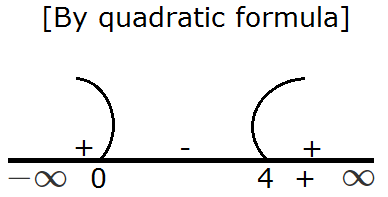
k(k - 4) > 0
$\Rightarrow\ \text{k }\in(-\infty,0)\text{ u }(4,\infty)$
Now, we know that
In quadratic Polynomial $ax^2 + bx + c$
If a > 0, b > 0, c > 0 or a < 0, b < 0, c < 0,
Then the polynomial has always all negative zeroes.
and if a > 0, c > 0 of a < 0, c > 0, then the ploynomial has always zeroes of opposite sing
Case I:
If $\text{k}\in(-\infty, 0)\text{ i.e., k}<0$
⇒ a = 1 > 0, b,c = k < 0
So, both zeroes are of opposite sign.
Case II:
If $\text{k}\in(4,\infty)\text{ i.e., k}\leq4$
⇒ a = 1 > 0, b, c > 4
So, both zeroes are negative,
Hence, in any case zeroes of the quadratic polynomial cannot both be positive.
View full question & answer
MCQ 31 Mark
Choose the correct answer from the given four options in the following questions:
If the zeroes of the quadratic polynomial $ax^2 + bx + c, c ≠ 0$ are equal, then:
  • c and a have opposite signs.
  • B
    c and b have opposite signs.
  • C
    c and a have the same sign.
  • D
    c and b have the same sign.
Answer
Correct option: A.
c and a have opposite signs.
The zeroes of the given quadratic polynomial $ax^2 + bx + c, c ≠ 0$ are equal, if coefficient of $x^2$ and constant term have the same sign i.e., c and a have the same sign. While b i.e., coefficient of x can be positive/negative but not zero.e.g., (i) $x^2+4 x+4=0$
(ii) $x^2-4 x+4=0$
$\Rightarrow(x+2)^2=0 \Rightarrow(x-2)^2=0$
$\Rightarrow x=-2,-2 \Rightarrow x=2,2$
Alternate Answer
Given that, the zeroes of the quadratic polynomial $ax^2 + bx + c$ where c ≠ 0, are equal i.e., discriminant (D) = 0
$\Rightarrow b^2-4 a c=0$
$\Rightarrow b^2+4 a c$
$\Rightarrow a c=\frac{b^2}{4}$
$\Rightarrow a c>0$
Which is olny possible when a and c have the same signs.
View full question & answer
MCQ 41 Mark
Choose the correct answer from the given four options in the following questions:A quadratic polynomial, whose zeroes are –3 and 4, is:
  • A
     $x^2-x+12$.
  • B
    $x^2+x+12$.
  • $\frac{x^2}{2}-\frac{x}{2}-6$
  • D
    $2 x^2+2 x-24$.
Answer
Correct option: C.
$\frac{x^2}{2}-\frac{x}{2}-6$
Then, sum of zeroes = -3 + 4 = 1
$\Big[\because\ \text{sum of zeroes}=\frac{\text{-b}}{\text{a}}\Big]$
$\Rightarrow\ \frac{-\text{b}}{\text{a}}=\frac{1}{1}\Rightarrow\ \frac{-\text{b}}{\text{c}}=-\frac{(-1)}{1}\ .....(\text{i})$
and product of zeroes = -3 × 4 = -12
$\Big[\because\ \text{product of zeroes} = \frac{\text{c}}{\text{a}}\Big]$
$\Rightarrow\ \frac{\text{c}}{\text{a}}=\frac{-12}{1}\ .....\text{(ii)}$
From Eqs. (i) and (ii),
a = 1, b = -1 and c = -12
$=a x^2+b x+c$
$\therefore \text { Required polynimial }=1 \cdot x^2-1 \cdot x-12$
$=x^2-x-12$
$=\frac{\text{x}^2}{2}-\frac{\text{x}}{2}-6$
We know that, if we multiply/divide and polynomial by any constant, then the zeroes of polynomial do not change.
Alternate Answer
Let the zeroes of a qaudratic polynomial are $\alpha = -3$ and $\beta = 4.$
Then, sum of zeroes $=\alpha + \beta = -3 + 4 = 1$ and product of zeroes $=\alpha\beta = (-3)(4) = -12.$
View full question & answer
MCQ 51 Mark
Choose the correct answer from the given four options in the following questions:If one of the zeroes of the quadratic polynomial $(k-1) x^2+k x+1$ is -3 , then the value of $k$ is:
  • $\frac{4}{3}$
  • B
    $\frac{-4}{3}$
  • C
    $\frac{2}{3}$
  • D
    $\frac{-2}{3}$
Answer
Correct option: A.
$\frac{4}{3}$
Given that, one of the zeroes of the quadratic polynpomial say $p(x)=(k-1) x^2+k x+1$ is -3 , then $p(-3)=0$
$\Rightarrow( k -1)(-3)^2+ k (-3)+1=0$
$\Rightarrow 9( k -1)-3 k +1=0$
$\Rightarrow 9 k -9-3 k +1=0$
$\Rightarrow 6 k -8=0$
$\therefore k =\frac{4}{3}$
View full question & answer
MCQ 61 Mark
Choose the correct answer from the given four options in the following questions:If the zeroes of the quadratic polynomial $x^2+(a+1) x+b$ are 2 and -3, then:
  • A
    a = -7, b = -1.
  • B
    a = 5, b = -1.
  • C
    a = 2, b = -1.
  • a = 0, b = -6.
Answer
Correct option: D.
a = 0, b = -6.
Let $p(x) = x^2 + (a + 1)x + b$Given that, 2 and -3 are the zeroes of the quadratic polynomial p(x).
$\therefore p(2)=0 \text { and } p(-3)=0$
$\Rightarrow 2^2+(a+1)(2)+b=0$
$\Rightarrow 4+2 a+2+b=0$
$\Rightarrow 2 a+b=-6 \ldots . .(i)$
$\text { and }(-3)^2+(a+1)(-3)+b=0$
$\Rightarrow 9-3 a-3+b=0$
$\Rightarrow 3 a-b=6 \ldots . . .(i i)$
On adding Eqs. (i) and (ii), we get
$5 a=0 \Rightarrow a=0$
Put the value of a in Eq. (i), we get
$2 \times 0+b=-6 \Rightarrow b=-6$
required values are $a=0$ and $b=-6$.
View full question & answer
MCQ 71 Mark
Choose the correct answer from the given four options in the following questions:
Given that one of the zeroes of the cubic polynomial $a x^3+b x^2+c x+d$ is zero, the product of the other two zeroes is:
  • A
    $-\frac{\text{c}}{\text{a}}$
  • $\frac{\text{c}}{\text{a}}$
  • C
    $0 $
  • D
    $-\frac{\text{b}}{\text{a}}$
Answer
Correct option: B.
$\frac{\text{c}}{\text{a}}$
Let $p(x)=a x^3+b x^2+c x+d$
Given that, one of the zeroes of the cubic polynomial $p(x)$ is zero,
Let $\alpha, \beta$ and $\gamma$ are the zeroes of cubic polynomial $p ( x )$, where $a =0$.
We know that,
$\text { Sum of product of two zeroes at a time }=\frac{c}{a}$
$\Rightarrow \alpha \beta+\beta \gamma+\gamma \alpha=\frac{c}{a}$
$\Rightarrow 0 \times \beta+\beta \gamma+\gamma \times 0=\frac{c}{a}[\because \beta=0, \text { given }]$
$\Rightarrow 0+\beta \gamma+0=\frac{c}{a}$
$\Rightarrow \beta \gamma=\frac{c}{a}$
Hence, Product of other two zeroes $=\frac{ c }{ a }$.
View full question & answer
MCQ 81 Mark
Choose the correct answer from the given four options in the following questions:
If one of the zeroes of a quadratic polynomial of the form $x^2+ax + b$ is the negative of the other, then it:
  • Has no linear term and the constant term is negative.
  • B
    Has no linear term and the constant term is positive.
  • C
    Can have a linear term but the constant term is negative.
  • D
    Can have a linear term but the constant term is positive.
Answer
Correct option: A.
Has no linear term and the constant term is negative.
Let p(x) = $x^2$+ ax + b.
Put a = 0, then, p(x) = $x^2$+ b = 0
⇒ $x^2$= -b
$\Rightarrow\ \text{x}=\pm\sqrt{-\text{b}}$
$[\therefore\ \text{b}<0]$
Hence, if one of the zeroes of quadratic polynomial p(x) is the negative of the other, then it has no linear term i.e., a = 0 and the constant term is negative i.e., b < 0.
Alternate Answer
Let f(x) $x^2$+ ax + b
and by given condition the zeroes area and $-\alpha$
Sum of the zeroes $=\alpha -\alpha = \text{a}$
⇒ a = 0
f(x) = $x^2$+ b, which cannot be linear,
and product of zeroes $=\alpha.(-\alpha)=\text{b}$
$\Rightarrow\ -\alpha^2=\text{b}$
Which is possible when, b < 0
Hence, it has no linear tern and the constant term is negative.
View full question & answer
MCQ 91 Mark
Choose the correct answer from the given four options in the following questions:
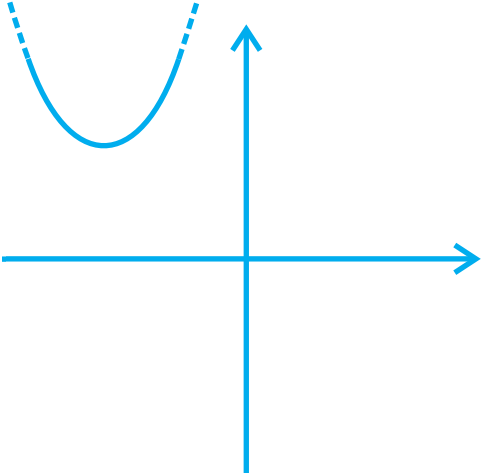
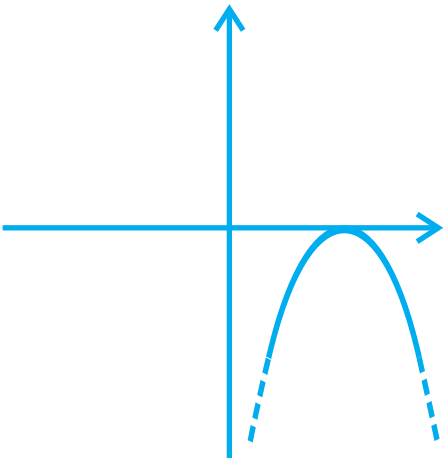
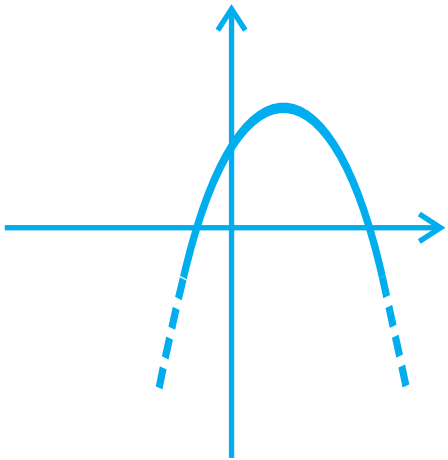
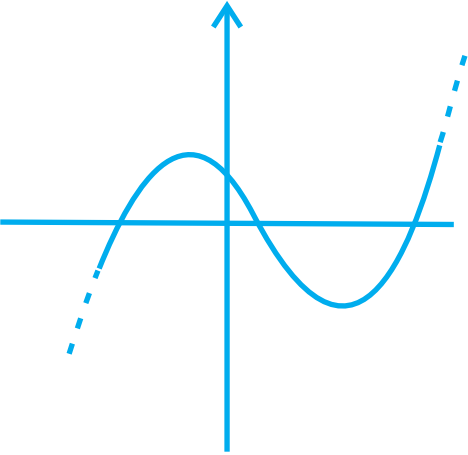
Which of the following is not the graph of a quadratic polynomial?
  • A
  • B
  • C
Answer
Correct option: D.
For any quadratic polynomial $a x^2+b x+c, a \neq 0$, the graph of the corresponding equation $y=a x^2+b x+c$ has one of the two shapes either open upwards like u or open downwards like $\cap$ depandign on whether $a > 0$ or a a $ < 0$. These curves are called parabolas. So, aption $(d)$ cannot be possible. Also, the curve of a quadrativ pilynomial crosses the $x -$axis on at most two points but in option $(d)$ the curve crosses the $x -$axis on the three points, so it does not represent the quadratic polynomial.
View full question & answer
MCQ 101 Mark
Choose the correct answer from the given four options in the following questions:
If one of the zeroes of the cubic polynomial $x^3+a x^2+b x+c$ is $-1$ , then the product of the other two zeroes is:
.
  • $b-a+1$.
  • B
    $b-a-1$.
  • C
    $a-b+1$.
  • D
    $a-b-1$
Answer
Correct option: A.
$b-a+1$.
Let $p ( x )= x ^3+ a x ^2+ bx + c$
Let $a, p$ and $y$ be the zeroes of the given cubic polynomial $p(x)$.
$\therefore \alpha=-1 \text { [given] }$
$\text { and } p(-1)=0$
$\Rightarrow(-1)^3+a(-1)^2+b(-1)+c=0$
$\Rightarrow-1+a-b+c=0$
$\Rightarrow c=1-a+b \ldots . .(i)$
We know that,
$\text { Product of all zeroes }=(-1)^3 \frac{\text { Constant term }}{\text { Coefficient of } x^3}=-\frac{c}{1}$
$\alpha \beta \gamma=-c$
$\Rightarrow(-1) \beta \gamma=-c[\therefore \alpha=-1]$
$\Rightarrow \beta \gamma=c$
$\Rightarrow \beta \gamma=1 a+b[\text { From Eq. (i) }]$
Hecne, product of the other two roots is $1-a+b$.
Alternate Answer
Since, -1 is one of the zeroes of the cubic polynomial $f(x)=x^2+a x^2+b x+c$ i.e., $(x+1)$ is a factor of $f(x)$,
Now, using division algorithm,
$x + 1 = { x ^ { 2 } + ( a - 1 ) x + ( b - a + 1 ) }$
$\frac{x^3+x^2}{(a-1) x^2+b x}$
$\frac{(a-1) x^2+(a-1) x}{(b-a+1) x+c}$
$\frac{(b-a+1) x(b-a+1)}{(c-b+a-1)}$
$\Rightarrow x^2+a x^2+b x+c=(x+1) x\left\{x^2+(a-1) x+(a-a+1)>+(c-b+a-1)\right.$
$\Rightarrow x^2+a x^2+b x+(b-a+1)=(x+1)\left\{x^2+(a-1) x+(b-a+1)\right.$
Let a and p be the other two zeroes of the given polynomial, then
$\text{Product of zeroes}=(-1)\alpha.\beta=\frac{\text{-Constant term}}{\text{Coefficient of x}^3}$
$\Rightarrow\ -\alpha.\beta=\frac{-(\text{b}-\text{a}+1)}{1}$
$\Rightarrow\ \alpha\beta=-\text{a}+\text{b}+1$
Hence, the required product of other two roots is $(-a + b + 1).$
View full question & answer
MCQ 111 Mark
Choose the correct answer from the given four options in the following questions:
The zeroes of the quadratic polynomial $x^2 + 99x + 127$ are:
  • A
    Both positive.
  • Both negative
  • C
    One positive and one negative.
  • D
    Both equal.
Answer
Correct option: B.
Both negative
Let given quadratic polynomial be $p(x)=x^2+99 x+127$.
On comparing $p(x)$ with $a x^2+b x+c$, we get
a = 1, b = 99 and c = 127
We know that, $\text{x}=\frac{-\text{b}\pm\sqrt{\text{b}^2-4\text{ac}}}{2\text{a}}$ [by quadratic formula]
$=\frac{-99\pm\sqrt{(99)^2-4\times1\times127}}{2\times1}$
$=\frac{-99\pm\sqrt{9801-508}}{2}$
$=\frac{-99\pm\sqrt{9293}}{2}=\frac{-99\pm96.4}{2}$
$=\frac{-99+96.4}{2},\frac{-99-96.4}{2}$
$=\frac{-2.6}{2},\frac{-195.4}{2}$
$=-13, -97.7$
Hence, both zeroes of the given quadratic polynomial p(x) are negative.
Alternate answer
In quadratic polynomial, if $\begin{matrix}\text{a} > 0 \\ \text{a} < 0 \end{matrix}\text{ or } \begin{matrix} \text{b} > 0,\text{ c} > 0 \\ \text{b}< 0, \text{ c} < 0 \end{matrix}\Bigg\},$ then both zeroes are negative,
In given polynomial, we see that
a = 1 > 0, b = 99 > 0 and c = 127 > 0
the above condition,
So, both zeroes of the given quadratic polynomial are negative.
View full question & answer