Sample QuestionsPolynomials questions
One sample from each question group in this chapter. Select any group above to see the full set with answer keys.
What should be subtracted to the polynomial $x^2-16 x+30$, so that $15$ is the zero of the resulting polynomial?
Answer: C.
View full solution →If one of the zeroes of a quadratic polynomial of the form $x^2+a x+b$ is the negative of the other, then it:
- ✓
Has no linear term and constant term is negative.
- B
Has no linear term and the constant term is position.
- C
Can have a linear term but the constant term is negative.
- D
Can have a linear term but the constant term is positive.
Answer: A.
View full solution →If $\alpha,\beta$ are the zeros of the polynomial $f(x) = ax^2 + bx + c$, then $\frac{1}{\text{a}^2}+\frac{1}{\beta^2}=$
- A
$\frac{\text{b}^2-2\text{ac}}{\text{a}^2}$
- ✓
$\frac{\text{b}^2-2\text{ac}}{\text{c}^2}$
- C
$\frac{\text{b}^2+2\text{ac}}{\text{a}^2}$
- D
$\frac{\text{b}^2+2\text{ac}}{\text{c}^2}$
Answer: B.
View full solution →If one of the zeroes of the quadratic polynomial $(k - 1)x^2 + kx + 1$ is $-3$, then the value of $k$ is:
- ✓
$\frac{4}{3}$
- B
$\frac{-4}{3}$
- C
$\frac{2}{3}$
- D
$\frac{-2}{3}$
Answer: A.
View full solution →Given that of the zeroes of the cubic polynomial $a x^3+b x^2+c x+d$ are $0$ , the third zero is:
- ✓
$\frac{-\text{b}}{\text{a}}$
- B
$\frac{\text{b}}{\text{a}}$
- C
$\frac{\text{c}}{\text{a}}$
- D
$\frac{-\text{d}}{\text{a}}$
Answer: A.
View full solution →Statement-1 (A): Degree of a zero polynomial is not defined.
Statement-2 (R): Degree of a non-zero constant polynomial is zero.
- A
Statement-1 is true, Statement-2 is true; Statement-2 is a correct explanation for Statement-1.
- ✓
Statement- 1 is true, Statement- 2 is true; Statement- 2 is not a correct explanation for Statement-1.
- C
Statement-1 is true, Statement-2 is false.
- D
Statement-1 is false, Statement-2 is true.
Answer: B.
View full solution →Statement-1 (A): If the graph of a polynomial touches the $x$-axis at only one point, then the polynomial cannot be a quadratic polynomial.
Statement-2 (R) : A polynomial of degree $n(n>1)$ can have at most $n$ real zeroes.
- A
Statement-1 is true, Statement-2 is true; Statement-2 is a correct explanation for Statement-1.
- B
Statement- 1 is true, Statement- 2 is true; Statement- 2 is not a correct explanation for Statement-1.
- C
Statement-1 is true, Statement-2 is false.
- ✓
Statement-1 is false, Statement-2 is true.
Answer: D.
View full solution →Statement-1 (A): The polynomial $p(x)=x^2+3 x+3$ has two real zeroes.
Statement-2 (R): A quadratic polynomial can have at most two real zeroes.
- A
Statement-1 is true, Statement-2 is true; Statement-2 is a correct explanation for Statement-1.
- B
Statement- 1 is true, Statement- 2 is true; Statement- 2 is not a correct explanation for Statement-1.
- C
Statement-1 is true, Statement-2 is false.
- ✓
Statement-1 is false, Statement-2 is true.
Answer: D.
View full solution →Statement-1 (A): If $\alpha, \beta$ and $\gamma$ are the zeroes of the polynomial $6 x^3+3 x^2-5 x+1$, then $\alpha^{-1}+\beta^{-1}+\gamma^{-1}=5$.
Statement-2 (R): If $\alpha, \beta, \gamma$ are the zeroes of the cubic polynomial $a x^3+b x^2+c x+d$, then $\alpha+\beta+\gamma=-\frac{b}{a}$.
- A
Statement-1 is true, Statement-2 is true; Statement-2 is a correct explanation for Statement-1.
- ✓
Statement- 1 is true, Statement- 2 is true; Statement- 2 is not a correct explanation for Statement-1.
- C
Statement-1 is true, Statement-2 is false.
- D
Statement-1 is false, Statement-2 is true.
Answer: B.
View full solution →Statement-1 (A): If $\alpha$ and $\beta$ are zeroes of the quadratic polynomial $x^2+7 x+12$, then
$
\frac{12}{\alpha}+\frac{12}{\beta}-24 \alpha \beta=395
$
Statement-2 (R): If $\alpha$ and $\beta$ are zeroes of the quadratic polynomial $a x^2+b x+c$, then
$
\alpha+\beta=-\frac{b}{a} \text { and } \alpha \beta=\frac{c}{a}
$
- A
Statement-1 is true, Statement-2 is true; Statement-2 is a correct explanation for Statement-1.
- B
Statement- 1 is true, Statement- 2 is true; Statement- 2 is not a correct explanation for Statement-1.
- C
Statement-1 is true, Statement-2 is false.
- ✓
Statement-1 is false, Statement-2 is true.
Answer: D.
View full solution →If a quadratic polynomial f(x) is not factorizable into linear factors, then it has no real zero. (True/ False).
If a quadratic polynomial f(x) is a square of a linear polynomial, then its two zeros are coincident.(True/ False).
If a quadratic polynomial f (x) is not factorizable into linear factors, then it has no real zero.
If a quadratic polynomial f (x) is a square of a linear polynomial, then its two zeroes are coincident.
The parabola representing a quadratic polynomial $f(x)=a x^2+b x+c$ opens downward when __________.
View full solution →The parabola representing a quadratic polynomial $f(x)=a x^2+b x+c$ opens upward when __________.
View full solution →If the zeroes of the quadratic polynomial $a x^2+b x+c$ are both negative, then a, b and call have the __________ sign.
View full solution →If the zeroes of the quadratic polynomial $a x^2+x+a$ are equal, then a =__________.
View full solution →If the parabola represented by $f(x)=a x^2+b x+c$ cuts x-axis at two distinct points, then the polynomial $a x^2+b x+c$ has __________ real zeroes.
View full solution →If $\alpha, \beta$are zeroes of the polynomial $p(x)=5 x^2-6 x+1$ then find the value of $\alpha+\beta+\alpha \beta$
View full solution →If $\alpha, \beta$ are the zeros of the polynomial $2 y^2+7 y+5$ write the value of $\alpha+\beta+\alpha \beta$.
View full solution →For what value of k, is -2 a zero of the polynomial $3 x^2+4 x+2 k$?
View full solution →For what value of k, is - 3 a zero of the polynomial $x^2+11 x+k$?
View full solution →For what value of k, is 3 a zero of the polynomial $2 x^2+x+k$?
View full solution →The graph of the polynomial $f(x)=a x^2+b x+c$ is as shown in Fig. Write the value of $b^2-4 a c$ and the number of real zeros of $f(x)$, write the sign of $c$.
View full solution →Write the standard form of a quadratic polynomial with real coefficients.
The graph of the polynomial $f(x) = ax^2 + bx + c$ is as shown in Fig. Write the value of $b^2 - 4ac$ and the number of real zeros of f(x).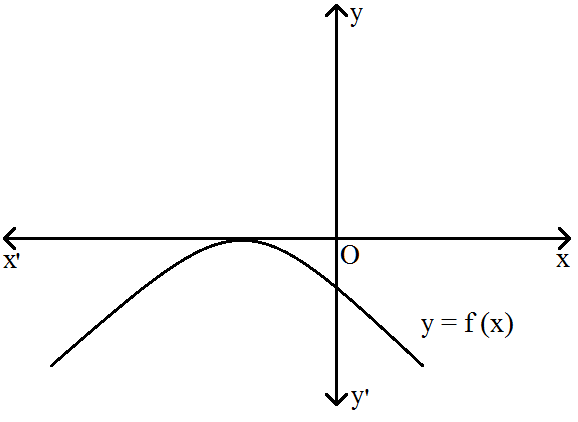
View full solution →If a quadratic polynomial f(x) is factorizable into linear distinct factors, then what is the total number of real and distinct zeros of f(x)?
Write the family of quadratic polynomials having $-\frac{1}{4}$ and 1 as its zeros.
View full solution →Give an example of polynomials $f(x), g(x), q(x)$ and $r(x)$ satisfying $f(x)=g(x), q(x)+r(x)$, where degree $r(x)=0$.
View full solution →If $\alpha$ and $\beta$ are the zeroes of the quadratic polynomial $f(x) = ax^2 + bx + c$, then evaluate:$\alpha^4+\beta^4$
View full solution →For the following, find a quadratic polynomial whose sum and product respectively of the zeroes are as given. Also, find the zeroes of these polynomials by factorization.
$\frac{21}{8},\frac{5}{16}$
View full solution →If a - b, a and b are zeros of the polynomial $f(x) = 2x^3- 6x^2 + 5x - 7$, write the value of a.
View full solution →What must be added to the polynomial $f(x) = x^4 + 2x^3 - 2x^2 + x - 1$ so that the resulting polynomial is exactly divisible by $x^2 + 2x - 3?$
View full solution →For what value of k, -4 is a zero of the polynomial $x^2 - x - (2k + 2)?$
View full solution →If the zeros of the polynomial $f(x) = ax^3 + 3bx^2 + 3cx + d$ are in A.P., prove that $2b^3 - 3abc + a^2d = 0.$
View full solution →If $\alpha$ and $\beta$ are the zeros of the quadratic polynomial $f(x) = x^2 - px + q$, prove that $\frac{\alpha^2}{\beta^2}+\frac{\beta^2}{\alpha^2}=\frac{\text{p}^2}{\text{q}}-\frac{4\text{p}^2}{\text{q}}+2.$
View full solution →Find all zeros of the polynomial $f(x) = 2x^4 - 2x^3 - 7x^2 + 3x + 6$, if its two zeros are $-\sqrt{\frac{3}{2}}$ and $\sqrt{\frac{3}{2}}$
View full solution →If the zeros of the polynomial $f(x) = 2x^3 - 15x^2 + 37x - 30$ are in A.P., find them.
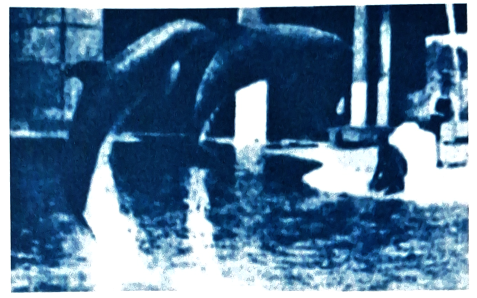
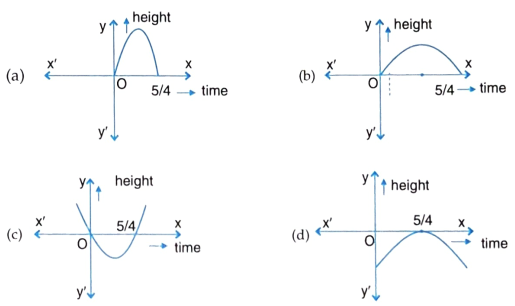
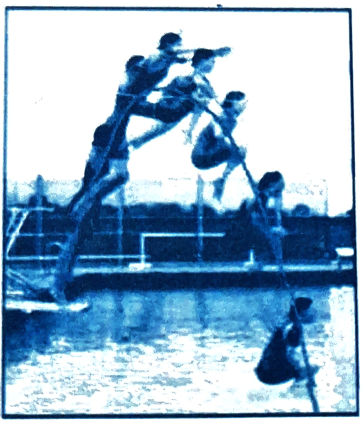
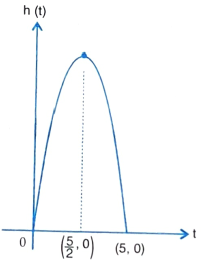
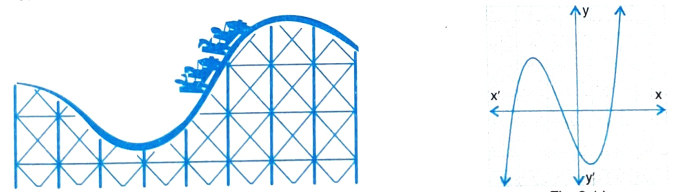
View full solution →View full solution →View full solution →View full solution →View full solution →Basketball and Soccer are played with a spherical ball. Even through an athlete dribbles the ball in both sports, a basketball player uses his hands, a soccer player uses his feet. Usually, a soccer is played outdoors on a large field, the basketball is played indoor on a court made out of wood. The projectile (path traced) of soccer ball and basketball are in the form of parabola representing a quadratic polynomial.
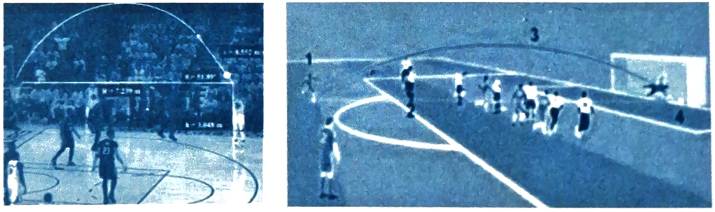
(i) The shape of the path traced shown in Fig. is
(a) Spiral $\qquad$ (b) Ellipse $\qquad$ (c) Linear $\qquad$ (d) Parabola
(ii) If $p(x)=a x^2+b x+c$ is the parabola representing the graphs shown in Fig. then
(a) $a=0$ $\qquad$ (b) $a<0$ $\qquad$ (c) $a>0$ $\qquad$ (d) $a \geq 0$
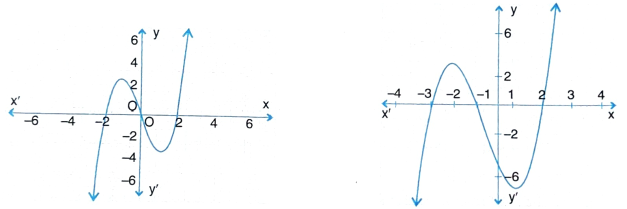
(iii) The polynomial representing the graph shown in Fig. 2.8 has
(a) no zero $\qquad$ (b) one zero $\qquad$ (c) two zeroes $\qquad$ (d) three zeroes
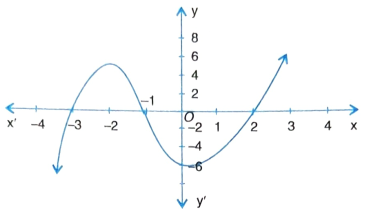
(iv) The three zeroes of the polynomial representing the above graph in Fig. 2.8 are
(a) $2,3,-1$ $\qquad$ (b) $-2,3,1$ $\qquad$ (c) $-3,-1,2$ $\qquad$ (d) $-2,-3,-1$ View full solution →