MCQ 1511 Mark
An unbiased die is thrown once. The probability of getting a composite number is :
- A
$\frac{2}{3}$
- B
$\frac{2}{5}$
- C
$\frac{1}{2}$
- ✓
$\frac{1}{3}$
AnswerCorrect option: D. $\frac{1}{3}$
Number of composite numbers on a dice $= \{4, 6\} = 2$
Number of possible outcomes $= 2$
Number of Total outcomes $= 6$
$\therefore$ Required Probability $=\frac{2}{6}=\frac{1}{3}$
View full question & answer→MCQ 1521 Mark
A box contains $3$ blue, $2$ white and $4$ red marbles. If a marble is drawn at random from the box, what is the probability that it will not be a white marble?
- A
$\frac{1}{3}$
- B
$\frac{4}{9}$
- ✓
$\frac{7}{9}$
- D
$\frac{2}{9}$
AnswerCorrect option: C. $\frac{7}{9}$
The bag contains $3$ blue, $2$ white and $4$ red marbles.
So, the total number of marbles $= 3 + 2 + 4 = 9$
Since the marbles cannot be white, it can blue or red.
The number of blue or red marbles $= 3 + 4 = 7$
$P($getting a blue or red marble$)$
$=\frac{7}{9}$
View full question & answer→MCQ 1531 Mark
An unbiased die is thrown once. The probability of getting an odd number is :
- A
$\frac{2}{5}$
- ✓
$\frac{1}{2}$
- C
$\frac{1}{3}$
- D
$\frac{2}{3}$
AnswerCorrect option: B. $\frac{1}{2}$
Number of odd numbers on a dice $= \{1, 3, 5\}, = 3$
Number of possible outcomes $= 3$
Number of Total outcomes $= 6$
$\therefore$ Required Probability $=\frac{3}{6}=\frac{1}{2}$
View full question & answer→MCQ 1541 Mark
A card is drawn at random from a pack of $52$ cards. The probability that the drawn card is not an ace is :
- A
$\frac{1}{13}$
- B
$\frac{9}{13}$
- C
$\frac{4}{13}$
- ✓
$\frac{12}{13}$
AnswerCorrect option: D. $\frac{12}{13}$
Total events $= 52$ cards
Probability of card which is not in ace Number of card $= 52 - 4 = 48$
$\therefore\ \text{Probability}=\frac{48}{52}=\frac{12}{13}$
View full question & answer→MCQ 1551 Mark
A box contains cards numbered $6$ to $50$. A card is drawn at random from the box. The probability that the drawn card has a number which is a perfect square is :
- A
$\frac{1}{45}$
- B
$\frac{2}{15}$
- C
$\frac{4}{45}$
- ✓
$\frac{1}{9}$
AnswerCorrect option: D. $\frac{1}{9}$
The numbers on the card have to be perfect sqaures.
So, the numbers would be $\{9, 16, 25, 36, 49\}.$
So, there are $5$ numbers
Total number of cards $= (50 - 6) + 1$
$= 44 + 1$
$= 45$
$P\ ($getting a perfect square$)$
$=\frac{\text{Number of perfect squares}}{\text{Total}}$
$=\frac{5}{45}$
$=\frac{1}{9}$
View full question & answer→MCQ 1561 Mark
The probability that a non leap year selected at random will have $53$ Sundays is :
- A
$\frac{4}{7}$
- B
$\frac{3}{7}$
- ✓
$\frac{1}{7}$
- D
$\frac{2}{7}$
AnswerCorrect option: C. $\frac{1}{7}$
Non $-$ leap year contains $365$ days $= 364$ days $+\ 1$ day $=\Big(\frac{364}{7}\Big)$ weeks $+\ 1$ day $= 52$ weeks $+\ 1$ remaining day $= 52$ Sundays $+\ 1$ remaining day
We will have $53$ Sundays if $1$ remaining day is a Sunday.
Possible outcomes $= \{\text{(Monday), (Tuesday), (Wednesday), (Thursday), (Friday), (Saturday), (Sunday)\}}$
Number of Total outcomes $= 7$
Number of possible outcomes $= 1$
$\therefore$ Required Probability $=\frac{\text{Possible outcomes}}{\text{Total outcomes}}=\frac{1}{7}$
View full question & answer→MCQ 1571 Mark
Two coins are tossed together. The probability of getting at most one head is :
- A
$1$
- B
$\frac{1}{4}$
- ✓
$\frac{3}{4}$
- D
$\frac{2}{4}$
AnswerCorrect option: C. $\frac{3}{4}$
Number of Total outcomes $= \text{\{HH, HT, TH, TT}\} = 4$
Number of possible outcomes $= \text{\{(HH, HT, TH)}\} = 3$
$\therefore$ Required Probability $=\frac{3}{4}$
View full question & answer→MCQ 1581 Mark
Cards marked with numbers $\{1, 2, 3, ..., 25\}$ are placed in a box and mixed thoroughly and one card is drawn at random from the box. The probability that the number on the card is a multiple of $3$ and $5$ is :
- A
$\frac{4}{25}$
- B
$\frac{12}{25}$
- C
$\frac{8}{5}$
- ✓
$\frac{1}{25}$
AnswerCorrect option: D. $\frac{1}{25}$
Multiples of $3 = \{3, 6, 9, 12, 15, 18, 21, 24\}$
Multiples of $5 = \{5, 10, 15, 20, 25\}$
Number of possible outcomes $($multiple of $3$ and $5) = {15} = 1$
Number of Total outcomes $= 25$
$\therefore$ Required Probability $=\frac{1}{25}$
View full question & answer→MCQ 1591 Mark
₹ 5 coins, twenty eight ₹ 10 coins and eight ₹ 20 coins. Now, they said to Nisha, their another friends, to choose a coin randomly.
Find the probability that the coin chosen is of denomination of atmost ₹ 5.
- ✓
$\frac{67}{85}$
- B
$\frac{36}{85}$
- C
$\frac{4}{85}$
- D
$\frac{18}{85}$
AnswerCorrect option: A. $\frac{67}{85}$
(a):Total number of coins of ₹ 1, ₹ 2 and ₹ 5
$ =50+48+36=134 $
$\therefore \quad$ Required probability $=\frac{134}{170}=\frac{67}{85}$
View full question & answer→MCQ 1601 Mark
₹ 5 coins, twenty eight ₹ 10 coins and eight ₹ 20 coins. Now, they said to Nisha, their another friends, to choose a coin randomly.
Find the probability that the coin chosen is of denomination of atleast ₹ 10 .
- ✓
$\frac{18}{85}$
- B
$\frac{36}{85}$
- C
$\frac{1}{17}$
- D
$\frac{16}{85}$
AnswerCorrect option: A. $\frac{18}{85}$
(a):Total number of coins of ₹ 10 and ₹ 20
$ =28+8=36 $
$\therefore \quad$ Required probability $=\frac{36}{170}=\frac{18}{85}$
View full question & answer→MCQ 1611 Mark
$₹ 5$ coins, twenty eight $₹ 10$ coins and eight $₹ 20$ coins. Now, they said to Nisha, their another friends, to choose a coin randomly.
Find the probability that the coin chosen is not a $₹ 10$ coin.
- A
$\frac{15}{31}$
- B
$\frac{36}{85}$
- C
$\frac{1}{5}$
- ✓
$\frac{71}{85}$
AnswerCorrect option: D. $\frac{71}{85}$
Number of $₹ 10$ coins $=28$
Probability $($coin is of $₹ 10 ) =\frac{28}{170}$
$\therefore$ Required probability $=1-P ($coin is of $\text ₹ 10)$
$=1-\frac{28}{170}$
$=\frac{142}{170}$
$=\frac{71}{85}$
View full question & answer→MCQ 1621 Mark
₹ 5 coins, twenty eight ₹ 10 coins and eight ₹ 20 coins. Now, they said to Nisha, their another friends, to choose a coin randomly.
Find the probability that the coin chosen is ₹ 20 coin.
- A
$\frac{13}{85}$
- ✓
$\frac{4}{85}$
- C
$\frac{3}{85}$
- D
$\frac{4}{15}$
AnswerCorrect option: B. $\frac{4}{85}$
(b):Number of ₹ 20 coins $=8$
$\therefore \quad$ Required probability $=\frac{8}{170}=\frac{4}{85}$
View full question & answer→MCQ 1631 Mark
₹ 5 coins, twenty eight ₹ 10 coins and eight ₹ 20 coins. Now, they said to Nisha, their another friends, to choose a coin randomly.
Find the probability that the coin chosen is ₹ 5 coin.
- A
$\frac{17}{55}$
- B
$\frac{36}{85}$
- ✓
$\frac{18}{85}$
- D
$\frac{1}{15}$
AnswerCorrect option: C. $\frac{18}{85}$
(c):Total number of coins $=50+48+36+28+8=170$
Number of ₹ 5 coins $=36$
$\therefore \quad$ Required probability $=\frac{36}{170}=\frac{18}{85}$
View full question & answer→MCQ 1641 Mark
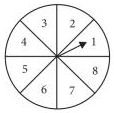
A game of chance consists of spinning an arrow on a circular board, divided into 8 equal parts, which comes to rest pointing at one of the numbers $1,2,3, \ldots ., 8$ as shown in the given figure which are equally likely outcomes. What is the probability that the arrow will point at a number which is less than 9 .
- A
$\frac{1}{2}$
- B
$\frac{1}{3}$
- C
$\frac{1}{8}$
- ✓
Answer(d):Total number of outcomes $=8$
Favourable outcomes are $\{1,2,3,4,5,6,7,8\}$ i.e., 8 in number.
$\therefore \quad P($ getting a number less than 9$)=\frac{8}{8}=1$
View full question & answer→MCQ 1651 Mark
A box contains 100 memory cards out of which 25 are good and 75 are defective. A memory card is selected at random. The probability that selected memory card is defective is
- A
$\frac{1}{4}$
- B
$\frac{1}{2}$
- ✓
$\frac{3}{4}$
- D
AnswerCorrect option: C. $\frac{3}{4}$
(c):Total number of possible outcomes $=100$
Favourable number of outcomes $=75$
$P($ selecting a defective memory card $)=\frac{75}{100}=\frac{3}{4}$
View full question & answer→MCQ 1661 Mark
Sunita picked a prime number from the integers 1 to 20 . The probability that it will be the number 13 is
- A
$\frac{1}{20}$
- ✓
$\frac{1}{8}$
- C
$\frac{2}{7}$
- D
$\frac{13}{20}$
AnswerCorrect option: B. $\frac{1}{8}$
(b):$\because$ Prime number between 1 to 20 are $\{2,3,5,7$, $11,13,17,19\}$
So, total number of outcomes $=8$
Favourable outcome is $\{13\}$ i.e., 1
$\therefore \quad$ Required probability $=\frac{1}{8}$
View full question & answer→MCQ 1671 Mark
A box contains 100 red cards, 200 yellow cards and 50 blue cards. If a card is drawn at random from the box, then find the probability that it will be neither yellow nor a blue card.
- A
$\frac{1}{7}$
- ✓
$\frac{2}{7}$
- C
$\frac{3}{7}$
- D
$\frac{5}{7}$
AnswerCorrect option: B. $\frac{2}{7}$
(b):Total number of cards $=100+200+50=350$
Total number of possible outcomes $=350$
$ \begin{aligned} \text { Number of favourable outcomes } & =\text { Number of red cards } \\ & =100 \end{aligned} $
$\therefore \quad P($ neither getting yellow nor a blue card) $=\frac{100}{350}=\frac{2}{7}$
View full question & answer→MCQ 1681 Mark
The blood group of 16 students of class $X$ are recorded as follows :
$A , B , O , O , AB , O , A , O , B , A , O , B , A , O , O , AB$
Find the probability of selecting a student with blood group $O$.
- A
$\frac{5}{16}$
- ✓
$\frac{7}{16}$
- C
$\frac{3}{16}$
- D
$\frac{1}{4}$
AnswerCorrect option: B. $\frac{7}{16}$
(b):Total number of possible outcomes $=16$
Let $E$ be an event of selecting a student with blood group $O$.
So, favourable number of outcomes $=7$
$ \therefore \quad P(E)=\frac{7}{16} $
View full question & answer→MCQ 1691 Mark
A die is thrown once. Find the probability of getting a number which is not a factor of 36 .
- A
$\frac{1}{3}$
- B
$\frac{1}{2}$
- ✓
$\frac{1}{6}$
- D
$\frac{5}{6}$
AnswerCorrect option: C. $\frac{1}{6}$
(c):Let $E$ be the event of getting a number on the die which is not a factor of 36 and this number is 5 .
Total number of possible outcomes $=6$ Number of outcomes favourable to event $E=1$
$\therefore \quad$ Required probability $=\frac{1}{6}$
View full question & answer→MCQ 1701 Mark
A bag contains 4 red and 6 black balls. A ball is taken out of the bag at random. Find the probability of getting a black ball.
- A
$\frac{1}{5}$
- B
$\frac{2}{5}$
- C
$\frac{4}{5}$
- ✓
$\frac{3}{5}$
AnswerCorrect option: D. $\frac{3}{5}$
(d):Number of red balls $=4$
Number of black balls $=6$
Total number of balls in the bag $=4+6=10$
$\therefore \quad P($ getting a black ball $)=\frac{6}{10}=\frac{3}{5}$
View full question & answer→MCQ 1711 Mark
A letter is chosen at random from the letters of the word 'PRONUNCIATION'. Find the probability that the letter chosen is a vowel.
- ✓
$\frac{6}{13}$
- B
$\frac{2}{3}$
- C
$\frac{1}{8}$
- D
$\frac{7}{13}$
AnswerCorrect option: A. $\frac{6}{13}$
(a):$\because$ There are 13 letters in the given word.
$\therefore \quad$Total number of possible outcomes $=13$
Vowels are O, U, I, A, I, O i.e., 6 in number.
$\therefore \quad$ Favourable number of outcomes $=6$
$\therefore \quad$ Required probability $=6 / 13$
View full question & answer→MCQ 1721 Mark
A school has five houses $A, B, C, D$ and $E$. A class has 23 students, 4 from house $A, 8$ from house $B, 5$ from house $C, 2$ from house $D$ and rest from house $E$. A single student is selected at random to be the class monitor. The probability that the selected student is not from $A, B$ and $C$ is
- A
$\frac{4}{23}$
- ✓
$\frac{6}{23}$
- C
$\frac{8}{23}$
- D
$\frac{17}{23}$
AnswerCorrect option: B. $\frac{6}{23}$
(b):Total number of students $=23$
Number of students in houses $A, B$ and $C=4+8+5=17$
$\therefore \quad$ Remaining students $=23-17=6$
So, probability that the selected student is not from $A, B$ and $C=\frac{6}{23}$
View full question & answer→MCQ 1731 Mark
One ticket is drawn at random from a bag containing tickets numbered 1 to 40 . The probability that the selected ticket has a number, which is a multiple of 5 is
- ✓
$\frac{1}{5}$
- B
$\frac{3}{5}$
- C
$\frac{4}{5}$
- D
$\frac{1}{3}$
AnswerCorrect option: A. $\frac{1}{5}$
(a):Total number of outcomes $=40$
Multiples of 5 from 1 to 40 are $\{5,10,15,20,25,30,35,40\}$
So, number of favourable outcomes $=8$
$\therefore \quad$ Required probability $=\frac{8}{40}=\frac{1}{5}$
View full question & answer→MCQ 1741 Mark
A card is drawn from a deck of 52 cards. The event $E$ is that card is not an ace of hearts. The number of outcomes favourable to $E$ is
Answer(d):In a deck of 52 cards, there are 13 cards of hearts and 1 of them is ace of heart.
Hence, the number of outcomes favourable to $E$ $=52-1=51$
View full question & answer→MCQ 1751 Mark
When a die is thrown, the probability of getting an odd number less than 3 is
- ✓
$\frac{1}{6}$
- B
$\frac{1}{3}$
- C
$\frac{1}{2}$
- D
$0$
AnswerCorrect option: A. $\frac{1}{6}$
(a):When a die is thrown, then total number of possible outcomes $=6$
Odd number less than 3 is 1 only.
$\therefore \quad$ Number of favourable outcomes $=1$
$\therefore \quad$ Required probability $=\frac{1}{6}$
View full question & answer→MCQ 1761 Mark
If $P(A)$ denotes the probability of an event $A$, then
- A
$P\left(A^{\prime}\right)<0$
- B
$P\left(A^{\prime}\right)>1$
- ✓
$0 \leq P\left(A^{\prime}\right) \leq 1$
- D
$-1 \leq P\left(A^{\prime}\right) \leq 1$
AnswerCorrect option: C. $0 \leq P\left(A^{\prime}\right) \leq 1$
(c):Since, probability of any event always lies from 0 to 1 .
View full question & answer→MCQ 1771 Mark
The probability expressed as a percentage of a particular occurrence can never be
- A
- ✓
- C
- D
anything but a whole number
Answer(b):We know that, the probability expressed as a percentage always lies from 0 to 100 . So, it cannot be less than 0 .
View full question & answer→MCQ 1781 Mark
A die is thrown once. The probability of getting a non-prime number is
- A
$\frac{2}{3}$
- B
$\frac{1}{3}$
- ✓
$\frac{1}{2}$
- D
$\frac{1}{6}$
AnswerCorrect option: C. $\frac{1}{2}$
(c):Total number of possible outcomes $=6$
Favourable outcomes are $\{1,4,6\}$ i.e., 3 in number.
$\therefore \quad P($ getting a non-prime number $)=\frac{3}{6}=\frac{1}{2}$
View full question & answer→MCQ 1791 Mark
An integer is chosen between 0 to 50 . What is the probability that it is divisible by 4 ?
- ✓
$\frac{12}{49}$
- B
$\frac{13}{49}$
- C
$\frac{1}{7}$
- D
$\frac{4}{49}$
AnswerCorrect option: A. $\frac{12}{49}$
(a):Total number of possible outcomes $=49$
Favourable outcomes are $\{4,8,12, \ldots, 48\}$ i.e., 12 in number.
$\therefore \quad$ Required probability $=\frac{12}{49}$
View full question & answer→MCQ 1801 Mark
A card is drawn from a pack of well-shuffled deck of 52 playing cards. The probability that the number on the card is a perfect square is
- ✓
$\frac{2}{13}$
- B
$\frac{3}{13}$
- C
$\frac{5}{13}$
- D
$\frac{7}{52}$
AnswerCorrect option: A. $\frac{2}{13}$
(a):Perfect square numbers on the cards are $[4,9\}$ i.e., 2 in number.
$\therefore$ Total number of favourable outcomes $=4 \times 2=8$
Total number of possible outcomes $=52$
$\therefore \quad$ Required probability $=\frac{8}{52}=\frac{2}{13}$
View full question & answer→MCQ 1811 Mark
One ticket is selected at random from 100 tickets numbered $00,01,02, \ldots, 99$. Suppose $x$ is sum of the digits and $y$ is product of the digits. Then, probability of getting $x=8$ and $y=0$ is
- A
$\frac{2}{17}$
- B
$\frac{3}{27}$
- ✓
$\frac{1}{50}$
- D
$\frac{1}{25}$
AnswerCorrect option: C. $\frac{1}{50}$
(c):Total number of possible outcomes $=100$
Sum of digits $=8$ and product $=0$
$\therefore \quad$ Favourable outcomes are 08 and 80 i.e., 2
$\therefore \quad$ Required probability $=\frac{2}{100}=\frac{1}{50}$
View full question & answer→MCQ 1821 Mark
A die is thrown once. Find the probability of getting an odd prime number.
- A
$\frac{1}{2}$
- ✓
$\frac{1}{3}$
- C
$\frac{1}{6}$
- D
$\frac{1}{4}$
AnswerCorrect option: B. $\frac{1}{3}$
(b):Total possible outcomes are $(1,2,3,4,5,6\}$ i.e., 6 in number.
Favourable outcomes are $\{3,5\}$ i.e., 2 in number.
$\therefore \quad$ Required probability $=\frac{2}{6}=\frac{1}{3}$
View full question & answer→MCQ 1831 Mark
A card is drawn at random from a pack of 52 cards. The probability that the drawn card is not a king is
- A
$\frac{1}{13}$
- B
$\frac{9}{13}$
- C
$\frac{4}{13}$
- ✓
$\frac{12}{13}$
AnswerCorrect option: D. $\frac{12}{13}$
(d):Total number of possible outcomes $=52$
Number of king cards in the pack $=4$
$\therefore \quad$ Number of cards that are not king $=52-4=48$
So, favourable number of outcomes $=48$
$\therefore \quad$ Required probability $=\frac{48}{52}=\frac{12}{13}$
View full question & answer→MCQ 1841 Mark
A month is selected at random from a year. The probability that it is May or July is
- A
$\frac{1}{12}$
- ✓
$\frac{1}{6}$
- C
$\frac{3}{4}$
- D
$\frac{1}{3}$
AnswerCorrect option: B. $\frac{1}{6}$
(b):Number of months in a year $=12$
So, total number of possible outcomes $=12$
Favourable outcomes are May or July i.e., 2
$\therefore \quad$ Required probability $=\frac{2}{12}=\frac{1}{6}$
View full question & answer→MCQ 1851 Mark
A bag contains 12 red roses only. Shalini takes out one rose without looking into the bag. The probability that she takes out an orange rose is
- A
$\frac{1}{2}$
- ✓
$0$
- C
- D
$\frac{2}{3}$
Answer(b):Since, there is no orange rose in the bag.
$\therefore \quad$ Required probability $=0$
View full question & answer→MCQ 1861 Mark
A bag contains 4 red, 5 black and 3 yellow balls. A ball is taken out of the bag at random. Find the probability that the ball taken out is not of yellow colour.
- A
$\frac{2}{3}$
- B
$\frac{1}{3}$
- ✓
$\frac{3}{4}$
- D
$\frac{1}{2}$
AnswerCorrect option: C. $\frac{3}{4}$
(c):Total number of possible outcomes $=4+5+3=12$
Favourable number of outcomes $=5+4=9$
$\therefore \quad$ Required probability $=\frac{9}{12}=\frac{3}{4}$
View full question & answer→MCQ 1871 Mark
A child has a block in the shape of a cube with one letter written on each face as follows:

The cube is thrown once. What is the probability of getting $A$ ? - ✓
$\frac{1}{3}$
- B
$\frac{1}{6}$
- C
$\frac{1}{2}$
- D
$\frac{1}{4}$
AnswerCorrect option: A. $\frac{1}{3}$
(a):Total number of possible outcomes $=6$
As there are two $A$ 's.
$\therefore \quad$ Favourable number of outcomes $=2$
$\therefore \quad$ Required probability $=\frac{2}{6}=\frac{1}{3}$
View full question & answer→MCQ 1881 Mark
A number $x$ is chosen at random from $-5,-4,-3,-2,-1,0,1,2,3,4,5$. The probability that $|x| \leq 3$ is
- A
$\frac{3}{11}$
- B
$\frac{6}{11}$
- ✓
$\frac{7}{11}$
- D
$\frac{9}{11}$
AnswerCorrect option: C. $\frac{7}{11}$
(c):Total number of possible outcomes $=11$
Let $E$ be the event ' $|x| \leq 3$ '.
So, outcomes favourable to $E$ are $\{-3,-2,-1,0,1,2,3\}$ i.e., 7 in number.
$ \therefore \quad P(E)=\frac{7}{11} $
View full question & answer→MCQ 1891 Mark
A letter is chosen at random from the English alphabet. Probability that it is a letter of the word "SIMULTANEOUSLY" is
- A
$\frac{14}{26}$
- ✓
$\frac{11}{26}$
- C
$\frac{10}{26}$
- D
$\frac{15}{26}$
AnswerCorrect option: B. $\frac{11}{26}$
(b):Total number of possible outcomes $=26$
Distinct letters in the word "SIMULTANEOUSLY" are {S, I, M, U, L, T, A, N, E, O, Y} i.e., 11 in number.
So, favourable number of outcomes $=11$
$\therefore \quad$ Required probability $=\frac{11}{26}$
View full question & answer→MCQ 1901 Mark
A card is accidently dropped from a pack of 52 playing cards. The probability that it is a red card is
- ✓
$\frac{1}{2}$
- B
$\frac{1}{13}$
- C
$\frac{1}{52}$
- D
$\frac{12}{13}$
AnswerCorrect option: A. $\frac{1}{2}$
(a):Total number of possible outcomes $=52$
$\because \quad$ Number of red cards $=26$
So, number of favourable outcomes $=26$
$\therefore \quad$ Required probability $=\frac{26}{52}=\frac{1}{2}$
View full question & answer→MCQ 1911 Mark
In a single throw of a pair of dice, the probability of getting the sum as a perfect square is
- ✓
$\frac{7}{36}$
- B
$\frac{5}{36}$
- C
$\frac{8}{36}$
- D
$\frac{11}{36}$
AnswerCorrect option: A. $\frac{7}{36}$
(a):Total number of possible outcomes $=6 \times 6=36$
Let $E$ be the event 'getting the sum as a perfect square'.
$\therefore$ Outcomes favorable to $E$ are $\{(1,3),(2,2),(3,1)$, $(3,6),(4,5),(5,4),(6,3) \mid$ i.e., 7 in number.
$ \therefore \quad P(E)=\frac{7}{36} $
View full question & answer→MCQ 1921 Mark
If a die is thrown, then what is the probability of getting a number less than 4 and greater than 3 ?
- ✓
$0$
- B
- C
$\frac{1}{3}$
- D
$\frac{2}{3}$
Answer(a):There is no such number lie on a die, which is less than 4 and greater than 3 .
$\therefore \quad$ Required probability $=0$
View full question & answer→MCQ 1931 Mark
A box contains 100 discs, numbered from 1 to 100. If one disc is drawn at random from the box, then the probability that it bears a prime number less than 30 , is
- A
$\frac{7}{100}$
- ✓
$\frac{1}{10}$
- C
$\frac{4}{50}$
- D
$\frac{9}{50}$
AnswerCorrect option: B. $\frac{1}{10}$
(b):Total number of possible outcomes $=100$
Let $E$ be the event 'drawing a prime number less than $30^{\circ}$.
Outcomes favourable to $E$ are $\{2,3,5,7,11,13,17,19$, $23,29\}$ i.e., 10 in number.
$ \therefore \quad P(E)=\frac{10}{100}=\frac{1}{10} $
View full question & answer→MCQ 1941 Mark
A number $x$ is chosen at random from the numbers $-2,-1,0,1,2$. What is the probability that $x^2<2$ ?
- A
$\frac{1}{5}$
- B
$\frac{2}{5}$
- ✓
$\frac{3}{5}$
- D
$\frac{4}{5}$
AnswerCorrect option: C. $\frac{3}{5}$
(c):Clearly, number $x$ can take any one of the five given values.
So, total number of possible outcomes $=5$
We observe that $x^2<2$, when $x$ take any one of the following three values $-1,0$ and 1 .
So, favourable number of outcomes $=3$
$ \therefore P\left(x^2<2\right)=\frac{3}{5} $
View full question & answer→MCQ 1951 Mark
A card is drawn from a pack of 52 cards. The probability of drawing a black face card is
- A
$\frac{2}{13}$
- ✓
$\frac{3}{26}$
- C
$\frac{1}{13}$
- D
$\frac{3}{52}$
AnswerCorrect option: B. $\frac{3}{26}$
(b):Total number of cards $=52$
Number of black face cards $=6$
$ \therefore \quad P(\text { getting a black face card })=\frac{6}{52}=\frac{3}{26} $
View full question & answer→MCQ 1961 Mark
In a single throw of a die, the probability of getting a multiple of 2 is
- ✓
$\frac{1}{2}$
- B
$\frac{1}{3}$
- C
$\frac{1}{6}$
- D
$\frac{2}{3}$
AnswerCorrect option: A. $\frac{1}{2}$
(a):Total number of possible outcomes $=6$
Favourable outcomes of getting multiple of 2 are $\{2,4,6\}$ i.e., 3 in number.
$\therefore \quad$ Required probability $=\frac{3}{6}=\frac{1}{2}$
View full question & answer→MCQ 1971 Mark
Two coins are tossed simultaneously. The probability of getting no head is
- ✓
$\frac{1}{4}$
- B
$\frac{1}{2}$
- C
$\frac{3}{4}$
- D
AnswerCorrect option: A. $\frac{1}{4}$
(a):Total possible outcomes are $\{H H, H T, T H, T T\}$ i.e., 4 in number.
Favourable outcome is $\{T T\}$ i.e., 1 in number.
$\therefore \quad P($ getting no head $)=\frac{1}{4}$
View full question & answer→MCQ 1981 Mark
A letter is chosen at random from the English alphabets. Find the probability that the letter chosen succeeds $V$.
- ✓
$\frac{2}{13}$
- B
$\frac{5}{26}$
- C
$\frac{1}{26}$
- D
$\frac{1}{2}$
AnswerCorrect option: A. $\frac{2}{13}$
(a):Total number of outcomes $=26$
Letters succeeding $V$ are $\{W, X, Y, Z\}$ i.e.,
favourable number of outcomes is 4 .
$\therefore \quad$ Required probability $=\frac{4}{26}=\frac{2}{13}$
View full question & answer→MCQ 1991 Mark
A single letter is selected at random from the word 'PROBABILITY'. The probability that it is a vowel is
- A
$\frac{3}{11}$
- ✓
$\frac{4}{11}$
- C
$\frac{2}{11}$
- D
$\frac{5}{11}$
AnswerCorrect option: B. $\frac{4}{11}$
(b):Total number of letters in the word
'PROBABILITY' = 11
$\therefore \quad$ Total number of possible outcomes $=11$
Vowels in the word 'PROBABILITY' are $\{ O , A , I , I \}$
So, favourable number of outcomes $=4$
$\therefore \quad$ Required probability $=\frac{4}{11}$
View full question & answer→MCQ 2001 Mark
If $P(E)=0.01$, then $P(\operatorname{not} E)$ is equal to
Answer(d):$P(\operatorname{not} E)=1-P(E)=1-0.01=0.99$
View full question & answer→