Questions

3 Marks Question

🎯

Test yourself on this topic

15 questions · timed · auto-graded

Question 13 Marks
Is it possible to design a rectangular park of perimeter $80 m$ and area $400 m^2$ ? If so find its length and breadth.
Answer
Let the length of the park $= y m$
Given perimeter of the park is $80 m.$
So, $2(y+\text { width })=80$
$\Rightarrow y+\text { width }=40$
$\Rightarrow \text { width }=40-y$
According to the question, the area of the park is $400 m^2.$
So, $\text { length } \times \text { width }=400$
$\Rightarrow y(40-y)=400$
$\Rightarrow 40 y-y^2=400$
$\Rightarrow y^2-40 y+400=0$
$\Rightarrow y^2-20 y-20 y+400=0$
$\Rightarrow y(y-20)-20(y-20)=0$
$\Rightarrow(y-20)(y-20)=0$
$\Rightarrow y=20,20$
As the roots are real, given situation is possible but the roots are equal,
so it is a square with the length of each side equal to $20 m .$
View full question & answer
Question 23 Marks
If the equation $\left(1+m^2\right) x^2+2 m c x+c^2-a^2=0$ has equal roots then show that $c^2=a^2\left(1+m^2\right)$.
Answer
For the given equation
$\left(1+m^2\right) x^2+2 m c x+c^2-a^2=0$
$a=\left(1+m^2\right), b=2 m c, c=c^2-a^2$
We know that when quadratic equation has equal roots, its discriminant is zero.
i.e. $D=b^2-4 a c=0$
Putting the values, we'll get
$\Rightarrow D=b^2-4 a c$
$=(2 m c)^2-4 \times\left(1+m^2\right) \times\left(c^2-a^2\right)=0$
$\Rightarrow 4 m^2 c^2-4 \times\left(c^2-a^2+c^2 m^2-a^2 m^2\right)=0$
$\Rightarrow 4 c^2 m^2-4 c^2+4 a^2-4 c^2 m^2+4 a^2 m^2=0$
$\Rightarrow-4 c^2+4 a^2+4 a^2 m^2=0$
$\Rightarrow 4 a^2+4 a^2 m^2=4 c^2$
$\Rightarrow 4 a^2\left(1+m^2\right)=4 c^2$
$\Rightarrow c^2=a^2\left(1+m^2\right)$
Hence proved.
View full question & answer
Question 33 Marks
If $a d \neq b c$, then prove that the equation $\left(a^2+b^2\right) x^2+2(a c+b d) x+\left(c^2+d^2\right)=0$ has no real roots.
Answer
We have,
$\left(a^2+b^2\right) x^2+2(a c+b d) x+\left(c^2+d^2\right)=0$
$a=\left(a^2+b^2\right), b=2(a c+b d), c=\left(c^2+d^2\right)$
$D=b^2-4 a c$
Therefore,
$D=[2(a c+b d)]^2-4 \times\left(a^2+b^2\right) \times\left(c^2+d^2\right)$
$\Rightarrow\left[4\left(a^2 c^2+b^2 d^2+2 \text { abcd }\right)\right]$
$-4 \times\left(a^2+b^2\right) \times\left(c^2+d^2\right)$
$\Rightarrow\left[4\left(a^2 c^2+b^2 d^2+2 \text { abcd }\right)\right]$
$-4\left(a^2 c^2+a^2 d^2+b^2 c^2+b^2 d^2\right)$
$\Rightarrow 4[(a^2 c^2+b^2 d^2+2 abcd)$
$-(a^2 c^2+a^2 d^2+b^2 c^2+b^2 d^2)]$
$\Rightarrow 4\left[\binom{a^2 c^2+b^2 d^2+2 \text { abed- }}{a^2 c^2-a^2 d^2-b^2 c^2-b^2 d^2}\right]$
$\Rightarrow 4\left[\left(2 \text { abcd }-a^2 d^2-b^2 c^2\right)\right]$
$\Rightarrow-4\left[\left(a^2 d^2+b^2 c^2-2 \text { abcd }\right)\right]$
$\Rightarrow-4(a d-b c)^2$
Given $a d \neq b c$
Therefore,
$(a d-b c) \neq 0$
$\Rightarrow(a d-b c)^2>0$
$\Rightarrow-4(a d-b c)^2<0$
$\Rightarrow D<0$
So, the given equation has no real roots.
Hence, proved.
View full question & answer
Question 43 Marks
Solve for $x, x^2-(2 b-1) x+\left(b^2-b-20\right)=0$
Answer
Here, the given equation is
$x^2-(2 b-1) x+\left(b^2-b-20\right)=0$
Finding the diseriminant
$D=b^2-4 a c$
$D=(-(2 b-1))^2-4 \times 1 \times\left(b^2-b-20\right)$
$D=4 b^2+1-4 b-4\left(b^2-b-20\right)$
${\left[\text { using }(a-b)^2=a^2+b^2-2 a b\right]}$
$D=4 b^2+1-4 b-4 b^2+4 b+80$
$D=81$
Now,
$x=\frac{-b \pm \sqrt{D}}{2 a}$
$x=\frac{-(-(2 b-1) \pm \sqrt{81}}{2}$
$x=\frac{2 b-1 \pm 9}{2}$
$x=\frac{2 b-1+9}{2}, \frac{2 b-1-9}{2}$
$x=\frac{2 b+8}{2}, \frac{2 b-10}{2}$
$x=b+4, b-5$
View full question & answer
Question 53 Marks
Solve for $x, \frac{1}{x+4}-\frac{1}{x-7}=\frac{11}{30}, x \neq-4,7$.
Answer
We will first simplify the given equation,
$\frac{1}{x+4}-\frac{1}{x-7}=\frac{11}{30}$
We will proceed with taking the $\text{LCM}$ of $\text{LHS,}$
$\Rightarrow \frac{(x-7)-(x+4)}{(x+4)(x-7)}=\frac{11}{30}$
$\Rightarrow \frac{x-7-x-4}{(x+4)(x-7)}=\frac{11}{30}$
$\Rightarrow \frac{-11}{(x+4)(x-7)}=\frac{11}{30}$
After cross multiplication of both the fraction, we have,
$\Rightarrow-11 \times 30=11(x+4)(x-7)$
$\Rightarrow-30=x(x-7)+4(x-7)$
$\Rightarrow-30=x^2-7 x+4 x-28$
$\Rightarrow-30=x^2-3 x-28$
$\Rightarrow-30-x^2+3 x+28=0$
After simplification, we have a quadratic equation
$\Rightarrow x^2-3 x+2=0$
Factorising the equation,
$\Rightarrow x^2-2 x-x+2=0$
$\Rightarrow x(x-2)-1(x-2)=0$
$\Rightarrow(x-1)(x-2)=0$
$\Rightarrow x=1,2$
View full question & answer
Question 63 Marks
Solve for $x :\frac{16}{x}-1=\frac{15}{x+1} ; x \neq 0,-1$
Answer
The given quadratic equation is
$\sqrt{3} x^2-2 \sqrt{2} x-2 \sqrt{3}=0$
So,
$a=\sqrt{3}, b=-2 \sqrt{2}, c=-2 \sqrt{3}$
The quadratic formula to find the root is
$x=\frac{-b \pm \sqrt{b^2-4 a c}}{2 a}$
$x=\frac{-(-2 \sqrt{2}) \pm \sqrt{(-2 \sqrt{2})^2-4 \times \sqrt{3} \times(-2 \sqrt{3})}}{2 \times \sqrt{3}}$
$x=\frac{2 \sqrt{2} \pm \sqrt{8+24}}{2 \sqrt{3}}$
$x=\frac{2 \sqrt{2} \pm \sqrt{32}}{2 \sqrt{3}}$
$x=\frac{2 \sqrt{2} \pm 4 \sqrt{2}}{2 \sqrt{3}}$
$x=\frac{2 \sqrt{2}+4 \sqrt{2}}{2 \sqrt{3}}, \frac{2 \sqrt{2}-4 \sqrt{2}}{2 \sqrt{3}}$
$x=\frac{6 \sqrt{2}}{2 \sqrt{3}}, \frac{-2 \sqrt{2}}{2 \sqrt{3}}$
$x=\frac{3 \sqrt{2}}{\sqrt{3}}, \frac{-\sqrt{2}}{\sqrt{3}}$
View full question & answer
Question 73 Marks
Solve for $x; \frac{16}{x}-1=\frac{15}{x+1} ; x \neq 0,-1$
Answer
Consider the equation:
$\frac{16}{x}-1=\frac{15}{x+1}$
$\Rightarrow \frac{16}{x}-\frac{15}{x+1}=1$
$\frac{16(x+1)-15 x}{x(x+1)}=1$
$\Rightarrow 16 x+16-15 x=x(x+1)$
$\Rightarrow x+16=x^2+x$
$\Rightarrow x^2=16$
Taking square root,
$x= \pm 4$
Therefore the solutions are $x= \pm 4$.
View full question & answer
Question 83 Marks
If $\alpha$ and $\beta$ are roots of the quadratic equation $x^2-7 x+10=0$, find the quadratic equation whose roots are $\alpha^2$ and $\beta^2$.
Answer
Given that $\alpha$ and $\beta$ are zeroes and the equation is
$x^2-7 x+10=0$
Here,
$\alpha+\beta =\frac{b}{a}=7$
$\alpha \beta =\frac{c}{a}=10$
$\alpha+\beta =7$
if Taking square, we get
$(\alpha+\beta)^2 =49$
$\alpha^2+\beta^2+2 \alpha \beta =49$
$\alpha^2+\beta^2 =49-(2 \times 10)$
$ =49-20$
$ =29$
or And
$\alpha \beta=10$
Squaring both the sides we get
$\alpha^2 \times \beta^2=100$
Now, new zeroes are $\alpha^2$ and $\beta^2$
Then, The required quadratic polynomial will be
$x^2-(\alpha+\alpha) x+a p=0$
$x^2-29 x+100=0$
View full question & answer
Question 93 Marks
The sum of two numbers is 15 . If the sum of their reciprocals is $\frac{3}{10}$, find the two numbers.
Answer
Let first number $= x$ then the other number $=15- x$ According to the question
$
\begin{aligned}
\frac{1}{x}+\frac{1}{15-x} & =\frac{3}{10} \\
10(15-x+x) & =3(x(15-x)) \\
150 & =45 x-3 x^2 \\
3 x^2-45 x+150 & =0 \\
x^2-15 x+50 & =0 \\
x^2-10 x-5 x+50 & =0 \\
(x-10)(x-5) & =0 \\
x=10, x & =5
\end{aligned}
$
View full question & answer
Question 103 Marks
Water in a canal, $6$ m wide and $1.5 m$ deep, is flowing with a speed of $10 \ km / h$. How much area will it irrigate in $30$ minutes, if $8 \ cm$ standing water is required?
Answer
Canal,
$

b =6 \ cm$
$h =1.5 m$
$\text { speed } =10 \ km / hr$
$ =\frac{10000}{60} m / mh$
$t =30 mins$
Volume of water that flows in $1$ min .
$\text { from canal } =\frac{1.5}{10} \times 6 \times \frac{10000}{60}$
$ =1500 m^3$
Volume of water flowing in $30$ mins . from canal
$30 \times 15000$
$=45000 m^3$
$\text { required height }=8 \ cm=\frac{8}{100} m$
Volume of water flowing in $30$ mins. from canal 
Volume of water irrigating the area 
$\Rightarrow 45000 m^3=l \times b \times \frac{8}{100} m$
$\Rightarrow l \times b=\frac{45000 \times 100}{8}$
$\Rightarrow l \times b=562500 m^2$
$\therefore \text { Area irrigated }=562500 m^2$
View full question & answer
Question 113 Marks
Solve for $x: \frac{1}{x+4}-\frac{1}{x+7}=\frac{11}{30}, x \#-4,7$.
Answer
$\frac{1}{x+4}-\frac{1}{x+7}=\frac{11}{30}$
$\frac{x+7-(x+4)}{(x+4)(x+7)}=\frac{11}{30}$
$\Rightarrow \frac{3}{x^2+7 x+4 x+28}=\frac{11}{30}$
$\Rightarrow 90=11 x^2+121 x+308$
$\Rightarrow 11 x^2+121 x+218=0$
$\Rightarrow D=b^2-4 a c$
$=(121)^2-(4 \times 11 \times 218)$
$=14641-9592$
$D=5049$
and $\sqrt{D}=71.05$
Now, $x=\frac{-b \pm \sqrt{D}}{2 a}$
$=\frac{-121 \pm 71.05}{22}$
$\Rightarrow x=-2.27$ or $x=-8.73.$
View full question & answer
Question 123 Marks
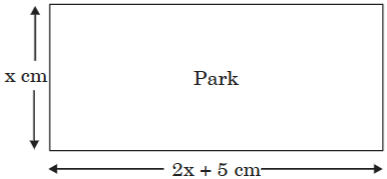
The length of a rectangular park is $5$ metres more than twice its breadth. If the area of the park is $250\ sq\ m,$ find the length and breadth of the park.
Answer
Image
Let the breadth of the rectangular park be $x \ cm .$
Then, according to question
Length of the rectangular park be
$2 x+5 \ cm$
Also, given area of rectangular park $=250 \ cm^2$
$\therefore 250=x(2 x+5)$
$\Rightarrow 2 x^2+5 x-250=0$
$\Rightarrow 2 x^2+25 x-20 x-250=0$
$\Rightarrow x(2 x+25)-10(2 x+250=0$
$\Rightarrow(2 x+25)(x-10)=0$
$\Rightarrow 2 x+25=0$ and $x-10=0$
$\Rightarrow x=-\frac{25}{2}$ and $x=10$
$\therefore$ Breadth, $x=10 \ cm$
$(\therefore x$ can't be negative $)$
Now, Length $=2(10)+5=25 \ cm$
Hence, the length of the park is $25 \ cm$ and breadth of the park is $10 \ cm .$
View full question & answer
Question 133 Marks
If $x=3$ is one root of the quadratic equation $2 x^2+ p x+30=0$, find the value of $p$ and the other root of the quadratic equation.
Answer
Given, $x=3$ is the root of quadratic equation
$2 x^2+px+30=0$
$\therefore 2(3)^2+p(3)+30=0$
$\Rightarrow 18+3 p+30=0$
$\Rightarrow 3 p=-48$
$\Rightarrow p=-16$
Now, the quadratic equation is
$2 x^2-16 x+30=0$
$\Rightarrow x^2-8 x+15=0$
$\Rightarrow x^2-3 x-5 x+15=0$
$\Rightarrow x(x-3)-5(x-3)=0$
$\Rightarrow(x-3)(x-5)=0$
$\Rightarrow x-3=0 $ or $ x-5=0$
$\Rightarrow x=3 $ or $ x=5$
Hence, the other root of quadratic equation is $5$ .
View full question & answer
Question 143 Marks
If $\alpha$ and $\beta$ are the zeroes of the quadratic polynomial $f(x)=x^2-4 x+3$, find the value of $\left(\alpha^4 \beta^2+\alpha^2 \beta^4\right)$.
Answer
$ f ( x )= x ^2-4 x +3$
$\because \alpha \ \beta \text { are the Zeros of } f ( x )$
$\therefore f ( x )=0$
$x ^2-4 x +3=0$
$\Rightarrow x ^2-3 x - x +3=0$
$\Rightarrow x ( x -3)-1( x -3)=0$
$\Rightarrow( x -3)( x -1)=0$
$\therefore x -3=0 $
$\Rightarrow x =3$
$\text { and } x -1=0 $
$\Rightarrow x =1$
$\therefore \alpha=3 \text { and } \beta=1 \text { or } \alpha=1 \text { and } \beta=3$
$\text { when } \alpha=3 \ \beta=1$
$\therefore \alpha^4 \beta^2+\alpha^2 \beta^4$
$=(3)^4(1)^2+(3)^2(1)^4$
$=81+9$
$=90$
View full question & answer
Question 153 Marks
Find that non$-$zero value of $k$, for which the quadratic equation $k x^2+1-2(k-1) x+x^2=0$ has equal roots. Hence find the roots of the equation.
Answer
Given the quadratic equation
$k x^2+1-2(k-1) x+x^2=0 .$
It can be written as:
$(k+1) x^2-2(k-1) x+1=0$
This equation is of the form
$a x^2+b x+c=0$
Discriminant is given by the formula,
$D=b^2-4 a c$
$D=[-2(k-1)]^2-4(k+1)(1)$
$=4\left(k^2+1-2 k\right)-4 k-4$
$=4 k^2-12 k$
$=4 k(k-3)$
For this quadratic equation to have zero roots the discriminant is zero.
$\Rightarrow 4 k(k-3)=0$
$\Rightarrow 4 k=0$ or $k-3=0$
$\Rightarrow k=0$ or $k=3$
But it is given that $k$ is non$-$zero.
$\Rightarrow k=3$
To find the roots of the equation substitute $k=3$ in the given quadratic equation we get,
$\Rightarrow(3+1) x^2-2(3-1) x+1=0$
$\Rightarrow 4 x^2-4 x+1=0$
On splitting the middle term we get,
$4 x^2-2 x-2 x+1=0$
$\Rightarrow 2 x(2 x-1)-1(2 x-1)=0$
$\Rightarrow(2 x-1)(2 x-1)=0$
$\Rightarrow x=\frac{1}{2}$ and $x=\frac{1}{2}$
The value of $k$ is $3$ and the roots of the equation are $\frac{1}{2}$ and $\frac{1}{2}$.
View full question & answer
3 Marks Question - Maths STD 10 Questions - Vidyadip