MCQ 11 Mark
If n is a natural number, then $9^{2 n }-4^{2 n }$ is always divisible by:
- A
$5$
- B
$3$
- ✓
both $5$ and $13$
- D
AnswerCorrect option: C. both $5$ and $13$
$n$ is natural number, and $9^{2 n}-4^{2 n}$ is the form of $a^{2 n}-b^{2 n}$ is or $\left(a^n\right)^2-\left(b^n\right)^2$ which is divisibel by $(a+b)$ and $(a-b)$ or $9+4$ and $9-4$ or $13$ and $5$ both.
View full question & answer→MCQ 21 Mark
The exponent of $2$ in the prime factorisation of $144$, is:
Answer$\begin{array}{c|c}2 &144\\\hline 2 & 72\\\hline 2 & 36\\\hline2 & 18\\\hline3 & 9\\\hline3 & 3 \\\hline&1 \end{array}$
$144=2^4 \times 3^2$
$\therefore$ Exponant of $2$ is $4$
View full question & answer→MCQ 31 Mark
For some integer q, every odd integer is of the form:
AnswerWe know that, all numbers that are not the multiple of 2 are odd numbers.
Odd integers are ..., -3, -1, 1, 3, 5,...
So, odd numbers can be written as 2m + 1, where m is an integer.
m can be ..., -2, -1, 0, 1, 2,...
$\therefore$ 2m + 1 can be ..., -3, -1, 1, 3,...
Hence, the correct answer is option D.
View full question & answer→MCQ 41 Mark
The smallest rational number by which $\frac{1}{3}$ should be multiplied so that its decimal expansion terminates after one place of decimal, is:
- ✓
$\frac{3}{10}$
- B
$\frac{1}{10}$
- C
$3$
- D
$\frac{3}{100}$
AnswerCorrect option: A. $\frac{3}{10}$
The smallest rational number which should be multiplied by $\frac{1}{3}$ to get a terminating.
$\text{decimals }=\frac{3}{10}$
$\because\ \frac{1}{3}\times\frac{3}{10}=\frac{1}{10}=0.1$
View full question & answer→MCQ 51 Mark
If $n =2^3 \times 3^4 \times 5^4 \times 7$, then the number of consecutive zeroes in $n$ , where $n$ is a natural number, is:|
AnswerSince, it is given that
$n=2^3 \times 3^4 \times 5^4 \times 7$
$=2^3 \times 5^4 \times 3^4 \times 7$
$=2^3 \times 5^3 \times 5 \times 3^4 \times 7$
$=(2 \times 5)^3 \times 5 \times 3^4 \times 7$
$=5 \times 3^4 \times 7 \times(10)^3$
So, this means the given number n will end with $3$ consecutive zeroes.
View full question & answer→MCQ 61 Mark
The number of decimal places after which the decimal expansion of the rational number $\frac{23}{2^2\times5}$ will terminate, is:
AnswerDecimal expansion of $\frac{23}{2^2\times5}=\frac{23}{20}$
$=\frac{23\times5}{20\times5}=\frac{115}{100}=1.15$
$\therefore$ Number of decimal places = 2
View full question & answer→MCQ 71 Mark
For some integer m, every even integer is of the form:
AnswerWe know that, even integers are 2, 4, 6, …
So, it can be written in the form of 2m Where, m = Integer = Z
[Since, integer is represented by Z]
or m = …, -1, 0, 1, 2, 3, …
2m = …, -2, 0, 2, 4, 6, …
View full question & answer→MCQ 81 Mark
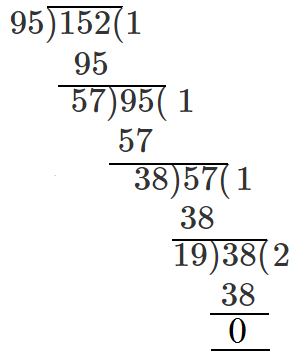
The HCF of 95 and 152, is:
AnswerHCF of 95 and 152 = 19
View full question & answer→MCQ 91 Mark
If $p$ and $q$ are co$-$prime numbers, then $p^2$ and $q^2$ are:
- ✓
Co$-$prime.
- B
Not co$-$prime.
- C
- D
AnswerCorrect option: A. Co$-$prime.
We know that the co$-$prime numbers have no factor in common, or, their $\text{HCF}$ is $1.$
Thus, $p^2$ and $q^2$ have the same factors with twice of the exponents of $p$ and $q$ respectively, which again will not have any common factor.
Thus we can conclude that $p ^2$ and $q ^2$ are co$-$prime numbers.
Hence, the correct choice is $(a).$
View full question & answer→MCQ 101 Mark
If the LCM of a and 18 is 36 and the HCF of a and 18 is 2, then a =
AnswerLCM (a, 18) = 36
HCF (a, 18) = 2
We know that the product of numbers is equal to the product of their HCF and LCM.
Therefore,
18a = 2(36)
$\text{a}=\frac{2(36)}{18}$
a = 4
Hence the correct choice is (c).
View full question & answer→MCQ 111 Mark
If two positive integers $a$ and $b$ are expressible in the form $a=p q^2$ and $b=p^2 q ; p, q$ being prime numbers, then $H C F(a, b)$ is:
- ✓
$pq$
- B
$p^3 q^3$
- C
$p^3 q^2$
- D
$p^2 q^2$
Answer$a=p q^2$ and $b=p^3 q$ where $a$ and $b$ are positive integers and $p, q$ are prime numbers, then $H C F=p q$.
View full question & answer→MCQ 121 Mark
If HCF (26, 169) = 13, then LCM (26, 169) =
AnswerHCF (26, 169) = 13
LCM (26, 169) $=\frac{26\times169}{13}=338$
View full question & answer→MCQ 131 Mark
Euclid’s division lemma states that for two positive integers a and b, there exist unique integers q and r such that a = bq + r, where r must satisfy:
AnswerAccording to Euclid’s Division lemma, for a positive pair of integers there exists unique integers q and r, such that,
a = bq + r, where 0 ≤ r < b
View full question & answer→MCQ 141 Mark
The remainder when the square of any prime number greater than 3 is divided by 6, is:
Answer$\because$ The given prime number is greater than 3
Let the prime number be $=6\text{k}\pm1$
When k is a natural number
$\therefore\ (6\text{k}\pm1)^2=36\text{k}^2\pm12\text{k}+1$
$=6\text{k}(6\text{k}\pm2)+1$
$\therefore$ Remainder = 1
View full question & answer→MCQ 151 Mark
The largest number which divides 70 and 125, leaving remainders 5 and 8, respectively, is:
AnswerSince, 5 and 8 are the remainders of 70 and 125, respectively.
Thus, after subtracting these remainders from the numbers, we have the numbers 65 = (70 - 5), 117 = (125 - 8), which is divisible by the required number.
Now, required number = HCF of 65, 117
[For the largest number]
For this, 117 = 65 × 1 + 52 [Dividend = divisor × quotient + remainder]
⇒ 65 = 52 × 1 + 13
⇒ 52 = 13 × 4 + 0
HCF = 13
Hence, 13 is the largest number which divides 70 and 125, leaving remainders 5 and 8.
View full question & answer→MCQ 161 Mark
If 3 is the least prime factor of number a and 7 is the least prime factor of number b, then the least prime factor of a + b, is:
Answer3 is the least prime factor of a 7 is the least prime factor of b, then sum of a a and b will be divisible by 2, 2 is the least prime factor of a + b.
View full question & answer→MCQ 171 Mark
If two positive integers $a$ and $b$ are written $a s a=x^3 y^2$ and $b=x y^3 ; x, y$ are prime numbers, then $H C F(a, b)$ is:
- A
$xy$
- ✓
$x y^2$
- C
$x^3 y^3$
- D
$x^2 y^2$
AnswerCorrect option: B. $x y^2$
It is given that,
$\text{a}=\text{x}^3\text{y}^2=\text{x}\times\text{x}\times\text{x}\times\text{y}\times\text{y}$
$\text{b}=\text{xy}^3=\text{x}\times\text{y}\times\text{y}\times\text{y}$
$\text{HCF(a, b)}=\text{HCF}(\text{x}^3\text{y}^2,\text{xy}^3)=\text{x}\times\text{y}\times\text{y}=\text{xy}^2$
Hence, the correct answer is option $B.$
View full question & answer→MCQ 181 Mark
Which of the following rational numbers have terminating decimal?
- $\frac{16}{225}$
- $\frac{5}{18}$
- $\frac{2}{21}$
- $\frac{7}{250}$
- A
$(i)$ and $(ii)$
- B
$(ii)$ and $(iii)$
- C
$(i)$ and $(iii)$
- ✓
$(i)$ and $(iv)$
AnswerCorrect option: D. $(i)$ and $(iv)$
We know that a rational number has terminating decimal if the prime factors of its denominator are in
the form $2^{ m } \times 5^{ n } \frac{16}{225}$ and $\frac{7}{250}$ has terminating decimals.
View full question & answer→MCQ 191 Mark
If two positive integers $a$ and $b$ are expressible in the form $a=p q^2$ and $b=p^2 q ; p, q$ being prime numbers, then $L C M(a, b)$ is:
- A
$pq$
- B
$p^3 q^3$
- C
$p^3 q^2$
- ✓
$p^2 q^2$
AnswerCorrect option: D. $p^2 q^2$
$A$ and $b$ are two positive integers and $a=p q^2$ and $b=p^2 q$, where $p$ and $q$ are prime numbers, then $L C M=p^2 q^2$.
View full question & answer→MCQ 201 Mark
If two positive integers $t n$ and $n$ arc expressible in the form $m=p q^3$ and $n=p^3 q^2$, where $p, q$ are prime numbers, then $H C F(m, n)=$
- A
$pq$
- ✓
$p q^2$
- C
$p^3 q^3$
- D
$p^2 q^3$
AnswerCorrect option: B. $p q^2$
$m$ and $n$ are two positive integers and $m=p q^3$ and $n=p q^2$, where $p$ and $q$ are prime numbers, then $H C F=p q^2$.
View full question & answer→MCQ 211 Mark
If $n$ is any natural number, then $6^n-5^n$ always ends with:
Answer$n$ is any natural number and $6^n-5^n$
We know that $6^n$ ends with $6$ and $5^n$ ends with $5$
$6^n-5^n$ will end with $6-5=1$
View full question & answer→MCQ 221 Mark
The least number that is divisible by all the numbers from 1 to 10 (both inclusive) is:
AnswerFactors of 1 to 10 numbers
1 = 1
2 = 1 × 2
3 = 1 × 3
4 = 1 × 2 × 2
5 = 1 × 5
6 = 1 × 2 × 3
7 = 1 × 7
8 = 1 × 2 × 2 × 2
9 = 1 × 3 × 3
10 = 1 × 2 × 5
LCM of number 1 to 10 = LCM (1, 2, 3, 4, 5, 6, 7, 8, 9, 10)
= 1 × 2 × 2 × 2 × 3 × 3 × 5 × 7 = 2520
View full question & answer→MCQ 231 Mark
The decimal expansion of the rational number $\frac{14587}{1250}$ will terminate after :
AnswerRational number $=\frac{14587}{1250}=\frac{14587}{2^1\times5^4}$
$\begin{array}{c|c}2 &1250\\\hline 5 & 625\\\hline 5 & 125\\\hline5 & 25\\\hline5&5\\\hline&1 \end{array}$
$=\frac{14587}{10\times5^3}\times\frac{(2)^3}{(2)^3}$
$=\frac{14587\times8}{10\times1000}$
$=\frac{116696}{10000}=11.6696$
Hence, given rational number will terminate after four decimal places.
View full question & answer→MCQ 241 Mark
The sum of the exponents of the prime factors in the prime factorisation of $196,$ is:
Answer$\begin{array}{c|c}2 &196\\\hline 2 & 98\\\hline 7 & 49\\\hline7 & 7\\\hline&1 \end{array}$
$=2 \times 2 \times 7 \times 7$
$=2^2 \times 7^2$
Sum of exponents $=2+2=4$
View full question & answer→MCQ 251 Mark
If $a =2^3 \times 3, b=2 \times 3 \times 5, c =3^{ n } \times 5$ and $\operatorname{LCM}( a , b , c )=2^3 \times 3^2 \times 5$, then $n =$
Answer$a =2^3 \times 3, b=2 \times 3 \times 5, c =3^{ n } \times 5$ and $LCm ( a , b , c )=2^3 \times 3^2 \times 5$
$\therefore 3^n=3^2 \Rightarrow n=2$
View full question & answer→MCQ 261 Mark
The LCM of two numbers is 1200. Which of the following cannot be their HCF?
AnswerLCM of two number = 1200
Their HCF of these two numbers will be the factor of 1200
500 cannot be its HCF.
View full question & answer→MCQ 271 Mark
$3.\overline{27}$ is:
Answer$3.\overline{27}$ is a rational number.
View full question & answer→MCQ 281 Mark
The decimal expansion of the rational number $\frac{33}{2^2\times5}$ will terminate after:
- A
- ✓
- C
- D
More than 3 decimal places.
Answer$\frac{33}{2^2\times5}$
Multiply and divide the expansion by 5
$\frac{33\times5}{2^2\times5^2}=\frac{165}{10^2}=1.65$
Hence, the decimal expansion of the rational number $\frac{33}{2^3\times5}$ will terminate after two decimal places.
View full question & answer→MCQ 291 Mark
If the HCF of 65 and 117 is expressible in the form 65m - 117, then the value of m is:
AnswerUse Euclid's algorithm to find the HCF of 65 and 117.
By Euclid's algorithm,
b = aq + r, 0 ≤ r < a
⇒ 117 = 65 × 1 + 32
⇒ 65 = 52 × 1 + 13
⇒ 52 = 13 × 4 + 0
$\therefore$ HCF (65, 117) = 13
It is given that HCF (65, 117) = 65m - 117.
⇒ 65m - 117 = 13
⇒ 65m = 130
⇒ m = 2
Hence, the correct option is option B.
View full question & answer→MCQ 301 Mark
The LCM and HCF of two rational numbers are equal, then the numbers must be:
AnswerLCM and HCF of two rational numbers are equal. Then those must be equal.
View full question & answer→MCQ 311 Mark
If the sum of LCM and HCF of two numbers is 1260 and their LCM is 900 more than their HCF, then the product of two numbers is:
AnswerGiven that sum of LCM and HCF = 1260
LCM + HCF = 1260 .....(1)
Let two numbers be a and b and HCF (a, b) = x
According to question:
Put value of HCF and LCM in equation (1)
⇒ 900 + x + x = 1260
⇒ 2x = 1260 - 900
⇒ 2x = 360
$\Rightarrow\ \text{x}=\frac{360}{2}$
⇒ x = 180 ......(2)
Now, LCM × HCF = Product of two numbers
Product of two number = (x + 900)(x)
= (180 + 900)(180)
= 1080 × 180
= 194400
View full question & answer→MCQ 321 Mark
If $p_1$ and $p_2$ are two odd prime numbers such that $p_1>p_2$, then $p_1^2-p_2^2$ is:
AnswerLet the two odd prime numbers $p_1$ and $p_2$ be $5$ and $3 .$
Then,
$\text{p}^2_1=5^2$
$=25$
And
$\text{p}^2_2=3^2$
$=9$
Thus,
$\text{p}^2_1-\text{p}^2_2=25-9$
$=16$
16 is even number.
Take another example, with $p_1$ and $p_2$ be $11$ and $7 .$
Then,
$\text{p}^2_1=11^2$
$=121$
And
$\text{p}^2_2=7^2$
$=49$
Thus,
$\text{p}^2_1-\text{p}^2_2=121-49$
$=72$
72 is even number.
Thus, we can say that $\text{p}^2_1-\text{p}^2_2$ is even number
In general the square of odd prime number is odd. Hence the difference of square of two prime numbers is odd
Hence the correct choice is $(a).$
View full question & answer→MCQ 331 Mark
$n^2 - 1$ is divisible by $8$, if $n$ is:
AnswerLet a $= n^2 - 1$
Here $n$ can be even or odd.
Case $I: n =$ Even i.e., $n = 2k$, where $k$ is an integer.
$\Rightarrow a=(2 k)^2-1$
$\Rightarrow a=4 k^2-1$
At $k=-1,4(-1)^2-1=4-1=3$, which is not divisible by $8 .$
At $k=0, a=4(0)^2-1=0-1=-1$, which is not divisible by $8$ , which is not.
Case II: $n =$ Odd i.e., $n =2 k +1$, where $k$ is an odd integer.
$\Rightarrow a=2 k+1$
$\Rightarrow a=(2 k+1)^2-1$
$\Rightarrow a=4 k^2+4 k+1-1$
$\Rightarrow a=4 k^2+4 k$
$\Rightarrow a=4 k(k+1)$
At $k=-1, a=4(-1)(-1+1)=0$ which is divisible by $8 $.
At $k=0, a=4(0)(0+1)=4$ which is divisible by $8.$
At $k=1, a=4(1)(1+1)=8$ which is divisible by $8.$
Hence, we can conclude from above two cases, if $n$ is odd, then $n^2-1$ is divisible by $8 .$
View full question & answer→MCQ 341 Mark
The smallest number by which $\sqrt{27}$ should be multiplied so as to get a rational number is
- A
$\sqrt{27}$
- B
$3\sqrt{3}$
- ✓
$\sqrt{3}$
- D
$3$
AnswerCorrect option: C. $\sqrt{3}$
$\sqrt{27}=\sqrt{3\times3\times3}$
$=3\sqrt{3}$
Out of the given choices $\sqrt{3}$ is the only smallest number by which if we multiply $\sqrt{27}$ we get a rational number.
Hence, the correct choice is (c).
View full question & answer→MCQ 351 Mark
The product of a non-zero rational number and an irrational number is
MCQ 361 Mark
For some integer $q$, every odd integer is of the form
AnswerCorrect option: D. $2 q+1$
View full question & answer→MCQ 371 Mark
For some integer $m$, every even integer is of the form
View full question & answer→MCQ 381 Mark
If two positive integers $a$ and $b$ are written as $a=x^3 y^2$ and $b=x y^3 ; x, y$ are prime numbers, then $\operatorname{HCF}(a, b)$ is
- A
$x y$
- ✓
$x y^2$
- C
$x^3 y^3$
- D
$x^2 y^2$
AnswerCorrect option: B. $x y^2$
View full question & answer→MCQ 391 Mark
If two positive integers $m$ and $n$ are expressible in the form $m=p q^3$ and $n=p^3 q^2$, where $p, q$ are prime numbers, then $\operatorname{HCF}(m, n)=$
- A
$p q$
- ✓
$p q^2$
- C
$p^3 q^3$
- D
$p^2 q^3$
AnswerCorrect option: B. $p q^2$
View full question & answer→MCQ 401 Mark
$n^2-1$ is divisible by 8 , if $n$ is
Answer(C) an odd integer
If $n$ is an even integer, then so is $n^2$ and hence $n^2-1$ is an odd integer. Consequently, $n^2-1$ cannot be divisible by 8 , if $n$ is an even integer. So, let $n$ be an odd integer. Then, $n=2 m+1$ for some integer $m$.
$
\therefore \quad n^2-1=(2 m+1)^2-1=4 m^2+4 m=4 m(m+1)
$
For any natural number $m, m(m+1)$ is an even natural number. Let $m=2 k$, where $k$ is a natural number.
$\therefore \quad n^2-1=8 k(2 k+1)$, which is divisible by 8 .
Hence, $n$ is an odd integer.
View full question & answer→MCQ 411 Mark
If $a=2^7 \times 3^{10}$ and $b=2^3 \times 3^7$, then $\operatorname{HCF}(a, b)$ is
- A
$2^3 \times 3^{10}$
- B
$2^{10} \times 3^{17}$
- ✓
$2^3 \times 3^7$
- D
$2^7 \times 3^7$
AnswerCorrect option: C. $2^3 \times 3^7$
(C) $2^3 \times 3^7$
HCF $(a, b)=\operatorname{HCF}\left(2^7 \times 3^{10}, 2^3 \times 3^7\right)=2^3 \times 3^7$
View full question & answer→MCQ 421 Mark
Given that $\operatorname{HCF}(2520,6600)=120$ and $\operatorname{LCM}(2520,6600)=252 \times k$, then the value of $k$ is
Answer(A) 550
We know that: $\operatorname{HCF}(a, b) \times \operatorname{LCM}(a, b)=a \times b$
$
\therefore \quad 120 \times 252 \times k=2520 \times 6600 \Rightarrow k=10 \times 55=550
$
View full question & answer→MCQ 431 Mark
The LCM of smallest prime number and the smallest odd composite number is
Answer(D) 18
The smallest prime number is 2 and the smallest odd composite number is 9 . Clearly,
View full question & answer→MCQ 441 Mark
The LCM of smallest odd prime number and the greatest two digit number is
MCQ 451 Mark
The smallest irrational number by which $\sqrt{20}$ should be multiplied so as to get a rational number, is
- A
$\sqrt{20}$
- B
$\sqrt{2}$
- C
- ✓
$\sqrt{5}$
AnswerCorrect option: D. $\sqrt{5}$
View full question & answer→MCQ 461 Mark
A pair of irrational numbers whose product is a rational number is
- A
$(\sqrt{16}, \sqrt{4})$
- B
$(\sqrt{5}, \sqrt{2})$
- ✓
$(\sqrt{3}, \sqrt{27})$
- D
$(\sqrt{36}, \sqrt{2})$
AnswerCorrect option: C. $(\sqrt{3}, \sqrt{27})$
View full question & answer→MCQ 471 Mark
The greatest number which divides 281 and 1249 , leaving remainder 5 and 7 respectively, is
MCQ 481 Mark
The LCM of three numbers $28,44,132$ is
View full question & answer→MCQ 491 Mark
The HCF of two numbers 65 and 104 is 13 . If LCM of 65 and 104 is $40 x$, then the value of $x$ is
View full question & answer→MCQ 501 Mark
If $p$ and $q$ are natural numbers and $p$ is a multiple of $q$, then what is the HCF of $p$ and $q$ ?
Answer(C) $q$
Given that $p$ is a multiple of $q$. So, let $p=m q$, where $m$ is a natural number.
$
\therefore \quad \operatorname{HCF}(p, q)=\operatorname{HCF}(m q, q)=q .
$
View full question & answer→MCQ 511 Mark
If $p^2=\frac{32}{50}$, then $p$ is a/an
Answer(C) rational number
We have, $p^2=\frac{32}{50} \Rightarrow p^2=\frac{16}{25} \Rightarrow p= \pm \frac{4}{5}$, which is a rational number.
View full question & answer→MCQ 521 Mark
The ratio of LCM and HCF of the least composite number and the least prime number is
- A
$1: 2$
- ✓
$2: 1$
- C
$1: 1$
- D
$1: 3$
AnswerCorrect option: B. $2: 1$
View full question & answer→MCQ 531 Mark
The HCF and the LCM of $12,21,15$ respectively are
View full question & answer→MCQ 541 Mark
The total number of factors of a prime number is
MCQ 551 Mark
If $\operatorname{HCF}(x, 8)=4, \operatorname{LCM}(x, 8)=24$, then $x$ is
Answer(C) 12
We know that: $\operatorname{LCM}(x, 8) \times \operatorname{HCF}(x, 8)=x \times 8$
$
\Rightarrow \quad 24 \times 4=x \times 8 \Rightarrow x=12
$
View full question & answer→MCQ 561 Mark
The smallest number which when divided by 17, 23 and 29 leaves a remainder 11 in each case is
Answer(B) 11350
Let the required natural number be $n$. Then,
$n-11$ is the LCM of 17,23 and 629.
i.e. $\quad n-11=\operatorname{LCM}(17,23,29)$
$\Rightarrow \quad n-11=17 \times 23 \times 29 \qquad[\because 17,23,29$ are distinct primes $]$
$\Rightarrow \quad n=11+11339=11350$
View full question & answer→MCQ 571 Mark
If two positive integers $a$ and $b$ are written as $a=p^3 q^4$ and $b=p^2 q^3$, where $p$ and $q$ are prime numbers, such that $\operatorname{HCF}(a, b)=p^m q^n$ and $\operatorname{LCM}(a, b)=p^r q^5$, then $(m+n)(r+s)$ equal to
Answer(C) 35
We find that: $\operatorname{HCF}(a, b)=\operatorname{HCF}\left(p^3 q^4, p^2 q^3\right)=p^2 q^3$
and,
$
\operatorname{LCM}(a, b)=\operatorname{LCM}\left(p^3 q^4, p^2 q^3\right)=p^3 q^4
$
$
\therefore \quad m=2, n=3, r=3 \text { and } s=4
$
Hence,
$
(m+n)(r+s)=5 \times 7=35
$
View full question & answer→MCQ 581 Mark
If $a=2^2 \times 3^x, b=2^2 \times 3 \times 5, c=2^2 \times 3 \times 7$, and $L C M(a, b, c)=3780$, then $x=$
Answer(D) 3
We have, $\operatorname{LCM}(a, b, c)=3780$
$
\Rightarrow \quad\left(2^2 \times 3^x, 2^2 \times 3 \times 5,2^2 \times 3 \times 7\right)=3780 \Rightarrow 2^2 \times 3^x \times 5 \times 7=2^2 \times 3^3 \times 5 \times 7 \Rightarrow x=3
$
View full question & answer→MCQ 591 Mark
If the LCM of two numbers is 3600 , then which of the following numbers cannot be their HCF?
Answer(B) 500
The HCF of two natural numbers is always a factor of their LCM. Clealy, 600, 400 and 150 are factors of 3600 , but 500 is not its factor. Hence, 500 cannot be the HCF of numbers whose LCM is 3600 .
View full question & answer→MCQ 601 Mark
The sum of the HCF and LCM of $12,21,15$ is
Answer(A) 423
We find that: $12=2^2 \times 3,21=3 \times 7$ and $15=3 \times 5$
$
\begin{array}{l}
\therefore \quad \operatorname{HCF}(12,21,15)=3 \text { and } \operatorname{LCM}(12,21,15)=2^2 \times 3 \times 5 \times 7=420 \\
\text { Hence, } \operatorname{HCF}(12,21,15)+\operatorname{LCM}(12,21,15)=3+420=423
\end{array}
$
View full question & answer→MCQ 611 Mark
If the HCF of 408 and 1032 is expressible in the form $1032 m-408 \times 5$, then the value of $m$ is
Answer(D) 3
We find that: $408=2^3 \times 3 \times 17$ and $1032=2^3 \times 3 \times 43$.
$
\therefore \quad \operatorname{HCF}(408,1032)=2^3 \times 3=24
$
It is given that: $\operatorname{HCF}(408,1032)=1032 m-408 \times 5$
$
\therefore \quad 1032 m-408 \times 5=24 \Rightarrow 1032 m=2040+24 \Rightarrow 1032 m=2064 \Rightarrow m=2
$
View full question & answer→MCQ 621 Mark
If $p_1$ and $p_2$ are odd prime numbers such that $p_1>p_2$, then $p_1^2-p_2^2$ is
Answer(A) an even number
$p_1^2-p_2^2=\left(p_1+p_2\right)\left(p_1-p_2\right)$.
It is given that $p_1$ and $p_2$ are odd prime numbers. Therefore $p_1+p_2$ and $p_1-p_2$ are even numbers. Hence, $\left(p_1+p_2\right)\left(p_1-p_2\right)=p_1^2-p_2^2$ is an even number. In fact, $p_1^2-p_2^2$ is a multiple of 4 .
View full question & answer→MCQ 631 Mark
If the HCF of 85 and 153 is expressible in the form $85 n-153$, then the value of $n$ is
Answer(B) 2
We have, $85=5 \times 17$ and $153=3^2 \times 17$. Therefore, $\operatorname{HCF}(85,153)=17$.
It is given that $\operatorname{HCF}(85,153)=85 n-153$.
$
\therefore \quad 85 n-153=17 \Rightarrow 85 n=170 \Rightarrow n=2
$
View full question & answer→MCQ 641 Mark
If 3 is the least prime factor of $m$ and 5 is the least prime factor of $n$, then the least prime factor of $(m+n)$ is
Answer(B) 2
It is given that least prime factor of $m$ is 3 , so other prime factors of $m$ are greater than 3 . Consequently, 2 is not a prime factor of $m$ and hence $m$ is an odd integer. Similarly, $n$ is an odd integer. Therefore, $m+n$ is an even integer and hence its least prime factor is 2 .
View full question & answer→MCQ 651 Mark
$m=d n+r$ where $m, n$ are positive integers and $d$ and $r$ integers, then $n$ is the HCF of $m$ and $n$, if
- A
$r=1$
- B
$0$
- ✓
$r=0$
- D
$r$ is a real number
Answer(C) $r=0$
In $n$ is the HCF of $m$ and $n$, then $n$ is a factor of $m$ and hence $n$ is a factor of $d n+r$. This is possible only when $r=0$.
View full question & answer→MCQ 661 Mark
If two positive integers $p$ and $q$ can be expressed as $p=18 a^2 b^4$ and $q=20 a^3 b^2$ where $a$ and $b$ are prime numbers, then $\operatorname{LCM}(p, q)$ is
- A
$2 a^2 b^2$
- B
$180 a^2 b^2$
- C
$12 a^2 b^2$
- ✓
$180 a^3 b^4$
AnswerCorrect option: D. $180 a^3 b^4$
(D) $180 a^3 b^4$
We have,
$
\begin{aligned}
& p=2 \times 3^2 \times a^2 \times b^4 \text { and } q=2^2 \times 5 \times a^3 \times b^2 \\
\therefore \quad & \operatorname{LCM}(p, q)=2^2 \times 3^2 \times 5 \times a^3 \times b^4=180 a^3 b^4
\end{aligned}
$
View full question & answer→MCQ 671 Mark
Let $n$ be a natural number. Then, the $\operatorname{LCM}(n, n+1)$ is
AnswerCorrect option: C. $n(n+1)$
(C) $n(n+1)$
For any natural number $n$, natural numbers $n$ and $n+1$ are relatively prime.
$
\therefore \quad \operatorname{LCM}(n, n+1)=n(n+1)
$
View full question & answer→MCQ 681 Mark
The HCF of two consecutive positive integers is
Answer(B) 1
In any two consecutive positive integers one is even and other is odd. So, they have 1 as the only common factor. Hence, their HCF is 1 .
View full question & answer→MCQ 691 Mark
The smallest number divisible by all natural numbers between 1 and 10 (both inclusive) is
Answer(B) 2520
Required number is the LCM of $1,2,3,4,5,6,7,8,9,10$.
Now,
$
\begin{aligned}
\operatorname{LCM}(1,2,3,4,5,6,7,8,9,10) & =\operatorname{LCM}\left(2^0, 2^1, 3^1 2^2, 5^1, 2^1 \times 3^1, 7^1, 2^3, 3^2, 2^1 \times 5^1\right) \\
& =2^3 \times 3^2 \times 5^1 \times 7^1=2520
\end{aligned}
$
View full question & answer→MCQ 701 Mark
The HCF of smallest prime number and the smallest composite number is
Answer(A) 2
The smallest prime and the smallest composite numbers are 2 and 4 respectively.
$\operatorname{HCF}(2,4)=2$.
View full question & answer→MCQ 711 Mark
The LCM of the smallest two digit composite number and the smallest composite number is
Answer(B) 20
The smallest two digit composite number is 10 and the smallest composite number is 4 . Prime factorizations of these two are: $10=2^1 \times 5^1$ and $4=2^2$.
$
\therefore \quad \operatorname{LCM}(10,4)=2^2 \times 5^1=20
$
View full question & answer→MCQ 721 Mark
Let $p$ be a prime number. The quadratic equation having its factors as zeros is
- A
$x^2-p x+p=0$
- ✓
$x^2-(p+1) x+p=0$
- C
$x^2+(p+1) x+p=0$
- D
$x^2-p x+(p+1)=0$
AnswerCorrect option: B. $x^2-(p+1) x+p=0$
(B) $x^2-(p+1) x+p=0$
Factors of $p$ are 1 and $p$ only. So, the quadratic equation having 1 and $p$ as its zero is
$x^2-x(1+p)+1 \times p=0$ or, $x^2-(p+1) x+p=0$
View full question & answer→MCQ 731 Mark
Let $p$ be a prime number. The sum of its factors is
Answer(C) $p+1$
The factors of $p$ are 1 and $p$. So, their sum is $p+1$.
View full question & answer→MCQ 741 Mark
If $p$ and $q$ are two distinct prime numbers, then $\operatorname{LCM}(p, q)$ is
Answer(D) $p q$
Factors of $p$ are: 1 and $p$. Factors of $q$ are: 1 and $q$.
$
\begin{array}{ll}
\therefore & \operatorname{LCM}(p, q)=1 \times p \times q=p q \\
\operatorname{ALITER} & \operatorname{LCM}(p, q) \times \operatorname{HCF}(p, q)=p q \Rightarrow \operatorname{LCM}(p, q) \times 1=p q \Rightarrow \operatorname{LCM}(p, q)=p q
\end{array}
$
View full question & answer→MCQ 751 Mark
If $p$ and $q$ are two distinct prime numbers, then their HCF is
Answer(D) 1
A prime number has no factor other than 1 and the number itself. Therefore, Factors of $p$ are: 1 and $p$ only. Factors of $q$ are: 1 and $q$ only.
Therefore, 1 is the only common factor of $p$ and $q$. Hence, HCF $(p, q)=1$.
View full question & answer→MCQ 761 Mark
HCF of two positive integers is always
MCQ 771 Mark
For any natural numbers, $25^{2 n}-9^{2 n}$ is always divisible by
Answer(C) both 16 and 34
[Hint: $a^{2 n}-b^{2 n}$ is divisible by both $(a+b)$ and $(a-b)$ ]
View full question & answer→MCQ 781 Mark
If $(a \times 5)^n$ ends with the digit zero for every natural number $n$, then a is
View full question & answer→MCQ 791 Mark
View full question & answer→MCQ 801 Mark
The remainder when the square of any prime number greater than 3 is divided by 6 , is
Answer(A) 1
[Hint: Any prime number greater than 3 is of the form $6 k \pm 1$, where $k$ is a natural number and $\left.(6 k \pm 1)^2=36 k^2 \pm 12 k+1=6 k(6 k \pm 2)+1\right]$
View full question & answer→MCQ 811 Mark
If $n$ is any natural number, then $6^n-5^n$ always ends with
Answer(A) 1
[Hint: For any $n \in N, 6^n$ and $5^n$ end with 6 and 5 respectively. Therefore, $6^n-5^n$ always ends with $6-5=1$.]
View full question & answer→MCQ 821 Mark
If $n$ is a natural number, then $9^{2 n}-4^{2 n}$ is always divisible by
Answer(C) both 5 and 13
[Hint: $9^{2 n}-4^{2 n}$ is of the form $a^{2 n}-b^{2 n}$ which is divisible by both $a-b$ and $a+b$. So, $9^{2 n}-4^{2 n}$ is divisible by both $9-4=5$ and $9+4=13$.]
View full question & answer→MCQ 831 Mark
Three bells ring at intervals of 4,7 and 14 minutes. All the three rang at 6 AM . When will they ring together again?
- A
$6: 07 AM$
- B
$6: 14 AM$
- ✓
$6: 28 AM$
- D
$6: 25 AM$
AnswerCorrect option: C. $6: 28 AM$
View full question & answer→MCQ 841 Mark
The smallest number by which $\sqrt{27}$ should be multiplied so as to get a rational number is
- A
$\sqrt{27}$
- B
$3 \sqrt{3}$
- ✓
$\sqrt{3}$
- D
AnswerCorrect option: C. $\sqrt{3}$
View full question & answer→MCQ 851 Mark
If 3 is the least prime factor of number $a$ and 7 is the least prime factor of number $b$, then the least prime factor of $a+b$, is
View full question & answer→MCQ 861 Mark
If $p$ and $q$ are co-prime numbers, then $p^2$ and $q^2$ are
View full question & answer→MCQ 871 Mark
If the LCM of $a$ and 18 is 36 and the HCF of $a$ and 18 is 2 , then $a=$
View full question & answer→MCQ 881 Mark
Any one of the numbers $a, a+2$ and $a+4$ is a multiple of
View full question & answer→MCQ 891 Mark
How many prime numbers are of the form $10 n+1$, where $n$ is a natural number such that $1 \leq n<10$ ?
View full question & answer→MCQ 901 Mark
If the LCM of two prime number $p$ and $q(p>q)$ is 221 then the value of $3 p-q$ is
View full question & answer→MCQ 911 Mark
If the sum of two numbers is 1215 and their HCF is 81 , then the possible number of pairs of such number is
MCQ 921 Mark
If $\operatorname{LCM}(x, 18)=36$ and $\operatorname{HCF}(x, 18)=2$, then $x$ is
View full question & answer→MCQ 931 Mark
If $a^2=\frac{23}{25}$, then $a$ is
View full question & answer→MCQ 941 Mark
Prime factors of the denominator of a rational number with decimal expansion 44.123 are
MCQ 951 Mark
If the sum of LCM and HCF of two numbers is 1260 and their LCM is 900 more than their HCF, then the product of two numbers is
MCQ 961 Mark
The LCM and HCF of two rational numbers are equal, then the numbers must be
MCQ 971 Mark
$3 . \overline{27}$ is
View full question & answer→MCQ 981 Mark
$119^2-11^2$ is a
View full question & answer→MCQ 991 Mark
If $a=2^3 \times 3, b=2 \times 3 \times 5, c=3^n \times 5$ and $\operatorname{LCM}(a, b, c)=2^3 \times 3^2 \times 5$, then $n=$
View full question & answer→MCQ 1001 Mark
The largest number which divides 70 and 125 , leaving remainders 5 and 8 , respectively, is
MCQ 1011 Mark
The least number that is divisible by all the numbers from 1 to 10 (both inclusive) is
MCQ 1021 Mark
The product of a non-zero rational number and an irrational number is
MCQ 1031 Mark
$\pi$ is
View full question & answer→MCQ 1041 Mark
The HCF of two numbers is 18 and their product is 12960 . Their LCM will be
MCQ 1051 Mark
The LCM of $2^3 \times 3^2$ and $2^2 \times 3^3$ is
- A
$2^3$
- B
$3^3$
- ✓
$2^3 \times 3^3$
- D
$2^2 \times 3^2$
AnswerCorrect option: C. $2^3 \times 3^3$
View full question & answer→MCQ 1061 Mark
$\sqrt{5}+\sqrt{3}+2$ is
View full question & answer→MCQ 1071 Mark
The smallest irrational number by which $\sqrt{18}$ should be multiplied so as to get a rational number is
- A
$\sqrt{18}$
- B
$2 \sqrt{2}$
- ✓
$\sqrt{2}$
- D
AnswerCorrect option: C. $\sqrt{2}$
View full question & answer→MCQ 1081 Mark
The decimal expansion of $\pi$ is
- A
- ✓
non-terminating non-repeating
- C
- D
AnswerCorrect option: B. non-terminating non-repeating
View full question & answer→MCQ 1091 Mark
If $\operatorname{HCF}(26,169)=13$, then $\operatorname{LCM}(26,169)=$
View full question & answer→MCQ 1101 Mark
The HCF of 95 and 152 , is
MCQ 1111 Mark
In Q. No. 6, $\operatorname{HCF}(a, b)$ is
- ✓
$p q$
- B
$p^3 q^3$
- C
$p^3 q^2$
- D
$p^2 q^2$
View full question & answer→MCQ 1121 Mark
If two positive ingeters $a$ and $b$ are expressible in the form $a=p q^2$ and $b=p^3 q ; p, q$ being prime numbers, then $\operatorname{LCM}(a, b)$ is
- A
$p q$
- B
$p^3 q^3$
- ✓
$p^3 q^2$
- D
$p^2 q^2$
AnswerCorrect option: C. $p^3 q^2$
View full question & answer→MCQ 1131 Mark
If two positive integers $a$ and $b$ are written as $a=x^3 y^2$ and $b=x y^3$, where $x, y$ are prime numbers, then the result obtained by dividing the product of the positive integers $a, b$ by the $\operatorname{LCM}(a, b)$ is
- A
$x y$
- ✓
$x y^2$
- C
$x^3 y^3$
- D
$x^2 y^2$
AnswerCorrect option: B. $x y^2$
View full question & answer→MCQ 1141 Mark
The sum of the exponents of the prime factors in the prime factorisation of 196 , is
MCQ 1151 Mark
If $n=2^3 \times 3^4 \times 5^4 \times 7$, then the number of consecutive zeros in $n$, where $n$ is a natural number, is
View full question & answer→MCQ 1161 Mark
The LCM of two numbers is 1200 . Which of the following cannot be their HCF?
MCQ 1171 Mark
The exponent of 5 in the prime factorisation of 3750 , is