Question 15 Marks
From the top of a $7 m$ high building, the angle of elevation of the top of a cable tower is $60^{\circ}$ and the angle of depression of its foot is $45^{\circ}$. Determine the height of the tower.
AnswerLet the height of the building be $\text{AB}$ and that of tower be $\text{EC}$
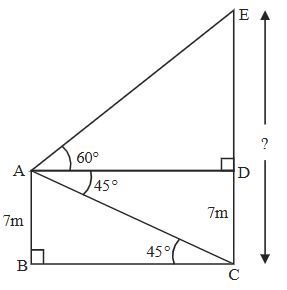
$\text{AD}$ and $\text{BC}$ are parallel
So,$\text{AD=BC}$
Now, $\text{AD \ BC}$ are parallel,
taking $\text{AC}$ as transversal
$\angle \text{ACB}=\angle \text{DAC} ($ Alternate angles $)$
$\angle \text{ACB}=45^{\circ}$
In right angle triangle $\text{ABC ,}$
$\tan C=\frac{\text { Side opposite to angle } C}{\text { Side adjacent to angle } C}$
$\tan 45^{\circ}
=\frac{AB}{BC}$
$1=\frac{AB}{BC}$
$1=\frac{7}{BC}$
$\text{BC}=7 m$
Since $\text{BC}$
So, $\text{AD}=7 m$
Since Now, In a right angle triangle $\text{ADE },$
$\tan A =\frac{\text { Side opposite to angle } A}{\text { Side adjacent to angle } A}$
$\tan 60^{\circ} =\frac{ED}{AD}$
$\sqrt{3} =\frac{ED}{AD}$
$\sqrt{3} =\frac{ED}{7}$
$7 \sqrt{3} =\text{ED}$
$\text{ED} =7 \sqrt{3}$
Height of tower $= \text{ED + DC}$
$=7 \sqrt{3}+7$
$=7(\sqrt{3}+1) m$ View full question & answer→Question 25 Marks
The shadow of a tower standing on a level ground is found to be 40 m longer when the Sun's altitude is $30^{\circ}$ than when it was $60^{\circ}$. Find the height of the tower.
Answer
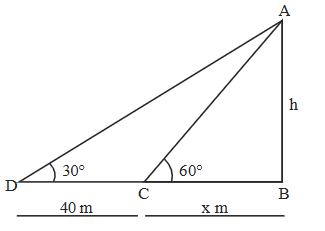
Let height of the tower $A B=h m$
Here, DC $=40 m$ and $B C=x m$
In $\triangle ABC , \tan 60^{\circ}=\frac{ AB }{ BC }=\frac{ h }{ x }$
$
\sqrt{3}=\frac{h}{x}
$
$
Or\quad h=\sqrt{3} x\quad \quad \ldots \ldots(i)
$
$
\begin{aligned}
Also, \quad\tan 30^{\circ} & =\frac{h}{(40+x)} \\
\frac{1}{\sqrt{3}} & =\frac{h}{(40+x)} \ \quad \quad \ldots \ldots(ii)
\end{aligned}
$
On putting the value of $h$ in eq. (ii) we get,
$
\begin{aligned}
\frac{1}{\sqrt{3}} & =\frac{\sqrt{3} x}{(40+x)} \\
40+x & =3 x \\
2 x & =40 \\
Or\quad\quad x & =20
\end{aligned}
$
Therefore, the height of the tower is $20 \sqrt{3} m$. View full question & answer→Question 35 Marks
The angle of elevation of a cloud from a point 60 m above the surface of the water of a lake is $30^{\circ}$ and the angle of depression of its shadow in water of lake is $60^{\circ}$. Find the height of the cloud from the surface of water.
AnswerThe depth of the shadow will be same as the distance of the cloud from the surface of the lake. Let us consider the following diagram.
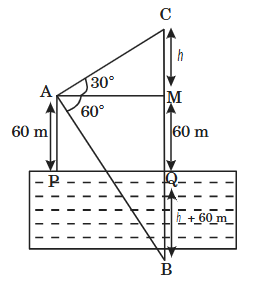
Here, $A P=60 m$ is the height of the point of observation. $Q C=h+60 m$ is the height of the cloud from the surface of the lake. $Q B=h+60 m$ is the depth of the shadow.
In $\triangle A M C$
$\begin{array}{l}\tan 30^{\circ}=\frac{C M}{M A} \\\Rightarrow \frac{1}{\sqrt{3}}=\frac{h}{M A} \\\Rightarrow M A=\sqrt{3} h\quad\quad \ldots\ldots \text {(i)}\end{array}$
In $\triangle A M B$
$\begin{array}{l}\tan 60^{\circ}=\frac{B M}{M A} \\\Rightarrow \sqrt{3}=\frac{60+h+60}{M A} \\\Rightarrow M A=\frac{120+h}{\sqrt{3}}\quad \quad \ldots \ldots \text {(ii)}\end{array}$
Equating equation (i) and (ii)
$\sqrt{3} h=\frac{120+h}{\sqrt{3}}$
$\begin{array}{l}\Rightarrow 3 h=120+h \\\Rightarrow 2 h=120 \\\Rightarrow h=60 m\end{array}$
Height of the cloud from the surface of the lake
$=Q C=h+60=60+60=120 m$
Hence, the height of the cloud from the surface of the lake is 120 m. View full question & answer→Question 45 Marks
An aeroplane is flying at a height of 300 m above the ground. Flying at this height, the angles of depression from the aeroplane of two points on both banks of a river in opposite directions are $45^{\circ}$ and $60^{\circ}$ respectively. Find the width of the river. [Use $\sqrt{3}=1.732$ ]
Answer
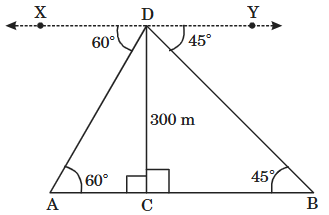
Let height of the aeroplane above the river is $C D$. Let $A$ and $B$ be two points on both banks in opposite direction.
Given:
Height of the aeroplane above the river is $C D=300 m$
$\angle A D X=\angle C A D=60^{\circ}\quad\ldots\text {(Alternateangle)}$
$\angle B D Y=\angle C B D=45^{\circ}\quad\ldots\text{(Alternate angle)}$
In right $\triangle B C D$
$\tan 45^{\circ}=\frac{C D}{B C}$
Using $\tan 45^{\circ}=1$ we get,
$\Rightarrow 1=\frac{300}{ BC }$
$\Rightarrow B C=300 m$
In right $\triangle A C D$
$\tan 60^{\circ}=\frac{CD}{AC}$
Using $\tan 60^{\circ}=\sqrt{3}$ we get,
$\sqrt{3}=\frac{300}{ AC }$
$\Rightarrow AC =\frac{300}{\sqrt{3}}=100 \sqrt{3} m$
As width of river is $AB = BC + AC$
$\begin{array}{l}=300+100 \sqrt{3} \\=300+100 \times 1.73 \\=300+173 \\=473 m\end{array}$
Therefore, Width of the river is $473 m.$ View full question & answer→Question 55 Marks
The angle of elevation of the top $Q$ of a vertical tower $P Q$ from a point $X$ on the ground is $60^{\circ}$. From a point $Y, 40 m$ vertically above $X$, the angle of elevation of the top $Q$ of the tower is $45^{\circ}$. Find the height of the tower $P Q$ and the distance $P X$.
AnswerAccording to the question, the angle of elevation of the top $Q$ of a vertical tower $P Q$ from a point $X$ on the ground is $60^{\circ}$. From a point $Y, 40 m$ vertically above $X$, the angle of elevation of the top $Q$ of the tower is
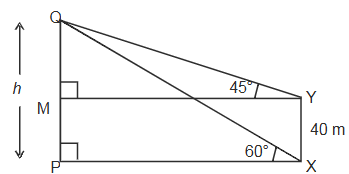
$\begin{array}{l}M P=X Y=40 m \\Q M=h-40\end{array}$
In right angled triangle $\triangle Q M Y$,
Using $\tan 45^{\circ}=1$ we get,
$1=\frac{h-40}{P X} \quad(M Y=P X)$
Hence, $P X=h-40\quad\quad\quad\text{(Equation I)}$
$\tan 60^{\circ}=\frac{Q P}{P X}$
Using $\tan 60^{\circ}=\sqrt{3}$ we get,
$\begin{array}{l}\sqrt{3}=\frac{Q P}{P X} \\P X=\frac{h}{\sqrt{3}}\quad\quad\quad\text{(Equation II)}\end{array}$
From equations I and II,
$h-40=\frac{h}{\sqrt{3}}$
$\begin{array}{l}\sqrt{3} h-40 \sqrt{3}=h \\\sqrt{3} h-h=40 \sqrt{3} \\1.732 h-h=40 \text { (1.732) } \\h=94.645 m\end{array}$
Thus, $P Q=94.645 m$
Also, $P X=94.645-40=54.645$
(Using Equation I) Thus, $P X=54.79 m$ View full question & answer→Question 65 Marks
At a point $A, 20$ metres above the level of water in a lake, the angle of elevation of a cloud is $30^{\circ}$. The angle of depression of the reflection of the cloud in the lake, at $A$ is $60^{\circ}$. Find the distance of the cloud from $A$.
Answer
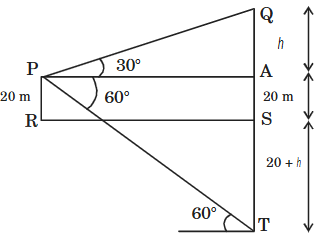
Let the distance of the cloud from $A$ be $h$ meters. Distance of the reflection of the cloud in the lake will be same as distance of the cloud from the level of water in the lake.
$\begin{array}{l}\Rightarrow T S=20+h \\\text { In } \triangle T A P\end{array}$
$\begin{array}{l}\tan 60^{\circ}=\frac{A T}{A P} \\\Rightarrow \sqrt{3}=\frac{40+h}{A P} \\\Rightarrow A P=\frac{40+h}{\sqrt{3}}\quad \quad \ldots \ldots(i)\end{array}$
In $\triangle A P Q$
$\tan 30^{\circ}=\frac{h}{A P}$
$\begin{array}{l}\Rightarrow \frac{1}{\sqrt{3}}=\frac{h}{A P} \\\Rightarrow A P=h \sqrt{3}\end{array}$
Equating both the values of $A P$ we get,
$\begin{array}{l}\frac{40+h}{\sqrt{3}}=\sqrt{3} h \\\Rightarrow 40+h=3 h \\\Rightarrow h=20 m\end{array}$
Distance of the cloud from $A$ is $20 m.$ View full question & answer→Question 75 Marks
From a point $P$ on the ground the angle of elevation of the top of a tower is $30^{\circ}$ and that of the top of a flag staff fixed on the top of the tower, is $60^{\circ}$. If the length of the flag staff is 5 m , find the height of the tower.
Answer
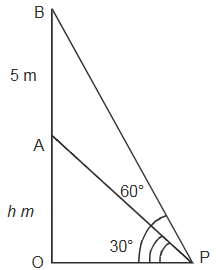
Let $O A$ be the tower of the height $h$ meters and $A B$ be the height of flag staff i.e. 5 m.
Now angle of elevation of the top of the tower and the flag staff from point $P$ is $30^{\circ}$ and $60^{\circ}$ respectively.
$\begin{array}{l}O A=h m, A B=5 m \text { and } \angle OPA=30^{\circ}, \\\angle O P B=60^{\circ}\end{array}$
In right $\triangle O A P, \angle O P A=30^{\circ}$,
$\Rightarrow \tan 30^{\circ}=\frac{h}{OP}$
Using $\tan 30^{\circ}=\frac{1}{\sqrt{3}}$ we get,
$\begin{array}{l}\Rightarrow \frac{1}{\sqrt{3}}=\frac{h}{OP} \\\Rightarrow OP=h \sqrt{3}\quad \quad \ldots \ldots \text {(i)}\end{array}$
Now in right $\triangle O B P, \angle O P B=60^{\circ}$,
$\Rightarrow \tan 60^{\circ}=\frac{h+5}{OP}$
Using $\tan 60^{\circ}=\sqrt{3}$ we get,
$\Rightarrow \sqrt{3}=\frac{h+5}{OP}$
Now using equation (i) and substituting the value of $O P$,
$\begin{array}{l}\Rightarrow \sqrt{3}=\frac{h+5}{h \sqrt{3}} \\\Rightarrow 3 h=h+5 \\\Rightarrow 2 h=5 \\\Rightarrow h=\frac{5}{2}=2.5\end{array}$
Here we get the value of, $h=2.5 m$
Hence the height of the tower is $2.5 m.$ View full question & answer→Question 85 Marks
The angles of elevation and depression of the top and the bottom of a tower from the top of a building, 60 m high, are $30^{\circ}$ and $60^{\circ}$ respectively. Find the difference between the heights of the building and the tower and the distance between them.
Answer
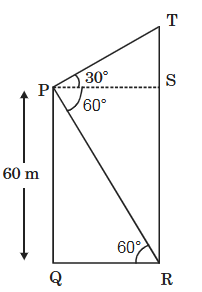
From the given figure we have,
$P Q=60 m, P S=Q R$
In $\triangle P Q R$
$\begin{array}{l}\frac{P Q}{Q R}=\tan 60^{\circ} \\\Rightarrow \frac{60}{Q R}=\frac{\sqrt{3}}{1} \\\Rightarrow Q R=\frac{60}{\sqrt{3}}=\frac{60}{\sqrt{3}} \times \frac{\sqrt{3}}{\sqrt{3}}=20 \sqrt{3} m\end{array}$
In $\triangle T S P$
$\begin{array}{l}\frac{T S}{P S}=\tan 30^{\circ} \\\Rightarrow \frac{T S}{20 \sqrt{3}}=\frac{1}{\sqrt{3}} \Rightarrow T S=\frac{20 \sqrt{3}}{\sqrt{3}}=20 m\end{array}$
Then, the height of the tower, $T R=T S+S R$ $=20+60=80 m$
Hence, difference between the heights of the tower and the building is $80 m-60 m=20 m$
And the distance between the tower and the building is $20 \sqrt{3} m$. View full question & answer→Question 95 Marks
From a point D on the ground the angle of elevation of the top of a tower is $45^{\circ}$ and that of the top of a flagstaff fixed on the top of the tower is $60^{\circ}$. If the distance between the foot & point D is 120 m, then find the height of the flagstaff. [Use $\sqrt{3}=1.73$]
AnswerConsider $B C$ as the tower and $A B$ as the flagstaff fixed on top of the tower. The distance $C D$ is 120 m .
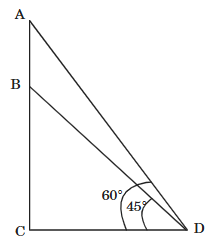
In $\triangle B C D, \tan 45^{\circ}=\frac{B C}{C D}$,
$\begin{array}{l}1=\frac{B C}{120} \\B C=120\end{array}$
So the height of the tower is 120 m.
Now in $\triangle A C D, \tan 60^{\circ}=\frac{ AC }{ CD }$,
$\begin{array}{l}\sqrt{3}=\frac{AB+BC}{CD} \\\sqrt{3}=\frac{AB+120}{120} \\120 \sqrt{3}=AB+120 \\AB=120 \sqrt{3}-120 \\AB=120(\sqrt{3}-1) \\AB=120(1.732-1) \\AB=120(0.732) \\AB=87.84 m\end{array}$
Therefore the height of the flagstaff is 87.84 m. View full question & answer→Question 105 Marks
The angle of elevation of the top of a building from the foot of the tower is $30^{\circ}$ and the angle of elevation of the top of the tower from the foot of the building is $60^{\circ}$. If the tower is 60 m high, find the height of the building.
AnswerAssume $A B$ as the building and $C D$ as the tower. Suppose the height of the building $A B$ as ' $h$ ' $m$.
Given that, $\angle A C B=30^{\circ}, \angle C B D=60^{\circ}$ and $C D=60 m$.
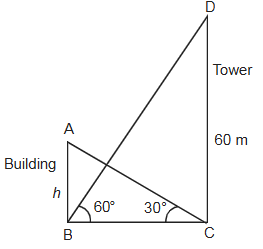
$\triangle B C D$ is a right angled triangle then,
$\begin{aligned}\cot 60^{\circ} & =\frac{B C}{C D} \\\Rightarrow B C & =C D \cot 60^{\circ} \\\Rightarrow B C & =60 \times \frac{1}{\sqrt{3}} \\& =\frac{60}{\sqrt{3}} \times \frac{\sqrt{3}}{\sqrt{3}} \\& =20 \sqrt{3} m\end{aligned}$
$\triangle A C B$ is a right angled triangle then,
$\begin{array}{l}\tan 30^{\circ}=\frac{A B}{B C} \\\Rightarrow A B=B C \tan 30^{\circ} \\\Rightarrow h=20 \sqrt{3} \times \frac{1}{\sqrt{3}}=20 m\end{array}$
$\therefore$ The height of the building is 20 m. View full question & answer→Question 115 Marks
The angles of elevation and depression of the top and bottom of a light-house from the top of a 60 m high building are $30^{\circ}$ and $60^{\circ}$ respectively. Find
(i) The difference between the heights of the light-house and the building.
(ii) The distance between the light-house and the building.
Answer
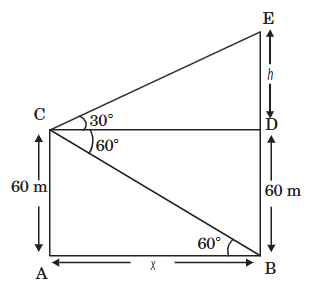
Let $A C$ be the building such that $A C=60 m$ and BE be the light house.
Let $A B=C D=x$ be the horizontal distance between the building and light house.
It is given that the angles of elevation and depression of the top and bottom of a light-house from the top of a 60 m high building are $30^{\circ}$ and $60^{\circ}$ respectively.
$\Rightarrow \angle D C E=30^{\circ} \text { and } \angle A B C=60^{\circ}$
Let $D E$ be the difference between the heights of the light-house and the building $h$.
(ii) Now, in right triangle $A B C$,
$\begin{array}{l}\tan 60^{\circ}=\frac{A C}{A B} \\\Rightarrow \sqrt{3}=\frac{60}{x} \\\Rightarrow x=\frac{60}{\sqrt{3}} \\
\Rightarrow x=20 \sqrt{3}\end{array}$
Therefore, the distance between the light-house and the building, $x=20 \sqrt{3} m$
$\begin{array}{l}\text { (i) In right triangle CDE, } \\\tan 30^{\circ}=\frac{D E}{C D} \\\Rightarrow \frac{1}{\sqrt{3}}=\frac{h}{x} \\\Rightarrow h=\frac{x}{\sqrt{3}} \\\Rightarrow h=\frac{20 \sqrt{3}}{\sqrt{3}} \\\Rightarrow h=20 m\end{array}$
Therefore, the difference between the heights of the light-house and the building is $h=20 m$ View full question & answer→Question 125 Marks
Two poles of equal heights are standing opposite to each other on either side of the road, which is 100 m wide. From a point between then on the road, the angles of elevation of the top of the poles are $60^{\circ}$ and $30^{\circ}$, respectively. Find the height of the poles.
Answer
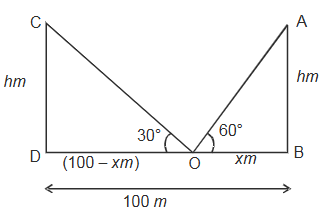
Let $A B$ and $C D$ be the poles of equal heights standing opposite to each other on either sides of the road and distance between them is $B D=100 m$
Let $O$ be the point on the road, the angles of elevation of the top of the poles are $60^{\circ}$ and $30^{\circ}$, respectively.
Let $O B=x m$, therefore $O D=(100-x) m$
Now in $\triangle A O B$
$\begin{array}{l}\tan 60^{\circ}=\frac{A B}{O B}=\frac{h}{x} \\\Rightarrow \sqrt{3}=\frac{h}{x} \\\Rightarrow h=x \sqrt{3}\quad\quad (1)\end{array}$
Now in $\triangle D O C$
$\begin{array}{l}\tan 30^{\circ}=\frac{C D}{O D}=\frac{h}{100-x} \\\Rightarrow \frac{1}{\sqrt{3}}=\frac{h}{100-x}\end{array}$
Using equation (1),
$\begin{array}{l}\Rightarrow \frac{1}{\sqrt{3}}=\frac{x \sqrt{3}}{100-x} \\\Rightarrow 100-x=3 x \\\Rightarrow 100=4 x \\\Rightarrow x=25\end{array}$
Now using equation (1)
$\Rightarrow h=25 \sqrt{3}$
Hence height of the poles is
$h=25 \sqrt{3} m$ View full question & answer→Question 135 Marks
From a point on the ground, the angles of elevation of the bottom and the top of a tower fixed at the top of a 20 m high building are $45^{\circ}$ and $60^{\circ}$ respectively. Find the height of the tower.
Answer
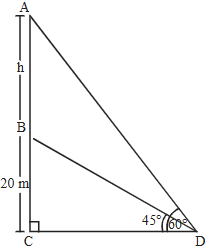
In figure, a tower of height ' h ' is fixed at the top of a 20 m tall building BC.
From a point D on ground, the angles of elevation of bottom and top of tower is $45^{\circ} $ and $60^{\circ}. $
To find : Height of tower
In $\triangle BCD,$
$ \begin{array}{l} \tan 45^{\circ}=\frac{B C}{C D} \\ \Rightarrow \quad 1=\frac{20}{C D} \\ \Rightarrow \quad C D=20 m \\ \text { In } \triangle A C D, \end{array} $
$ \begin{aligned} \tan 60^{\circ} & =\frac{AC}{CD} \\ \Rightarrow \quad \sqrt{3} & =\frac{h+20}{20} \end{aligned} $
$\Rightarrow \quad 20 \sqrt{3}=h+20$
$\begin{array}{lll}\Rightarrow & h & =20 \sqrt{3}-20 \\ \Rightarrow & h & =(20 \sqrt{3}-1) \\ & & =20(1.73-1)\quad[\because \sqrt{3}=1.73]\end{array}$
$\begin{array}{ll}\Rightarrow & h=20(0.73) \\ \Rightarrow & h=14.6 \text { metre }\end{array}$ View full question & answer→Question 145 Marks
As observed from the top of a 100 m high light house from sea level, the angles of depression of two ships are $30^{\circ}$ and $45^{\circ}$. If one ship is exactly behind the other on the same side of the light house, find the distance between the two ships.
[Use $\sqrt{3}=1.732$]
Answer
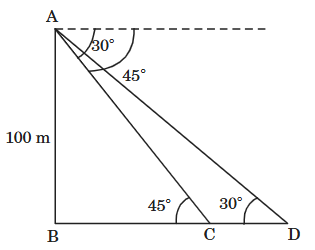
Height of the light house $=100 m$
Consider $\triangle A B C$
$\tan 45^{\circ}=\frac{A B}{B C}$
Using $\tan 45^{\circ}=1$ we get,
$\begin{array}{c}1=\frac{100}{B C} \\BC=100 m\end{array}$
Consider $\triangle A B D$
Using $\tan 30^{\circ}=\frac{1}{\sqrt{3}}$ we get,
$\begin{array}{l}\frac{1}{\sqrt{3}}=\frac{100}{B D} \\B D=100 \sqrt{3} m\end{array}$
Distance between the two ships $=B D-B C$
Distance between the two ships $=100 \sqrt{3}-100$
Distance between the two ships $=100(\sqrt{3}-1)$
Distance between the two ships $=100(1.732-1)$
Distance between the two ships $=100(0.732)$
Distance between the two ships is $73.2 m$ View full question & answer→Question 155 Marks
As observed from the top of a 100 m high lighthouse from the sea-level, the angles of depression of two ships are found to be $30^{\circ}$ and $45^{\circ}$. If one ship is exactly behind the other on the same side of the lighthouse, find the distance between the two ships. [Use $\sqrt{3}=1.732]$
AnswerLet $A B$ be the light house and two ships be at point $C$ and $D$.
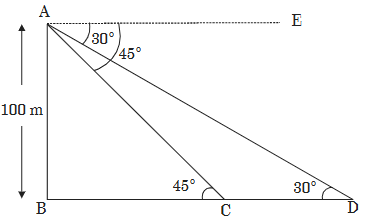
In $\triangle ABC$,
$\tan 45^{\circ}=\frac{ AB }{ BC }$
$\Rightarrow 1=\frac{100}{ BC }$
$\Rightarrow BC =100 m$
In $\triangle ABD$,
$\tan 30^{\circ}=\frac{ AB }{ BD }$
$\Rightarrow \frac{1}{\sqrt{3}}=\frac{100}{100+ CD }$
$\Rightarrow 100+ CD =100 \sqrt{3}$
$\Rightarrow CD =100(\sqrt{3-1})$
$\Rightarrow CD =100(1.732-1)$
$\Rightarrow CD =100 \times 0.732$
$\Rightarrow CD =73.2 m$
Therefore, the distance between the two ships is $73.2 m \sim 72 m$ View full question & answer→Question 165 Marks
From the top of a 75 m high lighthouse from the sea level, the angles of depression of two ships are $30^{\circ}$ and $45^{\circ}$. If the ships are on the opposite sides of the lighthouse, then find the distance between the two ships.
Answer
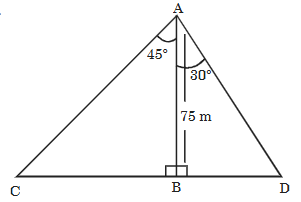
In figure, $A B$ is a 75 m , high lighthouse. The angles of depressions of 2 ships at points $C$ and $D$ are $45^{\circ}$ and $30^{\circ}$ respectively.
To find: Length CD
In $\triangle ABC$,
$\begin{aligned}& \tan 45^{\circ} & =\frac{B C}{A B} \\\Rightarrow & 1 & =\frac{B C}{75}\end{aligned}$
$\Rightarrow BC=75 m\quad \quad \ldots \ldots \text {(i)}$
In $\triangle ABD$,
$\begin{aligned}& & \tan 30^{\circ} & =\frac{B D}{A B} \\& \Rightarrow & \frac{1}{\sqrt{3}} & =\frac{B D}{75} \\& \Rightarrow & BD & =\frac{75}{\sqrt{3}} \\& \Rightarrow & BD & =25 \sqrt{3} m\quad \quad \ldots \ldots \text {(ii)}\end{aligned}$
Now, (1) + (2)
$\begin{aligned}BC+BD & =75+25 \sqrt{3} \\CD & =75+25(1.73) \\& =75+43.25 \\& =118.25 m\end{aligned}$ View full question & answer→Question 175 Marks
There are two poles, one each on either bank of a river just opposite to each other. One pole is 60 m high. From the top of this pole, the angle of depression of the top and foot of the other pole are $30^{\circ}$ and $60^{\circ}$ respectively. Find the width of the river and height of the other pole.
AnswerLet the width of river be x m and height of other pole be h m.
In $\triangle DCB$,
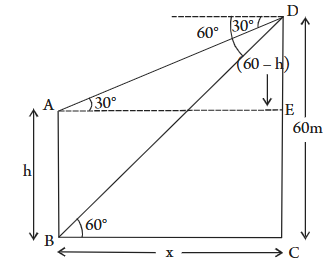
By Pythagoras theorem,
$\begin{array}{l}\tan 60^{\circ}=\frac{DC}{BC} \\\sqrt{3}=\frac{60}{x} \\x=\frac{60}{\sqrt{3}} \times \frac{\sqrt{3}}{\sqrt{3}}=\frac{60 \sqrt{3}}{3}=20 \sqrt{3} m \\\because DE=DC-EC=(60-h) m\end{array}$
In $\triangle AED$, By Pythagoras theorem,
$\begin{array}{l}\tan 30^{\circ}=\frac{DE}{AE} \\\frac{1}{\sqrt{3}}=\frac{60-h}{x} \quad(\because AE=BC) \\\Rightarrow \frac{1}{\sqrt{3}}=\frac{60-h}{20 \sqrt{3}} \\\Rightarrow 20=60-h \Rightarrow h=60-20=40 m\end{array}$
Hence, the width of river be $20 \sqrt{3} m$ and height of other pole be 40 m. View full question & answer→Question 185 Marks
A moving boat is observed from the top of a 150 m high eliff moving aw ay from the eliff. The angle of depression of the boat changes from $60^{\circ}$ to $45^{\circ}$ in 2 minutes. Find the speed of the boat in $m / min$.
AnswerLet the speed of the boat be ' $x$ ' $m / min$.
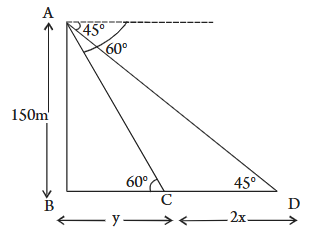
$\therefore$ Distance covered in 2 minute $=2 x m$
Let $B C='y ' m$
In $\triangle ABC$, By Pythagoras theorem,
$\begin{array}{l}\tan 60^{\circ}=\frac{A B}{B C} \\\sqrt{3}=\frac{150}{y} \Rightarrow y=\frac{150}{\sqrt{3}} \times \frac{\sqrt{3}}{\sqrt{3}}=50 \sqrt{3} m\quad \quad \ldots \ldots(i)\end{array}$
In $\triangle ABD$, By Pythagoras theorem.
$\begin{aligned}\tan 45^{\circ}= & \frac{AB}{BD} \\l & =\frac{150}{y+2 x} \\\Rightarrow y+2 x & =150\quad \quad \ldots \ldots(ii)\end{aligned}$
Substituting the value of $y$ from equation (i) in equation (ii),
we get $50 \sqrt{3}+2 x =150$
$\begin{array}{l}\Rightarrow 2 x=150-50 \sqrt{3} \\\Rightarrow x=\frac{50}{2}(3-\sqrt{3})=25(3-\sqrt{3})\end{array}$
Hence, the speed of boat $=25(3-\sqrt{3}) m / min$ View full question & answer→