Questions

5 Marks Questions

🎯

Test yourself on this topic

8 questions · timed · auto-graded

Question 15 Marks
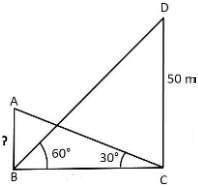
The angle of elevation of the top of a building from the foot of the tower is $30^\circ$ and the angle of elevation of the top of the tower from the foot of the building is $60^\circ$. If the tower is 50 m high, find the height of the building.
Answer
Given,

Let the height of building be $A B$ and height of tower $C D$
Height of the tower $(C D)=50 m$
Angle of elevation of top of building from foot of tower $=30^{\circ}$
Hence, $\angle A C B=30^{\circ}$
Angle of elevation of top of tower from from foot of building $=60^{\circ}$
Hence, $\angle D B C=60^{\circ}$
$\angle A B C=90^{\circ} \& \angle D C B=90^{\circ}$
In a right angle triangle DBC,
tan B = $\frac{side \ opposite \ to \ angle \ to \ D} {side \ opposite \ to \ angle \ H}$
tan B = $\frac{D C}{B C}$
$tan 60^0$ = $\frac{50}{B C}$
$B C=\frac{50}{\sqrt{3}}$
Similarly,
In a right angle triangle ABC,
tan C = $\frac{side \ opposite \ to \ angle \ to \ C} {side \ adjacent \ to \ angle \ C}$
$tan 30^0$ = $\frac{AB} {BC}$
$\frac{1}{\sqrt{3}}=\frac{A B}{\frac{50}{\sqrt{3}}}$
$\frac{1}{\sqrt{3}} \times \frac{50}{\sqrt{3}}=\mathrm{AB}$
$A B=\frac{1}{\sqrt{3}} \times \frac{50}{\sqrt{3}}$
$A B=\frac{50}{3} m$
View full question & answer
Question 25 Marks
A statue, 1.6 m tall, stands on the top of a pedestal. From a point on the ground, the angle of elevation of the top of the statue is $60^{\circ}$ and from the same point the angle of elevation of the top of the pedestal is $45^{\circ}$. Find the height of the pedestal.
View full question & answer
Question 35 Marks
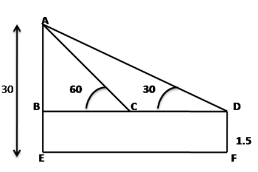
A 1.5 m tall boy is standing at some distance from a 30 m tall building. The angle of elevation from his eyes to the top of the building increases from 30° to 60° as he walks towards the building. Find the distance he walked towards the building.
Answer

Let AE is the Length of the building.

So AE = 30

Again BE = DF = 1.5

AB = AE - BE = 30 - 1.5 = 28.5

Now in triangle ABC,

tan60 = $\frac{AB}{BC}$

$\Rightarrow $ √3 = $\frac{28.5}{BC}$

$\Rightarrow $ BC = $\frac{28.5}{\sqrt 3}$

Again in triangle ABD

tan30 = $\frac{AB}{BD}$
$\sqrt{1}{\sqrt3}=\frac{28.5}{BD}$

$\Rightarrow $ BD = 28.5$\times$√3

$\Rightarrow $ BC + CD = 28.5√3

$\Rightarrow $ 28.5/√3 + CD = 28.5√3

$\Rightarrow $ CD = $\frac{28.5}{\sqrt 3}$- $\frac{28.5}{\sqrt 3}$

$\Rightarrow $ CD = $\frac{28.5\times3-28.5}{\sqrt3}$

$\Rightarrow $ CD = $\frac{28.5(3-1)}{\sqrt3}$

$\Rightarrow $ CD = $\frac{(28.5\times 2)}{\sqrt3}$

$\Rightarrow $ CD = $\frac{(57)}{\sqrt3}$

$\Rightarrow $ CD = $\frac{(57\sqrt3)}{\sqrt3\times\sqrt3}$ (Multiply √3 in numerator and denominator)

$\Rightarrow $ CD = $\frac{57\sqrt3}{3}$

$\Rightarrow $ CD = 19√3

The distance he walked towards the building is 19√3 m

View full question & answer
Question 45 Marks
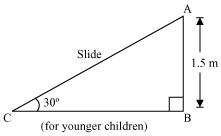
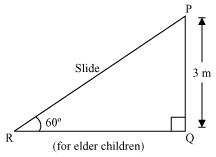
A contractor plans to install two slides for the children to play in a park. For the children below the age of 5 years, she prefers to have a slide whose top is at a height of 1.5 m, and is inclined at an angle of 30° to the ground, whereas for elder children, she wants to have a steep slide at a height of 3 m, and inclined at an angle of 60° to the ground. What should be the length of the slides in each case?
Answer

In the first case:

Height of slide= 1.5 m and angle of elevation = 30°
Now,
$\sin \theta=\frac{p}{h}$
where p = perpendicular, i.e. height of the slide and h = hypotenuse, i.e. length of the slide and $\theta$ is the angle of elevation
$\sin 30^{\circ}=\frac{1.5}{h}$
$\frac{1}{2}=\frac{1.5}{h}$
Hence, h = 3 m
In the second case:

Height of slide, = 3 m, angle of elevation = 60°
$\sin \theta=\frac{p}{h}$
$\sin 60^{\circ}=\frac{3}{h}$
$\frac{\sqrt{3}}{2}=\frac{3}{h}$
Hence, h = $2{\sqrt{3}}$ m
Therefore, the length of the slide in the first and the second case are 3 m and $2{\sqrt{3}}$ m respectively.

View full question & answer
Question 55 Marks
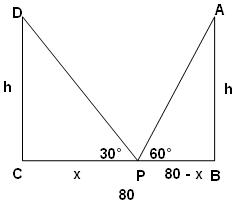
Two poles of equal heights are standing opposite each other on either side of the road, which is 80 m wide. From a point between them on the road, the angles of elevation of the top of the poles are $60^{\circ}$ and $30^{\circ}$ respectively. Find the height of the poles and the distances of the point from the poles.
Answer

Suppose AB and CD are the two poles of equal height h m. BC be the 80 m wide road. P is any point on the road. Let CP be x m, therefore BP = (80 – x) . Also, $\angle$APB = $60^o$​​​​​​​ and $\angle$$DPC =30^o​​​​​​​$
In right angled triangle DCP,
tan $30^o​​​​​​​$​​​​​​​ = $\frac{CD}{CP}$
⇒ $\frac{h}{x} = \frac{1}{{\sqrt 3 }}$
⇒ $h=\frac{x}{\sqrt3}$ .......(1)
In right angled triangle ABP,
Tan $60^o​​​​​​​$​​​​​​​ = AB/AP$\frac{AB}{AP}$
⇒ $\frac{h}{80-x}=\sqrt3$
⇒ $h=\sqrt3(80-x)$
⇒ $\frac{x}{\sqrt3}=\sqrt3(80-x)$
$\Rightarrow x = 3(80 – x)$
$\Rightarrow x = 240 – 3x$
$\Rightarrow x + 3x = 240$
$\Rightarrow 4x = 240$
$\Rightarrow x = 60$
Height of the pole, h = x/√3 = 60/√3 = 20√3.
Thus, the position of the point P is 60 m from C and the height of each pole is 20√3 m.
View full question & answer
Question 65 Marks
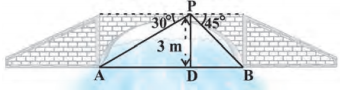
From a point on a bridge across a river, the angles of depression of the banks on opposite sides of the river are 30° and 45°, respectively. If the bridge is at a height of 3 m from the banks, find the width of the river.
Answer


In the above-given fig, A and B represent points on the bank on opposite sides of the river, so that AB is the width of the river.
P is a point on the bridge at a height of 3 m, i.e.,
DP = 3 m. Here, we are interested to determine the width of the river, which is the length of the side AB of the
$\triangle$ APB.
Now, AB = AD + DB
In right $\triangle$ APD, $\angle$ A = 30°
So, tan 30° = $\frac{\mathrm{PD}}{\mathrm{AD}}$
i.e., $\frac{1}{\sqrt{3}}=\frac{3}{\mathrm{AD}}$ or AD = $3 \sqrt{3}$ m
Also, in right $\triangle$ PBD, $\angle$ B = 45°. So, BD = PD = 3 m
Now, AB = BD + AD = 3 + $3 \sqrt{3}$ = 3$(1+\sqrt{3})$m
Therefore, the width of the river is $3(\sqrt{3}+1)$m

View full question & answer
Question 75 Marks
The angles of depression of the top and bottom of an 8 m tall building from top of a multistoreyed building are $30^o$ and $45^o,$ respectively. Find the height of multi-storeyed building and distance between two buildings.
Answer
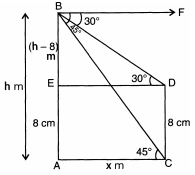
Let h is height of big building,here as per the diagram.
AE = CD = 8 m (Given)
BE = AB-AE = (h - 8) m
Let AC = DE = x
Also, $\angle F B D = \angle B D E = 30 ^ { \circ }$
$\angle F B C = \angle B C A = 45 ^ { \circ }$

In $\triangle $ACB, $\angle A = 90 ^ { \circ }$
$\tan 45 ^ { \circ } = \frac { A B } { A C }$
$\Rightarrow $ x = h, ...(i)
In $\vartriangle $BDE, $\angle E = 90 ^ { \circ }$
$\tan 30 ^ { \circ } = \frac { B E } { E D }$
$\Rightarrow \quad x = \sqrt { 3 } ( h - 8 )$ .(ii)
From (i) and (ii), we get
$h = \sqrt { 3 } h - 8 \sqrt { 3 }$
h(√3 - 1) = 8√3
h = $\frac{8\sqrt3}{\sqrt3-1}=\frac{8\sqrt3}{\sqrt3-1}×\frac{\sqrt3+1}{\sqrt3+1}$
= $\frac{1}{2}×(24+8√3)=\frac{1}{2}×(24+13.84)=18.92 m$
Hence height of the multistory building is 18.92 m and the distance between two buildings is 18.92 m.
View full question & answer
Question 85 Marks
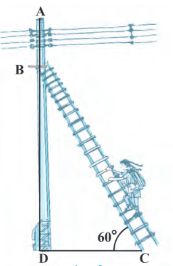
An electrician has to repair an electric fault on a pole of height 5 m. She needs to reach a point 1.3m below the top of the pole to undertake the repair work. What should be the length of the ladder that she should use which, when inclined at an angle of 60° to the horizontal, would enable her to reach the required position? Also, how far from the foot of the pole should she place the foot of the ladder? (You may take $\sqrt 3$ = 1.73)

Answer


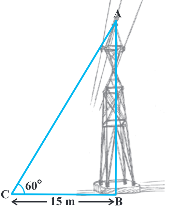
First, let us draw a simple diagram to represent the problem. Here AB represents the tower, CB is the distance of the point from foot of the tower and $\angle$ ACB is the angle of elevation. We need to determine the height of the tower, i.e., AB. Also, ACB is a triangle, right-angled at B. To solve the problem, we choose the trigonometric ratio tan 60° (or cot 60°), as the ratio involves AB and BC.
Now, tan 60° =$\frac{\mathrm{AB}}{\mathrm{BC}}$
i.e., $\sqrt{3}=\frac{\mathrm{AB}}{15}$
i.e., AB = $15 \sqrt{3}$
Hence, the height of the tower is $15 \sqrt{3}$ m
View full question & answer