MCQ 511 Mark
A person walking $50$ metres towards a chimney in a horizontal line. The angle of elevation of its top changes from $30^\circ$ to $45^\circ$ . Height of the chimney $($in metres$)$ is :
- A
$25(3+\sqrt{3})\text{m}$
- B
$50(\sqrt{3}+1)\text{m}$
- ✓
$25(\sqrt{3}+1)\text{m}$
- D
$25(\sqrt{3}-1)\text{m}$
AnswerCorrect option: C. $25(\sqrt{3}+1)\text{m}$
$25(\sqrt{3}+1)\text{m}$
View full question & answer→MCQ 521 Mark
The angles of elevation of the top of a tower from two points on the ground at distances $8m$ and $18m$ from the base of the tower and in the same straight line with it are complementary. The height of the tower is :
Answer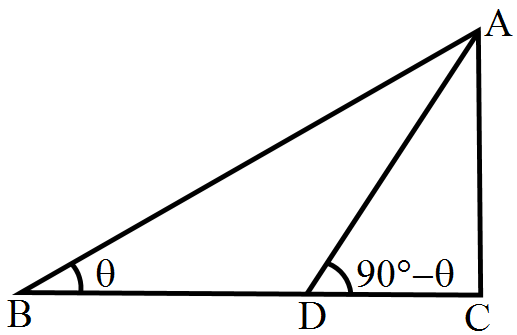
In triangle $\text{ABC}, \tan\theta=\frac{\text{h}}{18}...(\text{i})$
And in triangle $\text{ADC}, \tan(90^\circ-\theta)=\frac{\text{h}}{8}\text{h}$
$\Rightarrow\cot\theta=\frac{\text{h}}{8}...(\text{ii})$
Multiplying eq. $(i)$ and $(ii),$ we get
$\tan\theta.\cot\theta=\frac{\text{h}}{18}\times\frac{\text{h}}{8}$
$\Rightarrow1=\frac{\text{h}^2}{144}$
$\Rightarrow\text{h}^2=144$
$\Rightarrow\text{h}=12\text{m}.$ View full question & answer→MCQ 531 Mark
The top of a broken tree has its top touching the ground at a distance of $10m$ from the bottom. If the angle made by the broken part with the ground is $30^\circ, $ then the length of the broken part is :
AnswerCorrect option: A. $\frac{20}{\sqrt3\text{m}}$
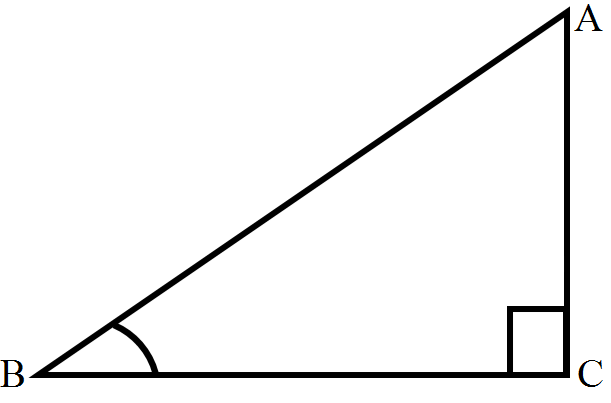
Let $AB$ be the broken part of the tree.
$\therefore\cos30^\circ=\frac{\text{BC}}{\text{AB}}$
$\Rightarrow\frac{\sqrt3}{2}=\frac{10}{\text{AB}}$
$\Rightarrow\text{AB}=\frac{10\times2}{\sqrt3}=\frac{20}{\sqrt3}\text{ meters}$
Therefore, the length of the broken part of the tree is $\frac{20}{\sqrt3}\text{ meters}.$ View full question & answer→MCQ 541 Mark
From the top of a cliff $25m$ high the angle of elevation of a tower is found to be equal to the angle of depression of the foot of the tower. The height of the tower is :
- A
$25m$
- ✓
$50m$
- C
$75m$
- D
$100m$
AnswerGiven that : height of cliff is $25m$ and angle of elevation of the tower is equal to angle of depression of foot of the tower that is $\theta.$
Now, the given situation can be represented as,
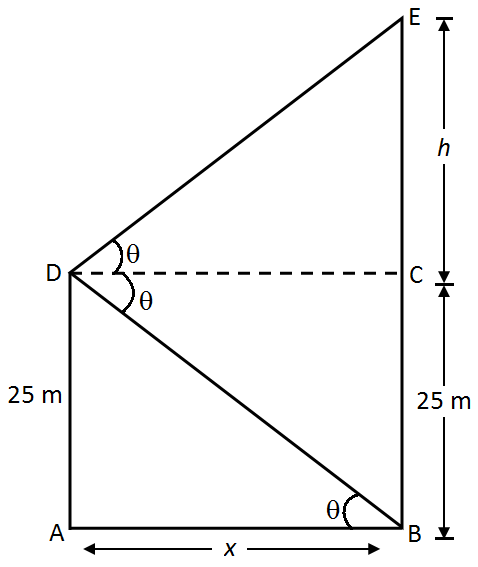
Here, $D$ is the top of cliff and $BE$ is the tower.
Let $CE = h, AB = x$.
Then $, AB = DC = x$
Here, we have to find the height of the tower $BE.$
So, we use trigonometric ratios.
In a triangle $\text{ABD},$
$\Rightarrow\ \tan\theta=\frac{\text{AD}}{\text{AB}}$
$\Rightarrow\ \tan\theta=\frac{25}{\text{x}}\ .....(1)$
Again in a triangle $\text{DCE},$
$\tan\theta=\frac{\text{CE}}{\text{CD}}$
$\Rightarrow\ \tan\theta=\frac{\text{h}}{\text{x}}$
$\Rightarrow\ \frac{25}{\text{x}}=\frac{\text{h}}{\text{x}}\ [$Using $(1)]$
$\Rightarrow\ \text{h}=25$
Thus, height of the tower $= BE = BC + CE $
$= (25 + 25)m = 50m$ View full question & answer→MCQ 551 Mark
A kite is flying at a height of $30m$ from the ground. The length of string from the kite to the ground is $60m.$ Assuming that there is no slack in the string, the angle of elevation of the kite at the ground is :
- A
$45^\circ$
- ✓
$30^\circ$
- C
$60^\circ$
- D
$90^\circ$
AnswerCorrect option: B. $30^\circ$
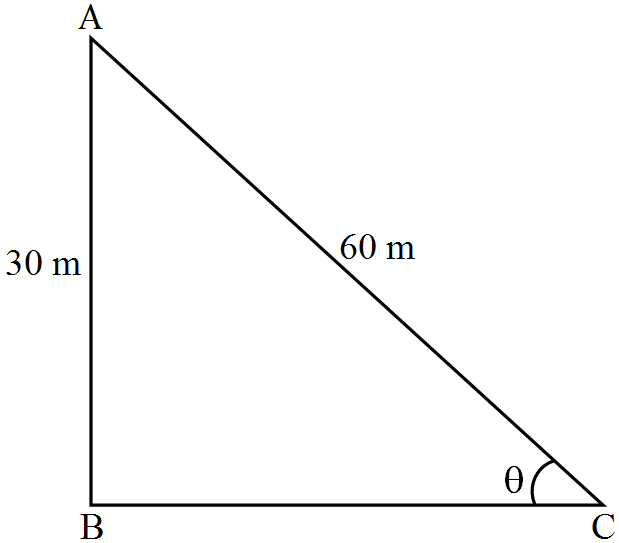
Let point $A$ be the position of the kite and $AC$ be its string.
We have,
$AB = 30m,$ and $AC = 60m$
Let $\angle\text{ACB}=\theta$
In $\triangle\text{ABC},$
$\sin\theta=\frac{\text{AB}}{\text{AC}}$
$\Rightarrow\sin\theta=\frac{30}{60}$
$\Rightarrow\sin\theta=\frac{1}{2}$
$\Rightarrow\sin\theta=\sin30^\circ$
$\therefore\ \theta=30^\circ$ View full question & answer→MCQ 561 Mark
The ratio of the length of a pole and its shadow is $1: \sqrt{3}.$ The angle of elevation of the sun is :
- A
$90^\circ$
- B
$60^\circ$
- C
$45^\circ$
- ✓
$30^\circ$
AnswerCorrect option: D. $30^\circ$
$\tan\theta=\frac{\text{h}}{\text{x}}$
$\Rightarrow\tan\theta=\frac{1}{\sqrt{3}}$
$\Rightarrow\tan\theta=\tan30^\circ$
$\Rightarrow\theta=30^\circ$
Hence, the answer is $= 30^\circ .$
View full question & answer→MCQ 571 Mark
On the level ground, the angle of elevation of a tower is $30^\circ $. On moving $20m$ nearer, the angle of elevation is $60^\circ $. The height of the tower is :
- A
$10\text{m}$
- ✓
$10\sqrt{3}\text{m}$
- C
$15\text{m}$
- D
$5\sqrt{3}\text{m}$
AnswerCorrect option: B. $10\sqrt{3}\text{m}$
Let $AB$ be the tower and $C$ and $D$ be the points of observation such that $\angle\text{BCD}=30^\circ,\angle\text{BDA}=60^\circ,\text{CD}=20\text{m}$ and $AD = x m.$
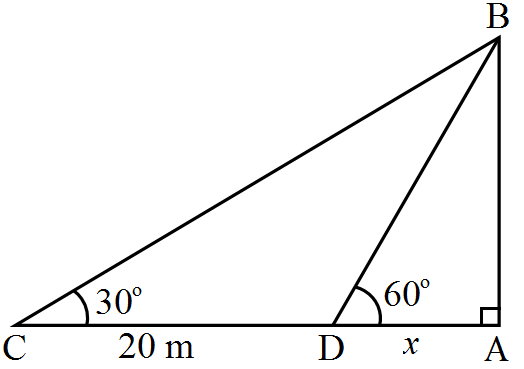
Now, in $\triangle\text{ADB},$
We have :
$\frac{\text{AB}}{\text{AD}}=\tan60^\circ=\sqrt{3}$
$\Rightarrow\frac{\text{AB}}{\text{x}}=\sqrt{3}$
$\Rightarrow\text{AB}=\sqrt{3}\text{x}$
In $\triangle\text{ACB},$
We have :
$\frac{\text{AB}}{\text{AC}}=\tan30^\circ=\frac{1}{\sqrt{3}}$
$\frac{\text{AB}}{20+\text{x}}=\frac{1}{\sqrt{3}}$
$\Rightarrow\text{AB}=\frac{20+\text{x}}{\sqrt{3}}$
$\therefore\sqrt{3}\text{x}=\frac{20+\text{x}}{\sqrt{3}}$
$\Rightarrow3\text{x}=20+\text{x}$
$\Rightarrow2\text{x}=20$
$\Rightarrow\text{x}=10$
$\therefore$ Height of the tower $\text{AB}=\sqrt{3}\text{x}=10\sqrt{3}\text{m}$ View full question & answer→MCQ 581 Mark
The angle of elevation of the sun when the shadow of a pole of height $‘h\ ’$ metres is $\sqrt3\text{h }\text{metres}$ long is :
- A
$45^\circ$
- ✓
$30^\circ$
- C
$60^\circ$
- D
AnswerCorrect option: B. $30^\circ$
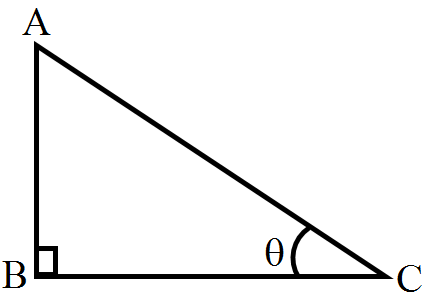
Let Height of the pole $= AB = h$
Meters and length of the shadow of the pole $=\text{BC}=\sqrt3\text{h }\text{ meters}.$
$\therefore\tan\theta=\frac{\text{AC}}{\text{BC}}$
$\Rightarrow\tan\theta=\frac{\text{h}}{\sqrt3\text{h}}=\frac{1}{\sqrt3}$
$\Rightarrow\tan\theta=\tan30^\circ$
$\Rightarrow\theta=30^\circ$ View full question & answer→MCQ 591 Mark
A pole $10m$ high cast a shadow $10m$ long on the ground, then the sun’s elevation is :
- A
$60^\circ$
- B
$15^\circ$
- ✓
$45^\circ$
- D
$30^\circ$
AnswerCorrect option: C. $45^\circ$
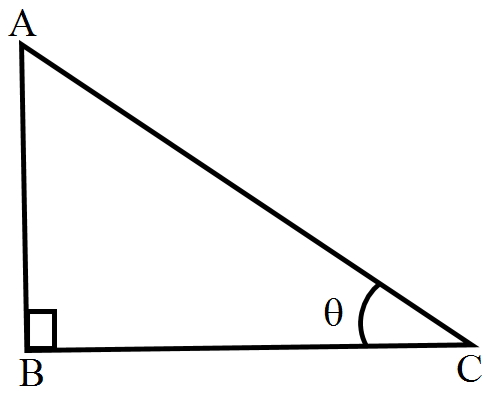
Let the length of the shadow $BC$ be $10$ meters.
Then the height of the pole $AB$ is $10$ meter.
$\therefore\tan\theta=\frac{\text{AB}}{\text{BC}}$
$\Rightarrow\tan\theta=\frac{10}{10}$
$\Rightarrow\tan\theta=1$
$\Rightarrow\tan\theta=\tan45^\circ$
$\Rightarrow\theta=45^\circ$ View full question & answer→MCQ 601 Mark
If the angle of depression of an object from a $75m$ high tower is $30^{\circ},$ then the distance of the object from the tower is :
- ✓
$75\sqrt3\text{m}$
- B
$25\sqrt3\text{m}$
- C
$100\sqrt3\text{m}$
- D
$50\sqrt3\text{m}$
AnswerCorrect option: A. $75\sqrt3\text{m}$
In triangle $\text{ABC},$
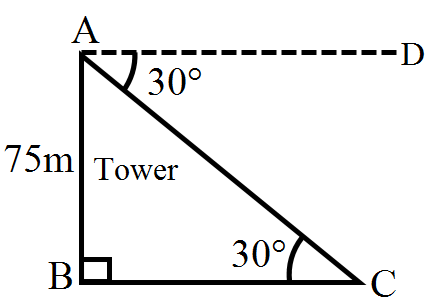
$\tan30^\circ=\frac{\text{AB}}{\text{BC}}$
$\Rightarrow\frac{1}{\sqrt3}=\frac{75}{\text{BC}}$
$\Rightarrow\text{BC}=75\sqrt3\text{m}$
Therefore, the distance between $P$ and foot of the tower is $75\sqrt3\text{m}$ meters. View full question & answer→MCQ 611 Mark
From a point $P$ on the level ground, the angle of elevation of the top of a tower is $30^{\circ}$. If the tower is $100m$ high, the distance between $P$ and the foot of the tower is :
- ✓
$100\sqrt3\text{m}$
- B
$300\sqrt3\text{m}$
- C
$150\sqrt3\text{m}$
- D
$200\sqrt3\text{m}$
AnswerCorrect option: A. $100\sqrt3\text{m}$
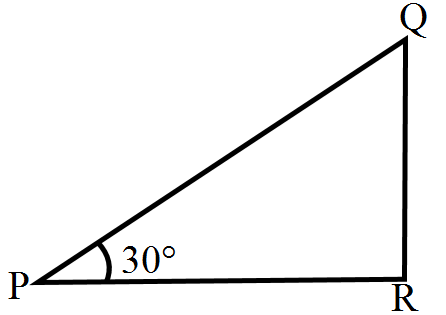
Let $QR$ be the height of the tower,
then $QR = 100m$ and the angle of elevation of the top of the tower be
$\angle\text{QPR}=30^\circ$
$\therefore\tan30^\circ=\frac{\text{QR}}{\text{PR}}$
$\Rightarrow\frac{1}{\sqrt3}=\frac{100}{\text{PR}}\text{m}$
$\Rightarrow\text{PR}=100\sqrt3\text{ meters}$
Therefore, the distance between $P$ and the foot of the tower is $100\sqrt3\text{ meters}.$ View full question & answer→MCQ 621 Mark
The ratio between the height and the length of the shadow of a pole is $ 3-\sqrt{3} : 1,$ then the sun’s altitude is :
- A
$45^\circ$
- B
$30^\circ$
- C
$75^\circ$
- ✓
$60^\circ$
AnswerCorrect option: D. $60^\circ$
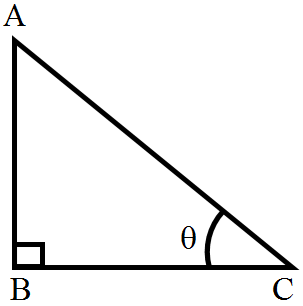
Let the height of the pole be $\text{AB}=\sqrt{3}\text{x}\text{ meters}$ and the lenght of the shadow be $BC = x$ meters and angle of elevation $=\theta$
$\therefore\tan\theta=\frac{\sqrt{3}\text{x}}{\text{x}}$
$\Rightarrow\tan\theta=\sqrt{3}$
$\Rightarrow\tan\theta=\tan60^\circ$
$\Rightarrow\theta=60^\circ$ View full question & answer→MCQ 631 Mark
The angle of elevation of the sun, when the length of the shadow of a pole is equal to its height, is :
- A
$30^\circ$
- ✓
$45^\circ$
- C
$60^\circ$
- D
$90^\circ$
AnswerCorrect option: B. $45^\circ$
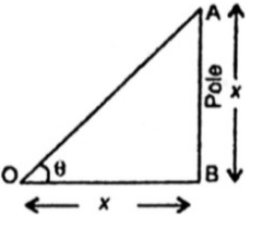
Let the height of the pole be $AB = x m$
Then the length of the shadow of the pole $AB$ will be $OB = x m$
Let the angle of elevation be $\theta$ i.e., $\angle AOB = \theta$
In the right $-$ angled triangle $\text{OAB},$ we have
$\Rightarrow \text{tan} \theta = \frac{AB}{\text{OB}}$
$=\frac{\text{x}}{\text{x}}$
$= 1$
$\Rightarrow \theta = \text{tan}^{-1}45^\circ $
Therefore angle of elevation is $45^\circ $
View full question & answer→MCQ 641 Mark
In the given figure, a tower $AB$ is $20m$ high and $BC,$ its shadow on the ground is $20\sqrt{3}\text{m}$ long. The sun's altitude is :
- ✓
$30^\circ$
- B
$45^\circ$
- C
$60^\circ$
- D
AnswerCorrect option: A. $30^\circ$
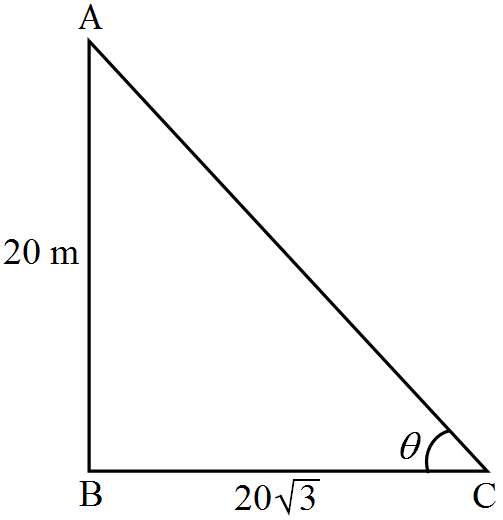
Let the sun's altitude be $\theta.$
We have,
$AB = 20m$ and $\text{BC}=20\sqrt{3}\text{m}$
In $\triangle\text{ABC},$
$\tan\theta=\frac{\text{AB}}{\text{BC}}$
$\Rightarrow\tan\theta=\frac{20}{20\sqrt{3}}$
$\Rightarrow\tan\theta=\frac{1}{\sqrt{3}}$
$\Rightarrow\tan\theta=\tan30^\circ$
$\therefore\ \theta=30^\circ$ View full question & answer→MCQ 651 Mark
The length of the shadow of a tower standing on level ground is found to be $2x$ metres longer when the sun's elevation is $30^\circ$ than when it was $45^\circ $. The height of the tower is :
- A
$\big(2\sqrt{3}\text{x}\big)\text{m}$
- B
$\big(3\sqrt{2}\text{x}\big)\text{m}$
- C
$\big(\sqrt{3}-1\big)\text{x }\text{m}$
- ✓
$\big(\sqrt{3}+1\big)\text{x }\text{m}$
AnswerCorrect option: D. $\big(\sqrt{3}+1\big)\text{x }\text{m}$
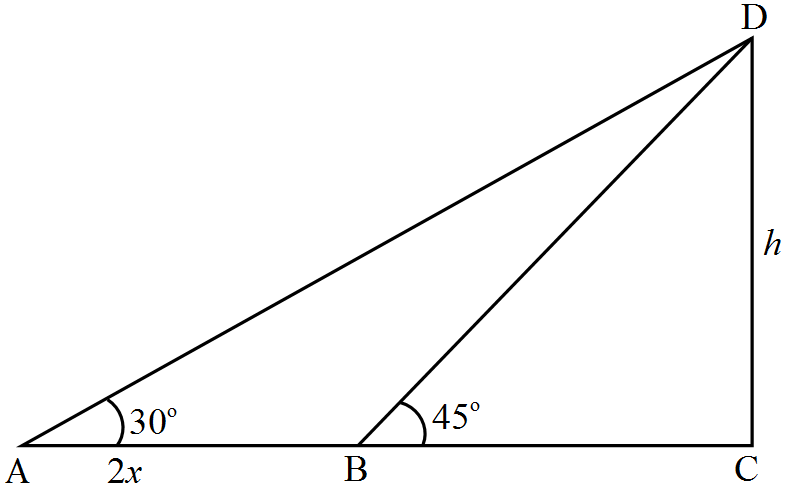
Let $CD = h$ be the height if the tower.
We have,
$AB = 2x, \angle\text{DAC}=30^\circ$ and $\angle\text{DBC}=45^\circ$
In $\triangle\text{BCD},$
$\tan45^\circ=\frac{\text{CD}}{\text{BE}}$
$\Rightarrow1=\frac{\text{h}}{\text{BC}}$
$\Rightarrow\text{BC}=\text{h}$
Now, in $\triangle\text{ACD},$
$\tan30^\circ=\frac{\text{CD}}{\text{AC}}$
$\Rightarrow\frac{1}{\sqrt{3}}=\frac{\text{h}}{\text{AB}+\text{BC}}$
$\Rightarrow\frac{1}{\sqrt{3}}=\frac{\text{h}}{2\text{x}+\text{h}}$
$\Rightarrow2\text{x}+\text{h}=\text{h}\sqrt{3}$
$\Rightarrow\text{h}\sqrt{3}-\text{h}=2\text{x}$
$\Rightarrow\text{h}\big(\sqrt{3}-1\big)=2\text{x}$
$\Rightarrow\text{h}=\frac{2\text{x}}{\big(\sqrt{3}-1\big)}\times\frac{\big(\sqrt{3}+1\big)}{\big(\sqrt{3}+1\big)}$
$\Rightarrow\text{h}=\frac{2\text{x}\big(\sqrt{3}+1\big)}{(3-1)}$
$\Rightarrow\text{h}=\frac{2\text{x}\big(\sqrt{3}+1\big)}{2}$
$\therefore\ \text{h}=\text{x}\big(\sqrt{3}+1\big)\text{m}$ View full question & answer→MCQ 661 Mark
An observer $1.5m$ tall $28.5$ away from a tower and the angle of elevation of the top of the tower form the eye of the observer is $45^\circ$ . The height of the tower is :
AnswerLet $AB$ be the observer and $CD$ be the tower.
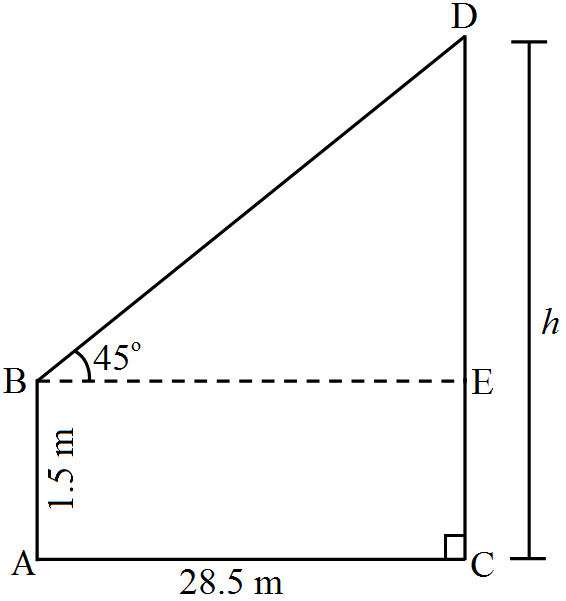
Draw $\text{BE}\perp\text{CD},$ let $CD = h$ metres.
Then, $\text{AB}=1.5\text{m},\text{BE}=\text{AC}=28.5\text{m}$ and $\angle\text{EBD}=45^\circ.$
$DE = (CD - EC) = (CD - AB) = (h - 1.5)m.$
In right $\triangle\text{BED},$
We have:
${\frac{\text{DE}}{\text{BE}}}=\tan45^\circ=1$
$\Rightarrow\frac{(\text{h}-1.5)}{28.5}=1$
$\Rightarrow\text{h}-1.5=28.5$
$\Rightarrow\text{h}=28.5+1.5=30\text{m}$
Hence the height of the tower is $30m.$ View full question & answer→MCQ 671 Mark
If the length of a shadow of a tower is increasing, then the angle of elevation of the sun is :
- ✓
- B
- C
- D
Neither increasing nor decreasing
AnswerIf the elevation moves towards the tower, it is increasing and if its elevation moves away from the tower, it decreases.
Hence if the shadow of a tower is increasing, then the angle of elevation of the sun is not increasing.
View full question & answer→MCQ 681 Mark
If the length of the shadow of a tower is equal to its height, then the angle of elevation of the sun is a :
- A
$30^\circ$
- ✓
$45^\circ$
- C
$60^\circ$
- D
$75^\circ$
AnswerCorrect option: B. $45^\circ$
Let $AB$ be the tower and $AC$ be its Shadow.
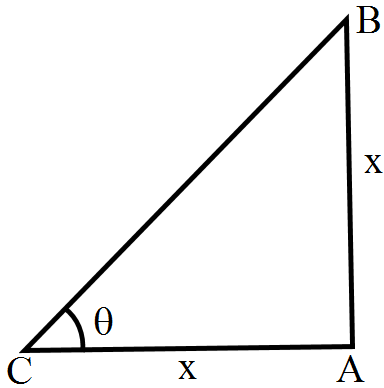
And $AB = AC = x m$
Let the angle of elevation of the sun be $\theta.$
Then $\angle\text{ACB}=\theta$
In right angled triangle $\text{ABC}$
$\tan\theta=\frac{\text{AB}}{\text{AC}}$
$\Rightarrow\tan\theta=\frac{\text{x}}{\text{x}}=1$
$\Rightarrow\tan\theta=\tan45^\circ$
$\Rightarrow\theta=45^\circ$
Therefore, the angle of the elevation of the sun is $45^\circ .$ View full question & answer→MCQ 691 Mark
From the top of a hill, the angles of depression of two consecutive $\ km$ stones due east are found to be $30^\circ$ and $45^\circ .$ The height of the hill is :
- A
$\frac{1}{2}\big(\sqrt{3}-1\big)\text{km}$
- ✓
$\frac{1}{2}\big(\sqrt{3}+1\big)\text{km}$
- C
$\big(\sqrt{3}-1\big)\text{km}$
- D
$\big(\sqrt{3}+1\big)\text{km}$
AnswerCorrect option: B. $\frac{1}{2}\big(\sqrt{3}+1\big)\text{km}$
Let $AB$ be the hill making angles of depression at points $C$ and $D$ such that $\angle\text{ADB}=45^\circ,\angle\text{ACB}=30^\circ$ and $CD = 1\ km.$
Let :
$AB = h \ km$ and $AD = x \ km$
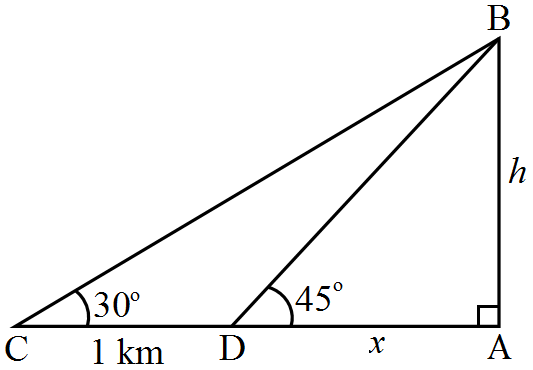
In $\triangle\text{ADB},$
We have :
$\frac{\text{AB}}{\text{AD}}=\tan45^\circ=1$
$\Rightarrow\frac{\text{h}}{\text{x}+1}=\frac{1}{\sqrt{3}}\dots(\text{ii})$
On putting the value of $h$ taken from $(i)$ in $(ii),$ we get:
$\frac{\text{h}}{\text{h}+1}=\frac{1}{\sqrt{3}}$
$\Rightarrow\sqrt{3}\text{h}=\text{h}+1$
$\Rightarrow\big(\sqrt{3}-1\big)\text{h}=1$
$\Rightarrow\text{h}=\frac{1}{\big(\sqrt{3}-1\big)}$
On multiplying the numerator and denominator of the above equation by $\big(\sqrt{3}+1\big),$
We get:
$\text{h}=\frac{1}{\big(\sqrt{3}-1\big)}\times\frac{\big(\sqrt{3}+1\big)}{\big(\sqrt{3}+1\big)}$
$=\frac{\big(\sqrt{3}+1\big)}{2}=\frac12\big(\sqrt{3}+1\big)\text{km}$
Hence, the height of the hill is $\frac12\big(\sqrt{3}+1\big)\text{km}.$ View full question & answer→MCQ 701 Mark
A ladder $14m$ long rests against a wall. If the foot of the ladder is $7m$ from the wall, then the angle of elevation is :
- ✓
$60^\circ$
- B
$45^\circ$
- C
$30^\circ$
- D
$75^\circ$
AnswerCorrect option: A. $60^\circ$
Let $AB$ be the ladder of length $14m$ and $BC = 7m$
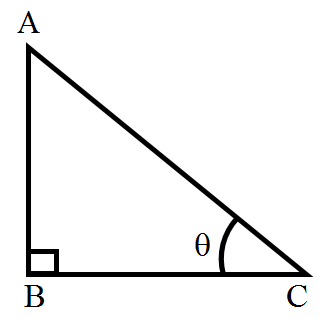
Let angle of elevation
$\angle\text{ACB}=\theta$
$\therefore\cos\theta=\frac{\text{BC}}{\text{AC}}$
$\Rightarrow\cos\theta=\frac{7}{14}$
$\Rightarrow\cos\theta=\frac{1}{2}$
$\Rightarrow\cos\theta=\cos60^\circ$
$\Rightarrow\theta=60^\circ$ View full question & answer→MCQ 711 Mark
The ratio between the height and the length of the shadow of a pole is $\sqrt{3} : 1,$ then the sun’s altitude is :
- A
$30^\circ$
- B
$45^\circ$
- C
$75^\circ$
- ✓
$60^\circ$
AnswerCorrect option: D. $60^\circ$
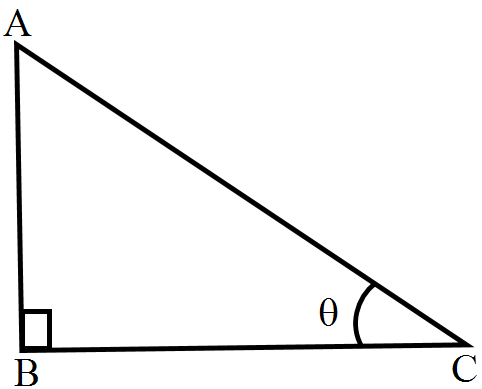
Let the height of the pole be $\text{AB}=\sqrt{3}\text{x}\text{ meters}$ and the length of the shadow be $BC = x$ methers and angle of elevation $=\theta$
$\therefore\tan\theta=\frac{\sqrt{3}\text{x}}{\text{x}}$
$\Rightarrow\tan\theta=\sqrt{3}$
$\Rightarrow\tan\theta=\tan60^\circ$
$\Rightarrow\theta=60^\circ$ View full question & answer→MCQ 721 Mark
The $............$ of an object is the angle formed by the line of sight with the horizontal when the object is above the horizontal level.
AnswerThe angle of elevation of an object is the angle formed by the line of sight with the horizontal when the object is above the horizontal level.
View full question & answer→MCQ 731 Mark
If the angle of elevation of a tower from a distance of $100$ metres from its foot is $60^\circ ,$ then the height of the tower is :
AnswerCorrect option: A. $100\sqrt{3}\text{m}$
Let $AB$ be the tower and a point $P$ at a distance of $100m$ from its foot, angle of elevation of the top of the tower is $60^\circ .$
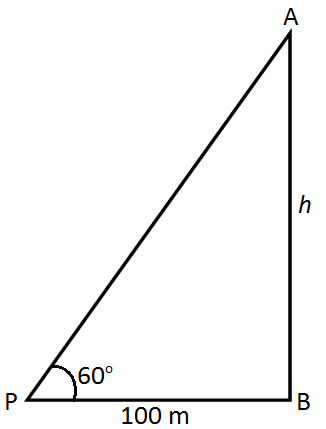
Let height of the tower $= h$
Then in right $\triangle\text{APB,}$
$\tan\theta=\frac{\text{Perpendicular}}{\text{Base}}=\frac{\text{AB}}{\text{PB}}$
$\Rightarrow\ \tan60^\circ=\frac{\text{h}}{100}$
$\Rightarrow\ \sqrt{3}=\frac{\text{h}}{100}$
$\Rightarrow\ \text{h}=100\sqrt{3}$
$\therefore$ Height of tower $=100\sqrt{3}\text{m}$ View full question & answer→MCQ 741 Mark
A $20m$ pole casts a $5m$ long shadow. If at the same time of the day, a building casts a shadow of $20m,$ how high is the building?
- A
$400m$
- B
$4m$
- ✓
$80m$
- D
$100m$
AnswerLet the angle subtended between pole and shadow be $\theta$
$\Rightarrow \text{tan} \theta =\frac{20}{5}=4$
Similarly,
At same time of the day, angle subtended will remain same as position of sun is fixed.
Given that the shadow is $20m$ long.
Let height of the building be $x$
$\Rightarrow \text{tan} \theta =\frac{\text{x}}{20}=4$
$\Rightarrow \text{x}=80 \text{m}$
View full question & answer→MCQ 751 Mark
The height of a tower is $100m$. When the angle of elevation of the sun changes from $30^\circ$ to $45^\circ ,$ the shadow of the tower becomes $x$ metres less. The value of $x$ is :
AnswerCorrect option: C. $100(\sqrt{3}-1)\text{m}$
Let $AB$ be tower and $AB = 100m$ and angles of elevation of $A$ at $C$ and $D$ are $30^\circ $ and $45^\circ $ respectively and $CD = x$
Let $BD = y$
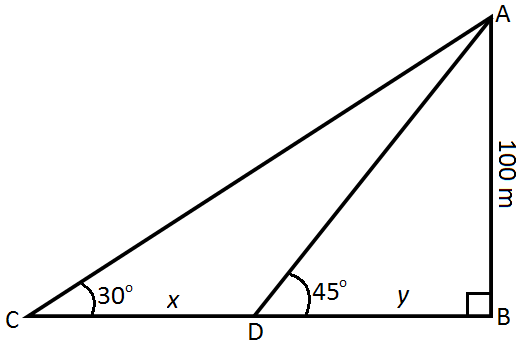
Now in right $\triangle\text{ADB},$
$\tan\theta=\frac{\text{Perpendicular}}{\text{Base}}=\frac{\text{AB}}{\text{DB}}$
$\tan45^\circ=\frac{100}{\text{y}}$
$\Rightarrow\ 1=\frac{100}{\text{y}}$
$\Rightarrow\ \text{y}=100\ ....(\text{i})$
Similarly in right $\triangle\text{ACB,}$
$\tan30^\circ=\frac{\text{AB}}{\text{CB}}$
$\Rightarrow\ \frac{1}{\sqrt{3}}=\frac{100}{\text{y}+\text{x}}$
$=\frac{100}{100+\text{x}}$
$\Rightarrow\ 100+\text{x}=100\sqrt{3}$
$\Rightarrow\ \text{x}=100\sqrt{3}-100$
$=100(\sqrt{3}-1)\text{m}$ View full question & answer→MCQ 761 Mark
The height of the vertical pole is $\sqrt{3}$ times the length of its shadow on the ground, then angle of elevation of the sun at that time is :
- A
$30^\circ$
- ✓
$60^\circ$
- C
$45^\circ$
- D
$75^\circ$
AnswerCorrect option: B. $60^\circ$
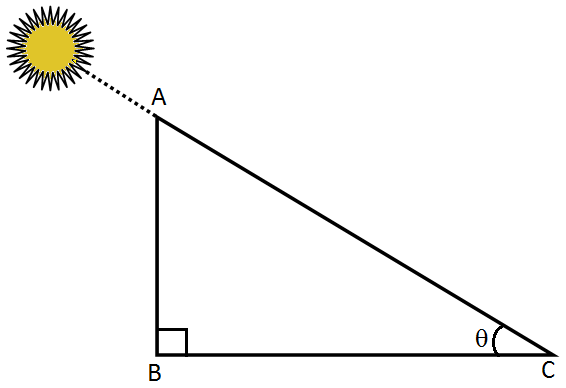
Let the angle of elevation of the sun be $\theta.$
Suppose $AB$ is the height of the pole and $BC$ is the length of its shadow.
It is given that, $\text{AB}=\sqrt{3}\text{BC}$
$\tan\theta=\frac{\text{AB}}{\text{BC}}$
$\Rightarrow\tan\theta=\frac{\sqrt{3}\text{BC}}{\text{BC}}=\sqrt{3}$
$\Rightarrow\tan\theta=\tan60^\circ$
$\Rightarrow\theta=60^\circ$
Thus, the angle of elevation of the sun is $60^\circ .$ View full question & answer→MCQ 771 Mark
The lengths of a vertical rod and its shadow are in the ratio $1:\sqrt{3}.$ The angle of elevation of the sun is :
- ✓
$30^\circ$
- B
$45^\circ$
- C
$60^\circ$
- D
$90^\circ .$
AnswerCorrect option: A. $30^\circ$
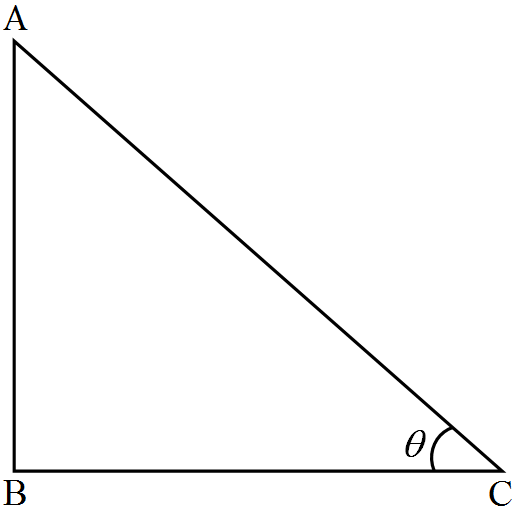
Let $AB$ be the rod and $BC$ be its shadow; and $\theta$ be the angle of elevation of the sun.
We have,
$\text{AB}:\text{BC}=1:\sqrt{3}$
Let $AB = x$
Then, $\text{BC}=\text{x}\sqrt{3}$
In $\triangle\text{ABC},$
$\tan\theta=\frac{\text{AB}}{\text{BC}}$
$\Rightarrow\tan\theta=\frac{1}{\sqrt{3}}$
$\Rightarrow\tan\theta=\tan30^\circ$
$\therefore\ \theta=30^\circ$ View full question & answer→MCQ 781 Mark
The angle of elevation of the top of a tower at a point on the ground $50m$ away from the foot of the tower is $45^\circ$ . Then the height of the tower $($in metres$)$ is :
- A
$50\sqrt{3}$
- ✓
$50$
- C
$\frac{50}{\sqrt{2}}$
- D
$\frac{50}{\sqrt{3}}$
AnswerLet $AB$ be tower and $C$ is a point on the ground $50m$ away.
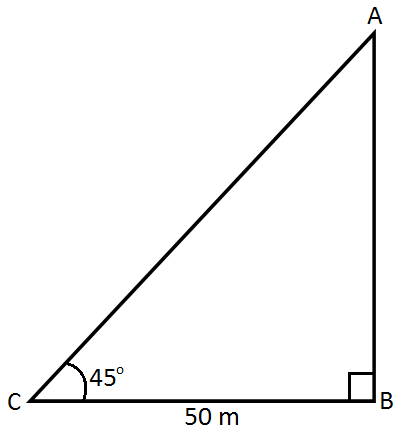
From foot of tower $B$
Angle of elevation is $45^\circ$
Let $h$ be height of tower $= xm$
$\therefore\ \tan\theta=\frac{\text{AB}}{\text{BC}}$
$\Rightarrow\ \tan45^\circ=\frac{\text{AB}}{5}$
$\Rightarrow\ 1=\frac{\text{AB}}{50}$
$\Rightarrow\ \text{AB}=50\text{m.}$ View full question & answer→MCQ 791 Mark
The angle of elevation of a cloud from a point h metre above a lake is $\theta.$ The angle of depression of its reflection in the lake is $45^\circ$ . The height of the cloud is :
- ✓
$\text{h}\tan(45^\circ+\theta)$
- B
$\text{h}\cot(45^\circ-\theta)$
- C
$\text{h}\tan(45^\circ-\theta)$
- D
$\text{h}\cot(45^\circ+\theta)$
AnswerCorrect option: A. $\text{h}\tan(45^\circ+\theta)$
Let $C$ is the cloud and $R$ is its reflection in the lake
From the lake $, '7’m$ aboves it, $E$ is point
where angle of elevation of $C$ is $\theta$
and angle of depression of reflection is $45^\circ $
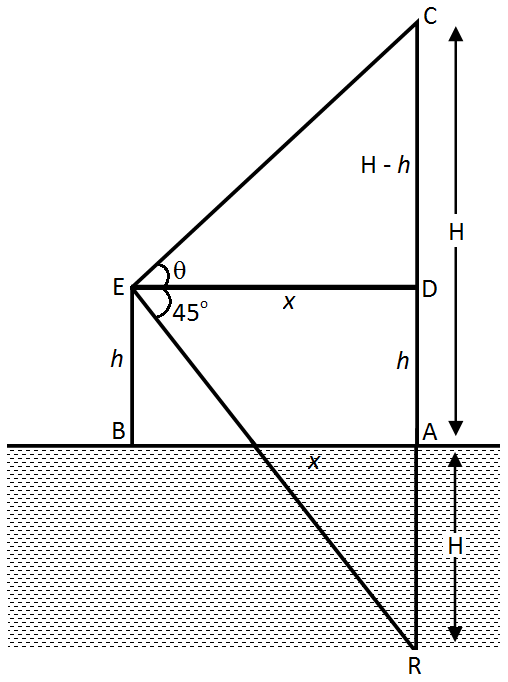
Let height of cloud $C$ is $H$
$\therefore CA = H = AR$
$AD = BE = h$
$CD = H - h$ and $BR = H + h$
Now in right $\triangle\text{CED,}$
$\tan\theta=\frac{\text{CD}}{\text{ED}}=\frac{\text{H}-\text{h}}{\text{x}}$
$\Rightarrow\ \text{x}=\frac{\text{H}-\text{h}}{\tan\theta}\ .....(\text{i})$
and in $\triangle\text{EDR,}$
$\tan45^\circ=\frac{\text{DR}}{\text{ED}}=\frac{\text{H}+\text{h}}{\text{x}}$
$\Rightarrow\ \text{x}=\frac{\text{H}+\text{h}}{\tan45^\circ}=\frac{\text{H}+\text{h}}{1}$
$\Rightarrow\ \text{x}=\text{H}+\text{h}\ .....(\text{i})$
From $(i) $ and $(ii)$
$\frac{\text{H}-\text{h}}{\tan\theta}=\text{H}+\text{h}$
$\Rightarrow\ \text{H}-\text{h}=\tan\theta(\text{H}+\text{h})$
$\Rightarrow\ \text{H}-\text{h}=\text{H}\tan\theta+\text{h}\tan\theta$
$\Rightarrow\ \text{H}-\text{H}\tan\theta=\text{h}+\text{h}\tan\theta$
$\Rightarrow\ \text{H}(1-\tan\theta)=\text{h}(1+\tan\theta)$
$\Rightarrow\ \text{H}=\frac{\text{h}(1+\tan\theta)}{1-\tan\theta}$
$\therefore$ Height of the cloud $=\frac{\text{h}(1+\tan\theta)}{1-\tan\theta}$
$=\text{h}\tan(45^\circ+\theta)$ View full question & answer→MCQ 801 Mark
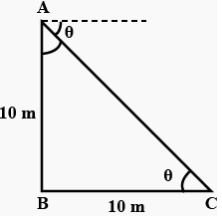
A pole $10m$ high cast a shadow $10m$ long on the ground, then the sun's elevation is :
- A
$60^\circ$
- ✓
$45^\circ$
- C
$30^\circ$
- D
$90^\circ$
AnswerCorrect option: B. $45^\circ$
In $\triangle BAC,$
$\Rightarrow \text{tan} \theta = \frac{\text{AB}}{\text{BC}} =\frac{10}{10} = 1$
$\Rightarrow \theta = 45^\circ$
Hence, the answer is $45^\circ$ .
View full question & answer→MCQ 811 Mark
An electric pole is $10\sqrt3\text{m}$ high and its shadow is $10m$ in length, then the angle of elevation of the sun is :
- A
$45^\circ$
- B
$30^\circ$
- ✓
$60^\circ$
- D
$15^\circ$
AnswerCorrect option: C. $60^\circ$
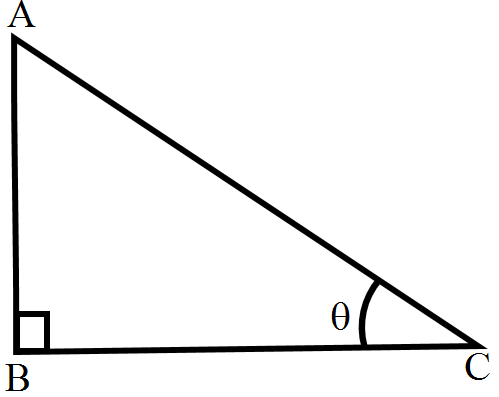
Let ab be the electric pole of height $10\sqrt3\text{m}$ its Shadow be $BC$ of lenght $10m.$
And the angle of elevation of the sun be $\theta.$
$\therefore\tan\theta=\frac{\text{AB}}{\text{BC}}$
$\Rightarrow\tan\theta=\frac{10\sqrt3}{10}$
$\Rightarrow\tan\theta=\sqrt3$
$\Rightarrow\tan\theta=\tan60^\circ$
$\Rightarrow\theta=60^\circ$ View full question & answer→MCQ 821 Mark
In a right $\triangle\text{ABC}, AC$ is the hypotenuse of length $10\ cm$. If $\angle\text{A} = 30^\circ,$ then the area of the triangle is :
AnswerCorrect option: C. $\frac{25}{2}\sqrt3\text{ cm}^2$
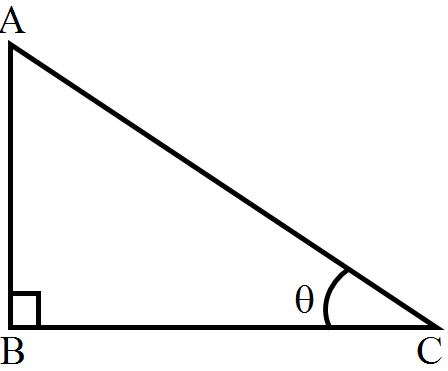
In triangle $\text{ABC}, AC$ is hypotenuse of the length $= 10\ cm \angle\text{A}=30^\circ$
Now, $\sin30^\circ=\frac{\text{BC}}{\text{AC}}$
$\Rightarrow\frac{1}{2}=\frac{\text{BC}}{10}$
$\Rightarrow\text{BC}=\frac{10}{2}=5\text{ cm}$
Now, $\text{AB}=\sqrt{(\text{AC})^2-(\text{BC})^2}$
$=\sqrt{(10)^2-(5)^2}$
$=\sqrt{100-25}$
$=\sqrt{75}=5\sqrt3\text{ cm}$
$\therefore$ ar $(\triangle\text{ABC})=\frac{1}{2}\times\text{BC}\times\text{AB}$
$=\frac{1}{2}\times5\sqrt3\times5$
$=\frac{25\sqrt3}{2}\text{sq.}\text{cm}$ View full question & answer→MCQ 831 Mark
The angle of depression of a car parked on the road from the top of a $150-m-$ high tower is $30^\circ$ . The distance of the car from the tower is :
- A
$50\sqrt{3}\text{m}$
- ✓
$150\sqrt{3}\text{m}$
- C
$150\sqrt{2}\text{m}$
- D
$75\text{m}$
AnswerCorrect option: B. $150\sqrt{3}\text{m}$
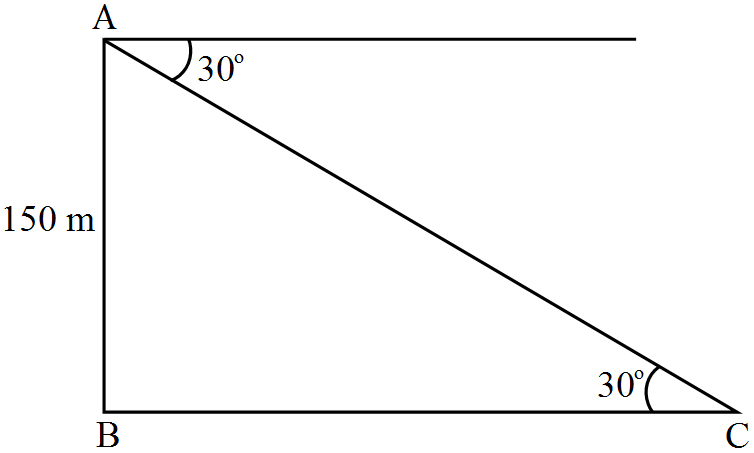
Let $AB$ be the tower and point $C$ be the position of the car.
We have,
$AB = 150m,$ and $\angle\text{ACB}=30^\circ$
In $\triangle\text{ABC},$
$\tan30^\circ=\frac{\text{AB}}{\text{BC}}$
$\Rightarrow\frac{1}{\sqrt{3}}=\frac{150}{\text{BC}}$
$\therefore\ \text{BC}=150\sqrt{3}\text{m}$ View full question & answer→MCQ 841 Mark
A plane is observed to be approaching the airport. It is at a distance of $12\ km$ from the point of observation and makes an angle of elevation of $30^\circ$ there at. Its height above the ground is :
- A
$6\ km$
- ✓
$10\ km$
- C
$12\ km$
- D
AnswerCorrect option: B. $10\ km$
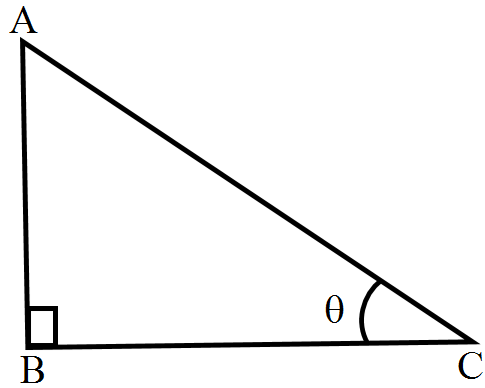
Let the height of the flying plane be $AB = h$ meters,
distance from the point of observation $AC = 12\ km$ and angle of elevation $ \theta=30^\circ$
$\therefore\sin30^\circ=\frac{\text{AB}}{\text{AC}}$
$\Rightarrow\frac{1}{2}=\frac{\text{h}}{12}$
$\Rightarrow\text{h}=6\text{ meters}.$ View full question & answer→MCQ 851 Mark
The angle of elevation of the top of a tower from two points $P$ and $Q$ at distances of $'a\ ’$ and $'b\ ’$ respectively from the base and in the same straight line with it are complementary. The height of the tower is :
- A
$2\sqrt{\text{ab}}$
- B
$\text{None of these}$
- C
$\text{ab}$
- ✓
$\sqrt{\text{ab}}$
AnswerCorrect option: D. $\sqrt{\text{ab}}$
Let $TW$ be the tower of height $h$ meters and $P$ and $Q$ are two points such that $PW = a$ and $QW = b.$
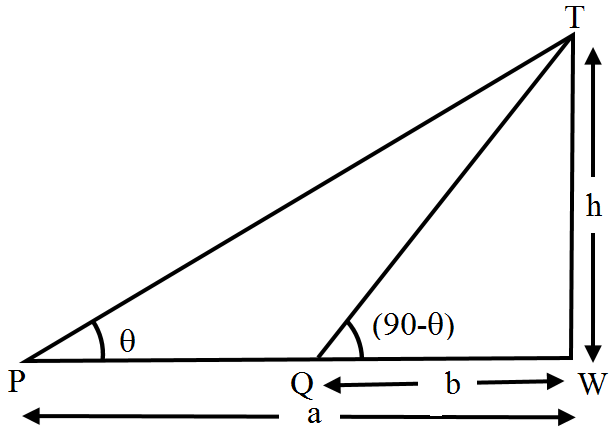
Let angles of elevation be $\angle\text{WPT}=\theta$
And $\angle\text{WQT}=90^\circ-\theta$
Now, in right angled triangle $\text{TWP},$
$\tan\theta=\frac{\text{TW}}{\text{PW}}$
$\Rightarrow\tan\theta=\frac{\text{h}}{\text{a}}$
$\Rightarrow\text{h}=\text{a}\tan\theta...(\text{i})$
Again in right angled triangle $\text{TWQ},$
$\tan(90^\circ-\theta)=\frac{\text{h}}{\text{b}}$
$\Rightarrow\cot\theta=\frac{\text{h}}{\text{b}}$
$\Rightarrow\text{h}=\text{b}\cot\theta...(\text{ii})$
Multiplying eq. $(i)$ and $(ii),$ we get
$\text{h}\times\text{h}=(\text{a}\tan \theta)(\text{b}\cot\theta)$
$\Rightarrow\text{h}^2=\text{ab}$
$\Rightarrow\text{h}^2=\sqrt{\text{ab}}$
Therefore, the height of the tower is $\sqrt{\text{ab}}.$ View full question & answer→MCQ 861 Mark
In a right triangle $\text{ABC}, \angle\text{C}=90^\circ.$ If $ \text{AC}=\sqrt{3} BC$ and $ \angle\text{B}=\text{f},$ then find its value.
- A
$45^\circ$
- B
$30^\circ$
- ✓
$60^\circ$
- D
AnswerCorrect option: C. $60^\circ$
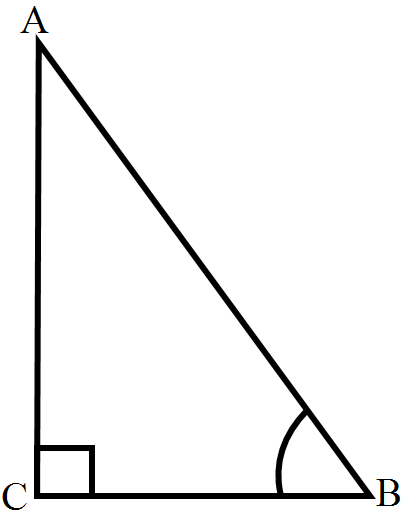
Given : $\angle\text{C}=90^\circ.$ If $ \text{AC}=\sqrt{3} BC$ and $\angle\text{B}=\phi$
$\therefore\tan\phi=\frac{\text{AB}}{\text{BC}}$
$\Rightarrow\tan\phi=\frac{\sqrt{3}\text{BC}}{\text{BC}}=\sqrt{3}$
$\Rightarrow\tan\phi=\tan60^\circ\phi$
$\Rightarrow\phi=60^\circ$ View full question & answer→MCQ 871 Mark
From the top of a cliff $24m$ height, a man observes the angle of depression of a boat is to be $60^\circ.$ The distance of the boat from the foot of the cliff is :
- ✓
$8\sqrt{3}\text{m}$
- B
$8\sqrt{2}\text{m}$
- C
$8\sqrt{5}\text{m}$
- D
$8\text{m}$
AnswerCorrect option: A. $8\sqrt{3}\text{m}$
$8\sqrt{3}\text{m}$
View full question & answer→MCQ 881 Mark
An observer $1.5m$ tall is $23.5m$ away from a tower $25m$ high. The angle of elevation of the top of the tower from the eye of the observer is :
- A
$30^\circ$
- B
$60^\circ$
- ✓
$45^\circ$
- D
AnswerCorrect option: C. $45^\circ$
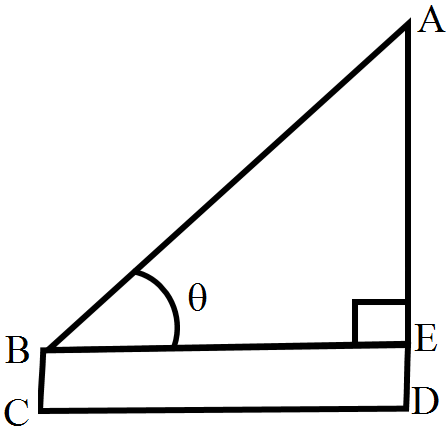
Let $\theta$ be the angle of elevation,
The height of the tower $AD = 25m$
And $CD = 23.5m$
In triangle $\text{ABE},$
$\therefore\tan\theta=\frac{\text{AE}}{\text{BE}}=\frac{\text{AD}-\text{ED}}{\text{CD}}$
$\Rightarrow\tan\theta=\frac{25-1.5}{23.5}=\frac{23.5}{23.5}=1$
$\Rightarrow\tan\theta=\tan45^\circ\theta$
$\Rightarrow\theta=\tan45^\circ$ View full question & answer→MCQ 891 Mark
A flag staff stands upon the top of a building. At a distance of $40m$. the angles of elevation of the tops of the flag staff and building are $60^\circ$ and $30^\circ$ then the height of the flag staff in metres is :
- A
$40\sqrt{3}$
- B
$\frac{40}{\sqrt{3}}$
- C
$\frac{160}{\sqrt{3}}$
- ✓
$\frac{80}{\sqrt{3}}$
AnswerCorrect option: D. $\frac{80}{\sqrt{3}}$
$\frac{80}{\sqrt{3}}$
View full question & answer→MCQ 901 Mark
A ladder makes an angle of $60^\circ$ with the ground when placed against a wall. If the foot of the ladder is $2m$ away from the wall, then the length of the ladder $($in metres$)$ is :
- A
$\frac{4}{\sqrt{3}}$
- B
$4\sqrt{3}$
- ✓
$4$
- D
$2\sqrt2$
AnswerSuppose $AB$ is the ladder of length $x m$
$\therefore OA = 2m, \angle\text{OAB}=60^\circ$
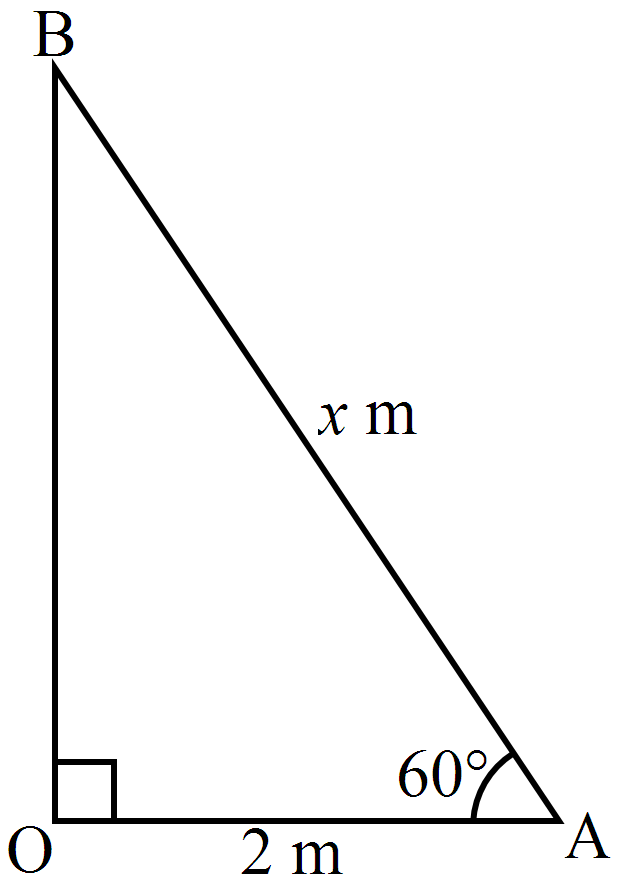
In right $\triangle\text{AOB},$
$\sec60^\circ=\frac{\text{x}}{2}$
$\Rightarrow2=\frac{\text{x}}{2}$
$\Rightarrow=4\text{m}$ View full question & answer→MCQ 911 Mark
If the shadow of a boy $'x\ ’$ metres high is $1.6m$ and the angle of elevation of the sun is $45^\circ,$ then the value of $'x\ ’$ is :
- A
$0.8m$
- ✓
$1.6m$
- C
$3.2m$
- D
$2m$
AnswerCorrect option: B. $1.6m$
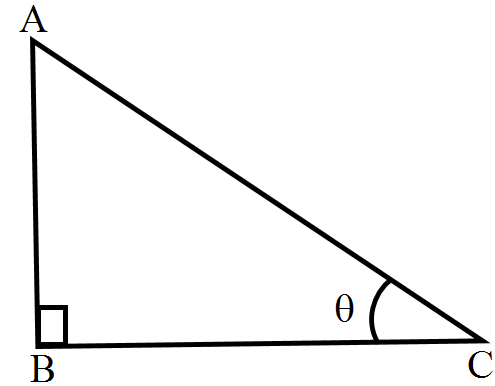
Given : Height of the boy $= AB =x$ meters
And the lenght of the shadow of the boy $= BC = 1.6m$
And angled of elevation $\theta=45^\circ$
$\therefore\tan45^\circ=\frac{\text{AB}}{\text{BC}}$
$\Rightarrow1=\frac{\text{x}}{1.6}$
$\Rightarrow\text{x}=1.6\text{m}$ View full question & answer→MCQ 921 Mark
From a point on the ground which is $15m$ away from the foot of a tower, the angle of elevation is found to be $60^\circ$ . The height of the tower is :
- ✓
$15\sqrt{3}\text{m}$
- B
$20\sqrt{3}\text{m}$
- C
$10\sqrt{3}\text{m}$
- D
$10\text{m}$
AnswerCorrect option: A. $15\sqrt{3}\text{m}$
Let the height of the tower be $h$ meters.
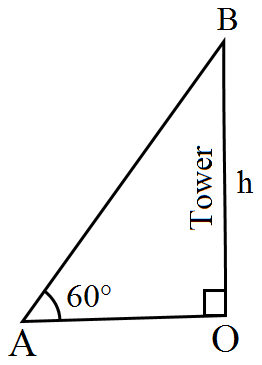
In triangle $\text{AOB},$
$\tan60^\circ=\frac{\text{AB}}{\text{OA}}$
$\Rightarrow\tan60^\circ=\frac{\text{h}}{15}$
$\Rightarrow\sqrt{3}=\frac{\text{h}}{15}$
$\Rightarrow\text{h}=15\sqrt{3}\text{m}$
Therefore, the height of the tower is $15\sqrt{3}\text{ meters}.$ View full question & answer→MCQ 931 Mark
From the top of a building $60m$ high, the angles of depression of the top and the bottom of a tower are observed to be $30^\circ$ and $60^\circ$ . The height of the tower is :
Answer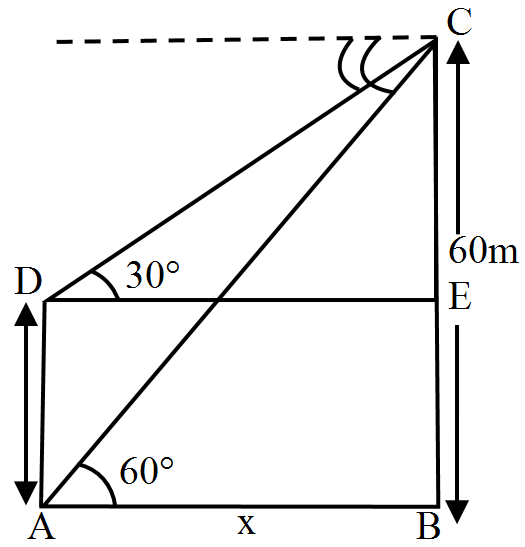
In triangle $\text{CDE},$
$\tan30^\circ=\frac{60-\text{h}}{\text{x}}$
$\Rightarrow\frac{1}{\sqrt3}=\frac{60-\text{h}}{\text{x}}$
$\Rightarrow\text{x}=\sqrt3(60-\text{h})\text{ meters }....(\text{i})$
Again, in triangle $\text{CAB},$
$\tan60^\circ=\frac{60}{\text{x}}$
$\Rightarrow\sqrt3=\frac{60}{\text{x}}$
$\Rightarrow\text{x}=\frac{60}{\sqrt3}\text{ meters }....(\text{ii})$
From eq. $(i),$ and $(ii)$ we get,
$\sqrt{3}(60-\text{h})=\frac{60}{\sqrt3}$
$\Rightarrow60-\text{h}=20$
$\Rightarrow\text{h}=40\text{ meters}$ View full question & answer→MCQ 941 Mark
From a point $P$ on the level ground, the angle of elevation of the top of a tower is $30^\circ$ . If the tower is $100m$ high, the distance between $P$ and the foot of the tower is :
- A
$300\sqrt{3}\text{m}$
- B
$150\sqrt{3}\text{m}$
- C
$200\sqrt{3}\text{m}$
- ✓
$100\sqrt{3}\text{m}$
AnswerCorrect option: D. $100\sqrt{3}\text{m}$
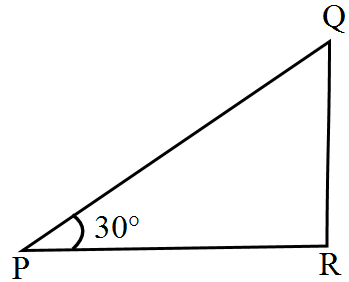
Let $QR$ be the height of the tower, then $QR = 100m$
And the angle of elevation of the top of the tower be $\angle\text{QPR}=30^\circ$
$\therefore\tan30^\circ=\frac{\text{QR}}{\text{PR}}$
$\Rightarrow\frac{1}{\sqrt3}=\frac{100}{\text{PR}}\text{m}$
$\Rightarrow\text{PR}=100\sqrt{3}\text{ meters}$
Therefore, the distance between $P$ and the foot of the tower is $100\sqrt{3}\text{ meters}.$ View full question & answer→MCQ 951 Mark
Two poles are $'a\ '$ metres apart and the height of one is double of the other. If from the middle point of the line joining their feet an observer finds the angular elevations of their tops to be complementary, then the height of the smaller is :
- A
$\sqrt{2}\text{a}\text{ meters}$
- ✓
$\frac{\text{a}}{2\sqrt{2}}\text{ meters}$
- C
$\frac{\text{a}}{\sqrt{2}}\text{ meters}$
- D
$2\text{a meters}$
AnswerCorrect option: B. $\frac{\text{a}}{2\sqrt{2}}\text{ meters}$
Let height of pole $CD = h$
and $AB = 2h, BD = a$
$M$ is mid $-$ point of $BD$
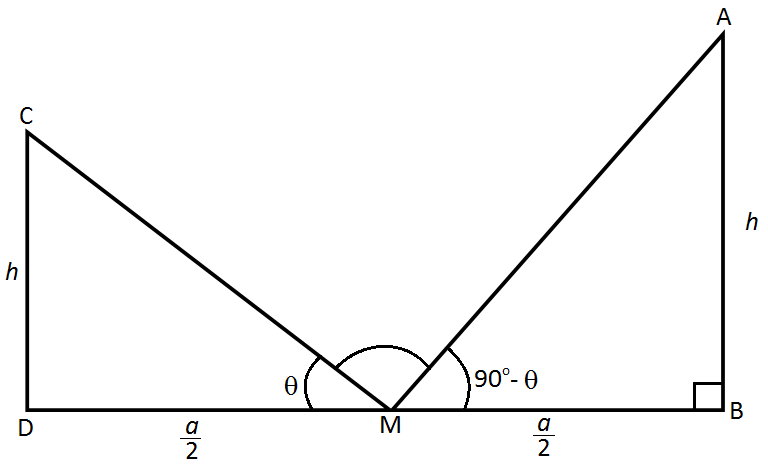
$\therefore\ \text{DM}=\text{MB}=\frac{\text{a}}{2}$
Let $\angle\text{CMD}=\theta,$
then $\angle\text{AMB}=90^\circ-\theta$
Now, $\tan\theta=\frac{\text{CD}}{\text{DM}}=\frac{\text{h}}{\frac{\text{a}}{2}}=\frac{2\text{h}}{\text{a}}\ ....(\text{i})$
and $\tan(90^\circ-\theta)=\frac{\text{AB}}{\text{MB}}$
$=\frac{2\text{h}}{\frac{\text{a}}{2}}=\frac{4\text{h}}{\text{a}}$
$\Rightarrow\ \cot\theta=\frac{4\text{h}}{\text{a}}\ .....(\text{ii})$
Multiplying $(i)$ and $(ii)$
$\tan\theta,\ \cot\theta=\frac{2\text{h}}{\text{a}}\times\frac{4\text{h}}{\text{a}}$
$1=\frac{8\text{h}^2}{\text{a}^2}$
$\Rightarrow\ \text{h}^2=\frac{\text{a}^2}{8}\text{m}$
$\text{h}=\sqrt{\frac{\text{a}^2}{8}}=\frac{\text{a}}{\sqrt{8}}$
$=\frac{\text{a}}{2\sqrt{2}}\text{m}$ View full question & answer→MCQ 961 Mark
The angle of elevation of the top of a tower standing on a horizontal plane from a point $A$ is $\alpha.$ After walking a distance d towards the foot of the tower the angle of elevation is found to be $\beta.$ The height of the tower is :
- A
$\frac{\text{d}}{\cot\alpha+\cot\beta}$
- ✓
$\frac{\text{d}}{\cot\alpha-\cot\beta}$
- C
$\frac{\text{d}}{\tan\beta-\tan\alpha}$
- D
$\frac{\text{d}}{\tan\beta+\tan\alpha}$
AnswerCorrect option: B. $\frac{\text{d}}{\cot\alpha-\cot\beta}$
The given information can be represented with the help of a diagram as below.
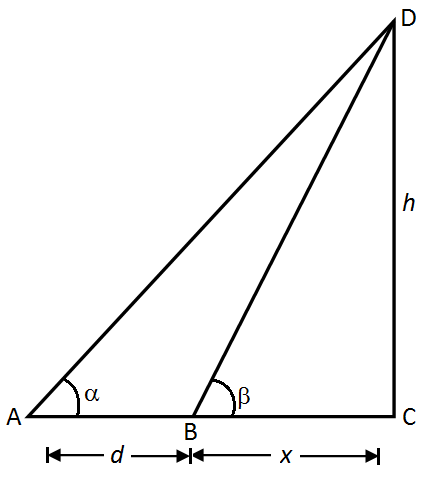
Here $,CD = h$ is the height of the tower.
Length of $BC$ is taken as $x.$
In $\triangle\text{ACD},$
$\tan\text{A}=\frac{\text{CD}}{\text{AC}}$
$\tan\alpha=\frac{\text{h}}{\text{d}+\text{x}}$
$\text{h}=(\text{d}+\text{x})\tan\alpha\ .......(1)$
In $\triangle\text{BCD},$
$\tan\text{B}=\frac{\text{CD}}{\text{BC}}$
$\tan\beta=\frac{\text{h}}{\text{x}}$
$\text{x}=\text{h}\cot\beta\ .....(2)$
From $(1)$ and $(2),$
$\text{h}=(\text{d}+\text{h}\cot\beta)\tan\alpha$
$\text{h}=\text{d}\tan\alpha+\text{h}\cot\beta\tan\alpha$
$\text{h}(1-\cot\beta\tan\alpha)=\text{d}\tan\alpha$
$\text{h}=\frac{\text{d}\tan\alpha}{(1-\cot\beta\tan\alpha)}=\frac{\text{d}}{\cot\alpha-\cot\beta}$ View full question & answer→MCQ 971 Mark
Two men are on opposite sides of a tower. They observe the angles of elevation of the top of the tower as $30^\circ$ and $45^\circ$ respectively. If the height of the tower is $100m,$ then the distance between them is :
- A
$100(1-\sqrt3)\text{m}$
- B
$100(\sqrt3-1)\text{m}$
- C
$\text{none of these}$
- ✓
$100(\sqrt3+1)\text{m}$
AnswerCorrect option: D. $100(\sqrt3+1)\text{m}$
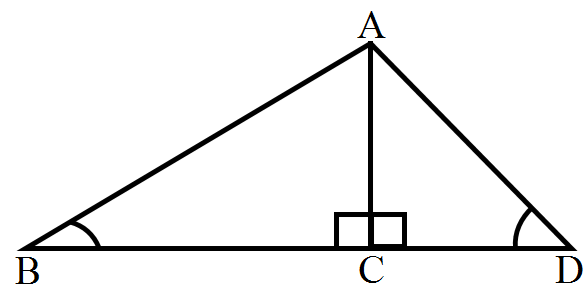
Let the height of the tower $AC = 100m$
Now, in triangle $\text{ABC},$
$\tan30^\circ=\frac{\text{AC}}{\text{BC}}$
$\Rightarrow\frac{1}{\sqrt3}=\frac{100}{\text{BC}}$
$\Rightarrow\text{BC}=100\sqrt3\text{m}$
Now, in triangle $\text{ACD},$
$\tan45^\circ=\frac{\text{AB}}{\text{CD}}$
$\Rightarrow1=\frac{100}{\text{CD}}$
$\Rightarrow\text{CD}=100\text{m}$
Therefore, the required distance $=\text{BC}+\text{CD}$
$=100\sqrt3+100$
$=100(\sqrt3+1)\text{m}$ View full question & answer→MCQ 981 Mark
The angle of depression of a boat from the top of a cliff $300m$ high is $60^\circ$ . The distance of the boat from the foot of the cliff is :
- ✓
$100\sqrt{3}$
- B
$100$
- C
$300\sqrt{3}$
- D
$300$
AnswerCorrect option: A. $100\sqrt{3}$
$100\sqrt{3}$
View full question & answer→MCQ 991 Mark
A boy is flying a kite, the string of the kite makes an angle of $30^\circ$ with the ground. If the height of the kite is $18m,$ then the length of the string is :
- A
$18\sqrt3\text{m}$
- B
$18\text{m}$
- ✓
$36\text{m}$
- D
$36\sqrt3\text{m}$
AnswerCorrect option: C. $36\text{m}$
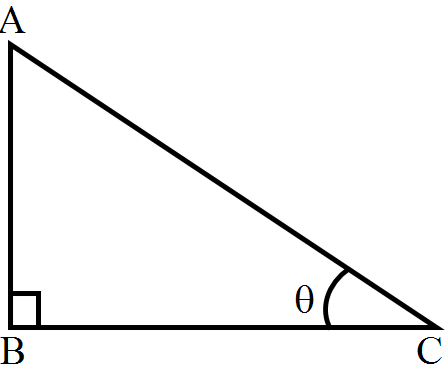
Let height of the kite $AB = 18m,$
length of the string $= AC$ and angle of elevation $= \theta =30^\circ$
$\therefore\sin30^\circ=\frac{\text{AB}}{\text{AC}}$
$\Rightarrow\frac{1}{2}=\frac{18}{\text{AC}}$
$\Rightarrow\text{AC}=36\text{m}$ View full question & answer→MCQ 1001 Mark
A ladder $15m$ long just reaches the top of a vertical wall. If the ladder makes an angle of $60^\circ$ with the wall, then the height of the wall is :
AnswerCorrect option: C. $\frac{15}{2}\text{m}$
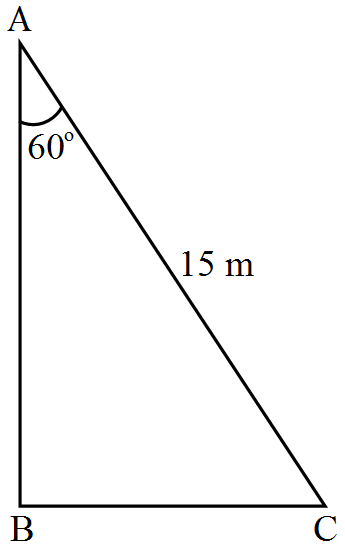
Let $AB$ be the wall and $AC$ be the ladder
We have,
$AC = 15m,$ and $\angle\text{BAC}=60^\circ$
In $\triangle\text{ABC},$
$\cos60^\circ=\frac{\text{AB}}{\text{AC}}$
$\Rightarrow\frac{1}{2}=\frac{\text{AB}}{15}$
$\therefore\ \text{AB}=\frac{15}{2}\text{m}$ View full question & answer→