Questions

2 Marks Questions

🎯

Test yourself on this topic

7 questions · timed · auto-graded

Question 12 Marks
If the total surface area of a solid hemisphere is $462 \ cm^2$, find its volume. $[$Take $\pi=\frac{22}{7}]$
Answer
Total surface area of a solid hemisphere $=3 \pi r^2$
$\Rightarrow 3 \pi r^2=462$
$\Rightarrow 3\left(\frac{22}{7}\right) r^2=462$
$\Rightarrow r^2=\frac{462 \times 7}{3 \times 22}$
$\Rightarrow r^2=49$
$\Rightarrow r=7 \ cm$
View full question & answer
Question 22 Marks
A solid sphere of radius $10.5 \ cm$ is melted and recast into smaller solid cones, each of radius $3.5 \ cm$ and height $3 \ cm .$ find the number of cones so formed. $($Use $\pi=\frac{22}{7})$
Answer
Since the solid sphere has been melted and recast into smaller solid cones, the total volume of all the solid cones will be equal to the volume of the solid sphere.
Let $n$ solid cones are formed by melting a solid sphere.
Let $R$ and $r$ be the radii of sphere and cone respectively and $h$ be the height of the cone.
$\therefore R=10.5 \ cm, r =3.5 \ cm$ and $h=3 \ cm$
Volume of the solid sphere $=\frac{4}{3} \pi R^3$
$=\frac{4}{3} \times \frac{22}{7} \times 10.5 \times 10.5 \times 10.5$
$=4851 \ cm^3$
Now, volume of one smaller solid cone
$=\frac{1}{3} \pi r^2 h$
$=\frac{1}{3} \times \frac{22}{7} \times 3.5 \times 3.5 \times 3$
$=38.5 \ cm^3$
Clearly, volume of solid sphere $=n\ \times$ volume of one solid cone.
$4851=n \times 38.5$
$\Rightarrow n=\frac{4851}{38.5}$
$\Rightarrow n=126$
Therefore, $126$ cones are formed by melting a solid sphere.
View full question & answer
Question 32 Marks
Two cubes, each of side $4 \ cm$ are joined end to end. Find the surface area of the resulting cuboid.
Answer
Given that, sides of each cube $=4 \ cm$
Now, when the cubes are joined end to end, then.
The length of the resulting cuboid $=4+4=8 \ cm$
Width of the resulting cuboid $=4 \ cm$
Height of the resulting cuboid $=4 \ cm$
We know that, the surface area of the cuboid
$=2(Ib+bh+hl)$
$=2(8 \times 4+4 \times 4+4 \times 8)$
$=2(32+16+32)$
$=2(80)$
$=160 \ cm^2$
Hence, the surface area of the resulting cuboid is $160 \ cm^2$.
View full question & answer
Question 42 Marks
A solid piece of metal in the form of a cuboid of dimensions $11 \ cm \times 7 \ cm \times 7 \ cm$ is melted to form $n$ number of solid spheres of radii $\frac{7}{2} \ cm$ each. Find the value of $n$.
Answer
We know that, volume of cuboid $=l \times b \times h$ volume of sphere $=\frac{4}{3} \pi r^3$
Given, $l=11 \ cm$
$b=7 \ cm,$
$h=7 \ cm \text { and } r=\frac{7}{2} \ cm$
Here, volume of cuboid $=n \times$ volume of sphere
or, $11 \times 7 \times 7=n \times \frac{4}{3} \pi\left(\frac{7}{2}\right)^3$
or, $11 \times 7 \times 7=n \times \frac{4}{3} \times \frac{22}{7} \times \frac{7}{2} \times \frac{7}{2} \times \frac{7}{2}$
or, $n=\frac{11 \times 7 \times 7 \times 3 \times 7 \times 2 \times 2 \times 2}{4 \times 22 \times 7 \times 7 \times 7}$
or, $n=3$
View full question & answer
Question 52 Marks
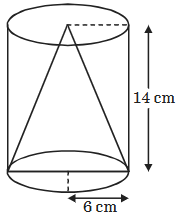
From a solid right circular cylinder of height $14 \ cm$ and base radius $6 \ cm ,$ a right circular cone of same height and same base radius is removed. Find the volume of the remaining solid.
Answer
Image
$\text { Volume of remaining solid }$
$=\text {Volume of cylinder }- \text { Volume of cone }$
$ =\pi r^2 h-\frac{1}{3} \pi r^2 h$
$ =\frac{2}{3} \pi r^2 h$
$ =\frac{2}{3} \times \frac{22}{7} \times 6 \times 6 \times 14$
$ =48 \times 22$
$=1056 \ cm^3$
View full question & answer
Question 62 Marks
The surface area of a sphere is 616 sq cm . Find its radius. [Use $\left.\pi=\frac{22}{7}\right]$
Answer
Given, surface area of sphere $=616 cm^2$
We know that,
Surface area of sphere $=4 \pi r ^2$
$
\begin{array}{lr}
\therefore & 4 \pi r^2=616 \\
\Rightarrow & r^2=\frac{616}{4 \pi}
\end{array}
$
$
\begin{array}{ll}
\Rightarrow & r^2=\frac{616 \times 7}{4 \times 22} \\
\Rightarrow & r^2=49 \\
\Rightarrow & r=7 cm
\end{array}
$
Hence, radius of sphere is 7 cm .
View full question & answer
Question 72 Marks
Find the curved surface area of a right circular cone whose height is $15 \ cm$ and base radius is $8 \ cm .\left[\text { Use } \pi=\frac{22}{7}\right]$
Answer
Given, height of cone, $h =15 \ cm$ base radius of cone, $r =8 \ cm$
$\therefore$ slant height of cone,
$\lambda =\sqrt{h^2+r^2}$
$ =\sqrt{(15)^2+(8)^2}$
$ =\sqrt{225+64}$
$=\sqrt{289} 17 \ cm$
Now, curved surface area of cone $=\pi r \lambda$
$=\frac{22}{7} \times 8 \times 17$
$=\frac{2992}{7}$
$=427.429 \ cm^2$
View full question & answer
2 Marks Questions - Maths STD 10 Questions - Vidyadip