Question 13 Marks
The dimensions of a solid iron cuboid are $4.4\ m \times 2.6 \ m \times 1.0\ m$. It is melted and recast into a hollow cylindrical pipe of $30 \ cm$ inner radius and thickness $5 \ cm$ . Find the length of the pipe.
AnswerGiven,
Volume of solid iron cuboid $=4.4\ m \times 2.6 \ m \times 1.0\ m$
$=440 \ cm \times 260 \ cm \times 100 \ cm$
Internal radius of pipe, $r=30 \ cm$
External radius of pipe, $R=30+5=35 \ cm$
Let length of pipe be $h \ cm$
Volume of iron in the pipe
$=\pi R^2 h-\pi r^2 h=\pi h\left(R^2-r^2\right)$
$=\pi h\left(35^2-30^2\right)$
$=\pi h(35-30)(35+30)$
$=\pi h(5-65)$
Volume of iron in pipe $= $ Volume of solid iron
cuboid
$\Rightarrow \pi h(5 \times 65)=440 \times 260 \times 100$
$\Rightarrow h=\frac{440 \times 260 \times 100 \times 7}{5 \times 65 \times 22}$
$\Rightarrow h=11,200 \ cm=112\ m$
Therefore, length of pipe is $ 112\ m \text {. }$
View full question & answer→Question 23 Marks
The $\frac{3}{4}$ th part of a conical vessel of internal radius $5 \ cm$ and height $24 \ cm$ is full of water. The water is emptied into a cylindrical vessel with internal radius $10 \ cm$ . Find the height of water in cylindrical vessel.
AnswerGiven: Height $(h)$ of conical vessel $=24 \ cm$
Radius $( r )$ of the conical vessel $=5 \ cm$
Radius $(R)$ of the cylindrical vessel $=10 \ cm$
Volume of the conical vessel is given by
$V=\frac{1}{3} \pi r^2 h$
According to the question the height of water is
$\frac{3}{4} ^{th } $ of the height of the conical vessel.
Therefore, volume of water $=\frac{3}{4}$ of volume of the conical vessel
$=\frac{3}{4} \times \frac{1}{3} \pi r^2 h$
Putting the values $=\frac{3}{4} \times \frac{1}{3} \pi(5)^2 \times 24$
$=\pi \times 25 \times 6$
$=150 \pi \ldots \ldots(i)$
Now, it is given that the water is emptied into a cylindrical vessel with internal radius $10 \ cm$ .
Volume of a cylinder is given by the formula
$V=\pi R^2 h$
Putting the values in the above equation
$V=\pi \times(10)^2 \times h$
$V=100 \pi h \ldots \ldots(ii)$
Equating $(i)$ and $(ii),$ we'll get
$100 \pi h=150 \pi$
$\Rightarrow h=\frac{150}{100}$
$h=1.5 \ cm$
Hence, height of water in cylindrical vessel is $1.5 \ cm$
View full question & answer→Question 33 Marks
The slant height of a frustum of a cone is $4 \ cm$ and the perimeters of its circular ends are $18 \ cm$ and $6 \ cm .$ Find the curved surface area of the frustum.
AnswerGiven, Perimeter of lower end, $c=6 \ cm$
Perimeter of upper end, $C=18 \ cm$
Slant height, $l=4 \ cm$
Let radius of upper end be $R$ and radius of lower end be $r$
As, We know
$C=2 \pi R$
$\Rightarrow 2 \pi R=18$
$\Rightarrow R=\frac{18}{2 \pi}$
$\Rightarrow R=\frac{9}{\pi} \ cm$
As, $c=6 \ cm$
$\Rightarrow 2 \pi R=6$
$\Rightarrow r=\frac{6}{2 \pi}$
$\Rightarrow r=\frac{3}{\pi} \ cm$
Curved surface area of frustum $=\pi(R+r) l$
$\Rightarrow \pi\left(\frac{9}{\pi}+\frac{3}{\pi}\right) \times 4$
$\Rightarrow \pi \times\left(\frac{12}{\pi}\right) \times 4$
$\Rightarrow 48 \ cm^2$
Therefore, the curved surface area of frustum is $48 \ cm^2$
View full question & answer→Question 43 Marks
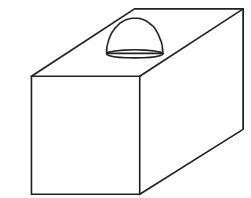
In the figure below, a decorative block, made up of two solids $-$ a cube and a hemi $-$ sphere? The base of the block is a cube of side $6 \ cm$ and the hemisphere fixed on the top has a diameter of $3.5 \ cm$ . Find the total surface area of the block. $\text { (use } \left.\pi=\frac{22}{7}\right)$
Answer
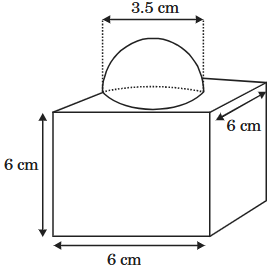
Surface area of the block $=$ Total surface area of the cube $-$ Base area of the hemisphere $+$ Curved surface area of the hemisphere
$=6 \times(\text { Edge })^2-\pi r^2+2 \pi r^2$
$=\left(6 \times(6)^2+\pi r^2\right)$
$=\left(216+\frac{22}{7} \times \frac{3.5}{2} \times \frac{3.5}{2}\right)$
$=(216+9.625)=225.625 \ cm^2$
Hence, the total surface area of the block is $225.625 \ cm^2$. View full question & answer→Question 53 Marks
Water in a canal $, 5.4 \ m$ wide and $1.8\ m$ deep, is flowing with a speed of $25 \ \text{km / hour}$. How much area can it irrigate in $40$ minutes, if $10 \ cm$ of standing water is required for irrigation?
AnswerGiven
Depth of canal $=1.8\ m$
Width of canal $=5.4\ m$
Height of standing water $=10 \ cm=0.1\ m$
Speed of flowing water $=25 \ km / h$
$=\frac{25000}{60}$
$=\frac{1250}{3} m / \min$
Volume of water flowing out of canal in $1 \min $
$\Rightarrow$ width $\times$ depth $\times$ water flowing in $1$ minute
$\Rightarrow 5.4 \times 1.8 \times \frac{1250}{3}$
$\Rightarrow 4050\ m^3$
Volume of water flowing out of canal in $40 \min $
$\Rightarrow 40 \times 4050\ m^3=162000\ m^3$
Area of irrigation $\times$ Height of standing water $=$ Volume of water flowing out in $40$ minutes.
Area of irrigation
$\Rightarrow \frac{\text { Volume of water out in } 40 \min}{\text { Height of standing water }}$
$\Rightarrow \frac{162000}{0.1}$
$\Rightarrow 1620000\ m^2$
$\Rightarrow 162$ hectare $(\because 1$ hectare $=10000\ m^2)$
It can irrigate $162$ hectare in $40 \min .$
View full question & answer→Question 63 Marks
A well of diameter $4 m$ is dug $21 m$ deep. The earth taken out of it has been spread evenly all around it in the shape of a circular ring of width to form an embankment. Find the height of the embankment.
AnswerLet suppose $r$ and $h$ be the radius and depth of the well respectively.
$\therefore r=\frac{4}{2}=2 m$ and $h=21 m$
Let suppose $R$ and $H$ be the outer radius and height of the embankment respectively.
$\therefore R=r+3=2+3=5 m$
Now, Volume of the earth used to form the embankment
$=$ Volume of the earth dug out of the well.
$=\pi\left(R^2-r^2\right) H=\pi r^2 h$
$\Rightarrow H=\frac{r^2 h}{R^2-r^2}$
$\Rightarrow H=\frac{2^2 \times 21}{5^2-2^2}=4 m$
Hence, the height of the embankment is $4m.$
View full question & answer→Question 73 Marks
The sum of the radius of base and height of a solid right circular cylinder is $37 \ cm$ . If the total surface area of the solid cylinder is $1628 \ cm^2,$ find the volume of the cylinder. $($Use $\pi=\frac{22}{7})$
AnswerLet suppose the base and height of the solid right circular cylinder be $r \ cm$ and $h \ cm,$ respectively.
According to the question,
$r+h=37 \ldots \ldots(1)$
Now the Total surface area $=1628 \ cm^2$
We know that Total Surface area of the cylinder is $2 \pi r(r+h)$.
So, $2 \pi r(r+h)=1628 \ldots \ldots(2)$
Form $(1)$ and $(2),$
$2 \pi r(37)=1628$
$\Rightarrow 2 \pi r=44 $
$\Rightarrow 2 \times \frac{22}{7} \times r=44$
$\Rightarrow r=\frac{44 \times 7}{2 \times 22}$
$\Rightarrow r=7 \ cm$
Substituting the value of $r$ in $(1),$ we get,
$7+h=37$
$\Rightarrow h=30 \ cm$
Now, we know the formula for the Volume of the Cylinder as $\pi r^3 h$
So, Volume of the Cylinder
$=\frac{22}{7} \times 7 \times 7 \times 30=4,620 \ cm^3$
Hence, the volume of the cylinder is $4,620 \ cm^3$.
View full question & answer→Question 83 Marks
A sphere of diameter $12 \ cm$ is dropped in a right circular cylindrical vessel partly filled with water. If the sphere is completely submerged in water, the water level in the cylindrical vessel rises by $3 \frac{5}{9} \ cm$. Find the diameter of the cylindrical vessel.
AnswerDiameter of sphere is $12 \ cm,$
Therefore, radius of sphere is $6 \ cm.$
Volume of sphere $=\frac{4}{3} \pi r^3=\frac{4}{3} \pi(6)^3=288 \pi \ cm^3$
Let $R$ be the radius of cylindrical vessel.
Rise in the water level of the cylinder $=h=3 \frac{5}{9} \ cm=\frac{32}{9} \ cm$
Rise in the volume of water in the cylindrical
vessel $=\pi R^2 h=\pi R^2 \frac{32}{9}=\frac{32}{9} \pi R^2$
Now, volume of water displaced by the sphere is equal to volume of the sphere.
Therefore, $\frac{32}{9} \pi R^2=288 \pi$
$R^2=\frac{288 \times 9}{32}=81$
$R=9 \ cm$
Hence, diameter of the cylindrical vessel $=2 R=2 \times 9=18 \ cm$
View full question & answer→Question 93 Marks
A conical vessel, with base radius $5 \ cm$ and height $24 \ cm $, is full of water. This water is emptied into a cylindrical vessel of base radius $10 \ cm$ . Find the height to which the water will rise in the cylindrical vessel.
AnswerRadius of the conical vessel $=r_1=5 \ cm$
Height of the conical vessel $=h_1=24$
Radius of the cylindrical vessel $=r_2=10 \ cm$
Let the water rise upto the height of $h_2 \ cm$ in the cylindrical vessel.
Now, volume of water in conical vessel $=$ Volume of water in cylindrical vessel
Hence, $\frac{1}{3} \pi r_1{ }^2 h_1=\pi r_2{ }^2 h_2$
$r_1^2 h_1=3 r_2^2 h_2$
$5^2 \times 24=3 \times 10^2 \times h_2$
$h_2=\frac{5 \times 5 \times 24}{3 \times 10 \times 10}=2 \ cm$
Thus, the water will rise up to the height of $2 \ cm$ in the cylindrical vessel.
View full question & answer→Question 103 Marks
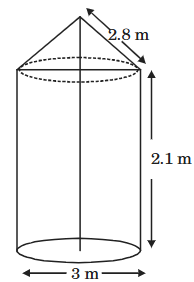
In the given figure, a tent is in the shape of a cylinder surmounted by a conical top of same diameter. If the height and diameter of cylindrical part are $2.1 \ m$ and $3 \ m$ respectively and the slant height of conical part is $2.8\ m ,$ find the cost of canvas needed to make the tent if the canvas is available at the rate of $Rs. 500 ^2$. metre.
AnswerGiven,
Height of the cylindrical part $=2.1 m$
Diameter of the cylindrical part $=3 m$
Slant height $(l)$ of the conical part $=2.8 m$
According to the figure,
Total canvas used $= \text{CSA}$ of the cylindrical part $+ \ \text{CSA}$ of the conical part
$=2 \pi r h+\pi r l$
$=\frac{22}{7} \times \frac{3}{2}((2 \times 2.1)+2.8)$
$=\frac{22}{7} \times \frac{3}{2}(4.2+2.8)$
$=\frac{22}{7} \times \frac{3}{2} \times 7$
$=33 m^2$
Cost of $1 \ m^2$ canvas $= Rs. 500$
Cost of $33 \ m^2$ canvas $=33 \times 500=16,500$
Therefore, the cost of the canvas needed to make the tent is $Rs. 16,500$.
View full question & answer→Question 113 Marks
Due to sudden floods, some welfare associations jointly requested the government to get $100$ tents fixed immediately and offered to contribute $50 \%$ of the cost. If the lower part of each tent is of the form of a cylinder of diameter $4.2 m$ and height $4 m$ with the conical upper part of same diameter but of height $2.8 m$ , and the canvas to be used costs $Rs. 100$ per sq. m, find the amount, the associations will have to pay. What values are shown by these associations? $[$Use $\pi=\frac{22}{7} ]$
AnswerThe height and diameter of the cylinder are $4 m$ and $4.2 m$ respectively.
$($Given$)$
The height and diameter of the cone are $2.8 m$ and $4.2 m$ respectively.
$($Given$)$
So, the radius of cylindrical and conical part is $2.1 m .$
Curved surface area of cylindrical part $=2 \pi r h$
$=2 \times \frac{22}{7} \times 2.1 \times 4=52.80 m^2$
Curved surface area of conical part $=\pi r l$
Where, $l=$ Slant height
$l=\sqrt{h^2+r^2}$
Curved surface area of conical part
$=\frac{22}{7} \times 2.1 \times \sqrt{2.8^2+2.1^2}$
$=6.6 \times \sqrt{12.25}$
$=23.10 m^2$
Surface area of tent $=$ Curved surface area of cylindrical part $+$ Curved surface area of conical part
Surface area of tent $=52.80 m^2+23.10 m^2$
$=75.90 m^2$
Surface area of $100$ tents $=100 \times 75.90=7590 m^2$
Cost of canvas used is $Rs.100$ per sq. m
$\therefore$ Cost of $100$ tents $=100 \times 7590= Rs.759000$
Welfare association is paying of the total amount $=50 \%$ of $759000= Rs. 379500$
The welfare associations will pay $Rs.3,79,500$
The welfare association has shown a sense of responsibility towards the society.
View full question & answer→Question 123 Marks
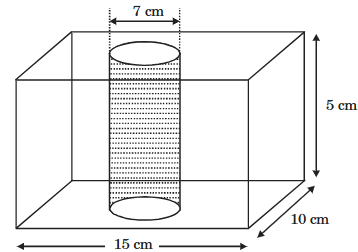
In the figure below, from a cuboidal solid metallic block, of dimensions $15 cm \times 10 cm \times 5 cm$, a cylindrical hole of diameter 7 cm is drilled out. Find the surface area of the remaining block.$\left[\right.$ Use $\left.\pi=\frac{22}{7}\right]$
AnswerGiven the dimensions of the cuboidal box as $15 cm \times 10 cm \times 5 cm$.
Length 'I' of the cuboidal block $=15 cm$
Breadth 'b' of the cuboidal block $=10 cm$
Height 'h' of the cuboidal block $=5 cm$
Let $d$ and $\tau$ represent the diameter and radius of the cylindrical hole respectively.
The diameter of the cylindrical hole $=7 cm$
The radius of the cylindrical hole
$
=\frac{d}{2}=\frac{7}{2}=3.5 cm
$
It is given that from a cuboidal solid metallic block, a cylindrical hole of diameter 7 cm is drilled out. Therefore the surface area of the remaining block $=$ Surface area of the cuboid + Curved surface area of the cylinder -2 (Area of the base of cylinder)
$
=\text { Remaining area }=2(l b+b h+l h)+2 \pi r h-2\left(\pi r^2\right)
$
$
\begin{aligned}
& 2(15 \times 10+10 \times 5+5 \times 15)+2 \times \frac{22}{7} \times 3.5 \\
\times & 5-2 \times \frac{22}{7}(3.5)^2 \\
= & 2(150+50+75)+110-77 \\
= & 550+110-77=583 cm^2
\end{aligned}
$
Hence, the area of the remaining block is $583 cm^2$
View full question & answer→Question 133 Marks
In the given figure, from the top of a solid cone of height $12 \ cm$ and base radius $6 \ cm ,$ a cone of height $4 \ cm$ is removed by a plane parallel to the base. Find the total surface area of the remaining solid. Use $\left(\pi=\frac{22}{7}\right.$ and $\left.\sqrt{5}=2.236\right)$.
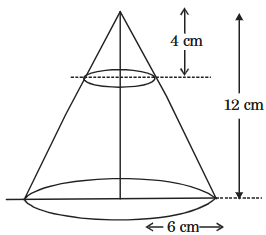
AnswerWhen from the top of a solid cone of height $12 \ cm$ and base radius $6 \ cm ,$ a cone of height $4 \ cm$ is removed by a plane parallel to the base the remaining solid will be a frustum.
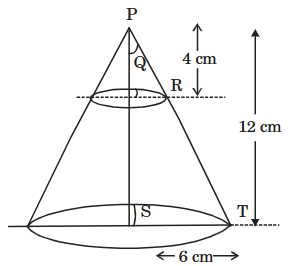
The total surface area of the frustum
$=\pi l\left(r_1+r_2\right)+\pi r_1^2+\pi r_2^2$
Where
$r_1$ is the smaller radius of the frustum.
$r_{ q }$ is the larger radius of the frustum $=6 \ cm$.
$l$ is the slant height of the frustum.
$\triangle P Q R-\triangle P S T $ by $AA$ similarity criterion.
$\therefore \frac{Q R}{S T}=\frac{P Q}{P S}$
$\Rightarrow \frac{r_1}{6}=\frac{4}{12}$
$\Rightarrow r_1=\frac{4}{12} \times 6=2 \ cm$
Height of the frustum is $12 \ cm-4 \ cm=8 \ cm$
We know that slant height is given by the formula,
$l=\sqrt{h^2+\left(r_2-r_1\right)^2}$
$l=\sqrt{8^2+(6-2)^2}$
$\Rightarrow l=\sqrt{64+16} $
$\Rightarrow l=\sqrt{80}=4 \sqrt{5} \ cm$
Therefore the total surface area of the frustum
$=\pi l\left(r_1+r_2\right)+\pi r_1^2+\pi r_2^2$
$=\frac{22}{7} \times 4 \sqrt{5}(2+6)+\frac{22}{7}(2)^2+\frac{22}{7}(6)^2$
$=\frac{22}{7}[32 \sqrt{5}+4+36]$
$=\frac{22}{7}[32 \sqrt{5}+40]$
$=\frac{22}{7}[32 \times 2.236+40]$
$=\frac{22}{7}[111.552]$
$=\frac{2454.144}{7}$
$=350.592 \ cm^2$
Hence the surface area of the frustum is $350.592 \ cm^2$
View full question & answer→Question 143 Marks
$504$ cones, each of diameter $3.5 \ cm$ and height $3 \ cm ,$ are melted and recast into a metallic sphere. Find the diameter of the sphere and hence find its surface area. $[$Use $=\frac{22}{7} ]$
AnswerLet $r$ and $h$ be the radius and the diameter of the cone respectively and $R$ be the radius of the sphere.
Diameter and height of each cone $3.5 \ c$m and $3 \ cm$ respectively.
Radius of the cone $=\frac{3.5}{2} \ cm$
Volume of cone $=\frac{1}{3} \pi r^2 h$
$=\frac{1}{3} \times \frac{22}{7} \times \frac{3.5}{2} \times \frac{3.5}{2} \times 3=\frac{77}{8}$
Volume of $504$ cones $=\frac{77}{8} \times 504=4851 \ cm^3$
They are melted and made into sphere.
$\therefore$ volume of $504$ cones $=$ volume of the sphere
$4851=\frac{4}{3} \times \pi \times r^3$
$=r^3=\frac{4851 \times 3 \times 7}{4 \times 22}$
$=1157.625 \ cm$
$=r=10.5 \ cm$
$\therefore$ Diameter $=2 \times 10.5=21 \ cm$
Total surface area of sphere $=4 \pi r^2$
$=4 \times \frac{22}{7} \times 10.5^2=1386 \ cm^2$
Total surface area of sphere $=1386 \ cm^2$
View full question & answer→Question 153 Marks
A hemispherical bowl of internal diameter $36 \ cm$ contains liquid. This liquid is filled into $72$ cylindrical bottles of diameter $6 \ cm$ . Find the height of the each bottle, if $10 \%$ liquid is wasted in this transfer.
AnswerA hemispherical bowl of internal diameter $36 \ cm$
$($Given$)$
Radius of the hemispherical bowl is $18 \ cm$ .
Radius of cylindrical bottles $=3 \ cm$
Volume of hemisphere $=\frac{2}{3} \pi r^3$
$=\frac{2}{3} \times \frac{22}{7} \times 18 \times 18 \times 18$
$=12219.43 \ cm^3$
$10 \%$ liquid is wasted in transfer from hemispherical bowl to cylindrical bottles.
$=10 \%$ of volume of the hemisphere
$=\frac{1}{10} \times 12219.43$
$=1221.943 \ cm^3$ is wasted.
The volume of the remaining liquid $=12219.430$
$-1221.943=10997.487$
Let, $h$ represent the height of the cylinder
Volume of cylinder $=\pi r^2 h$
$=\frac{22}{7} \times 3 \times 3 \times h$
Volume of $72$ cylindrical bottles $=\frac{22}{7} \times 9 \times h \times 72$
Volume of the remaining liquid after wastage $=$ Volume of $72$ cylindrical bottles
$\Rightarrow 10997.487$
$=\frac{22}{7} \times 9 \times h \times 72$
$h=5.4 \ cm$
Therefore, the height of each bottle is $5.4 \ cm .$
View full question & answer→Question 163 Marks
A cubical block of side $10 \ cm$ is surmounted by a hemisphere. What is the largest diameter that the hemisphere can have? Find the cost of painting the total surface area of the solid so formed, at the rate of $Rs. 5$ per $100 sq. cm. [$Use $\pi=3.14]$
AnswerLet $r$ be the radius of the hemisphere and $a$ be the length of the sides of the cubical block.
The largest diameter the hemisphere can have is $10 \ cm .$
Total surface area of the solid $=$ Total Surface area of the cube $+$ Curved surface area of the hemisphere $-$ area of the base of the hemisphere
$=6 a^2+2 \pi r^2-\pi r^2$
$=6 \times 10^2+2 \times \frac{22}{7} \times 5^2-\frac{22}{7} \times 5^2$
$=6 \times 10 \times 10+\frac{22}{7} \times 25$
$=600+78.57$
$=678.57 \ cm^2$
The cost of painting the total surface area of the solid so formed, at the rate of $Rs. 5$ per $100 sq. cm$
$=\frac{678.57}{100} \times 5$
$=33.93$
Hence, the amount is $Rs. 33.93.$
View full question & answer→Question 173 Marks
A solid wooden toy is in the form of a hemisphere surmounted by a cone of same radius. The radius of hemisphere is $3.5 \ cm$ and the total wood used in the making of toy is $166 \frac{5}{6} \ cm^3$. Find the height of the toy. Also, find the cost of painting the hemispherical part of the toy at the rate of $Rs. 10\ \text { per } \ cm^2 \cdot\left[\text { Use } \pi=\frac{22}{7}\right]$
AnswerLet $h$ represent the height of the cone and $r$ represent the radius of the base of the cone.
It is given that the radius of hemisphere is $3.5 \ cm$ and the total wood used in the making of toy is $166 \frac{5}{6} \ cm^3$
Therefore the total volume of the toy is
$=166 \frac{5}{6} \ cm^3$.
Volume of the toy $=$ Volume of the hemisphere $+$ Volume of the cone.
$\Rightarrow$ Volume of the toy $=\frac{2}{3} \pi r^3+\frac{1}{3} \pi r^2 h$
$\quad=\frac{1}{3} \pi r^2(2 r+h)$
$\Rightarrow 166 \frac{5}{6}=\frac{1}{3} \times \frac{22}{7} \times(3.5)^2(2 \times 3.5+h)$
Therefore the height of the toy $=$ height of cone $+$ radius of hemisphere
$=6+3.5=9.5 \ cm$
To paint the hemispherical part we need to find out the curved surface area of the hemisphere.
Curved surface area of the hemisphere $=2 \pi r^2$
$=2 \times \frac{22}{7} \times(3.5)^2$
$=\frac{44}{7} \times 12.25=77 \ cm^2$
Now, cost to paint $1 \ cm^2$ area the cost is $Rs. 10$
$\Rightarrow$ Cost to paint $77 \ cm^2$ the cost $=77 \times 10=770$
Therefore, the cost of painting the hemispherical part is $Rs. 770 $.
View full question & answer→Question 183 Marks
A solid metallic right circular cone $20 \ cm$ high and whose vertical angle is $60^{\circ}$, is cut into two parts at the middle of its height by a plane parallel to its base. If the frustum so obtained be drawn into a wire of diameter $\frac{1}{12} \ cm$, find the length of the wire.
Answer
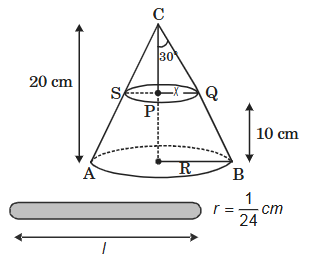
Let $\text{ACB}$ be the cone whose vertical angle $\angle A C B=60^{\circ}$.
Let $R$ and $x$ be the radii of the lower and upper end of the frustum.
Here, height of the cone, $O C=20 \ cm=H$ and $C P=h=10 \ cm$
Let us consider $P$ as the mid $-$ Point of $O C$.
After cutting the cone into two parts through $P$.
$O P=\frac{20}{2}=10 \ cm$
Also, $\angle A C O$ and $\angle O C B=\frac{1}{2} \times 60^{\circ}=30^{\circ}$
After cutting cone $\text{CQS}$ from cone $\text{CBA}$, the remaining solid obtained is a frustum.
Now, in triangle $\text{CPQ}$ :
$\tan 30^{\circ}=\frac{x}{10}$
$\frac{1}{\sqrt{3}}=\frac{x}{10}$
$x=\frac{10}{\sqrt{3}} \ cm$
In triangle $C O B$ :
$\tan 30^{\circ}=\frac{R}{C O}$
$\frac{1}{\sqrt{3}}=\frac{R}{20}$
$R=\frac{20}{\sqrt{3}} \ cm$
Volume of the frustum
$V=\frac{1}{3} \pi\left(R^2 H-x^2 h\right)$
$V=\frac{1}{3} \pi\left(\left(\frac{20}{\sqrt{3}}\right)^2 \cdot 20-\left(\frac{10}{\sqrt{3}}\right)^2 \cdot 10\right)$
$V=\frac{1}{3} \pi\left(\frac{8000}{3}-\frac{1000}{3}\right)$
$V=\frac{1}{3} \pi\left(\frac{7000}{3}\right)$
$V=\frac{1}{9} \pi \times 7000$
$V=\frac{7000}{9} \pi$
Thev olumes of the frustum and the wire formed are equal
$\pi \times\left(\frac{1}{24}\right)^2 \times l=\frac{7000}{9} \pi\left(\text { Volume of wire }=\pi r^2 h\right)$
$l=\frac{7000}{9} \times 24 \times 24$
$l=448000 \ cm$
$l=4480\ m$
Hence the length of the wire is $4480\ m$ View full question & answer→Question 193 Marks
A farmer connects a pipe of internal diameter $20 \ cm$ from a canal into a cylindrical tank which is $10 m$ in diameter and $2 m$ deep. If the water flows through the pipe at the rate of $4 \ km$ per hour, in how much time will the tank be filled completely?
AnswerFor the given tank.
Diameter $=10 m$
Radius, $R=5 m$
Depth, $H=2 m$
Internal radius of the pipe, $r=\frac{20}{2}=10 \ cm$
Rate of flow of water, $h=4 \ km / h=4000\ m / h$
Let $t$ be the time taken to fill the tank.
So, the water flows through the pipe in $t$ hours will equal to the volume of the tank
$\therefore \pi r^2 \times h \times t=\pi R^2 H$
$\pi \times\left(\frac{1}{10}\right)^2 \times 4000 \times t=\pi \times 5^2 \times 2$
$t=\frac{25 \times 2 \times 100}{4000}=\frac{5}{4}$
Hence, the time taken is $1 \frac{1}{4}$ Hours or $1$ hour and $15$ minutes.
View full question & answer→Question 203 Marks
Water in a canal, 6 m wide and 1.5 m deep, is flowing at a speed of $4 km / h$. How much area will it irrigate in 10 minutes, if 8 cm of standing water is needed for irrigation?
AnswerIt is given that width of canal is 6 m and depth is 1.5 m . Speed of water in canal is $4 km / h$.
Distance covered by water in 1 hour or 60 minutes $=4 km$ Distance covered in 1 minute $=\frac{4}{60}=\frac{1}{15} km$
Distance covered in 10 minutes
$
\frac{1}{15} \times 10=\frac{2}{3} km=\frac{2000}{3} m
$
Volume of water flowing through canal in 10 minutes $=$ Volume of area irrigated
Volume of water in canal = Area irrigated $\times$ Height
Volume of water in canal
$=$ Area irrigated $\times \frac{8}{100} m$
Area irrigated $=$ Volume of water in canal $\times \frac{100}{8}$
Area irrigated $=\frac{2000}{3} \times 6 \times 1.5 \times \frac{100}{8}$
Area irrigated $=75,000 m^2$
Therefore, $75,000 m^2$ area will be irrigated in 10 minutes.
View full question & answer→Question 213 Marks
The largest possible sphere is carved out of a wooden solid cube of side 7 cm . Find the volume of the wood left. [Use $\pi=\frac{22}{7}$ ]
AnswerSide of cube $=7 cm$
Volume of cube $=s^3$
$
=7 \times 7 \times 7=343 cm^3
$
Radius of the sphere carved out $=\frac{7}{2}=3.5 cm$
Volume of the sphere of radius $3.5 cm=\frac{4}{3} \pi r^3$
Volume of the sphere
$
=\frac{4}{3} \times \frac{22}{7} \times(3.5)^3=179.7 cm^3
$
Volume of wood left = Volume of cube - Volume
of sphere carved out
Volume of wood left = $343-179.7=163.3 cm^3$
Thus, $163.3 cm^3$ of wood was left.
View full question & answer→Question 223 Marks
A wooden toy was made by scooping out a hemisphere of same radius from each end of a solid cylinder. If the height of the cylinder is $10 \ cm$ , and its base is of radius $3.5 \ cm$ find the volume of wood in the toy. $\left[\pi=\frac{22}{7}\right]$
Answer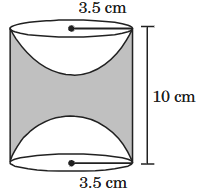
We know that,
Height of the cylinder $(h)=10 \ cm$
Radius of hemisphere $(r)=3.5 \ cm$
Hence, Radius of cylinder $(r)=3.5 \ cm$
Volume of wood in the toy $=$ Volume of the cylinder $-2\ \times$ Volume of each hemisphere.
$=\left(\pi r^2 h\right)-\left(2 \times \frac{2}{3} \times \pi r^3\right)$
Substituting the values,
$=\left(\frac{22}{7} \times(3.5)^2 \times 10\right)-\left(\frac{4}{3} \times \frac{22}{7} \times(3.5)^3\right)$
$=385-179.66$
$=205.33 \ cm^3$
Hence the volume of the wood in the toy is $205.33 \ cm^2$. View full question & answer→Question 233 Marks
A vessel is in the form of hemispherical bowl surmounted by a hollow cylinder of same diameter. The diameter of the hemispherical bowl is 14 cm and the total height of the vessel is 13 cm Find the total surface area of the vessel.
$
\left[\pi=\frac{22}{7}\right]
$
Answer
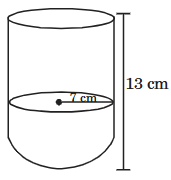
Let us assume the radius of the cylinder be $r$ and the height be $h$. The radius of hemispherical bowl $=\frac{14}{2}=7 cm$
Vessel Height = 13 cm
Height of the cylinder = Total height of the vesselRadius of the hemispherical bowl So, $\Rightarrow 13-7=6 cm$
Total surface area of the vessel = Curved surface area of the cylinder + Surface area of the hemisphere $=2 \pi r h+2 \pi r^2$
$
=2 \pi r(h+r)
$
Substituting the values,
$
=2 \times \frac{22}{7} \times 7(6+7)=572 cm^2
$
Hence the surface area of the vessel is $572 cm^2$. [1] View full question & answer→Question 243 Marks
A hemispherical bowl of internal radius $9 \ cm$ is full of water. Its contents are emptied in a cylindrical vessel of internal radius $6 \ cm$. Find the height of water in the cylindrical vessel.
AnswerLet $R$ and $r$ be the radii of hemispherical bowl and cylindrical vessel respectively and $h$ be the height of water present in the cylindrical vessel Volume of water in the hemispherical bowl
$=\frac{2}{3} \pi R^3$
$=\frac{2}{3} \times \frac{22}{7} \times 9 \times 9 \times 9$
$=\frac{10692}{7} \ cm^3$
This whole volume of water is emptied in a cylindrical vessel of internal radius $6 \ cm .$
Therefore, Volume of water in the cylindrical
vessel $=\frac{10692}{7} \ cm^3$
$\Rightarrow \pi r^2 h=\frac{10692}{7}$
$\Rightarrow \frac{22}{7} \times 6 \times 6 \times h$
$=\frac{10692}{7}$
$\Rightarrow h=\frac{10692}{792}$
$\Rightarrow h=13.5 \ cm$
Therefore, the height of water in the cylindrical vessel is $13.5 \ cm .$
View full question & answer→Question 253 Marks
The radii of the circular ends of a bucket of height $15 \ cm$ are $14 \ cm$ and $r \ cm (r<14 \ cm ).$ If the volume of bucket is $5390 \ cm^3,$ then find the value of $r .[$Use $\pi=\frac{22}{7} ]$
AnswerSince the bucket will be in a shape of frustum, And volume of a frustum is, $V=\frac{1}{3} \pi h\left(R^2+r^2+R \cdot r\right)$
Here $h$ is the height of the bucket i.e. $h=15 \ cm$
$R$ is the radius of the larger circular end, $R=14 \ cm$, Volume is given i.e. $V =5390 \ cm^3$
$V=\frac{1}{3} \pi h\left(R^2+r^2+R \cdot r\right)$
$\Rightarrow 5390=\frac{1}{3} \pi \times 15\left(14^2+r^2+14 \cdot r\right)$
$\Rightarrow \frac{5390 \times 3}{\pi \times 15}=\left(14^2+r^2+14 r\right)$
$\Rightarrow \frac{5390 \times 7}{22 \times 5}=\left(196+r^2+14 r\right)$
$\Rightarrow 49 \times 7=\left(r^2+196+14 r\right)$
$\Rightarrow 343=\left(r^2+196+14 r\right)$
$\Rightarrow r^2+196+14 r-343=0$
$\Rightarrow r^2+14 r-147=0$
$\Rightarrow r^2+21 r-7 r-147=0$
$\Rightarrow r(r+21)-7(r+21)=0$
$\Rightarrow(r+21)(r-7)=0$
Now $r =7$ or $r =-21$
Since $r$ cannot be negative, Therefore $r=7 \ cm$.
View full question & answer→Question 263 Marks
A wooden article was made by scooping out a hemisphere from each of the solid cylinder, as shown in fig. If the height of the cylinder is $10 \ cm$ and its base is of radius $3.5 \ cm .$ Find the total surface area of the article.
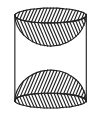
AnswerLet $r$ be the radius of the hemisphere and the cylinder and $h$ be the height of the cylinder.
For the hemisphere
Radius ( $r$ ) $=3.5 \ cm$
Surface area $=2 \pi r^2$
$\Rightarrow 2 \times \frac{22}{7} \times 3.5 \times 3.5$
$\Rightarrow 77 \ cm^2$
For the cylinder.
Radius $(r)=3.5 \ cm$
Height $(h)=10 \ cm$
Curved surface area of cylinder $=2 \pi r h$
$\Rightarrow 2 \times \frac{22}{7} \times 3.5 \times 10$
$\Rightarrow 220 \ cm^2$
Total surface area of the article $=2 \times$ surface area of the hemisphere $+$ curved surface area of the cylinder.
Total surface area of the article $=(2 \times 77+220) \ cm ^2$
$=374 \ cm^2$
View full question & answer→Question 273 Marks
A heap of rice is in the form of a cone of base diameter $24 m$ and height $3.5 m .$ Find the volume of the rice. How much canvas cloth is required to just cover the heap?
AnswerRadius of the heap $(r)=\frac{d}{2}=\frac{24}{2}=12 m$
Height if the heap $(h)=3.5 m$
Volume of a cone $=\frac{1}{3} \pi r^2 h$
$\therefore$ Volume of the heap of rice $=\frac{1}{3} \pi(12)^2 \times 3.5$
$\Rightarrow \frac{1}{3} \times \frac{22}{7} \times 144 \times 3.5$
$\Rightarrow 528 m^3$
The amount canvas required $=$ Surface area of the cone made by the rice heap.
Surface area of a cone $=\pi r l$
where $l=\sqrt{r^2+h^2}$
Surface area of the hes
$\Rightarrow \frac{22}{7} \times 12 \sqrt{12^2+3.5^2}$
$\Rightarrow \frac{22}{7} \times 12 \times 12.5$
$\Rightarrow 471.42 m^2$
Thus $471.42 m^2$ area of canvas required to cover the heap.
View full question & answer→Question 283 Marks
A farmer connects a pipe of internal diameter $20 \ cm$ from a canal into a cylindrical tank in his field which is $10 m$ in diameter and $2 m$ deep. If water flows through the pipe at the rate of $3 \ km / hr$, in how much time will the tank be filled?
AnswerGiven, Radius of tank $R=\frac{10}{2}=5 m$
Height of tank $( H )=2 m$
Radius of pipe $(r) =\frac{20}{2}=10 \ cm=0.1 m$
Speed of water $( h )=3 \ km / h =3000\ m / h$
Volume of cylindrical tank $=\pi R ^2 H$
$=\pi \times 5 \times 5 \times 2=50 \pi m^3$
$\therefore$ Volume of water in 1 hour through pipe $=\pi r^2 h$
$=\pi \times 0.1 \times 0.1 \times 3000=30 \pi m^3$
Time taken to fill the tank
$=\frac{\text { Volume of \tan } k}{\text { Volume of water in } 1 \text { hour }}$
$=\frac{50 \pi}{30 \pi}$
$=\frac{5}{3} \text { hour }$
$=1\ \text{hr}\ 40 \text { minutes }$
View full question & answer→Question 293 Marks
A cone of height $24 \ cm$ and radius of base $6 \ cm$ is made up of modelling clay. A child reshapes it in the form of a sphere. Find the radius of the sphere and hence find the surface area of this sphere.
AnswerGiven, Height of Cone $( h )=24 \ cm$
Radius of Cone $( r ) =6 \ cm$
Volume of Cone $=\frac{1}{3} \pi r ^2 h=\frac{1}{3} \times \pi \times(6)^2 \times 24$
$=\frac{1}{3} \times \pi \times 36 \times 24$
$=288 \pi \ cm^2$
Let the radius of sphere be $R \ cm$ According to the question,
Volume of sphere $=$ Volume of Cone
$\frac{4}{3} \pi R^3=288 \pi$
$\Rightarrow \frac{4}{3} R^3=288$
$\Rightarrow R^3=\frac{288 \times 3}{4}=216$
$\Rightarrow R=\sqrt[3]{216}=6 \ cm$
Hence, radius of sphere $=6 \ cm$.
$\because$ Surface area of sphere $=4 \pi r^2$
$=4 \times \pi \times(6)^2$
$=144 \pi \text { sq. } \ cm$
Hence, radius of sphere $=6 \ cm$ and surface area of sphere $=144 \pi \ cm^2$
View full question & answer→