MCQ 11 Mark
The number of solid spheres, each of diameter $6 \ cm$ that can be made by melting a solid metal cylinder of height $45 \ cm$ and diameter $4 \ cm$ , is:
AnswerLet $r$ and $h$ be the radius and the height of the cylinder, respectively.
Given: Diameter of the cylinder $=4 \ cm$
Radius of the cylinder, $(r)=2 \ cm$
Height of the cylinder $(h)=45 \ cm$
Volume of the solid cylinder
$=\pi r^2 h$
$=\pi \times 2 \times 2 \times 45 \ cm^2=180 \pi \ cm^3$
Suppose the radius of each sphere be $R \ cm$.
Diameter of the sphere $=6 \ cm$
Radius of the sphere, $R=3 \ cm$
Let $n$ be the number of solid spheres formed by melting the solid metallic cylinder.
$n \times$ Volume of the solid spheres $=$ Volume of the solid cylinder $n \times \frac{4}{3} \pi R^3=180 \pi$
$n \times \frac{4}{3} \pi \times 3^3=180 \pi$
$n=\frac{180 \times 3}{4 \times 27}=5$
Thus, the number of solid spheres that can be formed is $5$ .
View full question & answer→MCQ 21 Mark
A solid right circular cone is cut into two parts at the middle of its height by a plane parallel to its base. The ratio of the volume of the smaller cone to the whole cone is
- A
$1: 2$
- B
$1: 4$
- C
$1: 6$
- ✓
$1: 8$
AnswerCorrect option: D. $1: 8$
Let the height of the whole cone be h and its radius be $R$.
Since, the cone has been cut into two parts at the middle of its height by a plane parallel to its base.
Therefore, height of the smaller cone will be $\frac{h}{2}$.
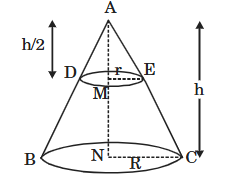
Let the radius of the smaller cone be $r$.
Now, we can see that $\triangle A M E$ and $\triangle A N C$ are similar triangles.
$\therefore \frac{A M}{A N}=\frac{M E}{N C}$
$\Rightarrow \frac{h / 2}{h}=\frac{r}{R}$
$\Rightarrow r=\frac{R}{2}$
Now, Volume of the whole cone $=\frac{1}{3} \pi R^2 h$
$=\frac{\pi R^2 h}{3}, \text { and }$
Volume of the smaller cone $=\frac{1}{3} \pi r^2 \frac{h}{2}$
$=\frac{1}{3} \pi\left(\frac{R}{2}\right)^2 \frac{h}{2}$
$=\frac{1}{3} \times \pi \times \frac{R^2}{4} \times \frac{h}{2}=\frac{\pi R^2 h}{24}$
$\frac{\text { Volume of the smaller cone }}{\text { Volume of the whole cone }}=\frac{\frac{\pi R^2 h}{24}}{\frac{\pi R^2 h}{3}}=\frac{3}{24}=\frac{1}{8}$
Therefore, the ratio of the volume of the smaller cone to the whole cone is $1: 8$. View full question & answer→MCQ 31 Mark
A sphere of diameter $18 \ cm$ is dropped into a cylindrical vessel of diameter $36 \ cm ,$ partly filled with water. If the sphere is completely submerged, then the water level rises $($in $\ cm )$ by
AnswerLet $r$ and $R$ denote the radii of sphere and cylinder respectively.
Let $H$ denote the rise in the water level.
$\therefore r=\frac{d}{2}=\frac{18}{2}=9 \ cm $ and
$ R=\frac{D}{2}=\frac{36}{2}=18 \ cm$
According to the question,
Volume of sphere $=$ volume of water rising up
$\frac{4}{3} \pi r^3=\pi R^2 H$
Substituting the given values in the above equation.
$\Rightarrow \frac{4}{3} \pi(9)^3=\pi(18)^2 H$
$\Rightarrow H=\frac{4 \pi(9)^3}{3 \pi(18)^2}$
$\Rightarrow H=3$
View full question & answer→MCQ 41 Mark
The volume of a right circular cone whose area of the base is $156 cm^2$ and the vertical height is 8 cm , is
- A
$2496 cm^3$
- B
$1248 cm^3$
- C
$1664 cm^3$
- ✓
$416 cm^3$
AnswerCorrect option: D. $416 cm^3$
(d)
Height of cone $=8 cm$.
Area of base $=156 cm^2$
Volume of cone $(V)=\frac{1}{3} \times$ Area of base $\times$ Height
Putting values we get,
$
\begin{aligned}
V & =\frac{1}{3} \times 156 \times 8 \\
& =\frac{1248}{3} \\
& =416 cm^3
\end{aligned}
$
Hence, the volume of cone $=416 cm^3$.
View full question & answer→MCQ 51 Mark
The total surface area of a frustum$-$shaper glass tumbler is $\left( r _1 > r _2\right)$
- A
$\pi r _1 l+\pi r _2 l$
- ✓
$\pi l\left(r_1+r_2\right)+\pi r_2^2$
- C
$\frac{1}{3} \pi h\left(r_1^2+r_2^2+r_1 r_2\right)$
- D
$\sqrt{h^2+\left(r_1-r_2\right)^2}$
AnswerCorrect option: B. $\pi l\left(r_1+r_2\right)+\pi r_2^2$
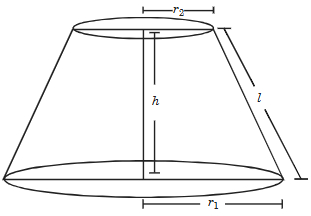
$\ce{TSA} =\pi r_2^2+\pi l\left(r_1+r_2\right)$
Ans $( b ) \pi l\left(r_1+r_2\right)+\pi r_2^2$ View full question & answer→MCQ 61 Mark
The slant height of the frustum of a cone is $4 \ cm$ and the perimeters of its circular ends are $18 \ cm$ and $6 \ cm .$ The curved surface area of frustum be.
- ✓
$48 \ cm^2$
- B
$49 \ cm^2$
- C
$50 \ cm^2$
- D
AnswerCorrect option: A. $48 \ cm^2$
Let the radii of its circular ends be $R \ cm$ and $r \ cm ,$ and it slant height be $1 \ cm .$
Then, $2 \pi R=18 $
$\Rightarrow \pi R=9$
and $2 \pi R =6 $
$\Rightarrow \pi r =3$
Also, $l = 4 \ cm ($given$)$
Curved surface area of the frustum
$=\pi l(R+r)=l \times(\pi R+\pi r)$
$=4 \times(9+3)=4 \times 12$
$=48 \ cm^2$
View full question & answer→MCQ 71 Mark
A bucket is in the form of a frustum of a cone and it can hold $28.49$ litres of water. If the radii of its circular ends are $28 \ cm$ and $21 \ cm ,$ then the height of the bucket be.
- A
$14 \ cm$
- ✓
$15 \ cm$
- C
$16 \ cm$
- D
$17 \ cm$
AnswerCorrect option: B. $15 \ cm$
$\text {Given, } r=21 \ cm, R=28 \ cm$
$\text {Volume of the bucket }=(28.49 \times 1000) \ cm^3$
$=\frac{1}{3} \times \pi\left[(28)^2+(21)^2+28 \times 21\right] \times h$
$=(28.49 \times 1000) \ cm^3$
$\Rightarrow \frac{1}{3} \times \frac{22}{7} \times[784+441+588] \times h=28490$
$\Rightarrow \frac{1}{3} \times \frac{22}{7} \times 1831 \times h=28490$
$\Rightarrow h=\frac{28490 \times 7 \times 3}{22 \times 1813}=15 \ cm$
View full question & answer→MCQ 81 Mark
A container in the shape of a frustum of a cone having diameter of its two circular faces as $35 \ cm$ and $30 \ cm$ and vertical height $14 \ cm ,$ is completely filled with oil If each $cm ^3$ of oil If each $cm ^3$ of oil has mass $1.2 g,$ then the cast of oil is the container if it cast $₹ 40 / \ kg$ be.
- ✓
$₹ 558.8$
- B
$₹ 550$
- C
$₹ 560$
- D
$₹ 600$
AnswerCorrect option: A. $₹ 558.8$
$(\alpha )$
Given, $r =15 \ cm, $
$R =17.5 \ cm, $
$h =14 \ cm$
Volume of container $=\frac{1}{3} \pi\left( R ^2+ r ^2+ Rr \right) h$
$=\left(\frac{3175 \times 11}{3}\right) \ cm^3$
Mass of oil in the container
$=\left(\frac{3175 \times 11}{3} \times 1.2\right) g$
$=13.97 \ kg$
Cost of oil $= Rs. (13.97 \times 40)$
$=\text { Rs. } 558.80$
View full question & answer→MCQ 91 Mark
If the radii of the ends of a bucket are $5 \ cm$ and $15 \ cm$ and it is $24 \ cm$ high then its surface area is
- A
$1815.3 \ cm^2$
- ✓
$1711.3 \ cm^2$
- C
$2025.3 \ cm^2$
- D
$2360 \ cm^2$
AnswerCorrect option: B. $1711.3 \ cm^2$
Slant height $l =\sqrt{ h ^2+( R - r )^2}$
$=\sqrt{(24)^2+(15-5)^2}$
Surface area of the bucket $=\pi\left[l(R+r)+r^2\right]$
$=3.14 \times[26 \times 20+250]$
$=1711.3 \ cm^2$
View full question & answer→MCQ 101 Mark
The circular ends of a bucket are of radii $35 \ cm$ and $14 \ cm$ and the height of the bucket is $40 \ cm .$ Its volume is
- A
$60060 \ cm^3$
- ✓
$80080 \ cm^3$
- C
$70040 \ cm^3$
- D
$80160 \ cm^3$
AnswerCorrect option: B. $80080 \ cm^3$
$\text { Volume of the bucket }=\frac{\pi h }{3}\left( R ^2+ r ^2+ Rr \right)$
$=\frac{22}{7} \times \frac{1}{3} \times 40 \times\left[(35)^2+(14)^2+(35 \times 14)\right]$
$=80080 \ cm^3$
View full question & answer→MCQ 111 Mark
The slant height of a bucket is $45 \ cm$ and the radii of its top and bottom are $28 \ cm$ and $7 \ cm$ respectively. The curved surface area of the bucket is
- A
$4953 \ cm^2$
- B
$4952 \ cm^2$
- C
$4951 \ cm^2$
- ✓
$4950 \ cm^2$
AnswerCorrect option: D. $4950 \ cm^2$
Here, $l =45 \ cm, R =28 \ cm$ and $r =7 \ cm$
$\therefore$ Curved surface area $=\pi l(R+r)$
$=\frac{22}{7} \times 45 \times(28+7)$
$=4950 \ cm^2$
View full question & answer→MCQ 121 Mark
The diameters of two circular ends of a bucket are $44 \ cm$ and $24 \ cm ,$ and the height of the bucket is $35 \ cm .$ The capacity of the bucket is
- A
$31.7$ litres
- ✓
$32.7$ litres
- C
$33.7$ litres
- D
$34.7$ litres
AnswerCorrect option: B. $32.7$ litres
Here, $R =22 \ cm, r =12 \ cm$ and $h =35 \ cm$
$\text { Capacity of the bucket }=\frac{1}{3} \pi h\left(R^2+r^2+Rr\right)$
$=\frac{1}{3} \times \frac{22}{7} \times 35 \times\left[(22)^2+(12)^2+22 \times 12\right]$
$=\left(\frac{110}{3} \times 892\right) \ cm^3$
$=\frac{110 \times 892}{3 \times 1000} \text { litres }$
$=32.7 \text { litres }$
View full question & answer→MCQ 131 Mark
The radii of the circular ends of a bucket of height $40 \ cm$ are $24 \ cm$ and $15 \ cm .$ The slant height $($in $cm )$ of bucket is.
AnswerSlant height $l =\sqrt{ h ^2+( R - r )^2}$
$=\sqrt{(40)^2+(24-15)^2}$
$=\sqrt{1600+81}$
$=\sqrt{1681}$
$=41 \ cm$
View full question & answer→MCQ 141 Mark
If the height of a bucket in the shape of frustum of a cone is $16 \ cm$ and the diameters of its two circular ends are $40 \ cm$ and $16 \ cm$ then its slant height is
- A
$20 \ cm$
- B
$12 \sqrt{5} \ cm$
- ✓
$8 \sqrt{13} \ cm$
- D
$16 \ cm$
AnswerCorrect option: C. $8 \sqrt{13} \ cm$
Slant height $l =\sqrt{ h ^2+( R - r )^2}$
$=\sqrt{(16)^2+(40-16)^2}$
$=\sqrt{256+576}$
$=\sqrt{832}$
$=8 \sqrt{13} \ cm$
View full question & answer→MCQ 151 Mark
A cone is cut by a plane parallel to its base and the upper part is removed. The part that is left over is called.
Answer(d)
When a cone is cut by a plane parallel to its base and the upper part is removed. The part that is left over is called frustum of a cone.
View full question & answer→MCQ 161 Mark
A metallic cone having base radius $2.1 \ cm$ and height $8.4 \ cm$ is melted and moulded into a sphere. The radius of the sphere is
- ✓
$2.1 \ cm$
- B
$1.05 \ cm$
- C
$1.5 \ cm$
- D
$2 \ cm$
AnswerCorrect option: A. $2.1 \ cm$
According to the question,
$\frac{1}{3} \pi \times(2.1)^2 \times 8.4=\frac{4}{3} \times \pi \times r^3$
$\Rightarrow r^3=\left(\frac{1}{3} \times 4.41 \times 8.4 \times \frac{3}{4}\right)=(2.1)^3$
$\Rightarrow r=2.1 \ cm$
View full question & answer→MCQ 171 Mark
A metallic cylinder of radius $8 \ cm$ height $2 \ cm$ is melted and converted into a right circular cone of height $6 \ cm .$ The radius of the base of this cone is
- A
$4 \ cm$
- B
$5 \ cm$
- C
$6 \ cm$
- ✓
$8 \ cm$
AnswerCorrect option: D. $8 \ cm$
According to the question,
$\pi \times 8 \times 8 \times 2=\frac{1}{3} \pi R^2 \times 6 $
$\Rightarrow R^2=64$
$\Rightarrow R=8 \ cm$
View full question & answer→MCQ 181 Mark
In a shower, $5 \ cm$ of rain falls. The volume of the water that falls on $2$ hectares of ground is
- A
$100 m^3$
- B
$10 m^3$
- ✓
$1000 m^3$
- D
$10000 m^3$
AnswerCorrect option: C. $1000 m^3$
$\text { Required volume }=(\text { area } \times \text { depth })$
$=\left(2 \times 10000 \times \frac{5}{100}\right) m ^3$
$=1000 m^3$
View full question & answer→MCQ 191 Mark
A metallic spherical shell of internal and external diameters $4 \ cm$ and $8 \ cm$ respectively, is melted and recast into the form of a cone of base diameter $8 \ cm .$ The height of the cone is
- A
$12 \ cm$
- ✓
$14 \ cm$
- C
$15 \ cm$
- D
$8 \ cm$
AnswerCorrect option: B. $14 \ cm$
Here, $R =4 \ cm$ and $r =2 \ cm$ Volume of spherical shell
$=\frac{4}{3} \pi\left\{(4)^3-(2)^3\right\}$
$=\left(\frac{4}{3} \pi \times 56\right) \ cm^3$
Let the height of the cone be $h \ cm$
$\therefore \frac{1}{3} \pi \times 4 \times 4 \times h$
$=\frac{4}{3} \times \pi \times 56$
$\Rightarrow h=14 \ cm$
View full question & answer→MCQ 201 Mark
Twelve solid sphere of the same size are made by melting a solid metallic cylinder of base diameter $2 \ cm$ and height $16 \ cm .$ The diameter of each sphere is
- ✓
$2 \ cm$
- B
$3 \ cm$
- C
$4 \ cm$
- D
$6 \ cm$
AnswerCorrect option: A. $2 \ cm$
Let the diameter of each sphere be $d \ cm .$ Then,
$12 \times \frac{4}{3} \pi r^3=\pi R^2 h$
$\Rightarrow 12 \times \frac{4}{3} \pi \times\left(\frac{d}{2}\right)^3=\pi \times 1^2 \times 16$
$\Rightarrow 2 d^3=16 $
$\Rightarrow d^3=8 $
$\Rightarrow d=2 \ cm$
View full question & answer→MCQ 211 Mark
The number of solid sphere, each of diameter $6 \ cm ,$ that can be made by melting a solid metal cylinder of height $45 \ cm$ and diameter $4 \ cm$ is
Answer$\text { Number of spheres }$
$=\frac{\text { Volume of the cylinder }}{\text { Volume of each sphere }}$
$=\frac{\pi \times 2 \times 2 \times 45}{\frac{4}{3} \times \pi \times 3 \times 3 \times 3}$
$=5$
View full question & answer→MCQ 221 Mark
A rectangular sheet of paper $40 \ cm \times 22 \ cm$, is rolled to form a hollow cylinder of height $40 \ cm .$ The radius of the cylinder $($in $cm )$ is
- A
$3.5$
- ✓
$7$
- C
$\frac{80}{7}$
- D
$5$
AnswerAccording to the question,
$4 \pi r^2=616 $
$\Rightarrow r^2=616 \times \frac{1}{4} \times \frac{7}{22}$
$\Rightarrow r^2=49 $
$\Rightarrow r=\sqrt{49}$
$=7 \ cm$
View full question & answer→MCQ 231 Mark
A metallic solid sphere of radius $9 \ cm$ is melted to form a solid cylinder of radius $9 \ cm .$ The height of the cylinder is.
- ✓
$12 \ cm$
- B
$18 \ cm$
- C
$36 \ cm$
- D
$96 \ cm$
AnswerCorrect option: A. $12 \ cm$
According to the question,
$\frac{4}{3} \pi \times 9 \times 9 \times 9$
$=\pi \times 9 \times 9 \times h$
$\Rightarrow h=\frac{4}{3} \times 9$
$=12 \ cm$
View full question & answer→MCQ 241 Mark
A solid piece of iron in the form of a cuboid of dimensions $( 49 \ cm \times 33 \ cm \times 24 \ cm )$ is moulded to form a solid sphere. The radius of the sphere is
- A
$19 \ cm$
- ✓
$21 \ cm$
- C
$23 \ cm$
- D
$25 \ cm$
AnswerCorrect option: B. $21 \ cm$
According to the question,
$\frac{4}{3} \pi r^3=49 \times 33 \times 24$
$\Rightarrow \frac{4}{3} \times \frac{22}{7} \times r^3=49 \times 33 \times 24$
$\Rightarrow r^3=\frac{49 \times 33 \times 24 \times 3 \times 7}{4 \times 22}$
$\Rightarrow r^3=21 \times 21 \times 21 $
$\Rightarrow 21 \ cm$
Hence, the radius of sphere $=21 \ cm$.
View full question & answer→MCQ 251 Mark
During conversion of a solid from one shape to another, the volume of the new shape will
Answer(c)
During conversion of a solid from one shape to another, the volume remains the same.
View full question & answer→MCQ 261 Mark
If the edge of a cube is increased by $50 \%$, the percentage increase in the surface area is
- A
$50 \%$
- B
$75 \%$
- C
$100 \%$
- ✓
$125 \%$
AnswerCorrect option: D. $125 \%$
(d)
Let original edge be a.
$\therefore$ Original surface area $=6 a ^2$
New edge $=150 \%$ of $a =\frac{150 a }{100}=\frac{3 a }{2}$
New surface area $=6 \times\left(\frac{3 a }{2}\right)^2=\frac{27 a ^2}{2}$
Increase in area $=\left(\frac{27 a ^2}{2}-6 a ^2\right)=\frac{15 a ^2}{2}$
$\therefore$ Increase $\%=\left(\frac{15 a ^2}{2} \times \frac{1}{6 a ^2} \times 100\right)=125 \%$
View full question & answer→MCQ 271 Mark
The area of the base of a rectangular tank is 6500 $cm ^2$ and the volume of water contained in it is $2.6 m^3$. The depth of water in the tank is
Answer(b)
Area of base $=\frac{6500}{100 \times 100}=\frac{13}{20} m^3$
Let the depth of water be d metres. Then,
$
\frac{13}{20} \times d=2.6 \Rightarrow d=\frac{26}{10} \times \frac{20}{13}=4 m
$
View full question & answer→MCQ 281 Mark
How many bricks each measuring $( 25 \ cm \times 11.25 \ cm \times 6 \ cm )$ will be required to construct a wall $( 8 m \times 6 m \times 22.5 \ cm )$?
- A
$8000$
- ✓
$6400$
- C
$4800$
- D
$7200$
AnswerCorrect option: B. $6400$
$\text { Volume of walls }=(800 \times 600 \times 22.5) \ cm ^3$
$\text { Volume of } 1 \text { bricks }=(25 \times 11.25 \times 6) \ cm ^3$
$\text { Number of bricks }=\frac{\text { Volume of the walls }}{\text { Volume of } 1 \text { bricks }}$
$=\frac{800 \times 600 \times 22.5}{25 \times 11.25 \times 6}$
$=6400$
View full question & answer→MCQ 291 Mark
The total surface area of a cube is $864 \ cm^2$. Its volume is
- A
$3456 \ cm^3$
- B
$432 \ cm^3$
- ✓
$1728 \ cm^3$
- D
$3456 \ cm^3$
AnswerCorrect option: C. $1728 \ cm^3$
$\because \text { Total surface area of a cube }=6 a^2$
$\Rightarrow 6 a^2=864$
$\Rightarrow a^2=144$
$\Rightarrow a=12$
$\therefore \text { Volume of cube }=a^3=12^3=1728 \ cm^3$
View full question & answer→MCQ 301 Mark
The length of longest pole that can be kept in a room $(12 \times 9 \times 8) m$ is
- A
$29 m$
- B
$21 m$
- C
$19 m$
- ✓
$17 m$
AnswerCorrect option: D. $17 m$
Length of longest pole $=$ length of diagonal of the room
$=\sqrt{1^2+b^2+h^2}$
$=\sqrt{12^2+9^2+8^2}$
$=\sqrt{289}$
$=17 m$
View full question & answer→MCQ 311 Mark
The volume of a cube is $2744 \ cm^3$. It surface area is
- A
$196 \ cm^2$
- ✓
$1176 \ cm^2$
- C
$784 \ cm^2$
- D
$588 \ cm^2$
AnswerCorrect option: B. $1176 \ cm^2$
$\because \text { volume of a cube }=(\text { side })^3$
$\Rightarrow a^3=2744$
$\Rightarrow a=\sqrt[3]{2744}=14 \ cm$
$\therefore$ Surface area $=6 a ^2=6 \times 14 \times 14=1176 \ cm^2$
View full question & answer→MCQ 321 Mark
The volume of two sphere are in the ratio $64: 27$. The ratio of their surface area is
- A
$9: 16$
- ✓
$16: 9$
- C
$3: 4$
- D
$4: 3$
AnswerCorrect option: B. $16: 9$
According to the questions,
$\frac{\frac{4}{3} \pi R^3}{\frac{4}{3} \pi r^3}=\frac{64}{27}$
$\Rightarrow \frac{R^3}{r^3}=\frac{64}{27} $
$\Rightarrow \frac{R}{r}=\frac{4}{3}$
Ratio of their surface area $=\frac{4 \pi R ^2}{4 \pi r ^2}=\frac{4^2}{3^2}=\frac{16}{9}$
$\therefore$ Required ratio $=16: 9$
View full question & answer→MCQ 331 Mark
If the radius of a sphere become $3$ times then its volume will be
- A
$3$ times
- B
$6$ times
- C
$9$ times
- ✓
$27$ times.
AnswerCorrect option: D. $27$ times.
Volume of sphere of radius $r,$
$V=\frac{4}{3} \pi r^3$
Volume of sphere of radius $3 r =\frac{4}{3} \pi(3 r )^3$
$=27 \times \frac{4}{3} \pi r^3$
$=27 V$
Hence, If the radius of sphere become $3$ times then its volume will be $27$ times.
View full question & answer→MCQ 341 Mark
If the surface area of a sphere is $616 \ cm^2$, its diameter is
- A
$7 \ cm$
- ✓
$14 \ cm$
- C
$28 \ cm$
- D
$56 \ cm$
AnswerCorrect option: B. $14 \ cm$
According to the question
$4 \pi r^2=616 $
$\Rightarrow r^2=\frac{616}{4 \times \frac{22}{7}}$
$\Rightarrow r^2=\frac{616 \times 7}{88}=49$
$\Rightarrow r=\sqrt{49}=7$
$\therefore$ Diameter of sphere $=2 r =2 \times 7=14 \ cm$
View full question & answer→MCQ 351 Mark
The surface areas of two spheres are in the ratio $16: 9$. The ratio of their volumes is
- ✓
$64: 27$
- B
$16: 9$
- C
$4: 3$
- D
AnswerCorrect option: A. $64: 27$
According to the question,
$\frac{4 \pi R^2}{4 \pi r^2}=\frac{16}{9}$
$\Rightarrow \frac{R^2}{r^2}=\frac{16}{9} $
$\Rightarrow \frac{R}{r}=\sqrt{\frac{16}{9}}=\frac{4}{3}$
$\therefore \frac{\frac{4}{3} \pi R^3}{\frac{4}{3} \pi R^3}$
$=\frac{(4)^3}{(3)^3}$
$=\frac{64}{27}$
$\therefore \text { Required ratio }=64: 27$
View full question & answer→