Questions

Case study (4 Marks)

🎯

Test yourself on this topic

8 questions · timed · auto-graded

Question 14 Marks
Temper-proof tetra-packed milk guarantees both freshness and security. This milk ensures uncompromised quality, preserving the nutritional values within and making it a reliable choice for health-conscious individuals.
Image

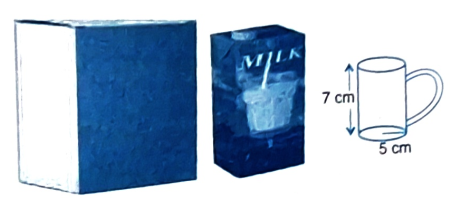
500 mL milk is packed in a cuboidal container of dimensions 15 cm x 8 cm x 5 cm. These milk packets are then packed in cuboidal cartons of dimensions 30 cm x 32 cm x 15 сm.
(i) Find the volume of the cuboidal carton.
(ii) (a) Find the total surface area of a milk packet.
OR
(b) How many milk packets can be filled in a carton?
(iii) How much milk can the cup (as shown in the Figure) hold?
Answer
(i) Volume of cuboidal carton $=(30 \times 32 \times 15) cm ^3=14,400 cm^3=14.4$ litres
(ii) (a) Surface area of a milk packet $=2(15 \times 8+8 \times 5+5 \times 15) cm ^2$
$=2(120+40+75) cm^2=470 cm^2$
OR
(b) Number of milk packets filled in a carton $=\frac{\text { Volume of a carton }}{\text { Volume of a milk packet }}=\frac{14400}{15 \times 8 \times 5}=24$
(iii) Volume of the milk in a cup $=\frac{22}{7} \times 5^2 \times 7 cm^3=550 cm^3$.
View full question & answer
Question 24 Marks
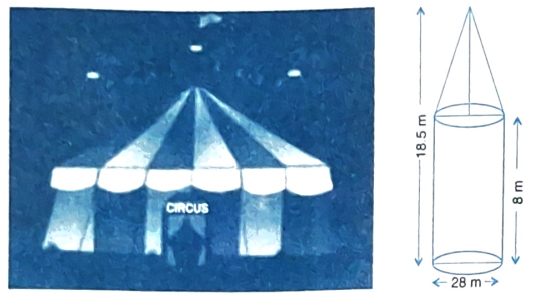
The word 'circus' has same root as 'circle. In a closed circular area, various entertainment acts including human skill and animal training are presented before the crowd.
A circus tent is cylindrical upto a height of 8 m and conical above it. The diameter of the base is 28 m and total height of tent is 18.5 m.
Image
(i) Find slant height of the conical part.
(ii) Determine the floor area of the tent.
(iii) (a) Find area of the cloth used for making tent.
OR
(b) Find total volume of air inside an empty tent.
Answer
(i) We have, $r=$ radius of base $=14 cm, h=$ height of conical part $=10.5 m$.
Let / be the slant height of the conical part. Then,
$l^2=r^2+h^2 \Rightarrow l=\sqrt{r^2+h^2}=\sqrt{14^2+(10.5)^2}=\sqrt{196+110.25}=\sqrt{306.25}=17.5 m$
(ii) Floor area of tent $=\pi r^2=\frac{22}{7} \times 14^2=616 m^2$.
(iii) (a) Area of cloth = Curved surface area of cylindrical part + Curved surface area of conical part
$\begin{array}{l}=2 \pi r H+\pi r l \text {, where } H=\text { Height of cylindrical part. } \\
=\pi r(2 H+l)=\frac{22}{7} \times 14 \times(2 \times 8+17.5) m^2=44 \times 33.5 m^2=1474 m^2\end{array}$
OR
(b) Volume of air inside tent $=$ Volume of cylindrical part + Volume of conical part$
\begin{array}{l}
=\pi r^2 H+\frac{1}{3} \pi r^2 h=\pi r^2\left(H+\frac{1}{3} h\right) \\
=\frac{22}{7} \times 14^2 \times\left(8+\frac{1}{3} \times 10.5\right)=22 \times 28 \times 11.5=7084 m^3
\end{array}
$
View full question & answer
Question 34 Marks
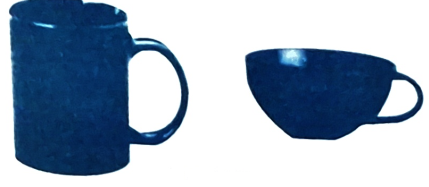
In a coffee shop, coffee is served in two types of cups. One is cylindrical in shape with diameter 7 cm and height 14 cm and the other is hemispherical with diameter 21 cm.
Image
(i) Find the area of the base of the cylindrical cup.
(ii) What is the capacity of the hemispherical cup?
(iii) Find the capacity of the cylindrical cup.
(iv) What is the curved surface area of the cylindrical cup?
Answer
(i) For the cylindrical cup, base radius $r_1=\frac{7}{2} cm$.
$\therefore \quad \text { Area of the base }=\pi r_1^2=\frac{22}{7} \times\left(\frac{7}{2}\right)^2 cm^2=38.5 cm^2$
(ii) For the hemispherical cup, radius $r_2=\frac{21}{2} cm$.$\therefore \quad \text { Capacity of hemispherical cup }=\frac{2}{3} \pi r_2^3=\frac{2}{3} \times \frac{22}{7} \times\left(\frac{21}{2}\right)^3=2425.5 cm^3$
(iii) Capacity of cylindrical cup $=\pi r_1^2 h=\frac{22}{7} \times\left(\frac{7}{2}\right)^2 \times 14 cm^3=539 cm^3$
(iv) Curved surface area of cylindrical cup $=2 \pi r_1 h=2 \times \frac{22}{7} \times \frac{7}{2} \times 14 cm^2=308 cm^2$
View full question & answer
Question 44 Marks
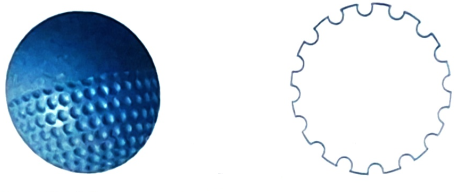
A golf ball is spherical with about 300-500 dimples that help increase its velocity while in play. Golf balls are traditionally white but available in colours also. In the given figure, a golf ball has diameter 4.2 cm and the surface has 315 dimples (hemispherical) of radius 2 mm.
Image
(i) Find the surface area of one such dimple.&
(n) Find the volume of the material dug out to make one dimple.
(iii) Find the total surface area exposed to the surroundings.
(iv) Find the volume of the golf ball
Answer
(i) Surface area of one dimple $=2 \pi r^2=2 \times \frac{22}{7} \times\left(\frac{2}{10}\right)^2 cm^2=0.25 cm^2$
(ii) Volume of material dug out to make one dimple $=\frac{2}{3} \times \frac{22}{7} \times\left(\frac{2}{10}\right)^3 cm^3=0.0168 cm^3$
(iii) Total surface area exposed to the surroundings$\begin{array}{l}
=\text { Surface area of the ball }-315 \pi r^2+315 \times 2 \pi r^2 \text {, where } r=\frac{2}{10} cm \\
=4 \pi \times(2.1)^2+315 \pi r^2 \\
=17.64 \pi+315 \pi \times\left(\frac{2}{10}\right)^2 cm^2=(17.64 \pi+12.6 \pi) cm^2=30.24 \times \frac{22}{7} cm^2=94.04 cm^2
\end{array}$
(iv) Volume of the golf ball $=\frac{4}{3} \times \frac{22}{7} \times(2.1)^3 cm^3=38.808 cm^3$
View full question & answer
Question 54 Marks
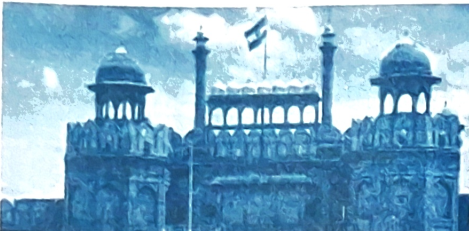
Mathematics teacher of a school took her 10 ^ (th) standard students to show Red Fort. It was a part of their Educational trip The teacher had interest in history as well. She narrated the facts of Red Fort to students. Then the teacher said in this monument one can find combination of solid figures. There are 2 pillars which are cylindrical in shape. Also, 2 domes at the corners which are hemispherical and 7 smaller domes at the centre. Flag hoisting ceremony on Independence Day takes place near these domes.
Image

(i) How much cloth material will be required to cover 2 big domes each of radius 2.5 metres?
$($ Take $\pi=22 / 7)$
(a) $75 m^2$$\quad$ (b) $78.57 m^2$$\quad$ (c) $87.47 m^2$$\quad$(d) $25.8 m^2$
(ii) Write the formula to find the volume of a cylindrical pillar.
(a) $\pi r^2 h$$\quad$ (b) $\pi r l$$\quad$ (c) $\pi r(i+r)$$\quad$ (d) $2 \pi r$
(iii) Find the lateral surface area of two pillars if height of the pillar is 7 m and radius of the base is 1.4 m.
(a) $112.3 cm^2$$\quad$ (b) $123.2 m^2$$\quad$ (c) $90 m^2$$\quad$ (d) $345.2 cm^2$
(iv) How much is the volume of a hemisphere if the radius of the base is 3.5 m?
(a) $85.9 m^3$$\quad$ (b) $80 m^3$$\quad$ (c) $98 m^2$$\quad$ (d) $89.83 m^3$
Answer
(i)  (b): Total material required $=2\left(2 \pi \times(2.5)^2\right) m ^2=4 \times \frac{22}{7} \times 6.25 m^2=78.57 m^2$.
(ii) (a): Volume of a cylindrical pillar of radius $r$ height $h$ is given by $V=\pi r^2 h$.
(iii) (b): Lateral surface area of two pillars $=2(2 \pi / h)=2 \times 2 \times \frac{22}{7} \times 1.4 \times 7=123.2 m^2$.
(iv)  (d): Volume of a hemi-sphere of radius $3.5 m=\frac{2}{3} \times \frac{22}{7} \times(3.5)^3 m^3=89.83 m^3$
View full question & answer
Question 64 Marks
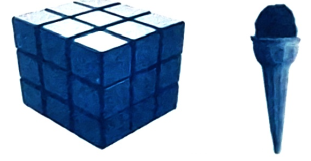
On a Sunday, your parents took you to a fair. You could see lot of toys displayed and you wanted them to buy a RUBIK'S cube and strawberry ice cream for you. Observe the figures and answer the following questions:
Image
(i) The lengtt of the diagonal, if each edge measures 6 cm , is
(a) $3 \sqrt{3} cm$$\quad$ (b) $3 \sqrt{6} cm$$\quad$ (c) $2 \sqrt{3} cm$$\quad$ (d) $6 \sqrt{3} cm$<br>
(ii) Volume of the solid figure, if the length of the edge is 7 cm , is
(a) $256 cm^3$$\quad$ (b) $196 cm^3$$\quad$ (c) $343 cm^3$$\quad$ (d) $434 cm^3$
(iii) What is the curved surface area of hemisphere (ice cream) if the base radius is 7 cm ?
(a) $309 cm^2$$\quad$ (b) $308 cm^2$$\quad$ (c) $803 cm^2$$\quad$ (d) $903 cm^2$
(iv) Slant height of a cone if the radius is 7 cm and the height is 24 cm is
(a) 26 cm$\quad$ (b) 25 cm$\quad$ (c) 52 cm$\quad$ (d) 62 cm
Answer
(i) (d): Using the formula, Diagonal of a cube $=\sqrt{3}$ (Side), we obtain Length of the diagonal $=6 \sqrt{3} cm$
(ii) (c): Volume $=7^3=343 cm^3$...$\left[\because\right.$ Volume of a cube $\left.=(\text { Side })^3\right]$
(iii) (b): Curved surface area $=2 \times \frac{22}{7} \times 7^2 cm^2=308 cm^2$....[Using: $S=2 \pi r^2$ ]
(iv) (b): Slant height $=\sqrt{7^2+24^2}=25 cm$....[Using: $l=\sqrt{r^2+h^2}$ ]
View full question & answer
Question 74 Marks
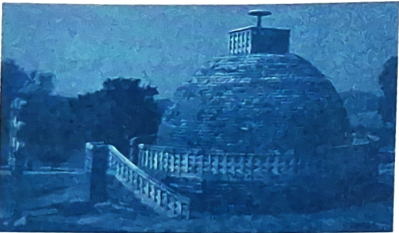
The great Stupa at Sanchi is one of the oldest stone structures in India, and an important Monument of Indian Architecture. It was originally commissioned by the emperor Ashoka in 3rd century BCE. Its nucleus was a simple hemispherical brick structure built over the relics of Buddha. It is a perfect example of combination of solid figures. A big hemispherical dome with a cuboidal structure mounted on it.
Image
(i) The volume of the hemispherical dome if the height of the dome 21 m, is (Take $\pi=22 / 7)$
(a) $19404 m^3$$\quad$ (b) $2000 m^3$$\quad$ (c) $15000 m^3$$\quad$ (d) $19000 m^3$
(ii) The formula for finding the volume of a hemi-sphere of radius r is
(a) $\frac{2}{3} \pi r^3$$\quad$ (b) $\frac{4}{3} \pi r^3$$\quad$ (c) $4 \pi r^2$$\quad$ (d) $2 \pi r^2$
(iii) The total surface area of the combined structure i.e. hemispherical dome with radius 14 m and cboidal shaped top with dimensions 8m * 6m * 4m is
(a) $1200 m^2$$\quad$ (b) $1232 m^2$$\quad$ (c) $1392 m^2$$\quad$ (d) $1932 m^2$
(iv) The plastic cloth required to cover the hemispherical dome, if the radius of its base is 14 m, is
(a) $1222 m^2$$\quad$ (b) $1184 m^2$$\quad$ (c) $1200 m^2$$\quad$ (d) $1400 m^2$
Answer
(i) (a): Clearly, radius $r$ of the hemispherical dome is equal to its height.
Therefore, $r=21 m$
$\text { Volume of the hemispherical dome }=\frac{2}{3} \pi r^3=\frac{2}{3} \times \frac{22}{7} \times 21^3=19404 m^3$
(ii) (a): Volume $=\frac{2}{3} \pi r^3$
(iii) (c): Total surface area $=\left(2 \times \frac{22}{7} \times 14^2+\{8 \times 6+2(6 \times 4+4 \times 8)\}\right) m ^2$$
=(1232+160) m^2=1392 m^2$
(iv) (b): Area of plastic cloth $=2 \pi(14)^2-8 \times 6=1184 m^2$
View full question & answer
Question 84 Marks
Answer
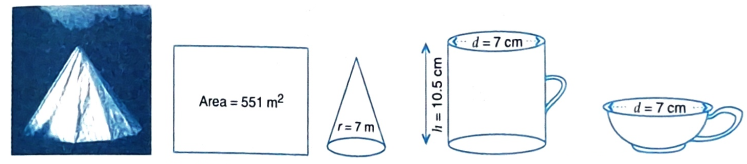
(i) (d): The radius and height of the cylindrical cup are h = 10.5cm respectively. Therefore, its volume V is given by 
$V=\pi r^2 h=\frac{22}{7} \times(35)^2 \times 10.5 cm^3=404.25 cm^3$(ii) (b). Radius of the hemispherical cup is $r_1=\frac{7}{2} cm$. Therefore, its volume $V_1$ is given by$
V_1=\frac{2}{3} \pi r_1^3=\frac{2}{3} \times \frac{22}{7} \times\left(\frac{7}{2}\right)^3 cm^3=89.83 cm^3
$(iii) (d): Clearly $V>V_1$. Therefore, cylindrical glass has more juice in comparison to the hemispherical cup by $V-V_1=314.42 cm^3$
(iv) (c): Radius of the tent is $r=7 m$ and its curved surface area is $550 m^2$. Let the slant height of the tent be $I$ metre. Then,
$
\begin{array}{l}
\pi r l=550 \Rightarrow \frac{22}{7} \times 7 \times l=550 \Rightarrow l=25 \\
l^2=r^2+h^2 \Rightarrow 25^2=7^2+h^2 \Rightarrow h=24 m
\end{array}$
View full question & answer