Questions

1 Marks Question

🎯

Test yourself on this topic

11 questions · timed · auto-graded

Question 11 Mark
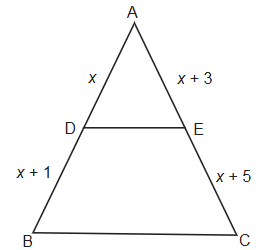
In a $\triangle A B C, D E \| B C$, then find the value of $x$.
Image
Answer
Given:
$\triangle A B C, D E \| B C, A D=x, D B=x+1,$
$A E=x+3,$ and $E C=x+5$
Now, according to Basic Proportionality Theorem,
$\frac{A D}{D B}=\frac{A E}{E C}$
$\Rightarrow \frac{x}{x+1}=\frac{x+3}{x+5}$
$\Rightarrow x(x+5)=(x+3)(x+1)$
$\Rightarrow x^2+5 x=x(x+1)+3(x+1)$
On simplifying the expression, we get,
$\Rightarrow x^2+5 x=x^2+x+3 x+3$
Taking all the terms to the left side,
$\Rightarrow x^2-x^2+5 x-4 x-3=0$
$\Rightarrow x-3=0$
$\Rightarrow x=3$
Hence, the value of $x$ is $3 .$
View full question & answer
Question 21 Mark
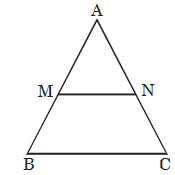
In $\triangle A B C, D$ and $E$ are point on side $A B$ and $A C$ resp. such that $DE \| BC$. If $A E=2 \ cm, A D=3 \ cm$ and $B D=4.5 \ cm$ then find $C E$.
Answer
In $\triangle A B C$, we have $D E \mid I B C$.
Image
By basic proportionality theorem,
$\frac{A D}{D B}=\frac{A E}{E C}$
$\frac{3}{4.5}=\frac{A E}{E C}$
$\frac{3}{4.5}=\frac{2}{E C}$
$E C=\frac{2 \times 4.5}{3}$
$E C=\frac{9}{3}$
$E C=C E=3$
$\text { Thus } C E=3 \ cm$
View full question & answer
Question 31 Mark
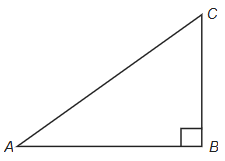
In a, right angled at $B, A C-A B=2 \ cm, B C=8 \ cm$ , find the value of $A C$.
Answer
It is given that $\triangle A B C$ is right angled at $B$, Also,
$A C-A B=2 \ cm$ and $B C=8 \ cm$.
$A C-A B=2 \ cm$ This implies
$A B=A C-2 \ cm \ldots \ldots(i)$
Image
Using the Pythagoras theorem we get,
$(A C)^2=(A B)^2+(B C)^2$
$\Rightarrow(A C)^2=(A C-2)^2+(B C)^2$
Using $(i)$
$\Rightarrow(A C)^2=(A C)^2+4-4 A C+(8)^2$
$\Rightarrow(A C)^2=(A C)^2+4-4 A C+64$
$\Rightarrow 0=-4 A C+68$
$\Rightarrow 4 A C=68$
$\Rightarrow A C=17$
Hence, the value of $AC$ is $17 \ cm .$
View full question & answer
Question 41 Mark
Find the length of the diagonal of a square whose each side is $8 \ cm .$
Answer
Let the length of each side of square be $a=8 \ cm$, and suppose the length of the diagonal be,
Now using Pythagoras theorem,
$\Rightarrow d^2=2 a^2$
$\Rightarrow d=\sqrt{2} a$
$\Rightarrow d=\sqrt{2} \times 8$
$=8 \sqrt{2}$
Hence length of the diagonal is $8 \sqrt{2} \ cm$.
View full question & answer
Question 51 Mark
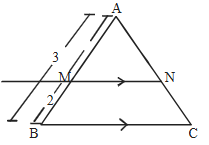
In below fig., $MN \| BC$ and $AM : MB =1: 2$, then $\frac{\operatorname{ar}(\triangle AMN )}{\operatorname{ar}(\triangle ABC )}=.......$
Image
Answer
Image
In $\triangle A M N$ and $\triangle A B C$,
$\frac{AM}{AB}=\frac{AN}{AC}$
$\text { (Due to BPT) }$
$\angle A=\angle A \text { (Common) }$
$\therefore \triangle AMN \sim \triangle ABC$
$\text { (By SAS) }$
$\Rightarrow \frac{\operatorname{ar}(AMN)}{\operatorname{ar}(ABC)}=\frac{AM^2}{AB^2}=\frac{AN^2}{AC^2}=\frac{MN^2}{BC^2}$
$\Rightarrow \frac{\operatorname{ar}(AMN)}{\operatorname{ar}(ABC)}=\left(\frac{1}{3}\right)^2=\frac{1}{9}$
View full question & answer
Question 71 Mark
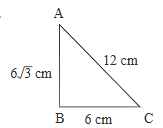
If $\triangle ABC , AB =6 \sqrt{3} cm, AC =12 cm$ and $BC =6$ cm , then $\angle B =$ ____________ .;
Answer

Image
$\begin{aligned} AB & =6 \sqrt{3} cm \\ AB ^2 & =(6 \sqrt{3})^2=36 \times 3=108 cm \\ BC & =6 cm \\ BC ^2 & =(6)^2=36 cm \\ AC & =12 cm \\ AC ^2 & =(12)^2=144 cm\end{aligned}$
We can see that $AB ^2+ BC ^2= AC ^2$
$\Rightarrow$ The triangle ABC follows Pythagorus theorem.
$\Rightarrow \angle B =90^{\circ}$


View full question & answer
Question 81 Mark
Given $\triangle A B C \sim \triangle P Q R$, if $\frac{A B}{P Q}=\frac{1}{3}$, then $\frac{a r \triangle A B C}{a r \triangle P Q R}$.
Answer
According to the theorem "If two triangles are similar then the ratio of the areas of two similar triangles is equal to the square of the ratio of their corresponding sides."
$\frac{a r_r \triangle A B C}{a_r \triangle P Q R}=\left(\frac{A B}{P Q}\right)^2=\left(\frac{1}{3}\right)^2=\frac{1}{9}$
$\therefore \frac{\operatorname{ar} \triangle A B C}{\operatorname{ar} \triangle P Q R}=\frac{1}{9}$
View full question & answer
Question 111 Mark
Let $\triangle ABC \sim \triangle DEF$ and their areas be respetively, $64 cm^2$ and $121 cm^2$. If $EF =15.4 cm$, find $BC .$
Answer
$\because \Delta ABC \sim \triangle DEF$
$\therefore \frac{\text { area of }(\Delta ABC)}{\text { area of }(\triangle DEF)}=\frac{(BC)^2}{(EF)^2} \text { (by conversion of }$
$\text { thales theorem) }[1 / 2]$
$\text { Given, area of }(\triangle ABC)=64 sq \ cm,$
$\text { area of }(\Delta DEF)=121 sq \cdot \ cm \text { and } EF=15.4 \ cm$
$\therefore \frac{64}{121}=\frac{(BC)^2}{(15.4)^2}$
$\Rightarrow \frac{BC}{15.4}=\sqrt{\frac{64}{121}}$
$\Rightarrow \frac{BC}{15.4}=\frac{8}{11} \Rightarrow BC=\frac{8 \times 15.4}{11}=11.2 \ cm$
Hence, $B C=11.2 \ cm$.
View full question & answer