Question 12 Marks
In Figure $4,$ a triangle $A B C$ is drawn to circumscribe a circle of radius $3 \ cm$ , such that the segments $B D$ and $D C$ are respectively of lengths $6 \ cm$ and $9 \ cm$ . If the area of $\triangle A B C$ is $54$ , then find the lengths of sides $A B$ and $A C$.
Answer
View full question & answer→Let us suppose that the circle touches the sides $A B$ and $A C$ of the triangle of the triangle at point $F$ and $E$, respectively.
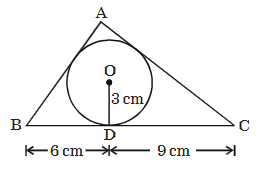
Let the length of the line segment $A F$ be $x \ cm$.
According to the theorem, that the lengths of tangents drawn form an external point to circle are equal.
In $\triangle A B C$,
$C E=C D=9 \ cm$
$($Tangents of the circle from point $C)$
$B F=B D=6 \ cm$
$($Tangents of the circle from point $B )$
$A B=A F+F B=(x+6) \ cm$
$B C=B D+D C=6+9=15 \ cm$
$C A=C E+E A=(9+x) \ cm$
Area of $\triangle O B C=\frac{1}{2} \times B C \times O D$
$=\frac{1}{2} \times 15 \times 3=\frac{45}{2} \ cm^2$
Area of $\triangle O C A=\frac{1}{2} \times A C \times O E$
$=\frac{1}{2} \times(x+9) \times 3=\frac{3}{2}(x+9) \ cm^2$
Area of $\triangle O A B=\frac{1}{2} \times A B \times O F$
$=\frac{1}{2} \times(x+6) \times 3=\frac{3}{2}(x+6) \ cm^2$
Area of $\triangle A B C=$ Area of $\triangle O B C+$ Area of $\triangle O C A+$ Area of $\triangle O A B$
$\Rightarrow 54=\frac{45}{2}+\frac{3}{2}(x+9)+\frac{3}{2}(x+6)$
Multiply the above equation by $2 ,$
$\Rightarrow 108=45+3 x+27+3 x+18$
$\Rightarrow 18=6 x$
Divide above equation by $6 ,$
$\Rightarrow x=3$
So, $A B=x+6=3+6=9 \ cm$
$A C=9+x=9+3=12 \ cm$
Hence, the lengths of sides $A B=9 \ cm$ and $AC =12 \ cm$
Let the length of the line segment $A F$ be $x \ cm$.
According to the theorem, that the lengths of tangents drawn form an external point to circle are equal.
In $\triangle A B C$,
$C E=C D=9 \ cm$
$($Tangents of the circle from point $C)$
$B F=B D=6 \ cm$
$($Tangents of the circle from point $B )$
$A B=A F+F B=(x+6) \ cm$
$B C=B D+D C=6+9=15 \ cm$
$C A=C E+E A=(9+x) \ cm$
Area of $\triangle O B C=\frac{1}{2} \times B C \times O D$
$=\frac{1}{2} \times 15 \times 3=\frac{45}{2} \ cm^2$
Area of $\triangle O C A=\frac{1}{2} \times A C \times O E$
$=\frac{1}{2} \times(x+9) \times 3=\frac{3}{2}(x+9) \ cm^2$
Area of $\triangle O A B=\frac{1}{2} \times A B \times O F$
$=\frac{1}{2} \times(x+6) \times 3=\frac{3}{2}(x+6) \ cm^2$
Area of $\triangle A B C=$ Area of $\triangle O B C+$ Area of $\triangle O C A+$ Area of $\triangle O A B$
$\Rightarrow 54=\frac{45}{2}+\frac{3}{2}(x+9)+\frac{3}{2}(x+6)$
Multiply the above equation by $2 ,$
$\Rightarrow 108=45+3 x+27+3 x+18$
$\Rightarrow 18=6 x$
Divide above equation by $6 ,$
$\Rightarrow x=3$
So, $A B=x+6=3+6=9 \ cm$
$A C=9+x=9+3=12 \ cm$
Hence, the lengths of sides $A B=9 \ cm$ and $AC =12 \ cm$