Question 15 Marks
A toy is in the shape of a right circular cylinder with a hemisphere on one end and a cone on the other. The radius and height of the cylindrical part are 5cm and 13cm respectively. The radi of the hemispherical and the conical parts are the same as that of the cylindrical part. Find the surface area of the toy, if the total height of the toy is 30cm.
AnswerTotal sueface area of the toy = CSA of the cylinder + CSA of hemisphere + CSA of cone
$=2\pi\text{rh}+2\pi\text{r}^2+\pi\text{rh}$
$=\Big(2\times\frac{22}{7}\times5\times13\Big)+\Big(2\times\frac{22}{7}\times5\times5\Big)+\Big(\frac{22}{7}\times5\times13\Big)$
$=\frac{22}{7}(130+50+65)$
$=\frac{22}{7}\times245$
$=770\text{cm}^2$
View full question & answer→Question 25 Marks
A cylindrical container of radius 6cm and height 15cm is filled with ice cream. The whole ice cream has to be distributed to 10 children in equal cones with hemispherical tops. If the height of the conical portion is 4 times the radius of its base, find the radius of the ice cream cone.
Answerlet R and H be the radius and height of the cylindrical container respectively.
Given R = 6cm and H = 15cm
Now,
Volume of the ice cream in the cylindrical container $=\pi\text{R}^2\text{H}$
$=\pi\times6\times6\times15$
$=540\pi\text{cm}^3$
Let the radius of the cone be r cm.
height of the cone (h) 2(2r) = 4r ...(Given)
Radius of the hemispherical portion = r cm
Volume of ice cream in the cone = volume of the cone + Volume of hemisphere
$=\frac{1}{3}\pi\text{r}^2\text{h}+\frac{2}{3}\pi\text{r}^3$
$=\frac{1}{3}\pi\text{r}^2(\text{h}+\text{2}\text{r})$
$=\frac{1}{3}\text{}\pi\text{r}^2(4\text{r}+2\text{r})$
$=\frac{1}{3}\times\pi\times\text{r}^2\times6\text{r}$
$=\frac{1}{3}\times\pi\times6\text{r}^3$
$=2\pi\text{r}^3$
Number of ice crem cones distributed to the children = 10 ... (Given)
⇒ 10 × Volume of ice cream in the cone = Volume of ice cream in the cylindrical
$\Rightarrow10\times2\pi\text{r}^3=540\pi$
$\Rightarrow20\text{r}^3=540$
$\Rightarrow\text{r}^3=27$
$\Rightarrow\text{r}=3\text{cm}$
thus, the radius of the ice cream cone is 3cm.
View full question & answer→Question 35 Marks
A cylindrical vessel with internal diameter 10cm and height 10.5cm is full of water. A solid cone of base diameter 7cm and height 6cm is completely immersed in water. Find the volume of water
- Displaced out of the cylinder
- Left in the cylinder.
AnswerWe have,
Internal radius of the cylindrical vessel, $\text{R}=\frac{10}{2}=5\text{cm},$
Height of the cylindrical vessel, $\text{H}=10.5\text{cm},$
Radius of the solid cone, $\text{r}=\frac{7}{2}=3.5\text{cm}$ and
Height of the solid cone, $\text{h}=6\text{cm}$
- Volume of water displaced out of the cylinder = Volume of the s lid cone
$=\frac{1}{3}\pi\text{r}^2\text{h}$
$=\frac{1}{3}\times\frac{22}{7}\times3.5\times3.5\times6$
$=77\text{cm}^3$
- Volume of the cylindrical vessel $=\pi\text{R}^2\text{H}$
$=\frac{22}{7}\times5\times5\times10.5$
$=825\text{cm}^3$
So, the volume of water left in the cylindrical vessel = Volume of the cylindrical vessel - Volume of the solid cone
$=825-77$
$=748\text{cm}^3$ View full question & answer→Question 45 Marks
The height of a right circular cone is 20cm. A small cone is cut off at the top by a plane parallel to the base. If its volume be $\frac{1}{8}$ of the volume of the given cone, then at what height above the base is the section made?
Answer
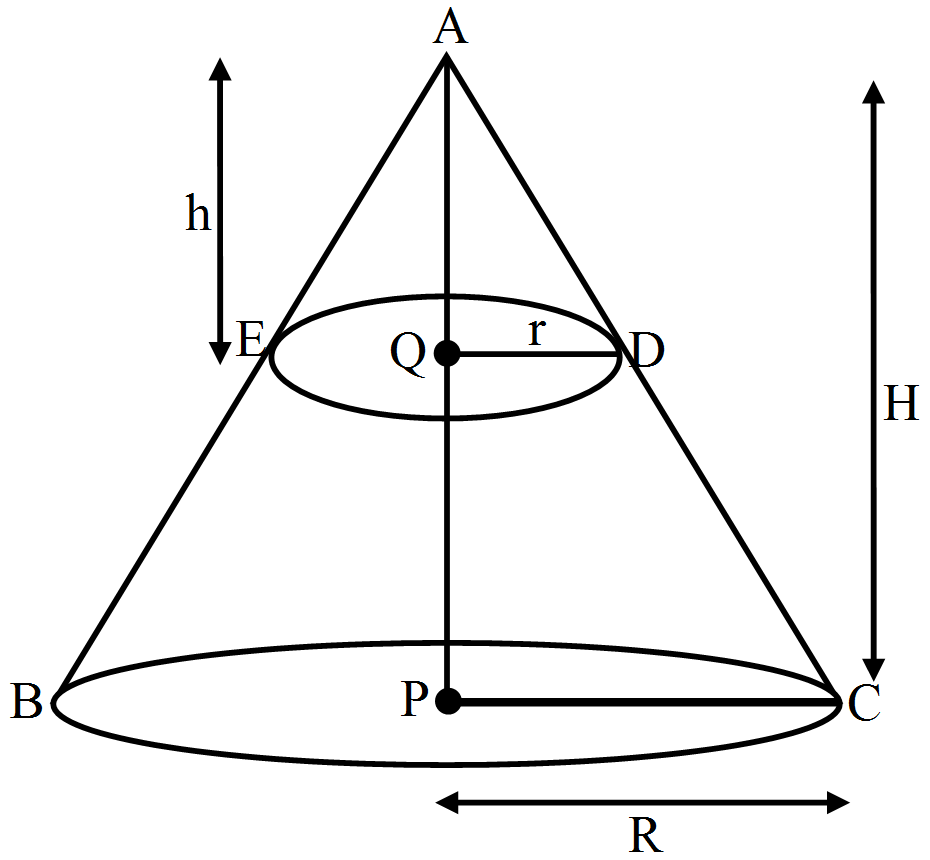 We have,
Height of the given cone, H = 20cm
Let the radius of the given cone be R,
the height of the smaller cone be h and
the radius of the smaller cone be r.
Now, in $\triangle\text{AQD}$ and $\triangle\text{APC},$
$\angle\text{QAD}=\angle\text{PAC}$ (Common angle)
$\angle\text{AQD}=\angle\text{APC}=90^\circ$
So, by AA criteria
$\triangle\text{AQD}\sim\triangle\text{APC}$
$\Rightarrow\frac{\text{AQ}}{\text{AP}}=\frac{\text{QC}}{\text{PC}}$
$\Rightarrow\frac{\text{h}}{\text{H}}=\frac{\text{r}}{\text{R}}\dots(\text{i})$
Volume of smaller cone $=\frac{1}{8}\times$ Volume of the given cone
$\Rightarrow\frac{\text{Volume of smaller cone}}{\text{Volume of the given cone}}=\frac{1}{8}$
$\Rightarrow\frac{\Big(\frac{1}{3}\pi\text{r}^2\text{h}\Big)}{\Big(\frac{1}{3}\pi\text{R}^2\text{h}\Big)}=\frac{1}{8}$
$\Rightarrow\Big(\frac{\text{r}}{\text{h}}\Big)^2\times\Big(\frac{\text{h}}{\text{H}}\Big)=\frac{1}{8}$
$\Rightarrow\Big(\frac{\text{h}}{\text{H}}\Big)^2\times\Big(\frac{\text{h}}{\text{H}}\Big)=\frac{1}{8}$
$\Rightarrow\Big(\frac{\text{h}}{\text{H}}\Big)^3=\frac{1}{8}$
$\Rightarrow\frac{\text{h}}{\text{H}}=\sqrt[3]{\frac{1}{8}}$
$\Rightarrow\frac{\text{h}}{20}=\frac{1}{2}$
$\Rightarrow\text{h}=\frac{20}{2}$
$\Rightarrow\text{h}=10\text{cm}$
$\therefore\text{PQ}=\text{H}-\text{h}$
$=20-20=20\text{cm}$
So, the section is made at the height of 10cm above the base. View full question & answer→Question 55 Marks
A wooden toy was made by scooping out a hemisphere of same radius from each end of a solid cylinder. If the height of the cylinder is 10cm and its base is of radius 3.5cm, then find the volume of wood in the toy.
Answer
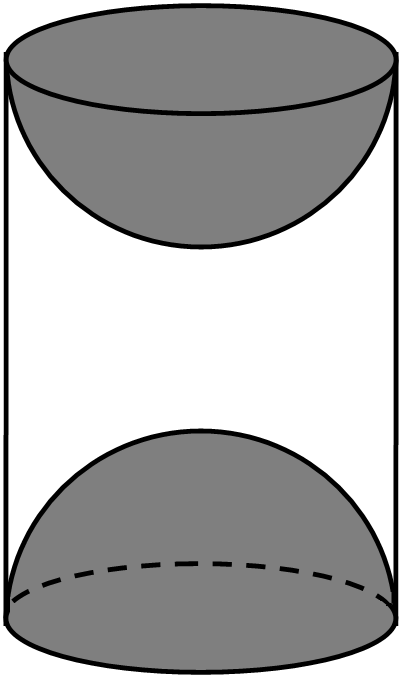
We have,
Radius of the cylinder = Radius of the hemisphcr = r = 3.5cm and
Height of the cylinder, h = 10cm
Now,
Volume of the toy = Volume of the cylinder - Volume of the two hemispheres
$=\pi\text{r}^2\text{h}-2\times\frac{2}{3}\pi\text{r}^3$
$=\pi\text{r}^2\Big(\text{h}=\frac{4\text{r}}{3}\Big)$
$=\frac{22}{7}\times3.5\times3.5\times\Big(10-\frac{4\times3.5}{3}\Big)$
$=38.5\Big(10-\frac{14}{3}\Big)$
$=38.5\times\frac{16}{3}$
$=\frac{616}{3}\text{cm}^3$
So. the volume of wood In the toy is $\frac{616}{3}\text{cm}^3$ or $205.33cm^3.$ View full question & answer→Question 65 Marks
A toy is in the shape of a cone mounted no a hemisphere of same base radius. If the volume of the toy is $231 cm^3$ and its diameter is 7cm, find the height of the toy.
AnswerGiven the base radius of the cone and the hemisphere are equal.
Diameter of hemisphere = 7cm
⇒ Radius of hemisphere = 3.5cm
Radius of the cone = Radius of the hemisphere = 3.5cm
Let H be the total height of the top.
H = h + r
H = h + 3.5 ...(Where h is the height of the cone.) ...(1)
Now,
Volume of toy = Volume of cone + Volume of hemisphere
$\Rightarrow231=\Big(\frac{1}{3}\pi\text{r}^2\text{h}\Big)+\Big(\frac{2}{3}\pi\text{r}^3\Big)$
$\Rightarrow231=\frac{1}{3}\pi\text{r}^2(\text{h}+2\text{r})$
$\Rightarrow231=\frac{1}{3}\times\frac{22}{7}\times3.5\times3.5(\text{h}+2\times3.5)$
$\Rightarrow231=\frac{269.5}{21}(\text{h}+\text{7})$
$\Rightarrow\text{h}+7=\frac{4851}{269.5}$
$\Rightarrow\text{h}+7=18$
$\Rightarrow\text{h}=11$
$\Rightarrow$ height of the toy $=\text{h}+\text{r}$
$=11+3.5\ ...(\text{From(1)})$
$=14.5\text{cm}$
View full question & answer→Question 75 Marks
Three cubes of iron whose edges are 6cm, 8cm and 10cm, respectively are melted and formed into a single cube. Find the edge of the new cube formed.
AnswerWe have,
Edges of the cubes : $a_1 = 6cm, a_2 = 8cm and a_3 = 10cm$
Let the edge of the new cube so formed be a.
As,
Volume of the new cube so formed $= a_1^3 + a_2^3 + a_3^3$
$\Rightarrow a^3 = 6^3 + 8^3 + 10^3$
$\Rightarrow a^3 = 216 + 512 + 1000$
$\Rightarrow a^3 = 1728$
$\Rightarrow\text{a}=\sqrt[3]{1728}$
$\therefore$ a = 12cm
So, the edge of the new cube so formed is 12cm.
View full question & answer→Question 85 Marks
The diameter of a copper sphere is 18cm. It is melted and drawn into a long wire of uniform crosssection. If the length of the wire is 108m, find its diameter.
AnswerDiameter of sphere = 18cm
Radius of the sphere = 9cm
Volume of sphere $=\frac{4}{3}\pi\text{r}^3=\frac{4}{3}\pi\times9\times9\times9\text{cm}^3$
Length of wire = 108m = 10800cm
Let radius of the wire be rcm.
Volume of the wire $\pi\text{r}^2\text{l}=\pi\times\text{r}^2\times10800\text{cm}^3$
The volume of the sphere and the wire are the same.
Therefore,
$\pi\times\text{r}^2\times10800=\frac{4}{3}\pi\times9\times9\times9$
$\Rightarrow\text{r}^2=\frac{4\times9\times9\times9}{3\times10800}=\frac{4\times9\times9}{3\times4\times3}=0.09$
$\Rightarrow\sqrt{0.09}=0.3\text{cm}$
Thus, $\text{d}=2\text{r}=2\times0.3\text{cm}=0.6\text{cm}$
The diameter of the wire is 0.6cm.
View full question & answer→Question 95 Marks
A cubical block of side 10cm is surmounted by a hemisphere. What is the largest diameter that the hemisphere can have? Find the cost of painting the total surface area of the solid so formed, at the rate of Rs 5 per 100 sq cm. $\Big[\text{Use }\pi=3.14\Big]$
AnswerTotal surface area of the solid = Total surface area of the cube + curved surface area of the hemisphere - Area of the base of the hemisphere
$=6\text{a}^2+2\pi\text{r}^2-\pi\text{r}^2$
$= [6 \times (10)^2 + 2 \times 3.14 \times (5)^2 - 3.14 \times (5)^2]cm^2$
$= (600 + 157 - 78.5)cm^2$
$= 678.5cm^2$
Cost of painting = Rs 5 per $100 cm^2$
Therefore,
Cost of painting the solid $=678.5\times\Big(\frac{5}{100}\Big)=\text{Rs}.33.90$
Hence, the approximate cost of painting the solid so formed is Rs. 33.90
View full question & answer→Question 105 Marks
A solid cone of base radius 10cm is cut into two parts through the midpoint of its height, by a plane parallel to its base. Find the ratio of the volumes of the two parts of the cone.
Answer
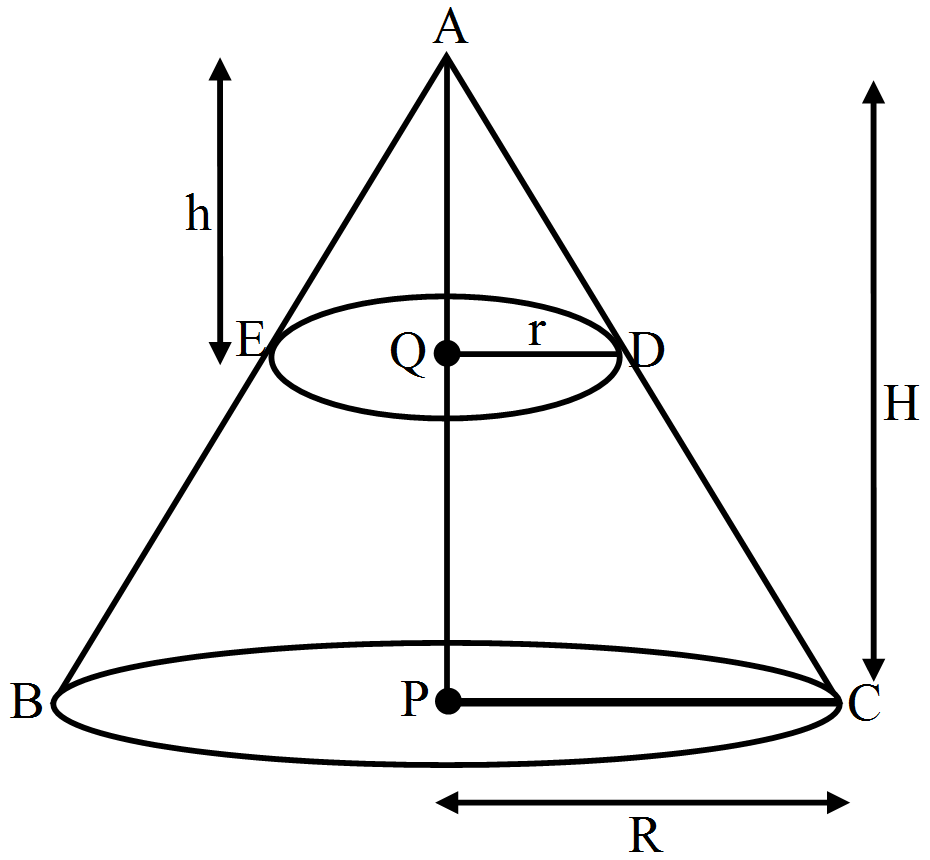 We have,
Radius of solid cone, R = OP = 10cm,
Let the height of the solid cone be, AP = H,
the radius of the smaller cone, QD = r and
the height of the smaller cone be, AQ = h.
Also, $\text{AQ}=\frac{\text{AP}}{2}$ i.e. $\text{h}=\frac{\text{H}}{2}$ or $\text{H}=\text{2h}\dots(\text{i})$
Now, in $\triangle\text{AQD}$ and $\triangle\text{APC},$
$\angle\text{QAD}=\angle\text{PAC}$ (Common angle)
$\angle\text{AQD}=\angle\text{APC}=90^\circ$
So, by AA criteria
$\triangle\text{AQD}\sim\text{APC}$
$\Rightarrow\frac{\text{AQ}}{\text{AP}}=\frac{\text{QD}}{\text{PC}}$
$\Rightarrow\frac{\text{h}}{\text{H}}=\frac{\text{r}}{\text{R}}$
$\Rightarrow\frac{\text{h}}{\text{2h}}=\frac{\text{r}}{\text{R}}$ [Using (i)]
$\Rightarrow\frac{1}{2}=\frac{\text{r}}{\text{R}}$
$\Rightarrow\text{R}=\text{2r}\dots(\text{ii})$
As,
Volume of smaller cone $=\frac{1}{3}\pi\text{r}^2\text{H}$
And,
Volome of solid cone $=\frac{1}{3}\pi\text{R}^2\text{H}$
$=\frac{1}{3}\pi(\text{2r})^2\times(\text{2h})$ [Using (i) and (ii)]
$=\frac{8}{3}\pi\text{r}^2\text{h}$
So,
Volume of frustum = Volume of solid cone - Volume of smaller cone
$=\frac{8}{3}\pi\text{r}^2\text{h}-\frac{1}{3}\pi\text{r}^2\text{h}$
$=\frac{7}{3}\pi\text{r}^2\text{h}$
Now, the ratio of the volumes of the two parts $=\frac{\text{Volume of the smaller cone}}{\text{Volume of the frustum}}$
$=\frac{\Big(\frac{1}{3}\pi\text{r}^2\text{h}\Big)}{\Big(\frac{7}{3}\pi\text{r}^2\text{h}\Big)}$
$=\frac{1}{7}$
$=1:7$
So, the ratio of the volume of the two parts of the cone Is 1 : 7. View full question & answer→Question 115 Marks
If the volumes of two bones are in the ratio of 1 : 4 and their iameters are in the ratio of 4 : 5, find the ratio of their heights.
AnswerGiven ratio of the volumes = 1 : 4 and
the ratio of the diameters 4 : 5
$\therefore\frac{\text{d}_1}{\text{d}_2}=\frac{2\text{r}_1}{2\text{r}_2}$
$\therefore\frac{4}{5}=\frac{2\text{r}_1}{2\text{r}_2}$
$\therefore\frac{\text{r}_1}{\text{r}_2}=\frac{4}{5}\ ...(1)$
now,
$\frac{\text{v}_1}{\text{v}_2}=\frac{\frac{1}{3}\pi\text{r}_1\ ^2\text{h}_1}{\frac{1}{3}\pi\text{r}_2\ ^2\text{h}_2}$
$\Rightarrow\frac{1}{4}=\Big(\frac{\text{r}_1}{\text{r}_ 2}\Big)^2\times\frac{\text{h}_1}{\text{h}_2}$
$\Rightarrow\frac{1}{4}=\Big(\frac{4}{5}\Big)^2\times\frac{\text{h}_1}{\text{h}_2}\ ...(\text{From }(1))$
$\Rightarrow\frac{1}{4}=\frac{16}{25}\times\frac{\text{h}_1}{\text{h}_2}$
$\Rightarrow\frac{\text{h}_1}{\text{h}_2}=\frac{25}{16\times4}$
$\Rightarrow\frac{\text{h}_1}{\text{h}_2}=\frac{25}{64}$
Thus, the ratio of there heights is 25 : 64.
View full question & answer→Question 125 Marks
A toy is in the form of a cone of radiLs 3.5cm mounted on a hemisphere of same radius on its circular face. The total height of the toy is 15.5cm. Find the total surface area of the toy.
Answer
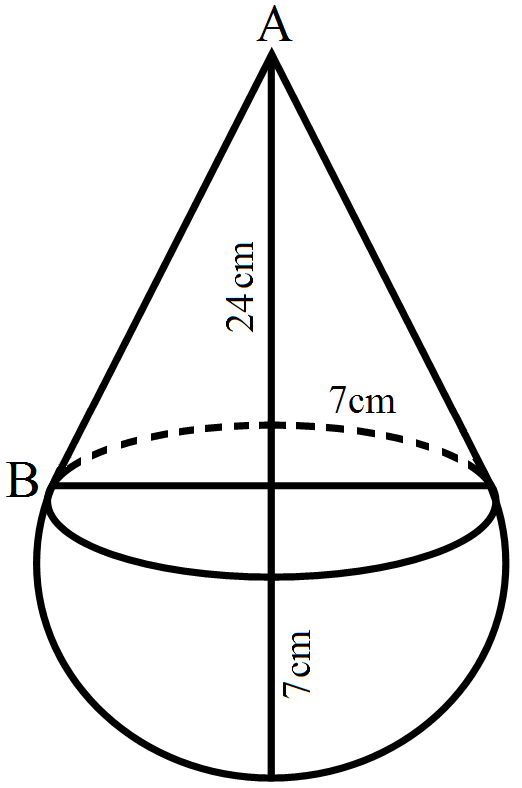 Height of cone = h = 24cm
lts radius = 7cm
$\therefore$ Slant height $=\sqrt{(24)^2+7^2}$
$=\sqrt{576+49}$
$=\sqrt{625}=25\text{cm}$
Total surface area of toy
$=\big(\pi\text{rl}+2\pi\text{r}^2\big)$
$=\pi\text{r}(\text{l}+2\text{r})$
$=\frac{22}{7}\times7\times(25+14)$
$=22\times39=858\text{cm}^2$ View full question & answer→Question 135 Marks
A container in the shape of a frustum of a cone having diameters of its two circular faces as 35cm and 30cm and vertical height 14cm, is completely filled with oil. If each $cm^3$ of oil has mass 1.2g, then find the cost of oil in the container if it costs Rs. 40 per kg.
AnswerWe have, Height, h = 14cm, Radius of upper end, $\text{R}=\frac{35}{2}=17.5\text{cm}$ and Radius of lower end, $\text{r}=\frac{30}{2}=15\text{cm}$Now,
Volume of the container $=\frac{1}{3}\pi\text{h}\big(\text{R}^2+\text{r}^2+\text{Rr}\big)$
$=\frac{1}{3}\times\frac{22}{7}\times14\times\big(17.5^2+15^2+17.5\times15\big)$
$=\frac{44}{3}\times(306.25+225+262.5)$
$=\frac{44}{3}\times793.75$
$=\frac{34925}{3}\text{cm}^3$
So, the mass of the oil that is completely filled in the container $=\frac{34925}{3}\times1.2$ $=13970\text{kg}$ $=13.97\text{kg}$ $\therefore$ The cost of the oil in the container $=40\times13.97=558.80$
View full question & answer→Question 145 Marks
A solid is in the shape of a cone surmounted on a hemisphere, the radius of each of them being 3.5cm and the total height of the solid is 9.5cm. Find the volume of the solid.
Answer
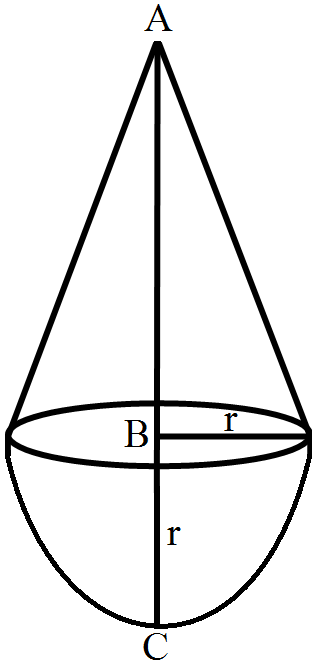
From the given fingure,
Height (AB) of the cone = AC - BC (Radius of the hemisphere)
Thus, height of the cone = Total height - Radius of the hemisphere
= 9.5 - 3.5
= 6cm
Volume of the solid = Volume of the cone + Volume of the hemisphere
$=\Big(\frac{1}{3}\pi\text{r}^2\text{h}\Big)+\Big(\frac{2}{3}\pi\text{r}^3\Big)$
$=\frac{1}{3}\times\frac{22}{7}\times3.5\times3.5(6+2\times3.5)$
$=\frac{1}{3}\times\frac{22}{7}\times3.5\times3.5\times13$
$=166.83\text{cm}^3$
Thus, total volume of the solid is $166.83cm^3,$ View full question & answer→Question 155 Marks
The rain water from a 22m × 20m roof drains into a cylindrical vessel of diameter 2m and height 3.5m. If the rain water collected from the roof fills $\frac{4}{5}\text{th}$ of the cylindrical vessel, then find the rainfall in centimetre.
AnswerWe have, The length of the roof, l = 22m, The width of the roof, b = 20m, The base radius of the cylindrical vessel, $\text{R}=\frac{2}{2}=1\text{m}$ and The height of the cylindrical vessel, H = 3.5m Let the height of the rainfall be h. Now, Volume of rainfall = Volume of rain water collected in the cylindrical vessel $\Rightarrow\text{lbh}=\frac{4}{5}\times$ Volume of cylindrical vessel $\Rightarrow22\times20\times\text{h}=\frac{4}{5}\times\pi\text{R}^2\text{H}$ $\Rightarrow440\text{h}=\frac{4}{5}\times\frac{22}{7}\times1\times1\times3.5$ $\Rightarrow\text{h}=\frac{4}{5}\times\frac{22}{7}\times\frac{3.5}{440}$ $\Rightarrow\text{h}=0.02\text{m}$$\therefore\text{h}=2\text{cm}$
So, the height of the rainfall is 2cm.
View full question & answer→Question 165 Marks
The radii of the circular ends of a bucket of height 15cm are 14cm and r cm (r < 14). If the volume of bucket is $5390cm^3,$ then find the value of r.
AnswerWe have, Height, h = 15cm, Radius of the upper end, R = 14cm, Radius of lower end = r, As, Volume of the bucket $= 5390cm^3$
$\Rightarrow\frac{1}{3}\pi\text{h}\big(\text{R}^2+\text{r}^2+\text{Rr}\big)=5390$
$\Rightarrow\frac{1}{3}\times\frac{22}{7}\times15\times\big(14^2+\text{r}^2+\text{14r}\big)=5390$
$\Rightarrow\frac{110}{7}\times(196+\text{r}^2+\text{14r}\big)=5390$
$\Rightarrow196+\text{r}^2+\text{14r}=\frac{5390\times7}{110}$
$\Rightarrow 196 + r^2 + 14r = 343$
$\Rightarrow r^2 + 14r - 147 = 0$
$\Rightarrow r^2 + 21r - 7r - 147 = 0$
$\Rightarrow r(r + 21) - 7(r + 21) = 0$
$\Rightarrow (r + 21)(r - 7) = 0$
$\Rightarrow r + 21 = 0 or r - 7 = 0$
$\Rightarrow r = -21 or r = 7$ As, r cannot be negative
$\therefore$ r = 7cm So, the value of r is 7cm.
View full question & answer→Question 175 Marks
A drinking glass is in the shape of a frustum of a cone of height 14cm. The diameters of its two circular ends are 16cm and 12cm. Find the capacity of the glass.
AnswerWe have,
Height of the frustum, h = 14cm,
Base radii, $\text{R}=\frac{16}{2}=8\text{cm}$ and $\text{r}=\frac{12}{2}=6\text{cm}$
The capacity of the glass = Volume of the frustum
$=\frac{1}{3}\pi\text{h}\big(\text{R}^2+\text{r}^2+\text{rR}\big)$
$=\frac{1}{3}\times\frac{22}{7}\times14\times\big(8^2+6^2+8\times6\big)$
$=\frac{1}{3}\times22\times2\times(64+36+48)$
$=\frac{44}{3}\times148$
$=\frac{6512}{3}\text{cm}^3$
$\approx2170.67\text{cm}^3$
So, the capacity of the glass is $2170.67cm^3.$
View full question & answer→Question 185 Marks
A solid sphere of radius 3cm is melted and then cast into small spherical balls. each of diameter 0.6cm. Find the number of balls so obtained.
AnswerRadius of solid sphere = 3cm
Volume of the sphere $=\frac{4}{3}\pi\text{r}^3=\frac{4}{3}\pi\times3\times3\times3\text{cm}^3$
Radius of each new ball = 0.3cm
Volume of each new ball $=\frac{4}{3}\pi\text{r}^3=\frac{4}{3}\pi\times\frac{3}{10}\times\frac{3}{10}\times\frac{3}{10}\text{cm}^3$
Total number of balls $=\frac{\frac{4}{3}\pi\times3\times3\times3}{\frac{4}{3}\pi\times\frac{3}{10}\times\frac{3}{10}\times\frac{3}{10}}=1000$
View full question & answer→Question 195 Marks
Marbles of diameter 1.4cm are dropped into a cylindrical beaker of diameter 7cm, containing some water. Find the number of marbles that should be dropped into the beaker so that the water level rises by 5.6cm.
AnswerDiameter of each marble = 1.4cm
Radius of each marble = 0.7cm
Volume of each marble $=\frac{4}{3}\pi\text{r}^3=\frac{4}{3}\pi\times(0.7)^3\text{cm}^3$
The water rises as a cylindrical column
Volume of cylindrical column filled with water $=\pi\text{r}^2\text{h}=\pi\times\Big(\frac{7}{2}\Big)^2\times5.6\text{cm}^3$
Total number of marbles
$=\frac{\text{Volume of cyUndrical water column}}{\text{Volume of marble}}$
$=\frac{\pi\times\Big(\frac{7}{2}\Big)^3\times5.6}{\frac{4}{3}\pi\times(0.7)^3}$
$=\frac{7\times7\times5.6\times3}{2\times2\times4\times0.7\times0.7}$
$=150$
View full question & answer→Question 205 Marks
A solid is in the form of a right circular done mounted on a hemisphere. The radius of the hemisphere is 2.1cm and the height of the cone is 4cm. The solid is placed in a cylinrical tub full of water in such a way that the whole solid is submerged in water. If the radius of the cylinder is 5cm and its height is 9.8cm, find the volume of the water left in the tub.
Answer
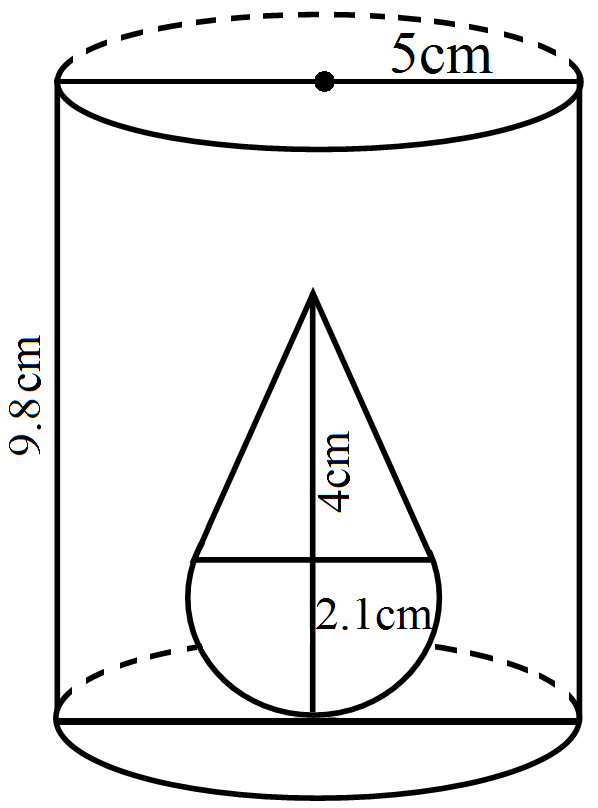
Radius of cylinder $r_1=5 cm$
And height of cylinder $h _1=9.8 cm$
Radius of cone $r=2.1 cm$
And height of cone $h _2=4 cm$
Volume of water left in tub
= (volume of cylindrical tub - volume of solid)
$=\Big(\pi^2_1\text{h}_1=\frac{2}{3}\pi\text{r}^3-\frac{1}{3}\pi\text{r}^2\text{h}_2\Big)$
$=\Big(\frac{22}{7}\times5\times5\times9.8-\frac{2}{3}\times\frac{22}{7}\times2.1\\\times2.1\times2.1-\frac{1}{3}\times\frac{22}{7}\times2.1\times2.1\times4\Big)$
$=[(770-19.404)-18.48]\text{cm}^3$
$=732.116\text{cm}^3$ View full question & answer→Question 215 Marks
A toy is in the form of a cylinder with hemispherical ends. If e whole length of the toy is 90cm and its demeter is 42cm, find the cost of painting the toy at the rate of 70 paise per sq cm.
AnswerGiven diameter of hemispherical ends = 42cm
⇒ Radius of hemispherical ends = 21cm
Radius of the cylinder = Redius of hemispherical ends = 21cm
height of the cylinder (h) = 90 - (21 + 21)
= 90 - 42
= 48cm
Total surface area of the solid = surface area of cylinder + 2(Surface area of hemispherical ends)
$=2\pi\text{rh}+2(2\pi\text{r}^2)$
$=2\times\frac{22}{7}\times21\times48+2\Big(2\times\frac{22}{7}\times21\times21\Big)$
$=6336+2\times2772$
$=6336+5544$
$=11880\text{cm}^2$
Thus,
Cost of painting the solid = 70 paise per sq cm $= Rs. 0.70 per cm^2$
Total cast = 11880 × 0.70
= Rs. 8316
View full question & answer→Question 225 Marks
A tent is in the shape of a righ circular cylinder up to a height pf 3m and conical above it. The total height of the tent is 13.5m and the radius of its base is 14m. Find the cost cloth required to make the tent at the rate of Rs. 80 per square metre. $\Big[$Take $\pi=\frac{22}{7}\Big]$
Answer
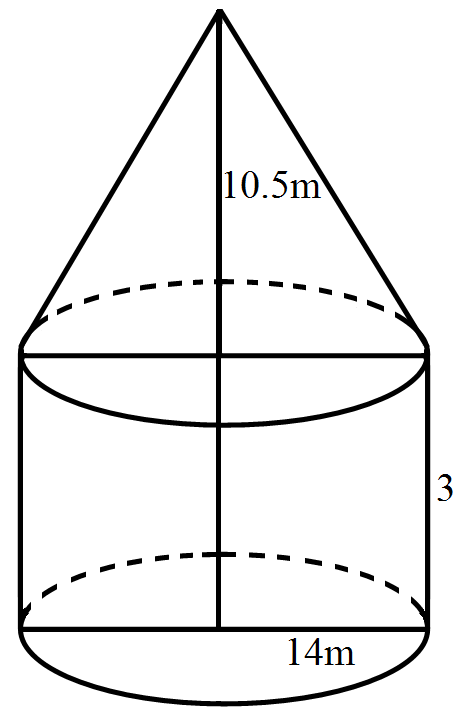
Radius of the cylinder = 14m
And its height = 3m
Radius of cone = 14m
And its heught = 10.5m
let l be the slant height
$\therefore\text{l}^2=(14)^2+(10.5)^2$
$\text{l}^2=(196+110.25)\text{m}^2$
$\text{l}^2=306.25\text{m}^2$
$\text{l}=\sqrt{306.25}\text{m}$
$=17.5\text{m}$
Curved surface area of tent
= (Cueved area of cylinder + curved surface area of cone)
$=2\pi\text{r}\text{h}+\pi\text{r}\text{l}$
$\Big[\Big(2\times\frac{22}{7}\times14\times3\Big)+\Big(\frac{22}{7}\times14\times17.5\Big)\Big]\text{m}^2$
$=(264+770)\text{m}^2=1034\text{m}^2$
Hence, the curved surface area of the tent $= 1034m^2$
Cost of canvas = Rs. (1034 × 80) = Rs. 82720 View full question & answer→Question 235 Marks
The radii of the circular ends of a solid frustum of a cone are 33cm and 27cm and its slant height is 10cm. Find its total surface area. [Use $\pi$ =3.14.]
AnswerGreater radius = R = 33cm Smaller radius = r = 27cm Slant height = l = 10cm Surface area of the frustum$=\pi\text{R}^2+\pi\text{r}^2+\pi\text{l}(\text{R}+\text{r})$
$=\pi\big[\text{R}^2+\text{r}^2+\text{l}(\text{R}+\text{r})\big]$
$=\big[33^2+27^2+10(33+27)\big]\pi$
$=[1089+729+10(60)]\pi$
$=2418\times3.14$
$=7592.52\text{cm}^2$
View full question & answer→Question 245 Marks
A spherical glass vessel has a cylindrical neck 7cm long and 4cm in diameter. The diameter of the spherical part is 21cm. Find the quantity of water it can hold. $\Big[\text{Use}\pi=\frac{22}{7}\Big]$
Answer
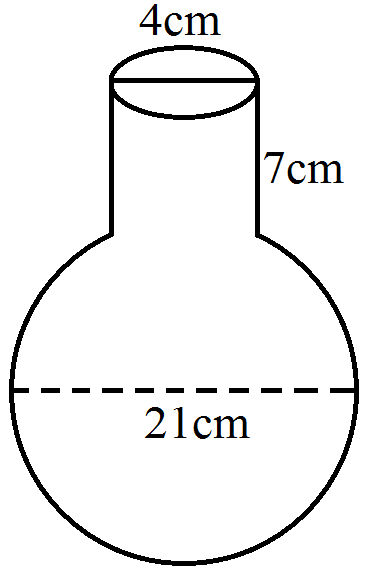
Diameter of spherical part of vessel = 21cm
Its radius $=\frac{21}{2}\text{cm}$
Its volume $=\frac{4}{3}\pi\text{r}^3$
$=\frac{4}{3}\times\frac{22}{7}\times\frac{21}{2}\times\frac{21}{2}\times\frac{21}{2}$
$=11\times21\times21\text{cm}^3=4851\text{cm}^3$
Volume of cylindrical part of vessel
$=\pi\text{r}^2\text{h}=\frac{22}{7}\times2\times2\times7\text{cm}^3$
$=88\text{cm}^3$
$\therefore$ Volume of whole vessel $= (4851 + 88)cm^3 = 4939cm^3$ View full question & answer→Question 255 Marks
Water is flowing at the rate of 6km/hr through a pipe of diameter 14cm into a rectangular tank which is 60m long and 22m wide. Determine the time in which the level of water in the tank Will rise by 7cm.
AnswerWe have,
Speed of the water flowing through the pipe, $\text{H}=6\text{km}/\text{h}=\frac{600000\text{cm}}{3600\text{ s}}=\frac{500}{3}\text{cm/s},$
Radius of the pipe, $\text{R}=\frac{14}{2}=7\text{cm},$
Length of the rectangular tank, l = 60m = 6000cm,
Breadth of the rectangular tank, b = 22m = 2200cm and
Rise in the level of water in the tank, h = 7cm
Now,
Volume of the water in the rectangular tank = lbh
$= 6000 \times 2200 \times 7$
$= 92400000cm^3$
Also,
Volume of the water flowing through the pipe in $1\text{s}=\pi\text{R}^2\text{H}$
$=\frac{22}{7}\times7\times7\times\frac{500}{3}$
$=\frac{77000}{3}\text{cm}^3$
So,
$\text{The time taken }=\frac{\text{Volume of the water in the rectangular tank}}{\text{Volume of the water flowing through the pipe in 1s}}$
$=\frac{92400000}{\Big(\frac{77000}{3}\Big)}$
$=\frac{92400\times3}{77}$
$=3600\text{s}$
$=1\text{ hr}$
So, the time in which the level of water in the tank Will rise by 7cm is 1 hour.
View full question & answer→Question 265 Marks
A military tent of height 8.25m is in form of a right circular cylinder of base diameter 30m and height 5.5m surmounted by a right tircular cone of same base radius. Find the length of canvas used in making the tent, if the breadth of the canvas is 1.5m.
Answer
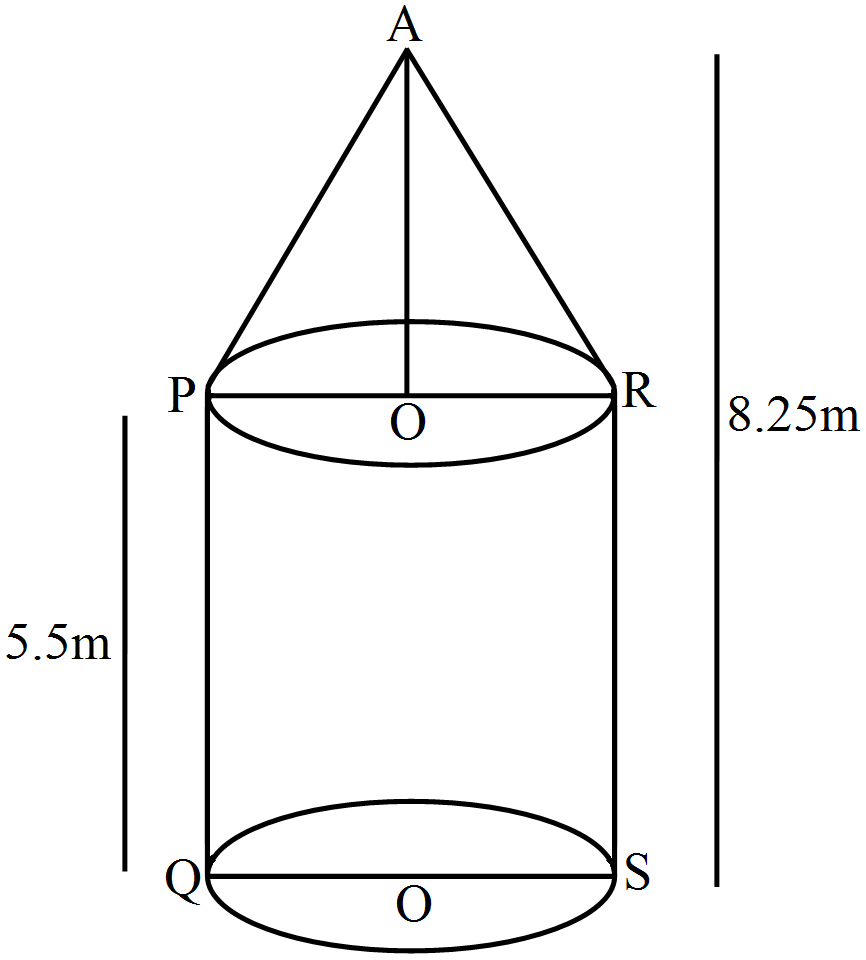 Given height of the tent (h) = 8.25m,
Diameter of cylindrical base = 30m
⇒ Radius of cylindrical base (r) = Radius of the cone = 15m,
Height of cylinder = 5.5m
Hwight of cone (h) = Height og the tent - height of the cylinder
= 8.25 - 5.5
2.75m
Slant height $=\sqrt{\text{r}^2+\text{h}^2}$
$=\sqrt{(15)^2+(2.75)^2}$
$=\sqrt{225+7.5625}$
$=\sqrt{232.5625}$
$=15.25\text{m}$
Total surface area of the = curved surface area of cone + curved surface area of cylinder
$=\pi\text{r}\text{l}+2\pi\text{r}\text{h}$
$=\pi\text{r}(\text{l}+2\text{h})$
$=\frac{22}{7}\times15(15.15+2\times5.5)$
$=\frac{22}{7}\times15\times26.25$
$=1237.5\text{m}^2$
New, breadth of the canvas (b) =1.5m
Let the length of the canvas = x m
Area of the triangular canvas = total surface area of the tent
⇒ l × b = 1237.5
⇒ l × 1.5 = 1237.5
⇒ l = 825m
Thus, length of the canvas is 825m. View full question & answer→Question 275 Marks
A metallic cylinder has radius 3cm and height 5cm. To reuce its weight, a conical hole is drilled in the cylinder. The conical hole has a radius of $\frac{3}{2}\text{cm}$ and its depth is $\frac{8}{9}\text{cm}.$ Calculate the ratio of the volume of metal left in the cylinder to the volume of metal taken out in conical shape.
AnswerGiven radius of the base of the metal cylinder (R) = 3cm,
height of the metalcylinder (H) = 5cm
Now,
Volume of the metal cylinder $=\pi\text{R}^2\text{h}$
$=\pi\times(3)^2\times5$
$=45\pi\text{cm}^3$
Given A conical hole is drilled in this metal cylinder.
Radius of the base of the cone $(\text{r})=\frac{3}{2}\text{cm}$
Height of the cylinder $(\text{h})=\frac{8}{9}\text{cm}$
Volume of the cone $=\frac{1}{3}\pi\text{r}^2\text{h}$
$=\frac{1}{3}\times\pi\times\Big(\frac{3}{2}\Big)^2\times\frac{8}{9}$
$=\pi\times\frac{9}{4}\times\frac{8}{9}$
$=\frac{2}{3}\pi\text{cm}^3$
When the conical hole is drilled out, then
Volume of the metal left in the solid = Volume of the metal cylinder - Volume of the cone
$=45\pi-\frac{2}{3}\pi$
$=\frac{133\pi}{3}\text{cm}^3$
Now,
$\frac{\text{Volume of the metal left in the solid}}{\text{Volume of the cone}}=\frac{\frac{133\pi}{3}}{\frac{2}{3}\pi}=\frac{133}{2}$
View full question & answer→Question 285 Marks
The radii of the circular ends of a solid frustum of a cone are 33cm and 27cm, and its slant height is 10cm. Find its capacity and total surface area. $\Big[\text{Take}\ \pi=\frac{22}{7}.\Big]$
AnswerGreater radius= R= 33cm Smaller radius = r = 27cm Slant height = I= 10cm Using the formula for height of a frustum: Height $=\text{h}=\sqrt{\text{l}^2-(\text{R}-\text{r})^2}$ $=\sqrt{10^2-(33-27)^2}$ $=\sqrt{100+(6)^2}$ $=\sqrt{100-36}$ $=\sqrt{64}$ $=8\text{cm}$ Capacity of the frustum$=\frac{1}{3}\pi\text{h}\big(\text{R}^2+\text{r}^2+\text{Rr}\big)$
$=\frac{1}{3}\times\frac{22}{7}\times8\big(33^2+27^2+33\times27\big)$
$=\frac{22\times8}{3\times7}\times2709=22704\text{cm}^3$
Surface area of the frustum $=\pi\text{R}^2+\pi\text{r}^2+\pi\text{l}(\text{R}+\text{r})$ $=\pi\big[\text{R}^2+\text{r}^2+\text{l}(\text{R}+\text{r})\big]$ $=\frac{22}{7}\big[33^2+27^2+10(33+27)\big]$ $=\frac{22}{7}[1089+729+10(60)]$ $=\frac{22\times2418}{7}=7599.43\text{cm}^2$
View full question & answer→Question 295 Marks
In a village, a well with 10m inside diameter, is dug 14m deep. Earth taken out of it is spread all around to a width 5m to form an embankment. Find the height of the embankment. What value of the villagers is reflected here?
Answer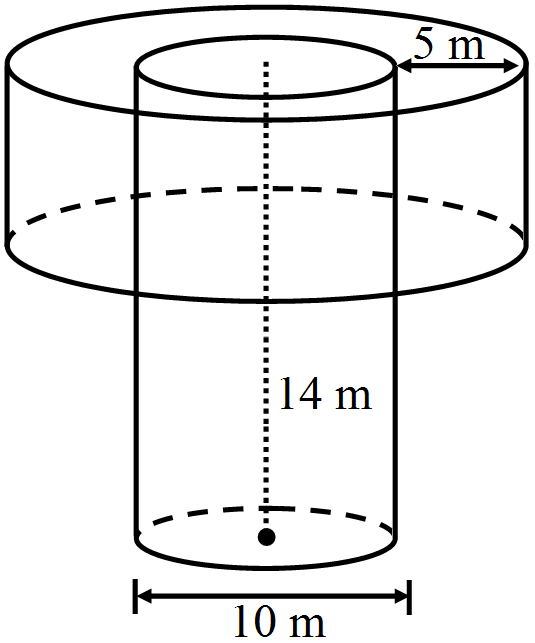
We have,
Radius of well, $\text{R}=\frac{10}{2}=5\text{m},$
Depth of the well, H = 14m and
Width of the embankment = 5m,
Also, the outer radius of the embankment, r = R + 5 = 5 + 5 = 10m
And, the inner radius of the embankment = R = 5m
Let the height of the embankment be h.
Now,
Volume of the embankment = Volume of the earth taken out
⇒ Volume of the embankment = Volume of the well
$\Rightarrow(\pi\text{r}^2-\pi\text{R}^2)\text{h}=\pi\text{R}^2\text{H}$
$\Rightarrow\pi(\text{r}^2-\text{R}^2)\text{h}=\pi\text{R}^2\text{H}$
$\Rightarrow(\text{r}^2-\text{R}^2)\text{h}=5\times5\times14$
$\Rightarrow(10^2-5^2)\text{h}=5\times5\times14$
$\Rightarrow(100-25)\text{h}=25\times14$
$\Rightarrow75\text{h}=25\times14$
$\Rightarrow\text{h}=\frac{25\times14}{75}$
$\therefore\text{h}=\frac{14}{3}\text{m}$
So, the height of the embankment is $\frac{14}{3}\text{m}.$
Value: We must lanour hard to make maximum use of the available resources
Disclaimer: The answer provided in the textbook is incorrect. It has been corrected above View full question & answer→Question 305 Marks
A solid metallic sphere of diameter 28cm is melted and recast into a number of smaller cones, each of diameter $4\frac{2}{3}\text{cm}$ and height 3cm. Find the number of cones so formed.
AnswerWe have,
Radius of the metallic sphere, $\text{R}=\frac{28}{2}=14\text{cm},$
Radius of the smaller cone, $\text{r}=\frac{1}{2}\times\Big(4\frac{2}{3}\Big)=\frac{1}{2}\times\frac{14}{3}=\frac{7}{3}\text{cm}$ and
Height of the smaller cone, h = 3cm
Now,
The number of cones so formedm $=\frac{\text{ Volume of the metallic sphere}}{\text{ Volume of a smaller cone}}$
$=\frac{\Big(\frac{4}{3}\pi\text{R}^3\Big)}{\Big(\frac{1}{3}\pi\text{r}^2\text{h}\Big)}$
$=\frac{4\text{R}^3}{\text{r}^2\text{h}}$
$=\frac{4\times14\times14\times14}{\Big(\frac{7}{3}\times\frac{7}{3}\times3\Big)}$
$=672$
So, the number of cones so formed is 672.
Disclaimer: The answer given in the textbook is incorrect. The same has been corrected above.
View full question & answer→Question 315 Marks
A 5-m-wide cloth is used to make a conical tent of base diameter 14m and height 24m. Find the cost of cloth used, at the rate of ₹ 25 per metre.
AnswerWe have, Width of the doth, B = 5m, Radius of the conical tent, $\text{r}=\frac{14}{2}=7\text{m}$ and Height of the conical tent, h = 24m
Let the length of the cloth used for making the tent be L. Also, The slant height of the conical tent, $\text{l}=\sqrt{\text{r}^2+\text{h}^2}$
$=\sqrt{7^2+24^2}$ $=\sqrt{49+576}$
$=\sqrt{625}$$=25\text{m}$
Now, The curved surface of the conical tent $=\pi\text{r}\text{l}$
$=\frac{22}{7}\times7\times25$
$\Rightarrow$ The area of the doth used for making the tent $= 550m^2$
$\Rightarrow\text{LB}=\frac{550}{\text{B}}$
$\Rightarrow\text{L}=\frac{550}{5}$
$\Rightarrow\text{L}=110\text{m}$
So, the cost of the cloth used = 25 × 110 = ₹ 2750
So, the cost of the ctoth used for making the tent is ₹ 2750.
View full question & answer→Question 325 Marks
A rocket is in the form of a circular cylinder closed at the lower end and a cone of the same radius is attached to the top. The radius fo the cylinder is 2.5m, its height is 21m and the slant height of the cone is 8m. Calculate the total surface area of rocket.
AnswerRadius of cylinder = 2.5m
Height of cylinder = 21m
Slant height of cone = 8m
Total surface area of the rocket = (curved surface area of cone + cueved surface area of cylinder + area of base)
$=(\pi\text{rl}+2\pi\text{rh}+\pi\text{r}^2)$
where $\text{l}=8\text{m},\ \text{h}=21\text{m}, \text{r}=2.5\text{m}$
$=\Big(\frac{22}{7}\times2.5\times8+2\times\frac{22}{7}\times2.5\times21+\frac{22}{7}\times2.5\times2.5\Big)\text{m}^2$
$=(62.85+330+19.64)\text{m}^2=412.5\text{m}^2$
View full question & answer→Question 335 Marks
The sum of the radius of the base and the height of a solid. cylinder is 37 metres. If the total surface area of the cylinder be 1628 sq metres, find its volume.
AnswerLet r and h be the radius and height of the solid cylinder respectively.
Given r + h = 37m
now,
total surface area of the cylimder $=2\pi\text{r}(\text{r}+\text{h})$
$\Rightarrow1628=2\times\frac{22}{7}\times\text{r}\times37$
$\Rightarrow1628=\frac{148}{7}\times\text{r}$
$\Rightarrow\text{r}=\frac{11396}{1628}$
$\Rightarrow\text{r}=7\text{m}$
$\Rightarrow\text{r}+\text{h}=37$
$\Rightarrow7+\text{h}=37$
$\Rightarrow\text{h}=30\text{m}$
Volume of the cylinder $=\pi\text{r}^2\text{h}$
$=\frac{22}{7}\times7\times7\times30$
$=22\times7\times30$
$=4620\text{m}^3$
View full question & answer→Question 345 Marks
A fez, the cap used by the Turks, is shaped like the frustum of a cone. If its radius on the open side is 10cm, radius at the upper base is 4cm and its slant height is 15cm, then find the area of material used for making it. $\Big[\text{Use}\ \pi=\frac{22}{7}.\Big]$
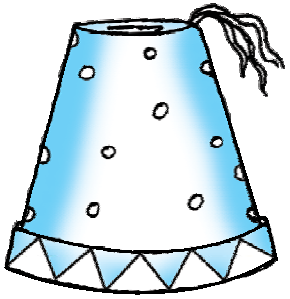
Answer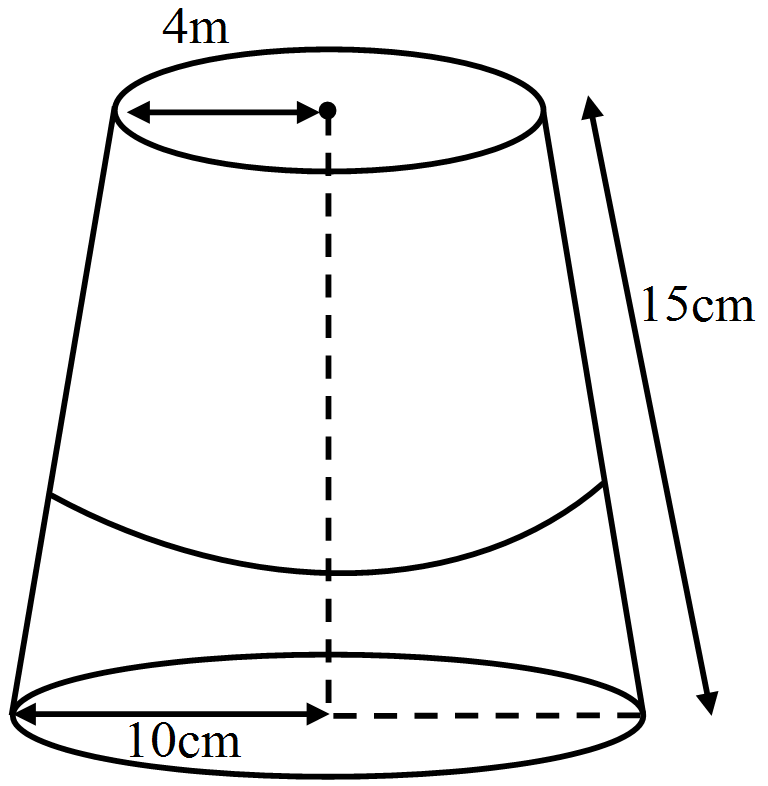 We have,
Radius of open side, R = 10cm,
Radius of upper base, r = 4cm and
Slant height, I = 15cm
Now,
The area of material used $=\pi(\text{R}+\text{r})\text{l}+\pi\text{r}^2$
$=\frac{22}{7}\times(10+4)\times15+\frac{22}{7}\times4\times4$
$=\frac{22}{7}\times14\times15+\frac{22}{7}\times4\times4$
$=\frac{22}{7}\times(14\times15+4\times4)$
$=\frac{22}{7}\times(210+16)$
$=\frac{22}{7}\times226$
$=\frac{4972}{7}\text{cm}^2$
$\approx710.28\text{cm}^2$
So, the area of material used for making the fez is $710.28cm^2$. View full question & answer→Question 355 Marks
A hemisphere of lead of radius 9cm is cast into a right circular cone of height 72cm. Find the radius of the base of the cone.
AnswerRadius of hemisphere = 9cm Volume of hemisphere $=\frac{2}{3}\pi\text{r}^3=\frac{2}{3}\pi\times9\times9\times9\text{cm}^3$Height of cone = 72cm
Let the radius of the cone be r cm. Volume of hemisphere $=\frac{1}{3}\pi\text{r}^2\text{h}=\frac{1}{3}\pi\text{r}^2\times72\text{cm}^3$ The volumes of the hemisphere and cone are equal. Therefore. $\frac{1}{3}\pi\text{r}^2\times72=\frac{2}{3}\pi\times9\times9\times9$ $\text{r}^2=\frac{2\times9\times9\times9}{72}=\frac{81}{4}$ $\text{r}^=\sqrt{\frac{81}{4}}=\frac{9}{2}=4.5\text{cm}$ The radius of the base of the cone is 4.5cm.
View full question & answer→Question 365 Marks
A metallic solid right circular cone is of height 84cm and the radius of its base is 21cm. It is melted and recast into a solid sphere. Find the diameter of the sphere.
AnswerWe have,
Height of the cone, h = 84cm and
Base radius of the cone, r = 21cm
Let the radius of the solid sphere be R.
Now,
Volume of the solid sphere = Volume of the solid cone
$\Rightarrow\frac{4}{3}\pi\text{R}^3=\frac{1}{3}\pi\text{r}^2\text{h}$
$\Rightarrow\text{R}^3=\frac{\text{r}^2\text{h}}{4}$
$\Rightarrow\text{R}^3=\frac{21\times21\times84}{4}$
$\Rightarrow\text{R}^3=\frac{21\times21\times21}{4}$
$\Rightarrow\text{R}=21\text{cm}$
$\therefore$ Diameter= 2R = 2 × 21 = 42cm
So, the diameter of the solid sphere is 42cm
View full question & answer→Question 375 Marks
From a solid cylinder whose height is 8cm and radius 6cm, conical cavity of height 8cm and of base radius 6cm is hollowed out. Find the volume of the remaining solid. Also, find the total surface area of the remaining solid. [Taken $\pi$ = 3.14.]
Answer
- Radius of cylinder = 6cm
Height of cylinder = 8cm
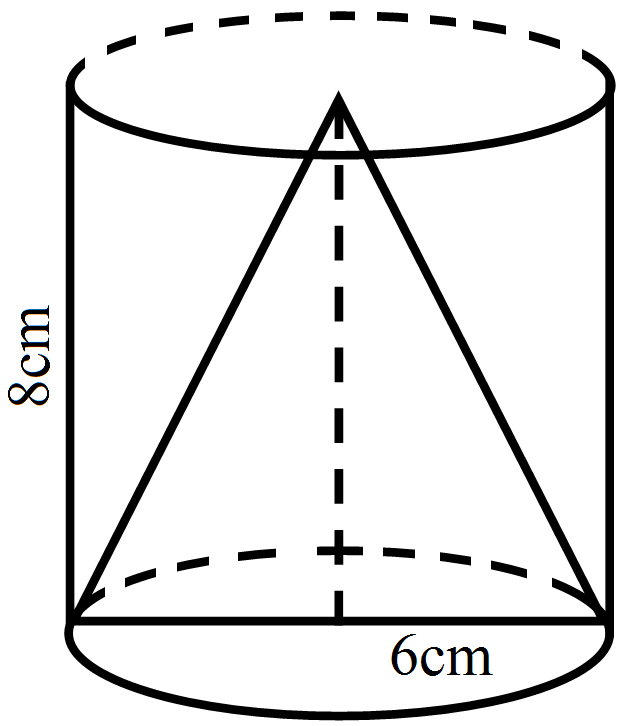
Volume of cylinder
$=\pi\text{r}^2\text{h}\text{ cu. units}$
$=\pi\times6\times6\times8\text{cm}^3$
$=288\pi\text{cm}^3$
Volume of cone removed
$=\frac{1}{3}\pi\text{r}^2\text{h}$
$=\frac{1}{3}\times\pi\times6\times6\times8\text{cm}^3$
- Surface area of cylinder $2\pi=2\pi\times6\times8\text{cm}^2=96\pi\text{cm}^2$
Slant height of cone $=\sqrt{6^2+8^2}=\sqrt{36+64}\text{cm}$
$=\sqrt{100}\text{cm}=10\text{cm}$
Curved surface area of remaining solid
$=(96\pi60\pi+36)\text{cm}^2$
$=192\pi\text{cm}^2=602.88\text{cm}^2$ View full question & answer→Question 385 Marks
A hemisphere of maximum possible diameter is placed over a cuboidal block of side 7cm. find the surface area of the solid so formed.
AnswerA cubodial block of side 7cm is surmounted by a hemisphere. What is the largest diameter that the hemisphere can have?
Also find the surface area of the solid.
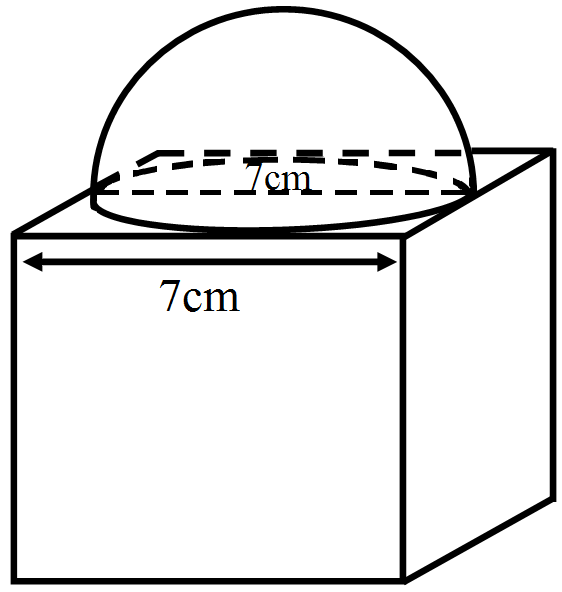
From the figure greatesr possible diameter for such hemeisphere is equal to cube's edge is 7cm
Radius of hemispherical $=\text{r}=\frac{7}{2}=3.5\text{cm.}$
total sirface area of solid = Surface area of cubical part + cueved surface area of hemispherical part - area of base of hemispherical part
$=6\times7^2+2\pi\text{r}^2-\pi\text{r}^2$
$=6\times7^2+\pi\text{r}^2$
Solving it we get
$= 332.5cm^2$ View full question & answer→Question 395 Marks
From a solid cylinder of height 2.8cm and diameter 4.2cm, conical cavity of the same height and same diameter is hollowed out. Find the total surface area of the remaining solid.
AnswerGiven height (h) of the conical part = haight (h) of cylindrical part = 2.8cm
Diameter of the cylindrical part = 4.2cm
⇒ Curved surface area of the cylindrical part $=2\pi\text{rh}$
$=2\times\frac{22}{7}\times2.1\times2.8$
$44\times0.3\times2.8$
$=36.96\text{cm}^2$
Now,
Slant height $(\text{l})=\sqrt{\text{h}^2+\text{r}^2}$
$\Rightarrow\text{l}=\sqrt{(2.8)^2+(2.1)^2}$
$\Rightarrow\text{l}=\sqrt{7.84+4.41}$
$\Rightarrow\text{l}=\sqrt{12.25}$
$\Rightarrow\text{l}=3.5$
⇒ Curved surface area of the concial part $=\pi\text{rl}$
$=\frac{22}{7}\times2.1\times3.5$
$=22\times0.5\times2.1$
$=23.1\text{cm}^2$
Area of cylindrical base $=\pi\text{r}^2$
$=\frac{22}{7}\times2.1\times2.1$
$=22\times0.3\times2.1$
$=13.86\text{cm}^2$
Total surface area of the remaining solid
= Curved surface area of the the cylindrical part + Curved surface area of the comcial prat + Area of cylindrical base
$=36.96+23.1+13.86$
$=73.92\text{cm}^2$
Thus, the total surface area of the remaining solid is $73.92cm^2$.
View full question & answer→Question 405 Marks
Water in a canal, 5.4m wide and 1.8m deep, is flowing with a speed of 25km/hr. How much area can it irriggate in 40 minutes, if 10cm of standing water is required for irrigation?
AnswerB = 5.4m
h = 1.8m
v = 25km/h
Therefore, l = 25km per hour
Therefore water that would be flowing in 40
Minutes $=40\times\frac{25}{60}=\frac{50}{3}\text{km}=\frac{50000}{3\text{m}}$
Area of irrigation= area water flowing in 40minutes
Volume of water which irrigates the land = volume water flowing from canal in 40 minutes and 10cm or $\frac{1}{10}\text{m}$ of standing water is required for irrigation therefore,
$\text{l}\times\text{b}\times\text{h}=\text{L}\times\text{B}\times\text{H}$
$\text{l}\times\text{b}\times\frac{1}{10}=\frac{50000}{3\times5.4\times1.8}$
$\text{l}\times\text{b}=300000\times5.4$
$\text{l}\times\text{b}=16200000\text{sq}.\text{m}$
Therefore, area to be irrigated when 10 cm of standing water is required = 16200000sq. m
View full question & answer→Question 415 Marks
A metallic bucket, open at the top, of height 24cm is in the form of the frustum of a cone, the radii of whose lower and upper circular ends are 7cm and 14cm, respectively. Find
- The volume of water which can completely fill the bucket,
- The area of the metal sheet used to make the bucket.
AnswerWe have,
Height, h = 24cm,
Upper base radius, R = 14cm and lower base radius, r = 7cm
Also, the slant height, $\text{l}=\sqrt{(\text{R}-\text{r})^2+\text{h}^2}$
$=\sqrt{(14-7)^2+24^2}$
$=\sqrt{7^2+24^2}$
$=\sqrt{49+576}$
$=\sqrt{625}$
$=25\text{cm}$
Volume of the bucket $=\frac{1}{3}\pi\text{h}\big(\text{R}^2+\text{r}^2+\text{Rr}\big)$
$=\frac{1}{3}\times\frac{22}{7}\times24\times\big(14^2+7^2+14\times7\big)$
$=\frac{22}{7}\times8\times(196+49+98)$
$=\frac{176}{7}\times343$
$=8624\text{cm}^3$
So, the volume of water which can completely fill the bucket is 8624cm$^3.$
Surface area of the bucket $=\pi(\text{R}+\text{r})\text{l}+\pi\text{r}^2$
$=\frac{22}{7}\times(14+7)\times25+\frac{22}{7}\times7\times7$
$=\frac{22}{7}\times21\times25+22\times7$
$=22\times3\times25+22\times7$
$=1650+154$
$=1804\text{cm}^2$
So, the area of the metal sheet used to make the bucket is 1804cm$^2.$
View full question & answer→Question 425 Marks
A hemispherical bowl of internal radius 9cm is full of water. Its contents are emptied into a cylindrical vessel of internal radius 6cm. Find the height of water in the cylindrical vessel.
AnswerWe have,
The radius of the hemispherical bowl, R = 9cm and
The internal base radius of the cylindrical vessel, r = 6cm
Let the height of the water in the cylindrical vessel be h.
As,
Volume of water in the cylindrical vessel = Volume of hemispherical bowl
$\Rightarrow\pi\text{r}^2\text{h}=\frac{2}{3}\pi\text{R}^3$
$\Rightarrow\text{r}^2\text{h}=\frac{2}{3}\text{R}^3$
$\Rightarrow6\times6\times\text{h}=\frac{2}{3}\times9\times9\times9$
$\Rightarrow\text{h}=\frac{2}{3}\times\frac{9\times0\times9}{6\times6}$
$\Rightarrow\text{h}=\frac{27}{2}$
$\therefore\text{h}=13.5\text{cm}$
So, the height of the water in the cylindrical vessel is 13.5cm.
View full question & answer→Question 435 Marks
The rain water from a roof of 44m × 20m drains into a cylindrical tank having diameter of base 4m and height 3.5m. If the tank is just full, then find the rainfall in cm.
AnswerWe have,
The length of the roof, l = 44m,
The width of the roof, b = 20m,
The height of the cylindrical tank, H = 3.5m and
The base radius of the cylindrical tank, $\text{R}=\frac{4}{2}=2\text{m}$
Let the height of the rainfall be h.
Now,
Volume of rainfall = Volume of cylindrical tank
$\Rightarrow\text{lbh}=\pi\text{R}^2\text{H}$
$\Rightarrow44\times20\times\text{h}=\frac{22}{7}\times2\times2\times3.5$
$\Rightarrow\text{h}=\frac{22}{7}\times\frac{2\times2\times3.5}{44\times20}$
$\Rightarrow\text{h}=\frac{1}{20}\text{m}$
$\Rightarrow\text{h}=\frac{100}{20}\text{cm}$
$\therefore\text{h}=5\text{cm}$
So, the height of the rainfall is 5cm.
View full question & answer→Question 445 Marks
A bucket is in the form of a frustum of a cone and it can hold 28.49 litres of water. If the radii of its circular ends are 28cm and 21cm, then find the height of the bucket.
AnswerWe have, Radius of upper end, R = 28cm and Radius of lower end, r = 21cm Let the height of the bucket be h. Now, Volume of water the bucket can hold = 28.49L
⇒ Volume of bucket $= 28490cm^3 (As, 1L = 1000cm^3)$
$\Rightarrow\frac{1}{3}\pi\text{h}\big(\text{R}^2+\text{r}^2+\text{Rr}\big)=28490$
$\Rightarrow\frac{1}{3}\times\frac{22}{7}\times\text{h}\times\big(28^2+21^2+28\times21\big)=28490$
$\Rightarrow\frac{22\text{h}}{21}\times49\times(16+9+12)=28490$
$\Rightarrow\frac{22\text{h}}3{}\times7\times37=28490$
$\Rightarrow\text{h}=\frac{28490\times3}{22\times7\times37}$
$\therefore\text{h}=15\text{cm}$
So, the height of the bucket is 15cm.
View full question & answer→Question 455 Marks
How many lead balls, each of radius 1cm, can be made from a sphere of radius 8cm?
AnswerRadius of the sphere = R = 8cm
Volume of the sphere $=\frac{4}{3}\pi\text{R}^3=\frac{4}{3}\pi\times8\times8\times8=\frac{4}{3}\pi\times512\text{cm}^3$
Radius of each new ball = r = 1cm
Volume of each ball $=\frac{4}{3}\pi\text{r}^3=\frac{4}{3}\pi\times1\times1\times1=\frac{4}{3}\pi\times1\text{cm}^3$
Total number of new balls that can be made $=\frac{\text{Volume of sphere}}{\text{Volume of each ball}}=\frac{\frac{4}{3}\pi\times512}{\frac{4}{3}\pi\times1}=512$
View full question & answer→Question 465 Marks
A container, open at the top and made up of metal sheet, is in the form of a frustum of a cone of height 16cm with diameters of its lower and upper ends as 16cm and 40cm, respectively. Find the cost of metal sheet used to make the container, if it costs ₹ 10 per $100cm^2.$
AnswerWe have,
Height, h = 16cm,
Radius of the upper end, $\text{R}=\frac{40}{2}=20\text{cm}$ and
Radius of the lower end, $\text{r}=\frac{16}{2}=8\text{cm}$
Also, the slant height, $\text{l}=\sqrt{(\text{R}-\text{r})^2+\text{h}^2}$
$=\sqrt{(20-8)^2+16^2}$
$=\sqrt{12^2+16^2}$
$=\sqrt{144+256}$
$=\sqrt{400}$
$=20\text{cm}$
Now,
Total surface area of the container $=\pi(\text{R}+\text{r})\text{l}+\pi\text{r}^2$
$=\frac{22}{7}\times(20+8)\times20+\frac{22}{7}\times8\times8$
$=\frac{22}{7}\times28\times20+\frac{22}{7}\times64$
$=\frac{22}{7}\times560+\frac{22}{7}\times64$
$=\frac{22}{7}\times624$
$=\frac{13728}{7}\text{cm}^2$
So, the cost of metal sheet used $=\frac{13728}{7}\times\frac{10}{100}$
$=\frac{13728}{70}$
$\approx196.11$
Hence, the cost of metal sheet used to make the container is 196.11
View full question & answer→Question 475 Marks
The radii of the circular ends of a solid frustum of a cone are 18cm and 12cm and its height is 8cm. Find its total surface area. $\big[\text {Use }\pi=3.14\big]$
AnswerWe have, Height, h = 8cm, Base radii, R = 18cm and r = 12cm Also, the slant height,
$\text{l}=\sqrt{(\text{R}-\text{r})^2+\text{h}^2}$
$=\sqrt{(18-12)^2+8^2}$
$=\sqrt{6^2+8^2}$
$=\sqrt{36+34}$
$=\sqrt{100}$
$=10\text{cm}$
Now, Total surface area of the solid frustum
$=\pi(\text{R}+\text{r})\text{l}+\pi\text{R}^2+\pi\text{r}^2$
$= 3.14 \times (18 + 12) \times 10 + 3.14 \times 18^2 + 3.14 \times 12^{2}$
$= 3.14 \times 30 \times 10 + 3.14 \times 324 + 3.14 \times 144$
$= 3.14 \times (300 + 324 + 144)$
$= 3.14 \times 768 = 2411.52cm^2$
So, the total surface area of the solid frustum is $2411.52cm^2.$
View full question & answer→Question 485 Marks
A hemisphere of lead of radius 6cm is cast into a right circular cone of height 75cm. Find the radius of the base of the cone.
AnswerWe have,
Radius of the hemisphere, R = 6cm and
Height of the cone, h = 75cm
Let the radius of the base of the cone be r.
Now,
Volume of the cone = Volume of the hemisphere
$\Rightarrow\frac{1}{3}\pi\text{r}^2\text{h}=\frac{2}{3}\pi\text{R}^3$
$\Rightarrow\text{r}^2=\frac{2\text{R}^3}{\text{h}}$
$\Rightarrow\text{r}^2\frac{2\times6\times6\times6}{75}$
$\Rightarrow\text{r}^2=5.76$
$\therefore\text{r}=2.4\text{cm}$
So, the radius of the base of the cone is 2.4cm.
View full question & answer→Question 495 Marks
A farmer connects a pipe of internal diameter 25cm from a canal into a cylindrical tank in his field, which is 12m in diameter and 2.5m deep. If water flows through the pipe at the rate of 3.6km/hr, then in how much time Will the tank be filled? Also, find the cost of water if the canal department charges at the rate of ₹ 0.07 per $m^3$.
AnswerWe have,
The radius of the cylindrical tank, $\text{R}=\frac{12}{2}=6\text{m}=600\text{cm},$
The depth of the tank, $\text{H}=2.5\text{m}=250\text{cm},$
The radius of the cylindrical pipe, $\text{r}=\frac{25}{2}=12.5\text{cm},$
Speed of the flowing water, $\text{h}=3.6\text{km/h}=\frac{360000\text{m}}{3600\text{s}}=100\text{cm/s}$
Now,
Volume of water flowing out from the pipe in a hour $=\pi\text{r}^2\text{h}$
$=\frac{22}{7}\times12.5\times12.5\times100\text{cm}^3$
Also,
Volume of the tank $=\pi\text{R}^2\text{H}$
$=\frac{22}{7}\times600\times600\times250\text{cm}^3$
So, the time taken to fill the tank
$=\frac{\text{Volume of the tank}}{\text{Volume of water Oowi.ng out from the pipe in a hour}}$
$=\frac{\frac{22}{7}\times600\times600\times250}{\frac{22}{7}\times12.5\times12.5\times100}$
$=5760\text{s}$
$=\frac{5760}{3600}$
$=1.6\text{h}$
Also, the cost of water $=0.07\times\frac{22}{7}\times6\times6\times2.5=19.80$
View full question & answer→Question 505 Marks
From a cubical piece of wood of side 21cm, a hemisphere is carved out in such a way that the diameter of the hemisphere is equal to the side of the cubical piece. Find the surface area and volume of the remaining piece.
AnswerGiven side of a cube = 21cm Diameter of the hemisphere is equal to the side of the cubical piece (d) = 21cm
$\Rightarrow $ Radius of the hemisphere = 10.5cm Volume of cube $= side^3 = (21)^3 = 9261cm^3$
Volume of the hemisphere
$=\frac{2}{3}\pi\text{r}^3$
$=\frac{2}{3}\times\frac{22}{7}\times10.5\times10.5\times10.5$
$44\times0.5\times10.5\times10.5$ $=2425.5\text{cm}^3$
⇒ Volume of the remaining piece $= 9261 - 2425.5 = 6835.5cm^3$
Now, Surface area of the cube (without the side carved) $= 5(side)^2= 5 \times 21 \times 21$
$= 2205cm^2$
Surface area of hemisphere $=2\pi\text{r}^2$
$=2\times\frac{22}{7}\times10.5\times10.5$
$=693\text{cm}^2$
$\Rightarrow$ Surface area of remaining piece $= 2205 + 693 = 2898cm^2$
View full question & answer→