Questions

M.C.Q

🎯

Test yourself on this topic

30 questions · timed · auto-graded

MCQ 11 Mark
Which of the following is $($are$)$ true when $HCl (g)$ is passed through water?
  1. It does not ionise in the solution as it is a covalent compound.
  2. It ionises in the solution.
  3. It gives both hydrogen and hydroxyl ion in the solution.
  4. It forms hydronium ion in the solution due to the combination of hydrogen ion with water molecule.
  • A
    $1$ only
  • B
    $3$ only
  • $2$ and $4$
  • D
    $3$ and $4$
Answer
Correct option: C.
$2$ and $4$
Any acid produces hydrogen ion $\left( H ^{+}\right)$which is present as hydronium ion $\left( H _3 O ^{+}\right)$because of combination with water molecule.
View full question & answer
MCQ 21 Mark
A sample of soil is mixed with water and allowed to settle. The clear supernatant solution turns the pH paper yellowish-orange. Which of the following would change the colour of this pH paper to greenish-blue?
  • A
    Lemon juice.
  • B
    Vinegar.
  • C
    Common salt.
  • An antacid.
Answer
Correct option: D.
An antacid.

Since soil mixture is turning the pH paper yellowish-orange, hence soil is acidic in nature. So, adding an antacid would change the colour to greenish-blue.

View full question & answer
MCQ 31 Mark
An aqueous solution turns red litmus solution blue. Excess addition of which of the following solution would reverse the change?
  • A
    Baking powder.
  • B
    Lime.
  • C
    Ammonium hydroxide solution.
  • Hydrochloric acid.
Answer
Correct option: D.
Hydrochloric acid.
Alkaline solutions turn red litmus paper to blue. Excess of acid will reverse the changes so we have to add excess of hydrochloric acid which turns the solution acidic.
View full question & answer
MCQ 41 Mark
What happens when a solution of an acid is mixed with a solution of a base in a test tube?
  1. The temperature of the solution increases.
  2. The temperature of the solution decreases.
  3. The temperature of the solution remains the same.
  4. Salt formation takes place.
  • A
    $1$ only
  • B
    $1$ and $3$
  • C
    $2$ and $3$
  • $1$ and $4$
Answer
Correct option: D.
$1$ and $4$
When an acid is mixed with a base; it results in neutralization reaction. Neutralization reaction results in formation of salt. Neutralization reaction is exothermic reaction.
View full question & answer
MCQ 51 Mark
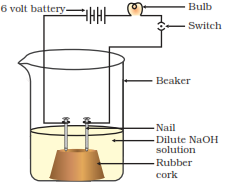
In an attempt to demonstrate electrical conductivity through an electrolyte, the following apparatus figure, was set up. Which among the following statement $(s)$ is $($are$)$ correct?
  1. Bulb will not glow because electrolyte is not acidic.
  2. Bulb will glow because $\ce{NaOH}$ is a strong base and furnishes ions for conduction.
  3. Bulb will not glow because circuit is incomplete.
  4. Bulb will not glow because it depends upon the type of electrolytic solution.

  • A
    $1$ and $3$
  • B
    $2$ and $4$
     
  • $2$ only
     
  • D
    $4$ only
Answer
Correct option: C.
$2$ only
 
Strong acids or bases are good conductors of electricity because they ionize completely in aqueous solution to give ions.
View full question & answer
MCQ 61 Mark
Which of the following are present in a dilute aqueous solution of hydrochloric acid?
  • $H_3O^+ + Cl^–$
  • B
    $H_3O^+ + OH^–$
  • C
    $Cl^– + OH^–$
  • D
    Unionised $\text{HCl}$
Answer
Correct option: A.
$H_3O^+ + Cl^–$

Any acid produces hydrogen ion $\left( H ^{+}\right)$which is present as hydronium ion $\left( H _3 O ^{+}\right)$because of combination with water molecule.


View full question & answer
MCQ 71 Mark
Equal volumes of hydrochloric acid and sodium hydroxide solutions of same concentration are mixed and the pH of the resulting solution is checked with a pH paper. What would be the colour obtained? (You may use colour guide given in Figure:
  • A
    Red.
  • B
    Yellow.
  • Yellowish green.
  • D
    Blue.
Answer
Correct option: C.
Yellowish green.
Hydrochloric acid and sodium hydroxide are strong acid and base respectively. So mixing of strong acid and strong base will form neutral salt and water giving the pH value as 7.
View full question & answer
MCQ 81 Mark
Common salt besides being used in kitchen can also be used as the raw material for making :
  1. Washing soda.
  2. Bleaching powder.
  3. Baking soda.
  4. Slaked lime.
  • A
    $1$ and $2$
  • B
    $1, 2$ and $4$
  • $1$ and $3$
  • D
    $1, 3$ and $4$
Answer
Correct option: C.
$1$ and $3$
Slaked time is made from calcium carbonate which is not common salt. Common salt is a raw material for making.
View full question & answer
MCQ 91 Mark
Identify the correct representation of reaction occurring during chloralkali process:
  • A
    $2NaCl(l) + 2H_2O(l) → 2NaOH(l) + Cl_2(g) + H_2(g)$
  • B
    $2NaCl(aq) + 2H_2O(aq) → 2NaOH(aq) + Cl_2(g) + H_2(g)$
  • C
    $2NaCl(aq) + 2H_2O(l) → 2NaOH(aq) + Cl_2(aq) + H_2(aq)$
  • $2NaCl(aq) + 2H_2O(l) → 2NaOH(aq) + Cl_2(g) + H_2(g)$
Answer
Correct option: D.
$2NaCl(aq) + 2H_2O(l) → 2NaOH(aq) + Cl_2(g) + H_2(g)$

 Chlor$-$alkali process is an industrial process that is used to form sodium hydroxide by electrolysis of aqueous solution of sodium chloride. It forms sodium hydroxide with hydrogen and chlorine gas as by$-$products.

View full question & answer
MCQ 101 Mark
Which of the following is not a mineral acid?
  • A
    Hydrochloric acid.
  • Citric acid.
  • C
    Sulphuric acid.
  • D
    Nitric acid.
Answer
Correct option: B.
Citric acid.
Mineral acids are mainly prepared from the minerals present in the earth's crust so they are also called as inorganic acids like $\text{HCl} ($hydrochloric acid$), H _2 SO _4 ($sulphuric acid$)$ and $HNO _3 ($nitric acid$)$. Organic acids are produced from plants or animals and contain carbon atoms like acetic acid, citric acid.
View full question & answer
MCQ 111 Mark
The pH of the gastric juices released during digestion is:
  • Less than 7.
  • B
    More than 7.
  • C
    Equal to 7.
  • D
    Equal to 0.
Answer
Correct option: A.
Less than 7.
The pH must be less than 7, so the juices are more gastric and can easily breakdown food into simpler molecules. Usually, the pH is 3.0.
View full question & answer
MCQ 121 Mark
Which of the following statements is not correct?
  • A
    All metal carbonates react with acid to give a salt, water and carbon dioxide.
  • All metal oxides react with water to give salt and acid.
  • C
    Some metals react with acids to give salt and hydrogen.
  • D
    Some non metal oxides react with water to form an acid.
Answer
Correct option: B.
All metal oxides react with water to give salt and acid.

Metal oxides are basic in nature. They give alkaline solution when dissolved in water.

View full question & answer
MCQ 131 Mark
To protect tooth decay we are advised to brush our teeth regularly. The nature of the tooth paste commonly used is:
  • A
    Acidic.
  • B
    Neutral.
  • Basic.
  • D
    Corrosive.
Answer
Correct option: C.
Basic.

 Basic toothpaste neutralizes any acid which may be present on teeth. Acid comes because of bacterial activity in mouth.

View full question & answer
MCQ 141 Mark
Which of the following salts does not contain water of crystallisation?
  • A
    Blue vitriol.
  • Baking soda.
  • C
    Washing soda.
  • D
    Gypsum.
Answer
Correct option: B.
Baking soda.

Other salts in the options usually appear as crystalline salts, but baking soda appears as white powder. Crystalline salts contain water of crystallization.

View full question & answer
MCQ 151 Mark
Which one of the following can be used as an acid–base indicator by a visually impared student?
  • A
    Litmus.
  • B
    Turmeric.
  • Vanilla essence.
  • D
    Petunia leaves.
Answer
Correct option: C.
Vanilla essence.

Vanilla works as olfactory indicator, hence it can be used by visually impaired student.

View full question & answer
MCQ 161 Mark
Which of the following statements is true for acids?
  • A
    Bitter and change red litmus to blue.
  • B
    Sour and change red litmus to blue.
  • Sour and change blue litmus to red.
  • D
    Bitter and change blue litmus to red.
Answer
Correct option: C.
Sour and change blue litmus to red.

Acids have sour taste and can turn blue litmus solution to red.

View full question & answer
MCQ 171 Mark
If a few drops of a concentrated acid accidentally spills over the hand of a student, what should be done?
  • A
    Wash the hand with saline solution.
  • Wash the hand immediately with plenty of water and apply a paste of sodium hydrogencarbonate.
  • C
    After washing with plenty of water apply solution of sodium hydroxide on the hand.
  • D
    Neutralise the acid with a strong alkali.
Answer
Correct option: B.
Wash the hand immediately with plenty of water and apply a paste of sodium hydrogencarbonate.

Washing the hand with plenty of water will minimize the presence of acid. Further, application of sodium hydrogen carbonate will neutralize any remaining acid. Sodium hydroxide is corrosive in nature, so it should not be used.

View full question & answer
MCQ 181 Mark
Which of the following is used for dissolution of gold?
  • A
    Hydrochloric acid.
  • B
    Sulphuric acid.
  • C
    Nitric acid.
  • Aqua regia.
Answer
Correct option: D.
Aqua regia.
Gold is a noble metal and does not react with even concentrated acids. Aqua regia is made by mixing nitric acid and hydrochloric acid in 1 : 3 ratio. It can dissolve even gold and platinum.
View full question & answer
MCQ 191 Mark
Sodium hydrogencarbonate when added to acetic acid evolves a gas. Which of the following statements are true about the gas evolved?
  1. It turns lime water milky.
  2. It extinguishes a burning splinter.
  3. It dissolves in a solution of sodium hydroxide.
  4. It has a pungent odour.
  • A
    $1$ and $2$
  • $1, 2$ and $3$
  • C
    $2, 3$ and $4$
  • D
    $1$ and $4$
Answer
Correct option: B.
$1, 2$ and $3$
Reaction of sodium hydrogen carbonate with acetic acid forms sodium acetate and water with carbon dioxide $\ce{(CO_2)}$ gas.
$\text{NaHCO}_3\ \ \ \ \ \ +\ \ \ \ \ \ \text{CH}_3\text{COOH}\ \ \rightarrow\ \ \text{CH}_3\text{COONa}\ +\ \text{CO}_2\ +\ \text{H}_2\text{O}$
$\text{Sodium hydrogen}\ \ \ \ \text{Acetic acid}\ \ \ \ \ \ \ \ \text{Sodium acetate}$
$\text{carbonate}$
View full question & answer
MCQ 201 Mark
Which of the following phenomena occur, when a small amount of acid is added to water?
  1. Ionisation.
  2. Neutralisation.
  3. Dilution.
  4. Salt formation.
  • A
    $1$ and $2$
  • $1$ and $3$
  • C
    $2$ and $3$
  • D
    $2$ and $4$
Answer
Correct option: B.
$1$ and $3$
Ionization can be defined as the dissociation of molecule into its respective ions. Mixing of an acid with water decreases the concentration of acid and is called as dilution.
View full question & answer
MCQ 211 Mark
One of the constituents of baking powder is sodium hydrogencarbonate, the other constituent is:
  • A
    Hydrochloric acid.
  • Tartaric acid.
  • C
    Acetic acid.
  • D
    Sulphuric acid.
Answer
Correct option: B.
Tartaric acid.

Baking powder is a mixture of sodium hydrogen carbonate and a weak edible acid named as tartaric acid.

View full question & answer
MCQ 221 Mark
Which of the following statements is correct about an aqueous solution of an acid and of a base?
  1. Higher the $\ce{pH},$ stronger the acid.
  2. Higher the $\ce{pH},$ weaker the acid.
  3. Lower the $\ce{pH},$ stronger the base.
  4. Lower the $\ce{pH},$ weaker the base.
  • A
    $1$ and $3$
  • B
    $2$ and $3$
  • C
    $1$ and $4$
  • $2$ and $4$
Answer
Correct option: D.
$2$ and $4$
The $\ce{pH},$ values lie between $0$ to $14$ in which $0$ to $7$ is acidic medium and $7$ to $14$ is alkaline or basic medium.
View full question & answer
MCQ 231 Mark
Which of the following substance will not give carbon dioxide on treatment with dilute acid?
  • A
    Marble.
  • B
    Limestone.
  • C
    Baking soda.
  • Lime.
Answer
Correct option: D.
Lime.
Explanation: Marble or lime stone $\left( CaCO _3\right)$ and baking soda $\left( NaHCO _3\right)$ release $CO _2$ with HCl but lime $( CaO )$ with HCl form $CaCl _2$ and water.
View full question & answer
MCQ 241 Mark
Which among the following is not a base?
  • A
    $NaOH.$
  • B
    $KOH.$
  • C
    $NH_4OH.$
  • $C2H_5OH.$
Answer
Correct option: D.
$C2H_5OH.$
 $C_2H_5OH$ is an organic compound with$–OH$ functional group that is known as alcohol. It cannot give $OH^-$ ions in its solution.
View full question & answer
MCQ 251 Mark
Sodium carbonate is a basic salt because it is a salt of:
  • A
    Strong acid and strong base.
  • B
    Weak acid and weak base.
  • C
    Strong acid and weak base.
  • Weak acid and strong base.
Answer
Correct option: D.
Weak acid and strong base.

A salt of strong base and weak acid produces basic salt. Sodium is a strong base and carbonate is a weak acid.

View full question & answer
MCQ 261 Mark
Which of the following gives the correct increasing order of acidic strength?
  • Water < acetic acid < hydrochloric acid.
  • B
    Water < hydrochloric acid < acetic acid.
  • C
    Acetic acid < water < hydrochloric acid.
  • D
    Hydrochloric acid < water < hydrochloric acid.
Answer
Correct option: A.
Water < acetic acid < hydrochloric acid.
Water is a natural substance, hydrochloric acid is a strong acid as it ionizes completely in water, whereas acetic acid ionizes only partially in water; hence, it is a weak acid.
View full question & answer
MCQ 271 Mark
Which of the following is acidic in nature?
  • Lime juice.
  • B
    Human blood.
  • C
    Lime water.
  • D
    Antacid.
Answer
Correct option: A.
Lime juice.
Lime juice contains citric acid.
View full question & answer
MCQ 281 Mark
During the preparation of hydrogen chloride gas on a humid day, the gas is usually passed through the guard tube containing calcium chloride. The role of calcium chloride taken in the guard tube is to:
  • A
    Absorb the evolved gas.
  • B
    Moisten the gas.
  • Absorb moisture from the gas.
  • D
    Absorb Cl–ions from the evolved gas.
Answer
Correct option: C.
Absorb moisture from the gas.
Calcium chloride is a good dehydrating agent so it is used to absorb moisture from the hydrogen chloride gas.
View full question & answer
MCQ 291 Mark
Calcium phosphate is present in tooth enamel. Its nature is:
  • Basic.
  • B
    Acidic.
  • C
    Neutral.
  • D
    Amphoteric.
Answer
Correct option: A.
Basic.

Calcium phosphate $Ca _3\left( PO _4\right)_2$ is salt of weak acid and strong base so it is a basic salt.
$3\text{Ca(OH)}_2\ \ +\ \ 2\text{H}_3\text{PO}_4\ \ \ \rightarrow\ \ \ \text{Ca}_3\text{(PO}_4)_2\ \ +\ \ 6\text{H}_2\text{O}\\\text{Calcium}\ \ \ \ \ \ \ \ \ \ \text{Phosphoric}\ \ \ \ \ \ \ \ \ \ \text{Calcium}\\\text{Hydroxide}\ \ \ \ \ \ \ \ \text{acid}\ \ \ \ \ \ \ \ \ \ \ \ \ \ \ \ \ \ \ \ \text{Phosphate}$

View full question & answer
MCQ 301 Mark
Match the chemical substances given in Column $(A)$ with their appropriate application given in Column $(B):$
  Column $(A)$   Column $(B)$
$A.$ Bleaching powder $1.$ Preparation of glass
$B.$ Baking soda $2.$ Production of $H_2$ and $Cl_2$
$C.$ Washing soda $3.$ Decolourisation
$D.$ Sodium chloride $4.$ Antacid
  • A
    $A—2, B—1, C—4, D—3$
  • B
    $A—3, B—2, C—4, D—1$
  • $A—3, B—4, C—1, D—2$
  • D
    $A—2, B—4, C—1, D—3$
Answer
Correct option: C.
$A—3, B—4, C—1, D—2$
  • Bleaching powder $\left(\ce{CaOCl} _2\right)-$ Used for bleaching or decolourization of clothes. Baking soda $\left(\ce{NaHCO} _3\right)-$ Used as an antacid for relieving stomach acidity. Washing soda $\left( \ce{Na_2CO}_3\right)-$ Used in preparation of glass.
  • Sodium chloride $(\ce{NaCl})-$ Used for production of $H _2$ and $\ce{Cl} _2$ gases.
View full question & answer