Questions · Page 1 of 2

Answer the questions.[Che-2M]

🎯

Test yourself on this topic

50 questions · timed · auto-graded

Question 12 Marks
You have been provided with three test-tubes. One of these test-tubes contains distilled water and the other two contain an acidic and a basic solution respectively. If you are given only blue litmus paper, how will you identify the contents of each test-tube?
Answer
Acidic solution will turn blue litmus red; This red litmus will turn blue in basic solution; Distilled water will have no effect on any type of litmus pape,
View full question & answer
Question 22 Marks
Write the neutralisation reaction between acids and bases in terms of the ions involved.
Answer
$\text{H}^+\text{(aq)}\ \ +\ \ \text{OH}^-\text{aq}\xrightarrow[\text{Reaction}]{\text{Neutralisation}}\text{H}_2\text{O}(\text{l})\\^{\text{Hydrogenions}}\ \ \ ^\text{Hydroxideions}\ \ \ \ \ \ \ \ \ \ \ \ \ \ \ \ \ \ \ ^{\text{Whater}}\\^{\text{(From acid)}}\ \ \ \ \ \ ^{\text{(From bases)}}$
View full question & answer
Question 32 Marks
Why should curd and other sour foodstuffs (like lemon juice, etc.) not be kept in metal containers (such as copper and brass vessels)?
Answer
Curd and other sour substances contains acids which can react with the metals of brass and copper vessels to form toxic (poisonous) metal compounds which can cause food poisoning and damage our health.
View full question & answer
Question 42 Marks
Why do HCl, H2SO4, HNO3, etc., show acidic character in aqueous solutions while solutions of compounds like C6H12O6 (glucose) and C6H12OH (alcohol) do not show acidic character?
Answer
The acidic character of a substance is due to the presence of hydrogen ions [H+(aq) ions] in its aqueous solution. HCl, H2SO4 etc show acidic properties because they produce hydrogen ions when dissolved in water. The solution of compounds like alcohol and glucose do not show acidic character because they do not ionize in water to produce hydrogen ions or any other ions in solution.
View full question & answer
Question 52 Marks
Which gas is liberated when dilute hydrochloric acid reacts with sodium carbonate? How will you test for the presence of this gas?
Answer
CO2 gas is liberated during the reaction. When carbon dioxide gas formed in the form of brisk effervescence is passed through lime water, it turns the lime water milky. If excess of carbon dioxide gas is passed through the milky lime water, the solution becomes clear again. This confirms the presence of carbon dioxide gas.
View full question & answer
Question 62 Marks
Which chemical is injected into the skin of a person:
During the nettle leaf hair sting?
How can the effect of these stings be neutralised?
Answer
Methanoic acid. The effect of methanoic acid can be neutralised by rubbing a mild base like baking soda solution on the stung area of the skin.
View full question & answer
Question 72 Marks
Which acid is produced in our stomach? What happens if there is an excess of acid in the stomach? How can its effect be cured?
Answer
Our stomach produces hydrochloric acid. If there is excess of hydrochloric acid in the stomach, it causes indigestion which produces pain and irritation. Its effect can be cured by taking antacids.
View full question & answer
Question 82 Marks
When the concentrated aqueous solution of substance X is electrolysed, then NaOH, Cl2 and H2 are produced. Name the substance X. What is the special name of this process?
Answer
Substance X, which gives sodium hydroxide, Cl2 and H2 upon electrolysis, is NaCl. The electrolysis of sodium chloride solution is called the chlor-alkali process because of the products formed, 'chlor' for chlorine and 'alkali' for sodium hydroxide (NaOH).
View full question & answer
Question 92 Marks
When a solution is added to vanilla extract, then the characteristic smell of vanilla cannot be detected. State whether the given solution is an acid or a base.
Answer
When Hydrochloric acid reacts with an active metal (like zinc), we observe that gas filled bubbles are formed on the surface of the metal. Pass the gas formed through soap solution. Then, bring a burning candle near the gas filled soap bubble. If the gas present in bubble burns with a ‘pop’ sound, then its hydrogen gas.
View full question & answer
Question 102 Marks
When a solution becomes more acidic, pH gets lower.
Answer
Acids are those chemical substances which have a sour taste.
Example: Acetic acid and citric acid.
Base is a chemical substance which has a bitter taste.
Example: Caustic soda and washing soda.
View full question & answer
Question 112 Marks
What is meant by strong acids and weak acids? Classify the following into strong acids and weak acids:
HCl, CH3 COOH, H2SO4, HNO3, H2CO, H2SO3
Answer
A strong acid is one that completely ionises in water to form a large amount of hydrogen ions whereas a weak acid only partially ionises in water and thus produces a small amount of hydrogen ions.
HCl, H SO, HNO are strong acids; CH COOH, H CO, H SO are weak acids.
View full question & answer
Question 122 Marks
What is gypsum? What happens when gypsum is heated to 100°C (373 K)?
Answer
Gypsum is calcium sulphate dihydrate, CaSO.2H O. When gypsum is heated to a temperature of 100?C, it loses 3/4th of its water of crystallisation and forms plaster of Paris.
View full question & answer
Question 132 Marks
What is bleaching powder? How is bleaching powder prepared? Write chemical equation of the reaction involved in the preparation of bleaching powder.
Answer
Bleaching powder is Calcium oxychloride (CaOCl ). It is prepared by passing chlorine gas over dry slaked lime.
$\text{Ca(OH)}_2+\text{Cl}_2\rightarrow\text{CaOCl}_2+\text{H}_2\text{O}$
View full question & answer
Question 142 Marks
What is “baking powder”? How does it make the cake soft and spongy?
Answer
Baking powder is a mixture of baking soda and tartaric acid. When baking powder mixes with water, then sodium hydrogencarbonate reacts with tartaric acid to evolve carbon dioxide gas which gets trapped in the wet dough and bubbles out slowly making the cake soft and spongy.
View full question & answer
Question 152 Marks
What is a universal indicator? For what purpose is it used?
Answer
Universal indicator is a mixture of many different indicators which gives different colours at different pH values of the entire pH scale. It is used to obtain an idea of how acidic or basic a substance is.
View full question & answer
Question 162 Marks
What is a salt? Give the names and formulae of any two salts. Also name the acids and bases from which these salts may be obtained.
Answer
A salt is a compound formed from an acid by the replacement of the hydrogen in the acid by a metal.
Example: Sodium chloride – NaCl; It is obtained from hydrochloric acid and sodium metal. Ammonium chloride – NH Cl; It is obtained from ammonia and hydrochloric acid.
View full question & answer
Question 172 Marks
What is an olfactory indicator? Name two olfactory indicators. What is the effect of adding sodium hydroxide solution to these olfactory indicators?
Answer
Those substances whose smell (or odour) changes in acidic or basic solutions are called olfactory indicators. Onion and vanilla extracts are olfactory indicators. When a basic solution like sodium hydroxide solution is added to a cloth strip treated with onions (or onion extract), then the onion smell cannot be detected.
View full question & answer
Question 182 Marks
What is a neutralisation reaction? Explain with an example. Give the chemical equation of the reaction which takes place.
Answer
The reaction between an acid and a base to form salt and water is called a neutralisation reaction. When hydrochloric acid reacts with sodium hydroxide solution, then a neutralisation reaction takes place to form sodium chloride and water.
$\text{NaOH}(\text{aq})+\text{HCl}(\text{aq})+\text{H}_2\text{O}(\text{l})$
View full question & answer
Question 192 Marks
What happens when zinc granules are heated with sodium hydroxide solution?
Write equation of the reaction which takes place.
Answer
When zinc granules are heated with sodium hydroxide solution, then sodium zincate salt and hydrogen gas are formed.
$\underset{\substack{\text { Sodium Hydroxide } \\ \text { (Base) }}}{2 NaOH ( aq )}+\underset{\text { Carbon dioxide }}{ Zn ( s ) \xrightarrow{\text { Heat }}} \underset{\substack{\text { Calctum carbonate } \\ (salt)}}{ Na _2ZnO_2}+\underset{\text { Water }}{ H _2(g)}$
View full question & answer
Question 202 Marks
What happens when dilute hydrochloric acid is added to sodium carbonate? Write a balanced chemical
Answer
When dilute hydrochloric acid reacts with sodium carbonate, then sodium chloride, carbon dioxide and water are formed.
$\text{Na}_2\text{CO}_3\ (\text{S})\ +\ 2\text{HCl}(\text{aq})+\text{CO}_2(\text{g})+\text{H}_2\text{O}(\text{l})$
View full question & answer
Question 222 Marks
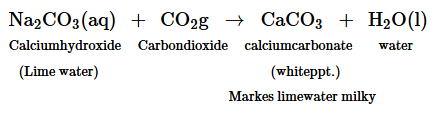
What happens when bases react with non-metal oxides? Explain with the help of an example. What does this reaction tell us about the nature of non-metal oxides?
Answer
when bases react with non-metal oxides, then salt and Water are Formed.
Example: Calcium hydroxide reactswith corbon dioxxide to from culcium carbonate and water.
$\underset{\substack{\text { Calcium hydroxide } \\ \text { (Base) }}}{ Ca ( OH )_{2(a q)}}+\underset{\substack{\text { Carbon hydroxide } \\ \text { (Non-matl oxide) }}}{ CO _2(g)} \longrightarrow \underset{\substack{\text { Calcium hydroxide } \\ \text { (Salt) }}}{ CaCO _{3(g)}}+\underset{\text { water }}{ H _2 O (l)}$
View full question & answer
Question 232 Marks
What happens when a solution of sodium hydrogencarbonate is heated? Write equation of the reaction involved.
Answer
When a solution of sodium hydrogencarbonate is heated, then it decomposes to give sodium carbonate with the evolution of carbon dioxide gas.
$2\text{NaHCO}_3\xrightarrow{\text{Heat}}\text{Na}_2\text{CO}_3+\text{CO}_2+\text{H}_2\text{O}$
View full question & answer
Question 242 Marks
What happens when an acid reacts with a metal oxide? Explain with the help of an example. Write a balanced equation for the reaction involved.
Answer
Acids react with metal oxides to form salt and water.
For example: Copper (II) Oxide, a metal oxide reacts with dilute hydrochloric acid to form copper chloride and water.
$\text{CuO}\text{(s)}+2\text{HCl}(\text{aq})\rightarrow\text{CuCl}_2(\text{aq})+\text{H}_2\text{O}(\text{l})$
View full question & answer
Question 252 Marks
What happens when an acid reacts with a metal hydrogencarbonate? Write equation of the reaction which takes place.
Answer
When an acid reacts with a metal hydrogen carbonate, then a salt, carbon dioxide gas and water are formed.
$ \underset{\text { Sodiumhydrogen Carbonate}}{ NaHCO_3 }+\underset{\text { Hydrochloric acid }}{ HCl(aq)}\longrightarrow \underset{\text { Sodlum chlorkle }}{ NaCl ( aq )}+\underset{\text { Carbondoxide }}{ CO _2(g)}+\underset{\text { water }}{ H _2 O ( l )}$
View full question & answer
Question 262 Marks
What happens when an acid reacts with a metal? Give chemical equation of the reaction involved.
Answer
When an acid reacts with a metal, then a salt and hydrogen gas are formed.
$\text{Zn}\ (\text{S})\ \ \ +\ \ \ 2\text{HCl}\ \ \ \rightarrow\ \ \ \text{ZnCl}_2\ \ \ +\ \ \ \text{H}_2\ (\text{g})\\\ \ \ ^{\text{Zinc}}\ \ \ \ \ \ \ ^{\text{Hydrochloric acid}}\ \ \ \ ^{\text{Zinc chloride}}\ \ \ \ \ \ ^{\text{Hydrogen}}\\^{(\text{Ametal})}\ \ \ \ \ \ \ \ \ \ \ ^{(\text{Dilute})}\ \ \ \ \ \ \ \ \ \ \ ^{(\text{Asalt})}$
View full question & answer
Question 272 Marks
What happens when an acid reacts with a metal carbonate? Explain with the help of an example.
Write chemical equation of the reaction involved.
Answer
When an acid reacts with a metal carbonate, then a salt, carbon dioxide and water are produced. Example: When dilute hydrochloric acid reacts with sodium carbonate, then sodium chloride, carbon dioxide and water are formed.
$\text{Na}_2\text{CO}_3\text{s}+2\text{HCl}\text{(aq)}\rightarrow2\text{NaCl}\text{(aq)}+\text{CO}_2\text{g}+\text{H}_2\text{O}\text{ (l)}$
View full question & answer
Question 282 Marks
What happens when a concentrated solution of sodium chloride (brine) is electrolysed? Write the equation of the reaction involved.
Answer
When a concentrated solution of sodium chloride is electrolysed, it decomposes to form sodium hydroxide, chlorine and hydrogen.
$\underset{\substack{\text { Soducl } \\ \text { (Brime) }}}{2 Nacl ( aq )}+\underset{\text { Water }}{2 H _2 O ( l )} \xrightarrow[\text { (Eletrolysis) }]{\text { Electricity }} \underset{\substack{\text { Sodiumcloride } \\ \text { (Causticsoda) }}}{2 NaCH ( aq )}+\underset{\text { Cloride }}{ Cl _2 g}+\underset{\text { Hydrogen }}{ H _2(g)}$
View full question & answer
Question 292 Marks
What happens when a cold and concentrated solution of sodium chloride reacts with ammonia and carbon dioxide? Write the chemical equation of the reaction which takes place.
Answer
When a cold and concentrated solution of sodium chloride reacts with ammonia and carbon dioxide, sodium hydrogencarbonate and ammonium chloride are formed.
 NaCl + NH3 + H2O + CO2 → NaHCO3 + NH4Cl
View full question & answer
Question 302 Marks
What happens to:
  1. The H ions, and
  2. Temperature of the solution, when an acid is neutralised?
Answer
  1. H+ ions of acid combine with OH- ions of alkali to form water, H2O.
  2. Temperature of the solution rises.
View full question & answer
Question 312 Marks
What happens during a wasp sting? What is its remedy?
Answer
When a wasp stings, it injects an alkaline liquid into the skin. Rubbing a mild acid like vinegar on the stung area of the skin gives relief.
View full question & answer
Question 322 Marks
What happens during a bee sting? What is its remedy?
Answer
When a bee stings a person, it injects an acidic liquid into the skin which causes immense pain and irritation. Its remedy is to rub a mild base like baking soda solution on the stung are of the skin.
View full question & answer
Question 332 Marks
What are organic acids and mineral acids?
Answer
Organic acids are acids present in plant materials and animals. These are naturally occuring acids.
A mineral acid (or inorganic acid) is an acid derived from one or more minerals of the earth.
View full question & answer
Question 342 Marks
The soil in a field is highly acidic. Name two materials which can be added to this soil to reduce its acidity. Give the reason for your choice.
Answer
If the soil is too acidic, then it can be treated with materials like quicklime or slaked lime as these materials are bases and hence react with the excess acids present in the soil to reduce its acidity.
View full question & answer
Question 352 Marks
The pH values of six solutions A to F are given below:
A = 0, B = 11, C = 6, D = 3, E = 13, F = 8
Answer
  1. Acids; A, C and D.
  2. Alkalis; B, E and F.
View full question & answer
Question 362 Marks
State two important uses of plaster of Paris.
Answer
Uses of plaster of Paris:
  1. It is used as a fire proofing material.
  2. it is used in hospitals for setting fractured bones in the right position to ensure correct healing.
View full question & answer
Question 372 Marks
State two important uses of bleaching powder.
Answer
  1. It is used for disinfecting drinking water supply.
  2. It is used in the manufacture of chloroform.
View full question & answer
Question 382 Marks
Separate the following into substances having pH values above and below 7. How do these influence litmus paper?
Answer
Substances having pH values above 7: Solution of washing soda and toothpaste; They will turn red litmus paper blue due to their basic nature.
Substances having pH values less than 7: Lemon juice, vinegar and stomach juices; They will turn blue litmus paper red due to their acidic nature.
View full question & answer
Question 392 Marks
Potatoes grow well on Anhad’s farm which has soil with a pH of 5.5. Anhad decides to add lot of lime to soil so that he can grow broccoli in the same farm:
  1. Do potatoes grow better in acidic or alkaline soil?
  2. Does broccoli grow better in acidic or alkaline soil?
Answer
  1. Potatoes grow better in acidic soil having pH = 5.5
  2.  Broccoli grows better in an alkaline soil since adding a lot of lime to acidic soil will make it basic in nature.
View full question & answer
Question 402 Marks
P and Q are aqueous solutions of sodium chloride and sodium hydroxide, respectively. Which of these will turn:
  1. Blue litmus red?
  2. Red litmus blue?
Answer
  1. Neither solution will turn blue litmus red. Solution P is sodium chloride, formed from a strong acid, hydrochloric acid (HCl), and a strong base, sodium hydroxide (NaOH). When sodium chloride is dissolved in water, it gets hydrolysed to give equal amounts of hydroxide and hydrogen ions, which makes its aqueous solution neutral. Therefore, the solution of sodium chloride will have no effect on red or blue litmus paper.
  2. Sodium hydroxide solution (Q) will turn red litmus blue, because solution Q is basic.
View full question & answer
Question 412 Marks
Name the acids or alkalis used to make,
  1. Car batteries.
  2. Explosives.
  3. Soaps.
  4. Fertilisers..
Answer
  1. Sulphuric acid.
  2. Sulphuric acid.
  3. Sodium hydroxide.
  4. Nitric acid.
View full question & answer
Question 422 Marks
In addition to sodium hydrogencarbonate, baking powders contain a substance X. Name the substance X. What is the role of substance X in the baking powder?
Answer
Substance X is tartaric acid. It can react with any sodium carbonate formed and neutralise it otherwise cakes and bread will taste bitter.
View full question & answer
Question 432 Marks
How many molecules of water of crystallisation (per formula unit) are present in:
  1. Copper sulphate crystals?
  2. Washing soda?
  3. Gypsum?
Answer
a.Copper sulphate crystals.5
b.Washing soda.10
c.Gypsum.2
View full question & answer
Question 442 Marks
How is plaster of Paris prepared? Write chemical equation of the reaction involved.
Answer
It is prepared by heating gypsum to a temperature of 100C in a kiln; it loses 3/4th of its water of crystallisation and forms plaster of paris.
$\text{CaSO}_42\text{H}_2\text{O}\xrightarrow[(373\text{K})]{\text{Hent to}100^\circ\text{C}}\text{CaSO}_4.\frac{1}{2}\text{H}_2\text{O}+1\frac{1}{2}\text{H}_2\text{O}\\\ \ \ \ \ \ ^{\text{Gypsum}}\ \ \ \ \ \ \ \ \ \ \ \ \ \ \ \ \ \ \ \ \ \ \ \ \ \ \ \ \ ^{\text{plaster of peris}}\ \ \ \ \ \ \ \ \ \ ^{\text{water}}$
View full question & answer
Question 452 Marks
How does a universal indicator work?
Answer
When an acid or base solution is added to the universal indicator, it produces a new colour which is used to find the pH value of the acid or the base solution by matching the colour with the colours on pH colour chart.
View full question & answer
Question 462 Marks
How could the person change his eating habits to lessen chances of suffering from tooth decay?
Answer
A person can prevent tooth decay by consuming less sweet foods, such as ice creams and chocolates. Tooth decay can also be prevented by brushing with toothpastes (which is basic) regularly and by cleaning the mouth carefully after meals.
View full question & answer
Question 472 Marks
Give two important uses of washing soda (or sodium carbonate).
Answer
  1. It is used as cleansing agent for domestic purposes.
  2. It is used for removing permanent hardness of water.
View full question & answer
Question 482 Marks
Give two examples each of organic acids and mineral acids.
Answer
Organic acids: Citric acid, lactic acid;
Mineral acids: Hydrochloric acid, sulphuric acid.
View full question & answer
Question 492 Marks
Give the names and formulae of two strong bases and two weak bases.
Answer
Strong bases – Sodium hydroxide, NaOH, potassium hydroxide (KOH). Weak bases – Calcium hydroxide, Ca( OH2 ), ammonium hydroxide, NH4OH.
View full question & answer
Question 502 Marks
Fresh milk has a pH of 6. When it changes into curd (yogurt), will its pH value increase or decrease? Why?
Answer
pH value will decrease when milk changes to curd. Curd contains lactic acid hence the pH decreases.
View full question & answer