Questions · Page 1 of 2

Answer the questions.[Che-3M]

🎯

Test yourself on this topic

50 questions · timed · auto-graded

Question 13 Marks
Why does micelle formation take place when soap is added to water? Will a micelle be formed in other solvents such as ethanol also?
Answer
Soap molecule has two ends. One end is hydrophilic and another end is hydrophobic. When soap is dissolved in water and clothes are put in the soapy solution, soap molecules converge in a typical fashion to make a structure; called micelle. The hydrophobic ends of different molecules surround a particle of grease and make the micelle; which is a spherical structure. In this, the hydrophilic end is outside the sphere and hydrophobic end is towards the centre of the sphere. This is why mice lie formation takes place when soap is added to water. Since ethanol is not as polar as soap, so micelles will not be formed in other solvents such as ethanol.
View full question & answer
Question 23 Marks
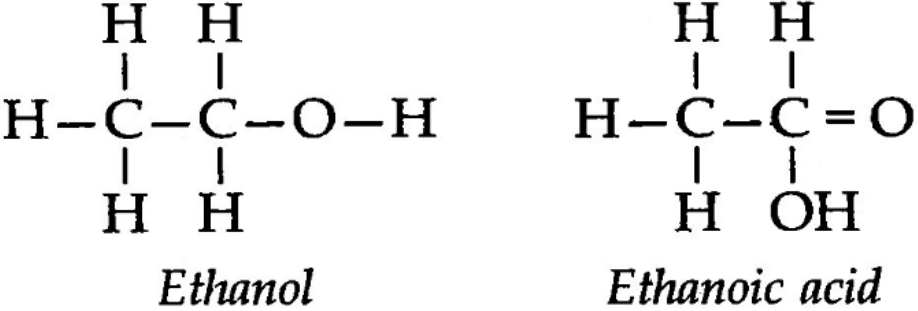
How can ethanol and ethanoic acid be differentiated on the basis of their physical and chemical properties?
Answer
  1. Ethanol has a pleasant smell whereas ethanoic acid has the smell of vinegar.
  2. Ethanol has a burning taste whereas ethanoic acid has a sour taste.
  3. Ethanol has no action on litmus paper whereas ethanoic acid turns blue litmus paper red.
  4. Ethanol has no reaction with sodium hydrogencarbonate but Ethanoic acid gives brisk effervescence with sodium hydrogencarbonate.
View full question & answer
Question 33 Marks
What is a homologous series? Explain with an example.
Answer
Homologous series is a group of organic compounds having similar structures and similar chemical properties in which the successive compounds differ by CH2 group.
Example of Homologous series: All the alkanes have similar structures with single covalent bonds and show similar chemical properties, so they can be grouped together in the form of a homologous series.
Homologous series of alkanes: Methane- CH4, Ethane- C2H6, Propane- C3H8, Butane- C4H10, Pentane- C5H12.
View full question & answer
Question 43 Marks
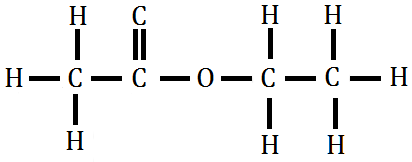
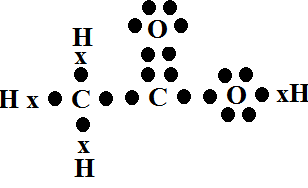
Draw the electron dot structures for:
  1. Ethanoic acid.
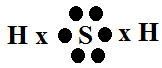
  2. H2S.
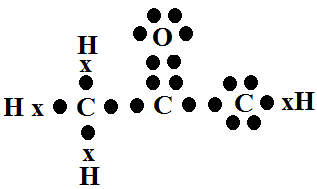
  3. Propanone.
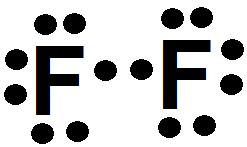
  4. F2.
Answer
  1. Ethanoic acid

  1. H2S

  1. Propanone

  1. F2

View full question & answer
Question 53 Marks
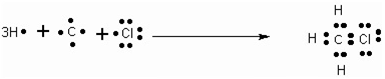
Explain the nature of the covalent bond using the bond formation in CH3Cl.
View full question & answer
Question 63 Marks
Explain the mechanism of the cleaning action of soaps.
Answer
Soap are sodium or potassium salt of long chain fatty acids. Two ends of molecules of soap behave differently. This ionic end is hydrophilic and it is oriented towards water. The other hydrocarbon end is hydrophobic and it is oriented towards dirt which is oily in nature. A micelle formation around the oily dirt takes place. When flushed with excess of water, the micelle containing the dirt is removed, thus cleaning the clothes, etc.
View full question & answer
Question 73 Marks
Write the structural formula of ethanol. What happens when it is heated with excess of conc. H2SO4 at 443 K? Write the chemical equation for the reaction stating the role of conc. H2SO4 in this reaction.
Answer
Structural formula of ethanol:

$\ \ \ \ \ \ \ \ \ \ \ \text{H}_2 \\ \ \ \ \ \ \ \ \ \ \ \ \ \text{|} \\ \text{H}_3\text{C} {-} \text{C} {-} \text{OH}$

On adding conc. sulphuric acid to ethanol to ethanol and heating the mixture up to 443 k (443 K - 273 = 170º C) gives ethene.

$\text{C}_2\text{H}_5\text{OH} \xrightarrow[170^\circ]{\text{Conc H}_2\text{SO}_4} \text{CH}_2 = \text{CH}_2 +\text{H}_2 \\$

The role of conc. H2SO4 in the above reaction is that it is used as a dehydrating agent and causes dehydration of ethanol.

View full question & answer
Question 83 Marks
Write the name and general formula of a chain of hydrocarbons in which an addition reaction with hydrogen is possible. State the essential condition for an addition reaction. Stating this condition, write a chemical equation giving the name of the reactant and the product of the reaction.
Answer
Name and general formula of hydrocarbons undergoing addition reaction are:

Name
General Formula
Alkene
CnH2n
Alkyne
CnH2n-2
Essential conditions required for the addition reaction to occur are:

  1. The presence of multiple bonds (double and triple bonds) between carbon atoms in the chain of a hydrocarbon.
  2. The addition of hydrogen should be carried out in the presence of a catalyst such as Nickel or platinum.

Chemical equation involved is:

$\text{CH}_2=\text{CH}_2+\text{H}_2\xrightarrow{\text{Ni or Pt}}\text{CH}_3-\text{CH}_3$

The reactant is Ethene and the product formed is Ethane.

View full question & answer
Question 93 Marks
List two tests for experimentally distinguishing between an alcohol and a carboxylic acid and describe how these tests are performed.
Answer
  • Test 1 (Litmus Test).

Take two strips of blue litmus paper. Place a drop each of the alcohol and carboxylic acid on these strips separately. The blue litmus paper turns red in the case of carboxylic acid and remains unaffected in the case of alcohol.

  • Test 2 (Sodium hydrogen carbonate test/sodium carbonate test).

A pinch of sodium hydrogen carbonate or sodium carbonate is added, to both separately. If brisk effervescence with the evolution of a colourless gas is observed, it indicates the presence of carboxylic acid.

If no change is observed then it confirms the presence of the alcohol.

  • Test 3 – Ester test.
View full question & answer
Question 103 Marks
Define the term ‘structural isomerism’. Explain why propane cannot exhibit this property. Draw the structures of possible isomers of butane, C4H10.
Answer
  1. The organic compounds having the same molecular formula but different structures are known as structural isomers.
  2. The phenomenon of occurring two or more different organic compounds having the same molecular formula but different structures is called 'structural isomerism'.
  3. No isomerism is possible in prqpane as it has only 3 carbon atoms, it is not possible to have different arrangement of carbon atoms in propane.
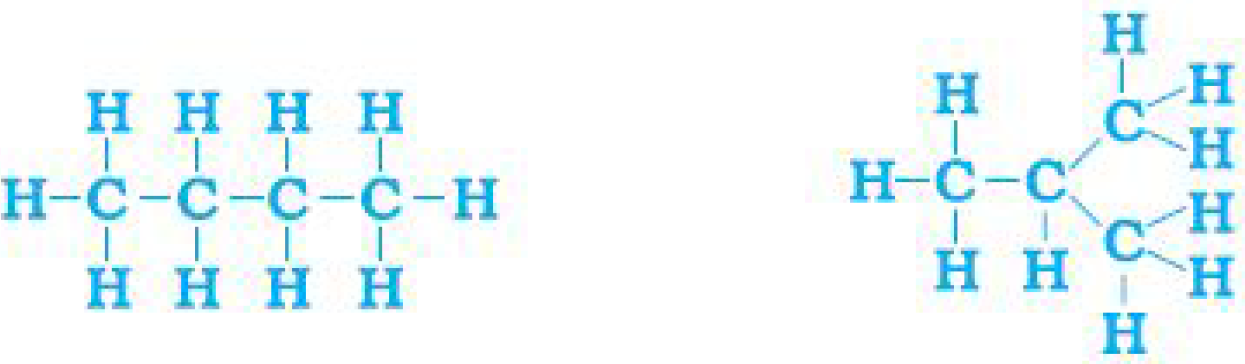
  4. Isomers of butane, C4H10:

$ \ \ \ \ \ \ \text{H} \ \ \ \text{H} \ \ \ \text{H} \ \ \ \text{H} \\ \ \ \ \ \ \ \ \text{|} \ \ \ \ \ \text{|} \ \ \ \ \ \text{|} \ \ \ \ \ \text{|} \\ \text{H} {-} \text{C} {-} \text{C} {-} \text{C} {-} \text{C} {-} \text{H} \\ \ \ \ \ \ \ \ \text{|} \ \ \ \ \ \text{|} \ \ \ \ \ \text{|} \ \ \ \ \ \text{|} \\ \ \ \ \ \ \ \text{H} \ \ \ \text{H} \ \ \ \text{H} \ \ \ \ \text{H} \\ \ \ \ \ \ \ \ \ \ \text{n}-\text{butane}$

$ \ \ \ \ \ \ \text{H} \ \ \ \ \ \ \ \ \ \text{H} \ \ \ \ \ \ \ \ \ \text{H} \\ \ \ \ \ \ \ \ \text{|} \ \ \ \ \ \ \ \ \ \ \ \text{|} \ \ \ \ \ \ \ \ \ \ \ \text{|} \\ \text{H} {-} \text{C} \ \ \ {-} \ \ \ \text{C} \ \ \ {-} \ \ \ \text{C} {-} \text{H} \\ \ \ \ \ \ \ \ \text{|} \ \ \ \ \ \ \ \ \ \ \ \text{|} \ \ \ \ \ \ \ \ \ \ \ \text{|} \\ \ \ \ \ \ \ \text{H}\ \ \ \text{H} {-} \text{C} {-} \text{H} \ \ \ \text{H} \\ \ \ \ \ \ \ \ \ \ \ \ \ \ \ \ \ \ \ \ \text{|} \\ \ \ \ \ \ \ \ \ \ \ \ \ \ \ \ \ \ \ \text{H} \\ 2-\text{Methyl propane}$

View full question & answer
Question 113 Marks
What happens when (write chemical equation in each case).
  1. Ethanol is burnt in air?
  2. Ethanol is heated with excess conc. H2SO4 at 443 K?
  3. A piece of sodium is dropped into ethanol?
Answer
  • ​​​​​​​$\text{C}_2\text{H}_5\text{OH}+\text{3O}_2\xrightarrow{\text{ }\text{ }\text{ }\text{ }\text{ }\text{ }\text{ }\text{ }\text{ }\text{ }\text{ }\text{ }\text{ }\text{ }\text{ }\text{ }\text{ }}\text{2CO}_2+\text{3H}_2\text{O}$

  • $\text{CH}_3\text{CH}_2\text{OH}\xrightarrow[\Delta443\text{K}]{\text{Conc.}\text{H}_2\text{SO}_4}\text{c}_2\text{H}_4+\text{H}_2\text{O}$

  • $2\text{C}_2\text{H}_5\text{OH}+\text{2Na}\xrightarrow{\text{ }\text{ }\text{ }\text{ }\text{ }\text{ }\text{ }\text{ }\text{ }\text{ }\text{ }\text{ }\text{ }\text{ }\text{ }\text{ }\text{ }\text{ }\text{ }\text{ }\text{ }\text{ }\text{ }}\text{2C}_2\text{H}_5\text{ONa}+\text{H}_2$.

View full question & answer
Question 123 Marks
Na, Mg and Al are the elements of the 3rd period of the Modern Periodic Table having group number 1, 2 and 13 respectively. Which one of these elements has the (a) highest valency, (b) largest atomic radius, and (c) maximum chemical reactivity? Justify your answer stating the reason for each.
Answer
  1. Aluminium (Al) has the highest valency. Valency of Na is 1, Mg is 2, and Al is 3
  2. Sodium (Na) has the largest atomic radius. As we move from left to right in a period, the atomic radius decreases as increase in nuclear charge pulls the electrons closer to the nucleus reducing the atomic size.
  3. Sodium (Na) has the maximum chemical reactivity. Reactivity decreases on moving from left to right in a period.
View full question & answer
Question 133 Marks
Explain esterification reaction with the help of a chemical equation. Describe an activity to show esterification.
Answer
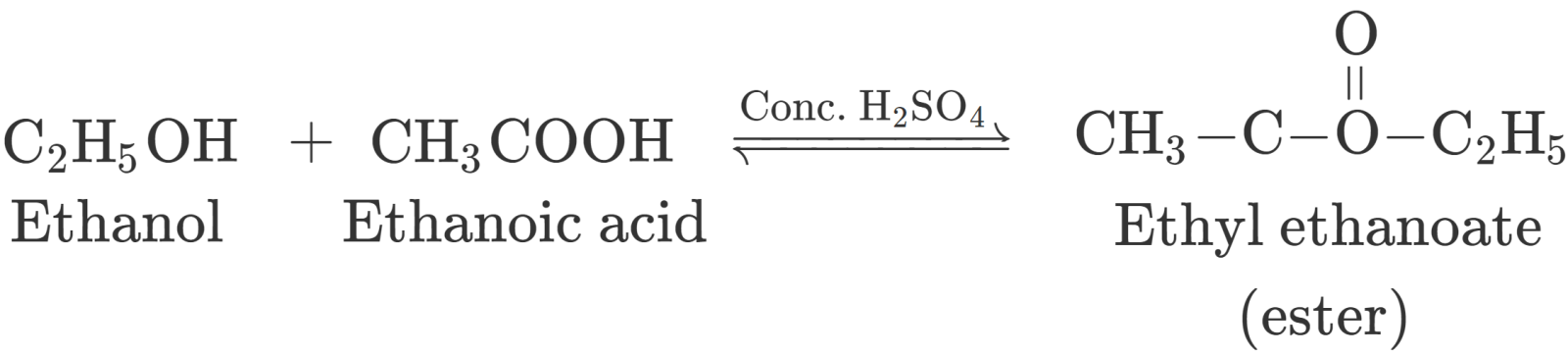
Esterification– A process in which an alcohol and a carboxylic acid react in the presence of conc. H2SO4 to form an ester.

$\text{CH}_3\text{COOH}+\text{C}_2\text{H}_5\xrightarrow{\text{ }\text{Conc.}\text{H}_2\text{SO}}{\text{ }}\text{CH}_3\text{COOC}_2\text{H}_5+\text{H}_2\text{O}$

Activity-

  • Take 1 mL of ethanol mixed with 1 mL of acetic acid along with few drops of conc. H2SO4 in a test tube.
  • Warm it for 5 min. in a water bath.
  • Pour the contents in a beaker containing 20 – 50 mL of water and smell the resulting mixture.
  • It will give a fruity smell indicating the formation of ester.
View full question & answer
Question 143 Marks
On dropping a small piece of sodium in a test tube containing carbon compound ‘X’ with molecular formula C2H6O, a brisk effervescence is observed and a gas ‘Y’ is produced.  On bringing a burning splinter at the mouth of the test tube the gas evolved burns with a pop sound. Identify ‘X’ and ‘Y’. Also write the chemical equation for the reaction. Write the name and structure of the product formed, when you heat ‘X’ with excess conc. sulphuric acid.
Answer
X is ethanol and Y is hydrogen.  

Chemical equation:

2Na + 2C2H5OH → 2C2H5ONa + H2

Product formed: sodium ethaoxide

When X is heated with excess conc. sulphuric acid dehydration reaction takes place. Ethanol is converted to ethene (C2H4).

View full question & answer
Question 153 Marks
An aldehyde as well as a ketone can be represented by the same molecular formula, say C3H6O. Write their structure and name them. State the relation between the two in the language of science.
Answer
Since the molecular formula is same for both aldehyde and ketone. Hence they are isomers (same molecular formula but different structural formula or functional group). Their chemical name is,

Aldehyde = Propanal

Ketone = Propanone

$\ \ \ \ \ \ \ \ \ \ \ \ \ \ \ \ \ \ \ \ \ \text{ O} \\ \ \ \ \ \ \ \ \ \ \ \ \ \ \ \ \ \ \ \ \ \ \ \text{||} \\ \text{CH}_3 {-} \text{CH}_2 {-} \text{C} {-} \text{H} \\ \ \ \ \ \ \ \ \ \text{Propanal}$ $\ \ \ \ \ \ \ \ \ \ \ \text{CH}_3 \\ \ \ \ \ \ \ \ \ \ \ \ \ \text{|} \\ \text{CH}_3 {-} \text{C}=\text{O} \\ \ \ \ \text{Propanone}$

View full question & answer
Question 163 Marks
What is meant by homologous series of carbon compounds? Classify the following carbon compounds into two homologous series and name them.
C3H4, C3H6, C4H6, C4H8, C5H8, C5H10.
Answer
Organic compounds that have similar general formula belong to a series called homologous series. The chemical properties of the organic compounds in the homologous series are the same because of the presence of the same functional group.
Alkanes, alkenes, alkynes, etc. form such series in which their respective members differ in mass by 14 atomic mass units. Each member in the series differs from the previous one by a CH2 group.
The given carbon compounds can be classified into the following two homologous series:
  1. Alkenes: Propene C3H6, Butene C4H8, Pentene C5H10.
  2. Alkynes: Propyne C3H4, Butyne C4H6, Pentyne C5H8.
View full question & answer
Question 173 Marks
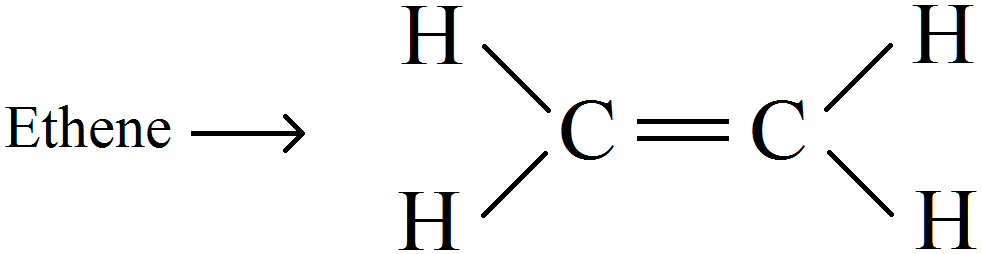
What is meant by homologous series of carbon compounds? Write the general formula of (i) alkenes, and (ii) alkynes. Draw the structures of the first member of each series to show the bonding between the two carbon atoms.
Answer
Homologous Series: A homologous series is a series of organic compounds that belongs to the same family (i.e., possesses the same functional group) and show similar chemical properties. The members of this series are called homologues; they differ from each other by the number of CHunits in the main carbon chain.

General Formula:

Alkenes: CnH2n
Alkynes: CnH2n-2
Structures: The first member of alkenes is ethene and its structure is given below.

$\ \ \ \ \ \ \ \ \ \ \ \ \text{H} \\ \ \ \ \ \ \ \ \ \ \ \ \ \ \text{|} \\ \text{H} {-}\text{C} {=}\text{C} {-} \text{H} \\ \ \ \ \ \ \ \ \text{|} \\ \ \ \ \ \ \ \text{H}$

The first member of alkynes is ethyne and its structure is given below.

$\text{H - C}\equiv\text{C - H}$

View full question & answer
Question 183 Marks
Distinguish between esterification and saponification reactions with the help of the chemical equations for each. State one use of each (i) esters, and (ii) saponification process.
Answer
Esterification is opposite of saponification
In esterification :
$
\mathrm{RCOOH}+\mathrm{R}^{\prime} \mathrm{OH} \stackrel{\Delta}{\rightarrow} \mathrm{RCOOR}+\mathrm{H}_2 \mathrm{O}
$
Whereas in saponification:
$\mathrm{RCOOR}^{\prime}+\mathrm{NaOH} \rightarrow \mathrm{RCOONa}+\mathrm{R}^{\prime} \mathrm{OH}$
(i) Uses of Esters : Esters are used in making perfumes.
(ii) Uses of saponification process: Used in making soaps and soap products on a large scale.
View full question & answer
Question 193 Marks
Write chemical equation of the reaction of ethanoic acid with the following: (a) Sodium; (b) Sodium hydroxide; (c) Ethanol.
Write the name of one main product of each reaction.
Answer
a. $CH_3 COOH +  2Na \xrightarrow{}  \underset{\text {Sodium ethanoate/Sodium acetate}} {2CH_3 COONa + H_2}$
b. $CH_3 COOH +  NaOH \xrightarrow{}  \underset{\text {Sodium ethanoate/sodium acetate}} {CH_3 COONa + H_2O}$
c. $CH_3 COOH +  C_2H_5OH \xrightarrow{}  \underset{\text {Ethyl ethanoate/ester}} {CH_3 COOC_2H_5 + H_2O}$
View full question & answer
Question 203 Marks
An aldehyde as well as a ketone can be represented by the same molecular formula, say C3H6O. Write their structure and them. State the relation between the two in the language of science.
Answer
Since the molecular formula is same for both aldehyde and ketone. Hence they are isomers (same molecular formula but different structural formula or functional group).
Their chemical name is,
Aldehyde: CH3CH2CHO = C3H6O (Propanal)
Ketone: CH​3COCH3 = C3H6​O​ (Propanone)
View full question & answer
Question 213 Marks
Draw the electron-dot structure for ethyne. A mixture of ethyne and oxygen is burnt for welding. In your opinion, why cannot we use a mixture of ethyne and air for this purpose?
Answer

Ethyne burns in air with a sooty flame due to incomplete combustion caused by limited supply of air.

But ethyne burns in oxygen with a clean flame with temperature 30000C because of complete combustion.

This oxy-acetylene flame is used for welding.

Such a high temperature cannot be achieved without mixing oxygen. Therefore, mixture of ethyne and air is not used for welding.

View full question & answer
Question 223 Marks
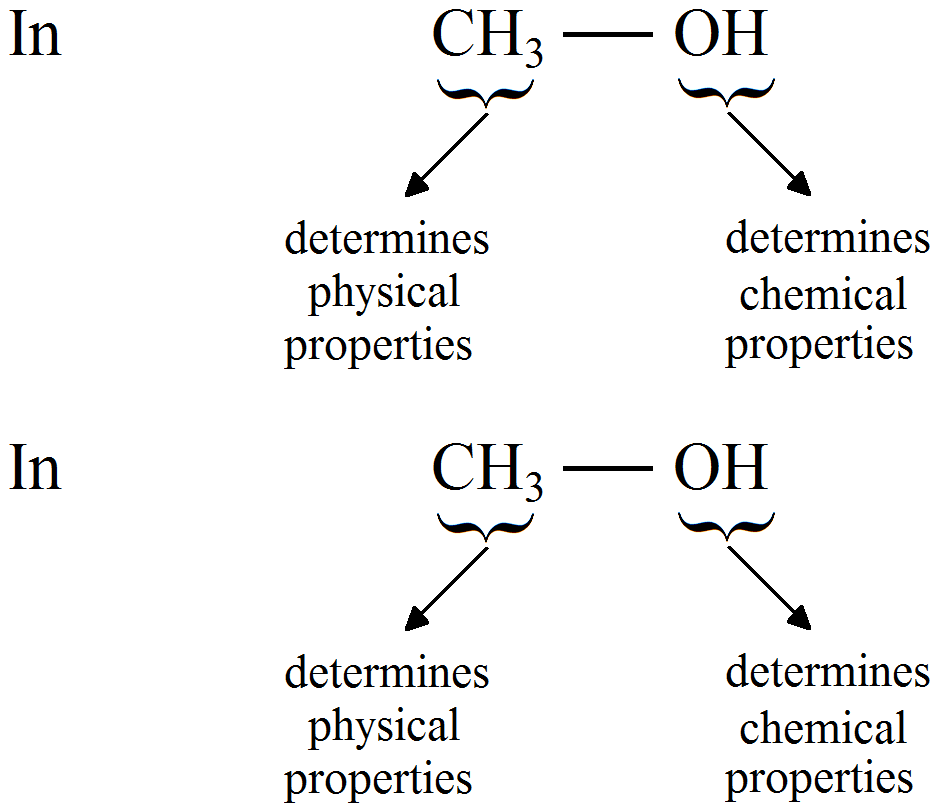
What are homologous series of carbon compounds? Write the molecular formula of two consecutive members of homologous series of aldehydes. State which part of these compounds determines their (i) physical and (ii) chemical properties.
Answer
A homologous series is a series of organic compounds which belong to the same family (i.e. possess same functional group) and show similar chemical properties. The members of this series are called homologue and differ from each other by the number of $\text{CH}_{2}$ units in the main carbon chain.

Molecular formula of two consecutive members of homologous series of aldehydes:

$\text{CH}_{3}\text{-CHO} \text{ and CH}_{3}-\text{CH}_{2}-\text{CHO}$

In $\text{CH}_{3}-\text{CHO}$ compound, $\text{-CHO}$ part and in $\text{CH}_{3}-\text{CH}_{2}\text{-CHO, -CH}_{2}\text{-CHO}$ part will determine their physical and chemical properties.

View full question & answer
Question 233 Marks
A carboxylic acid (molecular formula C2H4O2) reacts with an alcohol in the presence of an acid catalyst to form a compound ‘X’. The alcohol on oxidation with alkaline KMnO4 followed by acidification gives the same carboxylic acid C2H4O2. Write the name and structure of,
  1. Carboxylic acid.
  2. Alcohol.
  3. The compound ‘X’.
View full question & answer
Question 243 Marks
  1. Differentiate, between alkanes and alkenes. Name and draw the structure of one member of each.
  2. Alkanes generally give clean flame. Why?
View full question & answer
Question 253 Marks
An organic compound ‘X’ on heating with cone. $\text{H}_{2}\text{SO}_{4}$ forms a compound ‘Y’ which on addition of one molecule of hydrogen in the presence of nickel forms a compound ‘Z’. One molecule of compound ‘Z’ on combustion forms two molecules $\text{CO}_{2}$ of  and three molecules of $\text{H}_{2}\text{O.}$ Identify giving reasons the compounds ‘X’, ‘Y’ and ‘Z’. Write the chemical equations for all the chemical reactions involved.
Answer
Organic compound ' X ' is ethanol, (i.e., $CH _3- CH _2 OH$ ).
When ethanol is heated with conc. $H _2 SO _4$ it forms ' Y ' which is ethene $\left( CH _2= CH _2\right)$.
(i). $\underset{\text {(X)}} {CH_3 - CH_2OH  }\xrightarrow[170^{\circ} C ]{\text { Conc. } H _2 SO _4}  \underset{\text {(Ethene) (Y)}} { CH _2= CH _2} + {H_2O}$
(ii). $\underset{\text {(Ethene) (Y)}} {CH _2= CH _2} \xrightarrow[\text {Ni Catalyst}]{\text   H _2 }  \underset{\text {(Ethene) (Z)}} {CH_3 - CH_3}$
(iii). $\underset{\text {(Z)}}{CH_3 - CH_3} + \frac{7}{2} O _2 \xrightarrow{\text {Combustion}}   {2CO_2 + 3H_2O + Heat + Light}$
$\therefore \quad ' X ^{\prime}  \rightarrow  \text { Ethanol }  CH _3- CH _2 OH $
$' Y ^{\prime} \rightarrow  \text { Ethene }  CH _2= CH _2 $
$' Z ^{\prime}  \rightarrow  \text { Ethane }  CH _3- CH _3$
View full question & answer
Question 263 Marks
A carboxylic acid $\text{C}_{2}\text{H}_{4}\text{O}_{2}$ reacts with an alcohol in the presence of $\text{H}_{2}\text{SO}_{4}$ to form a compound ‘X’. The alcohol on oxidation with $\text{KMnO}_{4} $ alkaline followed by acidification gives the same carboxylic acid, $\text{C}_{2}\text{H}_{4}\text{O}_{2}$. Write the name and structure of
  1.  Carboxylic acid.
  2.  Alcohol.
  3.  The compound ‘X’.
Answer
Carboxylic acid, $\text{C}_{2}\text{H}_{4}\text{O}_{2}$:

$\text{C}_{2}\text{H}_{4}\text{O}_{2} + \text{Alcohol}\xrightarrow{\text{H}_{2}\text{SO}_{4}}\text{ 'X'}$

$\text{Alcohol}\xrightarrow[\text{Alkaline KMnO}_{4}]{\text{Oxidation}}\text{C}_{2}\text{H}_{4}\text{O}_{2}$

  1. carboxylic acid:

Name: $\text{CH}_{3}\text{COOH} \text{ (Ethanoic Acid)}$

Structure: $\ \ \ \ \ \ \text{H}\\ \ \ \ \ \ \ \ \text{|} \\ \text{H} {-} \text{C} {-} \text{C} {-} \text{O} {-} \text{H} \\ \ \ \ \ \ \ \ \text{|} \ \ \ \ \ \text{||} \\ \ \ \ \ \ \ {\text{H}}\ \ \ \text{ O}$

  1. Alcohol: $\text{C}_{2}\text{H}_{5}\text{OH}$

Name: $\text{CH}_{3} - \text{CH}_{2}-\text{OH} \text{ (Ethanol)}$

Structure: $\ \ \ \ \ \ \text{H} \ \ \ \text{H}\\ \ \ \ \ \ \ \ \text{|} \ \ \ \ \ \text{|}\\ \text{H} {-} \text{C} {-} \text{C} {-} \text{O} {-} \text{H} \\ \ \ \ \ \ \ \ \text{|}\ \ \ \ \ \text{|} \\ {\ \ \ \ \ \ \text{H}} \ \ \ \ \text{H} $

  1. Compound 'X' Ester

Name: $\text{CH}_{3}\text{COOC}_{2}\text{H}_{5} \text{ (Ethyl ethanoate)}$

Structure: $ \ \ \ \ \ \ \text{H} \ \ \ \ \ \ \ \ \ \ \ \ \ \ \text{ H}\ \ \ \ \text{H } \\ \ \ \ \ \ \ \ \text{|} \ \ \ \ \ \ \ \ \ \ \ \ \ \ \ \ \ \text{|} \ \ \ \ \ \text{|} \\ \text{H} {-} \text{C} {-} \text{C} {-} \text{O} {-} \text{C} {-}\text{C} {-}\text{H} \\ \ \ \ \ \ \ \text{ |}\ \ \ \ \ \text{||}\ \ \ \ \ \ \ \ \ \ \text{|}\ \ \ \ \ \text{|} \\ \ \ \ \ \ {\text{ H}} \ \ \ \ \text{O} \ \ \ \ \ \ \ \ \text{H} \ \ \ \text{H}$

Chemical reactions:

$\underset{\substack{\text { Corboxylic acid } \\ \text { (Ethanoic acid) }}}{ CH _3 COOH }+\underset{\text { Alcohol (Ethanol) }}{ CH _3 CH _2 OH } \xrightarrow{ H _2 SO _4} \underset{( X ) \text { (Ethyl ethanoate) }}{ CH _3 COOC _2 H _5}$

$\underset{\text { Ethanol }}{ CH _3 CH _2 OH } \xrightarrow[\text { alkaline } KMnO _4]{ o } \underset{\text { Ethanoic acid }}{ CH _3 COOH }+ H _2 O$

View full question & answer
Question 273 Marks
What is meant by homologous series of organic compounds? Write the chemical formulae of two members of a homologous series and state which part determines the,

  1. Physical properties,
  2. Chemical properties,

of these compounds.

Answer
A homologous series may be defined as a family of organic compounds having the same functional group, and the successive (adjacent) members of which differ by a CH unit or 14 mass units.
Two consecutive members of homologous series of Aldehydes: CHCHO and CHCHO.
A carbon compound is made up of two parts: R-F, where R is the hydrocarbon part and F is the functional group part.
So, this R (hydrocarbon) part determines the physical properties of a compound and the F (functional group) part determines the chemical properties of the compound.
View full question & answer
Question 283 Marks
An ester has the molecular formula C4H8O2. Write its structural formula. What happens when this ester is heated in the presence of sodium hydroxide solution? Write the balanced chemical equation for the reaction and name the products. What is a saponification reaction?
Answer

Esters in the presence of an acid or a base, give back alcohol and carboxylic acid as per the following reaction of the ester in the presence of sodium hydroxide solution.
$CH _3 COOC _2 H _5 \xrightarrow{ NaOH } \underset{\text { Ethanol }}{ C _2 H _5 OH }+\underset{\text { Ethanoic acid }}{ CH _3 COOH }$

View full question & answer
Question 293 Marks
  1. Distinguish between esterification and saponification reactions of organic compounds.
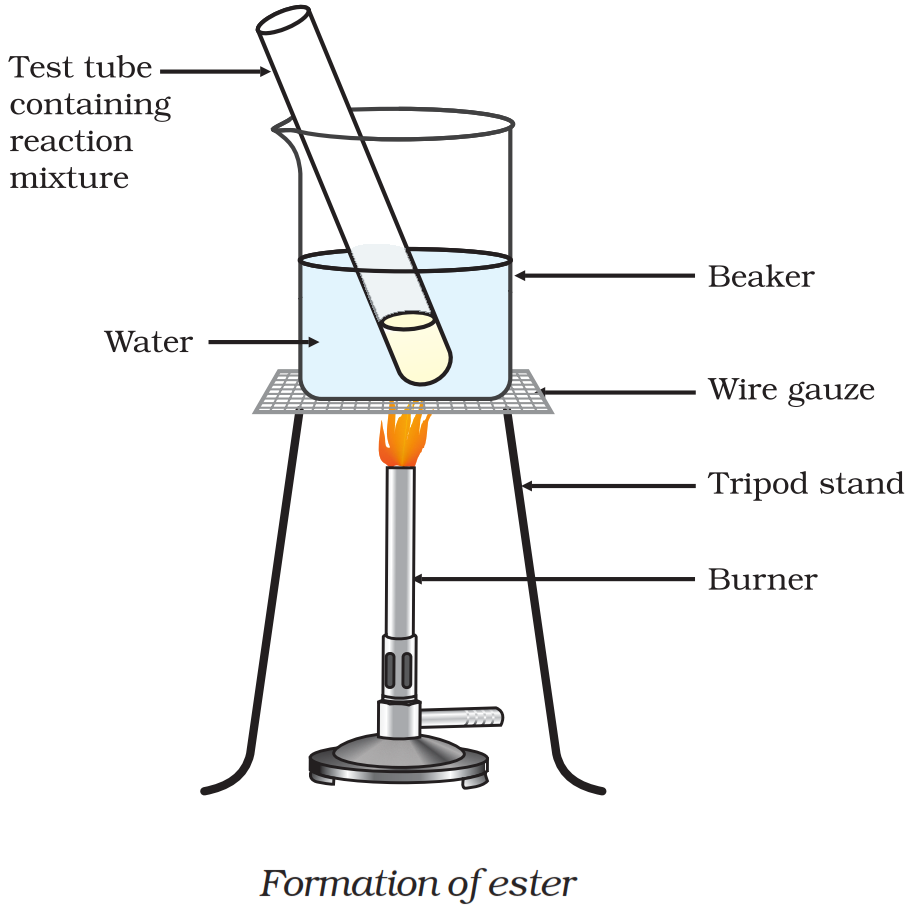
  2. With a labelled diagram describe an activity to show the formation of an ester.
Answer
EsterificationSaponification
Carboxylic acid reacts with acohols in the presence of a little conc. sulphuric acid to from esters.
On treating an ester with a converted back to alcohol and sodium salt of carboxylic acid.
Example:Ethanoic acid reacts with ethanol in the presence of a little conc. sulphuric acid to form exters.

$C_2H_5OH+CH_3COOH\xrightarrow { \text { Cons.} {H_2SO_4}}CH_3COOC_2H_5+H_2O$
Example:Ethyl ethanoate on reaction with sodium hydroxide gives ethanol and sodium ethanoate.

$CH_3COOC_2H_5+NaOH\xrightarrow { }C_2H_5OH+CH_3COONa$

Description: Ethyl alcohol and acetic acid are mixed in a test tube and a few drops of conc. H2SO4are added. The mixture is warmed in a water bath.
View full question & answer
Question 303 Marks
  1. Why are covalent compounds generally poor conductors of electricity?
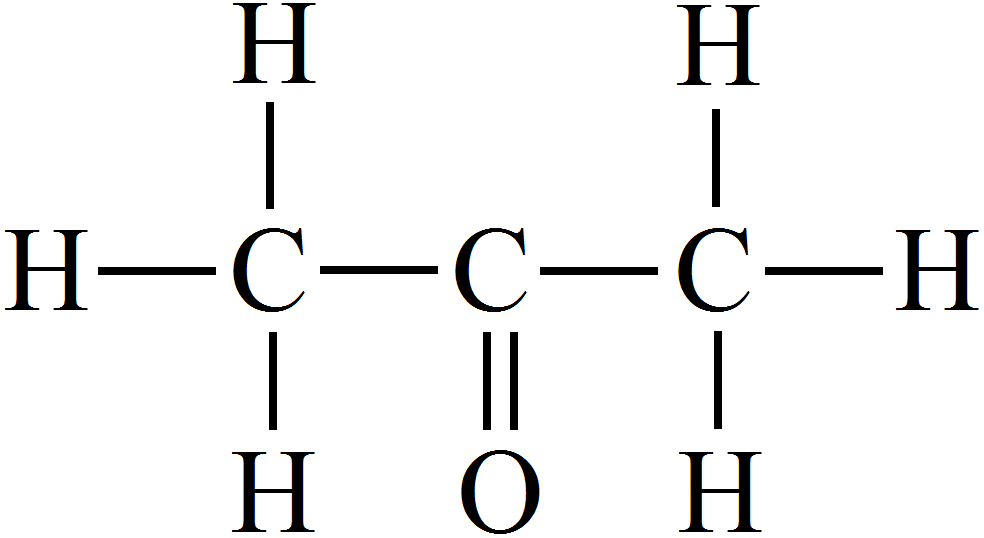
  2. Name the following compound:


  1. Name the gas evolved when ethanoic acid is added to sodium carbonate. How would you prove the presence of this gas?
Answer
  1. Covalent compounds are formed by sharing of electrons. Hence, they neither contain ions nor free electrons to conduct electricity. So, the covalent compounds are generally poor conductors of electricity.
  2. Propanone/ acetone.
  3. Ethanoic acid reacts with sodium carbonate to produce carbon dioxide gas. To prove the presence of-this gas, allow it to pass through lime water. It turns lime water milky.
View full question & answer
Question 313 Marks
What are hydrocarbons? Write the general formula of,
  1. Saturated hydrocarbons.
  2. Unsaturated hydrocarbons and draw the structure of one hydrocarbon of each type.
Answer

Hydrocarbons are defined as the compounds which are composed of Hydrogen and Carbon atoms. The names and general formula for saturated Hydrocarbons is Alkane and the formula is: CnH2n+2. The 'n' represents number of carbon atoms in molecule of the alkane. The names and general formula for unsaturated hydrocarbons are:

Alkene and Alkyne. The general formula for alkene is: CnH2n and for Alkyne, it is: CnH2n-2

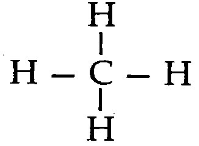
Structure of saturated hydrocarbon:

Molecular formula for 1 carbon atom = CH4

Structure:

$\ \ \ \ \ \ \text{H} \\ \ \ \ \ \ \ \ \text{|} \\ \text{H} {-} \text{C} {-} \text{H} \\ \ \ \ \ \ \ \ \text{|} \\ \ \ \ \ \ \ \text{H}$

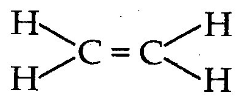
Structure of unsaturated hydrocarbon:

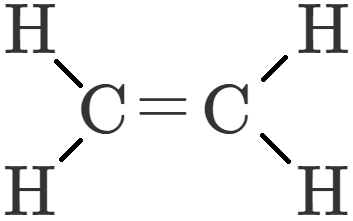
Molecular formula for 2 carbon atom is Ethene C2H4

The structure of Ethene is as follows:

Molecular formula for 2 carbon atom is Ethyne C2H2.

View full question & answer
Question 323 Marks
What are esters? How are esters prepared? Write the chemical equation for the reaction involved. What happens when an ester reacts with sodium hydroxide? Write the chemical equation for the reaction and also state the name and use of this reaction.
Answer
Ester is a Sweet smelling substance. It is used in perfumes, manufacturing of dye and flavoring agent. They are formed when ethanol reacts with ethanoic acid in the presence of acid, as catalysts (H2SO4). This reaction resulting in the formation of Esters is known as "Esterification".

The chemical equation for the reaction involved:

CH3COOH + CH3CH2OH → CH3COOC2H5 + H2O. (Include H2SO4 as a catalyst)

CH3COOH = Ethanoic acid.

CH3CH2OH = Ethanol.

CH3COOC2H5 = Ethyl Acetate.

When esters (CH3COOC2H5) with sodium hydroxide (NaOH) forms sodium ethanoate (CH3COONa) as the main product and ethanol (C2H5OH).

CH3COOC2H5 + NaOH → CH3COONa + C2H5OH + heat.

This reaction is known as Saponification Reaction, Alkaline Hydrolysis or Esters Hydrolysis. This reaction is used in the production of soap and hence the name is Saponification Reaction. It is an exothermic reaction since heat is evolved.

View full question & answer
Question 333 Marks
  1. Define the term functional group. Identify the functional group present in

  1. $\text{ }\text{ }\text{ }\text{ }\text{ }\text{ }\text{ }\text{ }\text{ }{\text{O}}\\ \text{ }\text{ }\text{ }\text{ }\text{ }\text{ }\text{ }\text{ }\parallel\\ \text{H}\text{ }- \text{C}\text{ }-\text{H}\text{ }$

  2. $\ \ \ \ \ \ \ \ \text{H}\ \ \ \ \ \text{OH} \\ \ \ \ \ \ \ \ \ \ \text{|} \ \ \ \ \ \ \ \text{|} \\ \text{H}-\text{C}-\text{C}=\text{O}\\ \ \ \ \ \ \ \ \ \ \text{|} \\ \ \ \ \ \ \ \ \ \text{H}$

  1. What happens when 5% alkaline KMnO4 solution is added drop by drop to warm ethanol taken in a test tube? State the role of alkaline KMnO4 solution in this reaction.
Answer
  1. The functional group is defined as an atom or group of atoms joined in a specific manner, which gives the chemical properties of the organic compound and are the centers for chemical reactivity.
  1. Aldehyde group.
  2. Carboxylic acid.
  1. The KMNO4 turns to green K2MNO4 which then again gets converted to MNo2 which discharges brown colour which serves as the test for unsaturation for ethane.
View full question & answer
Question 343 Marks
Name two oxidising agents that are used for the conversion of alcohols to acids. Distinguish between ethanol and ethanoic acid on the basis of,
  1. Litmus test.
  2. Reaction with sodium hydrogen carbonate.
Answer
Alkaline potassium permanganate KMnO4 and Acidified K2Cr2O7 can be used as an oxidizing agent for a conversion of ethanol to ethanoic acid. Oxidizing agent for the conversion of ethanol to ethanoic acid.
  1. Litmus test: Ethanoic acid changes blue litmus paper to red. Whereas ethanol does not change the colour of litmus paper.
  2. Sodium hydrogen carbonate NaHCO3 Test: Ethanoic acid reacts with sodium hydrogen carbonate give brisk effervescence with the liberation of carbon dioxide gas which turns lime water milky.
View full question & answer
Question 353 Marks
The molecular formula of two carbon compounds are C4H8 and C3H8. Which one of the two is most likely to show addition reaction? Justify your answer. Also give the chemical equation to explain the process of addition reaction in this case.
Answer
Compound X has the molecular formula = C4H8 (CnH2n, alkene)
Compound Y has the molecular formula = C3H8 ( CnH2n+2, alkane)
C4H8 is unsaturated hydrocarbon, i.e. alkene (butene) and C3H8 is a saturated hydrocarbon, i.e. alkane (propane).
Saturated compounds undergo substitution reaction.
Unsaturated compounds undergo addition reaction at the multiple bonds.
For example, 1-butene and 2-butene will add a chlorine molecule (Cl2) to form 1,2-dichlorobutane and 2, 3-dichlorobutane, respectively. The reaction will be:
CH3CH2CH=CH2 + Cl2 → CH3CH2CH(Cl)−CH2Cl
Or
CH3CH=CHCH3 + Cl2 → CH3CH(Cl)−CH(Cl)CH3
View full question & answer
Question 363 Marks
Name the compound formed when ethanol is heated in excess of conc. sulphuric acid at 443 K. Also write the chemical equation of the reaction stating the role of conc. sulphuric acid in it. What would happen if hydrogen is added to the product of this reaction in the presence of catalysts such as palladium or nickel?
Answer
The compound is alcohol i.e ethanol

When ethanol react with H2SO4 the product obtained is ethene.

Reaction involved:

$\text{CH}_3\text{CH}_2\text{OH}\xrightarrow[443\text{K}]{\text{H}_2\text{SO}_3}\text{CH}_2 = \text{CH}_2$

Role of conc. H2SO4:

It acts as dehydrating agent as it allows the removal of H2O from ethanol.

View full question & answer
Question 373 Marks
What are esters? How are they prepared? List two uses of esters.
Answer
Esters are usually volatile liquids having pleasant smell. (in fruity smell)

Preparation When carboxylic acid reacts with an alcohol in the presence of a - little concentrated sulphuric acid, it gives a pleasant smelling ester.

For example When ethanoic acid is warmed with ethanol in the presence of a few drops of concentrated sulphuric acid, a sweet smelling ester called ethyl ethanoate is formed.

$ \underset{\text { Ethanoic acid }}{CH _3 COOH} +  \underset{\text { Ethanol}}{C_2H_5OH} \xrightarrow{ conc.H_2SO_4 } \underset{\text { Ethyl ethanoate}}{ CH_3COOC_2H_5 }+H_2O$

View full question & answer
Question 383 Marks
Consider two elements 'X' (Atomic number 17) and 'Y' (Atomic number 20)
  1. Write the positions of these elements in the modern periodic table giving justification.
  2. Write the formula of the compound formed by the combination of 'X' and "Y'.
  3. Draw the electron-dot structure of the compnd formed and state the nature of the bound formed between the two elements?
Answer
  1. Atomic no. of A - 17

Electronic configuration of A = 2, 8, 7

Since it has '7' electrons in its outermost shell.

So, group to which A belongs = 10 + 7 = group 17.

Period to which element A belongs = no. of shells = 3

So, period to which A belongs is 3rd

Atomic no. of B = 19

Electronic configuration of A = 2, 8, 8, 1

Since it has 'l' electrons in its outermost shell.

So, group to which B belongs = group 1.

Period to which element B belongs = no. of shells = 4

So, period to which B belongs is 4th

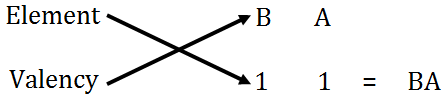
  1. Since, Valency of A = -1

Valency of B = +1

So, when A combines with B, the formula will be BA.

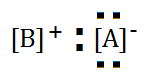
  1. The electron dot structure is as follows:

The bond formed between B and A is an ionic bond.

View full question & answer
Question 393 Marks
What is an oxidising agent? What happens when an oxidising agent is added to propanol? Explain with the help of a chemical equation.
Answer
The compound that supplies oxygen in a reaction for oxidation and gets reduced is called an oxidizing agent. Examples of oxidizing agents are potassium permanganate, potassium dichromate etc. When propanol is heated with alkaline potassium permanganate solution (or acidified potassium dichromate solution), it gets oxidised to propanoic acid.

$ \underset{\text { Propanol }}{CH _3 -CH_2- CH_2-OH}  \xrightarrow[\text { or, Acdiffed } K _2 Cr _2 O _7+\text { Heat }]{\text { Alkaline } KMnO _4+\text { Heat }}\underset{\text { Propanoic acid}}{ CH_3-CH_2-COOH }$

View full question & answer
Question 403 Marks
What are covalent compounds? Why are they different from ionic compounds? List their three characteristic properties.
Answer
  • Covalent compounds are those compounds which are formed by sharing of electrons between two atoms/ which contain covalent bonds.
  • Covalent compounds are different from ionic compounds because the ionic compounds are formed by the transference of electrons.
  • Three characteristics of covalent compounds:
  1. Generally have low melting and boiling points.
  2. Generally insoluble or less soluble in water but soluble in organic solvents.
  3. Do not conduct electricity.
View full question & answer
Question 413 Marks
What is the difference between the molecules of soaps and detergents, chemically? Explain the cleansing action of soaps.
Answer
Soaps
Detergents
Soap molecules are sodium or potassium salts of long-chain carboxylic acids.
Detergent molecules are ammonium or sulphonate salts of long-chain carboxylic acids
They form scum upon reaction with calcium and magnesium ions present in hard water.
They do not form insoluble precipitates with calcium and magnesium ions.

Cleansing action of soaps: The oily spot present on clothes is organic in nature and insoluble in water. Therefore, it cannot be removed by only washing with water. When soap is dissolved in water, its hydrophobic ends attach themselves to the oily spot and remove it from the cloth. Then, the molecules of soap arrange themselves in the form of micelle and trap the dirt at the centre of the cluster. These micelles remain suspended in the water. Hence, the oily spots are easily rinsed away by water.

View full question & answer
Question 423 Marks
What is meant by isomers? Draw the structures of two isomers of butane, C4H10. Explain why we cannot have isomers of first three members of alkane series.
Answer
  • Isomers are compounds having the same molecular formula but different structures.

  • Since branching is not possible, isomers (two different structures) are not possible for the first three members of alkane series.
View full question & answer
Question 433 Marks
Write the name and general formula of a chain of hydrocarbons in which an addition reaction with hydrogen can take place. Stating the essential conditions required for an addition reaction to write the chemical equation giving the name of the reactant and the product of such a reaction.
View full question & answer
Question 443 Marks
State the meaning of the functional group in an organic compound. Write the formula of the functional group present in alcohols, aldehydes, ketones and carboxylic acids.
Answer
Definition: Functional group is an atom or a group of atoms that is bonded to a carbon chain. It defines the chemical property of the organic compound.
Compound Functional Group
Alcohol -OH
Aldehyde -CHO
Ketone >C=O
Carboxylic acid -COOH
View full question & answer
Question 453 Marks
Two carbon compounds X and Y have the molecular formula C4H8 and C5H12 respectively. Which one of these is most likely likely to show addition reaction ? Justify your answer. Also give the chemical equation to explain the process of addition reaction in this case.
Answer
Saturated compounds: C5H12 (Compound Y) - undergo substitution reaction.
Unsaturated compound: C4H8 (Compound X) undergo addition reaction at the multiple bonds.
For example, l-butene and 2-butene will add a chlorine molecule (Cl2) to form 1, 2-dichlorobutane and 2, 3-dichlorobutane respectively.
The reaction will be:
CH- CH2 - CH = CH2 + Cl2 → CH3 - CH- CH (Cl) - CH2Cl
or
CH3 - CH = CH - CH3 + Cl2 → CH3CH(Cl) - CH(Cl) - CH3
View full question & answer
Question 463 Marks
When ethanol reacts with ethanoic acid in the presence of conc. H2SO4, a substance with fruity smell is produced. Answer the following:
  1. State the class of compounds to which the fruity smelling compounds belong. Write the chemical equation for the reaction and write the chemical name of the product formed.
  2. State the role of conc. H2 SO4 in this reaction.
View full question & answer
Question 473 Marks
With the help of an example, explain the process of hydrogenation. Mention the essential conditions for the reaction and state the change in physical property with the formation of the product.
Answer
Hydrogenation is a process to obtain saturated hydrocarbons from unsaturated hydrocarbons.
See a common example: The unsaturated hydrocarbon ethene is reduced to ethane. The conditions require pressure (different for different reactions) and catalyst such as Ni, Pd, and Pt .....
The Physical properties might change as follows:
  1. Unsaturated hydrocarbons are mainly insoluble in water but saturated are soluble. Therefore the insoluble becomes soluble.
  2. The boiling point and freezing point changes as accordance to the compounds.
View full question & answer
Question 483 Marks
State the meaning of functional group in a carbon compound. Write the functional group present in (i) ethanol and (ii) ethanol acid and also draw their structures.
Answer
An 'atom''or' 'a group of atoms'which makes a carbon compound reactive and decides its properties (or functions ) is called a functional group.
Compound
Functional Group
Structure
Ethanol
Hydroxy (-OH)
$CH_3CH_2OH$
Ethanoic acid
Carboxylic acid (-COOH)
$CH_3COOH$
View full question & answer
Question 493 Marks
Write the name and the structural formula of the compound formed when ethanol is heated at 443 K with excess of conc. $\text{H}_{2}\text{SO}_{4}$ State the role of conc. $\text{H}_{2}\text{SO}_{4}$ in this reaction. Write chemical equation for the reaction.
Answer
$\DeclareMathOperator*{\median}{{\text{C}_{2}\text{H}_{5}\text{OH}}} \median_{\text{Ethanol}}\xrightarrow[\text{443k}]{\text{Conc.H}_{2}\text{SO}_{4}}\text{CH}_{2}=\DeclareMathOperator*{\median}{{\text{CH}_{2}}} \median_{\text{Ethane}}+\text{H}_{2}\text{O}$

The product formed is:

$\text{H}_{2}\text{SO}_{4}$ is a dehydrating agent. So, ethanol undergoes dehydration i.e., loses a water molecule to form ethane.

View full question & answer
Question 503 Marks
Why homologous series of carbon compounds are so called? Write chemical formula of two consecutive members of a homologous series and state the part of these compounds that determines their (i) physical properties, and (ii) chemical properties.
Answer

Homologous series of carbon compounds are so called because in such a series of compounds, the same functional group dictates the properties of the carbon compound regardless of the length of the carbon chain. The two consecutive members of a homologous series are $\text{CH}_{3}\text{OH and} \text{ C}_{2}\text{H}_{5}\text{OH.}$

View full question & answer
Answer the questions.[Che-3M] - Science STD 10 Questions - Vidyadip