Questions

[1 Mark Questions]

🎯

Test yourself on this topic

22 questions · timed · auto-graded

Question 11 Mark
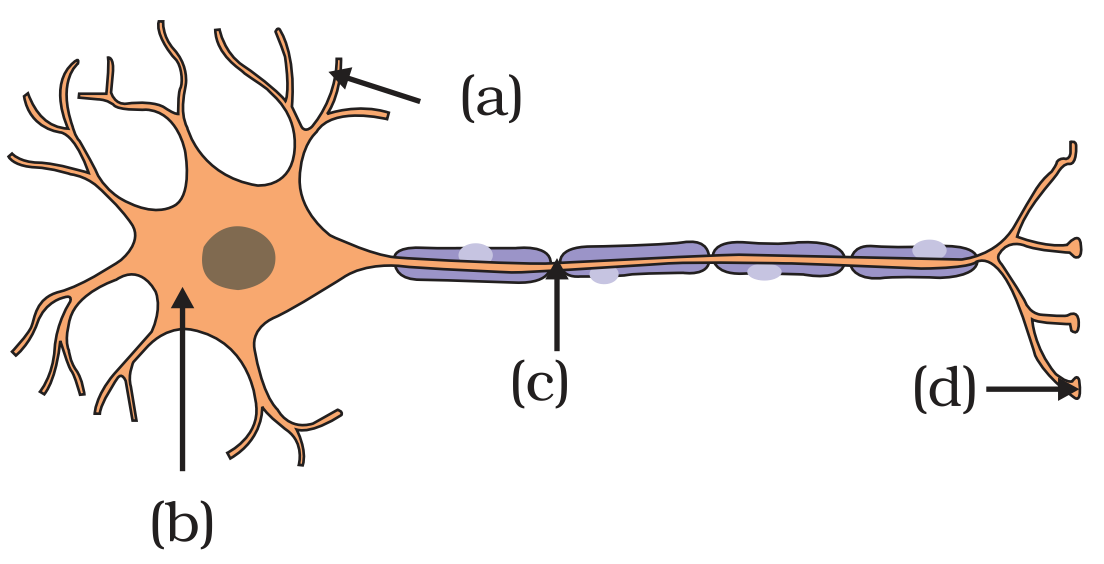
Why is the flow of signals in a synapse from axonal end of one neuron to dendritic end of another neuron but not the reverse?
Answer
As the electrical impulse reaches the axon terminal in the region of axon-dendrite synapse, it stimulates the exocytosis of vesicles containing neurotransmitter (e.g. acetylcholine). Neurotransmitter attaches to the chemoreceptor sites of the membrane covering the dendrite end of synapse. It creates a new impulse that travels through cell body and axon of the second neuron. At synapse, the axon end does not contain any chemoreceptor sites so that reverse flow of electrochemical impulses is not possible.
View full question & answer
Question 21 Mark
Answer the following:
Dwarfism results due to deficiency of which hormone?
Answer
Dwarfism. Growth hormone.
View full question & answer
Question 31 Mark
What will happen if intake of iodine in our diet is low?
Answer
Thyroid gland produces thyroxine and triiodothyronine. Thyroxine has four iodine atoms, while triiodothyronine has three iodine atoms. The dietary iodine serves as source and thus iodine deficient diet renders the gland unable to synthesize the hormones. Thyroid hormones deficiency inhibits metabolic rate, growth and development.
A person might suffer from goitre in case of iodine deficiency in the body.
View full question & answer
Question 71 Mark

In figure (a), (b) and (c), which appears more accurate and why?
Answer
Figure (a) is more accurate as it shows appropriate response of both shoot and root to the vector of gravity. Shoot is negatively geotropic. It, therefore, bends upwardly. Root is positively geotropic. It, therefore, bends downwardly.
View full question & answer
Question 91 Mark
Mention one function for each of these hormones:
Testosterone.
Answer
Sperm production, development of secondary sexual characters during puberty.
View full question & answer
Question 101 Mark
Answer the following:
Which endocrine gland is present in males but not in females?
Answer
Endocrine Gland in Males only Testis.
View full question & answer
Question 111 Mark
Mention one function for each of these hormones:
Thyroxin.
Answer
Controls general metabolism and growth in the body.
View full question & answer
Question 121 Mark
Answer the following:
Name the endocrine gland associated with kidneys?
Answer
Endocrine Gland Associated with Kidneys. Adrenal glands.
View full question & answer
Question 131 Mark
Answer the following:
Which hormone is responsible for the changes noticed in females at puberty?
Answer
Puberty changes in females. Oestrogen.
View full question & answer
Question 151 Mark
Answer the following:
Blood sugar level rises due to deficiency of which hormone?
Answer
Blood Sugar. Insulin.
View full question & answer
Question 161 Mark
Mention one function for each of these hormones:
Adrenaline.
Answer
Prepares the body for emergency situations and hence is also called ‘Fight and flight’ hormone.
View full question & answer
Question 171 Mark
Answer the following:
Iodine is necessary for the synthesis of which hormone?
Answer
Iodine Hormone. Thyroxine.
View full question & answer
Question 181 Mark
Answer the following:
Name the endocrine gland associated with brain?
Answer
Endocrine Gland Associated with Brain. Pituitary.
View full question & answer
Question 191 Mark
What is a tropic movement? Explain with an example.
Answer
The movements which are in a particular direction in relation to the stimulus are called tropic movements. Tropic movements happen as a result of growth of a plant part in a particular direction. There are four types of tropic movements, viz. geotropic, phototropic, hydrotropic and thigmotropic.
Example: Roots usually show positive geotropic movement, i.e. they grow in the direction of the gravity. Stems usually show negative geotropic movement.
View full question & answer
Question 201 Mark
What happens at the synapse between two neurons?
Answer
The junction between two neurons is called synapse. When electrical impulse reaches the axonal end of a neuron, it sets off the release of neurotransmitters in the synapse. These neurotransmitters enter the dendrite of another neuron to set off electrical signal in that neuron. That is how electrical impulse travels from one neuron to another.
View full question & answer
