Questions · Page 3 of 3

Answer the questions.[Phy-1M]

Question 1011 Mark
How does the wire in the filament of a light bulb behave differently to the other wires in the circuit when the current flows?
Answer
The filament wire becomes white hot where as other wires in the circuit do not get heated much.
View full question & answer
Question 1021 Mark
How does the resistance of a pure metal change if its temperature decreases?
Answer
On decreasing the temperature, the resistance decreases.
View full question & answer
Question 1031 Mark
How does the presence of impurities in a metal affect its resistance?
Answer
Presence of impurities in a metal increases the resistance.
View full question & answer
Question 1041 Mark
How does the heat H produced by a current passing through a fixed resistance wire depend onb the magnitude of current I?
Answer
Heat produced is directly proportional to the square of current.
View full question & answer
Question 1051 Mark
How can you change the brightness of the lamps?
Answer
The brightness of the lamps can be changed by connecting the lamps in parallel.
View full question & answer
Question 1061 Mark
Explain why, filament type electric bulbs are not power efficient.
Answer
Filament type electric bulbs are not power efficien because most of the electric power consumed by the filament of a bulb appears as heat and only a small amount of electric power is converted into light.
View full question & answer
Question 1071 Mark
Electrons are responsible for conduction in a conductor. The speed of electron is not very high. Then, how the bulb is on immediately even through the switch and bulb are far away from
each other in a household circuit?
Answer
A calculation shows that the electron is traveling at about 2,200 kilometers per second. That's less than 1% of the speed of light, but it's fast enough to get it around the Earth in just
over 18 seconds. Read up on what happens when nothing can go faster than the speed of light.
View full question & answer
Question 1081 Mark
Draw a schematic diagram of an electric circuit consisting of a battery of two cells each of $\text{1.5 V, 5 } \Omega, \text{10 } \Omega \text{ and 15 } \Omega$ resistors and a plug key, all connected in series.
View full question & answer
Question 1101 Mark
Draw a circuit diagram showing two electric lamps connected in parallel together with a cell and a switch that works both lamps. Mark an on your diagram to show where an ammeter should be placed to measure the current.
View full question & answer
Question 1111 Mark
Define the unit of current.
Answer
The unit of electric current is ampere (A). 1 A is defined as the flow of 1 C of charge through a wire in 1 s.
View full question & answer
Question 1121 Mark
Define one coulomb charge.
Answer
One coulomb of charge is that quantity of charge which exerts a force of 9 × 10⁹ Newton on an equal charge is placed at a distance of 1m from it.
View full question & answer
Question 1131 Mark
Compare how an ammeter and a voltmeter are connected in a circuit.
Answer
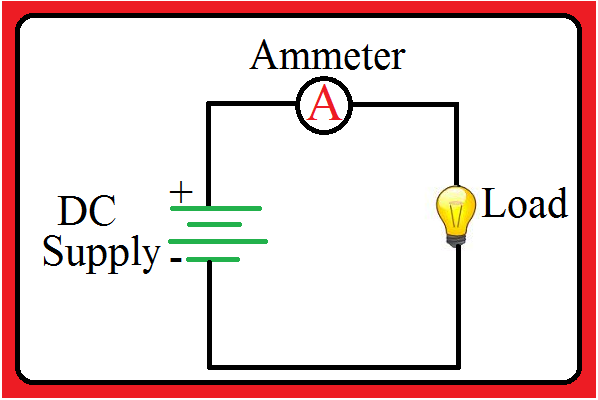
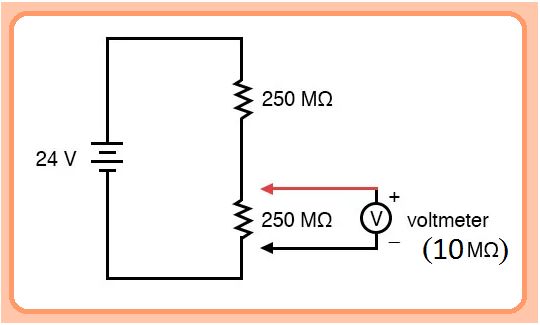
Ammeter is connected in series in a circuit whereas voltmeter is connected in parallel.
View full question & answer
Question 1141 Mark
Christmas tree lamps are usually wired in series. What happens if one lamp breaks?
Answer
All the other lamps stop glowing.
View full question & answer
Question 1151 Mark
Calculate the potential difference between the two terminals of a battery if 100 J of work is required to transfer 20 C of charge from one terminal of the battery to the other.
Answer
Potential difference (V) – is measured in volts (V). Potential difference is the work done per unit charge. A potential difference of 1V means that 1 joule of work is done per coulomb of

charge.

$\text{P.D}= \frac{\text{Work done}}{\text{Charge}}$.

$\text{P.D}=\frac{100\text{J}}{20\text{C}}.$

$\text{P.D}=5\text{V}.$

View full question & answer
Question 1181 Mark
A simple circuit consists of a resistor, a battery, and connecting wires.
Draw the circuit diagram.
Answer
Below is the circuit diagram for the voltmeter.

View full question & answer
Question 1191 Mark
A simple circuit consists of a resistor, a battery, and connecting wires. How must a voltmeter be connected to a resistor in order to read the potential difference across it?
Answer
The voltmeter must be connected in parallel to the resistor to read the potential difference across the resistor. Voltmeter has very high resistance to ensure that it's connection do not
change the flow of current in the circuit. Now if it is connected in series then no current will be there in the circuit due to its high resistance. Hence it is connected in parallel to the load
across which potential difference is to be measured. Also the voltage in the parallel connection is constant; therefore we will not get any error while measuring the voltage across resistor.
View full question & answer
Question 1201 Mark
A simple circuit consists of a resistor, a battery, and connecting wires. How must an ammeter be connected in a circuit to correctly read the current?
Answer
The ammeter must be connected in the series to read the current correctly. Ammeter has very low resistance If it is connected in parallel across any load then all current in circuit will
choose lower resistive path (i.e ammeter) which will cause the circuit to be damaged. Hence it is used in series. Also the current in the series is always same.
View full question & answer
Question 1221 Mark
A resistance of 20 ohms has a current of 2 amperes flowing in it. What potential difference is there between its ends?
Answer
R = 20 ohms
I = 2 amp
We know that
V = IR
Thus,
V = 2 × 20
V = 40V
View full question & answer
Question 1231 Mark
A potential difference of 20 volts is applied across the ends of a resistance of 5 ohms. What current will flow in the resistance?
Answer
Potential difference, V = 20V

Resistance, R = 5 ohms

Current, I = ?

We know that

V = IR

20 = I × 5

$\text{I}=\frac{20}{5}=4\text{A}$

View full question & answer
Question 1241 Mark
An electric lamp is labelled 12V, 36W. This indicates that it should be used with a 12V supply. What other information does the label provide?
Answer
Other information is that it will consume energy at the rate of 36 J/s.
View full question & answer
Question 1251 Mark
An electrician has wired a house in such a way that if a lamp gets fused in one room of the house, all the lamps in other rooms of the house stop working. What is the defect in the wiring?
Answer
All lamps are connected in series.
View full question & answer
Question 1261 Mark
An electric fan/motor becomes warm when continuously used for a long time. Why?
Answer
This is because in electric fan electrical energy converts into mechanical energy. And it generates heat.
View full question & answer
Question 1271 Mark
An electric bulb is rated at 220V, 100W. What is its resistance?
Answer
V = 220 V, P = 100W

R=?

We know that

$\text{P}=\frac{\text{V}_2}{\text{R}}$

Thus

$\text{R}=\frac{\text{V}_2}{\text{P}}=\frac{2202}{100}=484\ \text{ohm}$

View full question & answer
Question 1281 Mark
A current of 5 amperes flows through a wire whose ends are at a potential difference of 3 volts. Calculate the resistance of the wire.
Answer
I = 5 amp

p.d., V = 3V

We know that

V=IR

Thus,

3 = 5 × R

$\text{R}=\frac{3}{5}=0.6\ \text{ohm}$

View full question & answer
Question 1291 Mark
A current of 4A flows around a circuit for 10s. How much charge flows past a point in the circuit in this time?
Answer
Given, I = 4amp, C, t = 10s

Q = ?

We know that:

$\text{I}=\frac{\text{Q}}{\text{T}}.$

Q = 4*10 = 40C.

View full question & answer
Answer the questions.[Phy-1M] - Page 3 - Science STD 10 Questions - Vidyadip