Question 13 Marks
A current of 1 ampere flows in a series circuit containing an electric lamp and a conductor of 5Ω when connected to a 10V battery. Calculate the resistance of the electric lamp.
Now if a resistance of 10Ω is connected in parallel with this series combination, what change (if any) in current flowing through 5Ω conductor and potential difference across the lamp will take place? Give reason.
Now if a resistance of 10Ω is connected in parallel with this series combination, what change (if any) in current flowing through 5Ω conductor and potential difference across the lamp will take place? Give reason.
Answer
View full question & answer→Total resistance of circuit can be calculated as follows:$\text{R}=\frac{\text{V}}{\text{I}}=\frac{10\text{V}}{1\text{A}}=10\Omega$
Since lamp and conductor are in series so resistance of lamp,
$=10\Omega-5\Omega=5\Omega$
The new resistance in parallel to earlier combination has same value, i.e. 10Ω as the resistance of series combination. This means that the amount of current would be equally divided into two branches. Hence, 0.5A current will flow through 5Ω conductor.
Now, resistance remains the same but current has become half. Using Ohm formula, potential difference across the lamp can be calculated as follows:$\text{V}=\text{IR}=0.5\text{A}\times5\Omega=2.5\text{V}$
Since lamp and conductor are in series so resistance of lamp,
$=10\Omega-5\Omega=5\Omega$
The new resistance in parallel to earlier combination has same value, i.e. 10Ω as the resistance of series combination. This means that the amount of current would be equally divided into two branches. Hence, 0.5A current will flow through 5Ω conductor.
Now, resistance remains the same but current has become half. Using Ohm formula, potential difference across the lamp can be calculated as follows:$\text{V}=\text{IR}=0.5\text{A}\times5\Omega=2.5\text{V}$
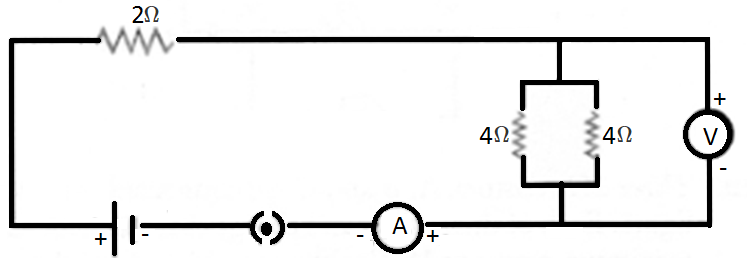 Equivalent resistance of two resistors (4Ω each) connected in parallel is given by
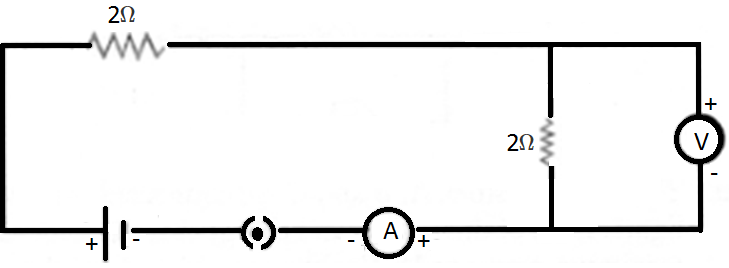 Therefore, potential difference across 2Ω resistor will be same; as that of across the parallel combination of 4Ω resistors. V = IR.