Questions · Page 1 of 2

[2 Mark Questions]

🎯

Test yourself on this topic

50 questions · timed · auto-graded

Question 12 Marks
If five resistances, each of value 0.2 ohm, are connected in series, what will be the resultant resistance?
Answer
As per the law of combination of resistances in series,
$R=R_1+R_2+R_3+R_4+R_5$
R = 0.2 + 0.2 + 0.2 + 0.2 + 0.2 = 1ohm.
View full question & answer
Question 22 Marks
An electric room heater draws a current of 2.4A from the 120V supply line. What current will this room heater draw when connected to 240V supply line?
Answer
In first case,
I = 2.4 amp, V = 120 volt
V = IR
120 = 2.4 × R
$\text{R}=\frac{120}{2.4}=50\ \text{ohm}$
In second case,
V = 240 volt, R = 50 ohm
V = IR
240 = I × 50
I = 4.8amp.
View full question & answer
Question 32 Marks
An electric bulb is connected to a 220V power supply line. If the bulb draws a current of 0.5A, calculate the power of the bulb.
Answer
V =220V, I = 0.5amp, P = ?
We know that
P = VI = 220 × 0.5
P = 110 watt.
View full question & answer
Question 42 Marks
What is meant by the heating effect of current? Give two applications of the heating effect of current.
Answer
When an electric current is passed through a high resistance wire, the wire becomes very hot and produces heat. This effect is knows as heating effect of current. This effect is used in room heaters and electric ovens.
View full question & answer
Question 52 Marks
A heating coil has a resistance of 200Ω. At what rate will heat be produced in it when a current of 2.5A flows through it?
Answer
 Given: $R =200$ ohms, $I =2.5 amp , t =1 sec$
We know that
$H=I^2 R T$
$H=2.5^2 \times 200 \times 1$
$H=1250 J / s$
View full question & answer
Question 62 Marks
What is meant by conductors and insulators? Give two examples of conductors and two of insulators.
Answer
Conductors: Those substances through which electricity can flow are known as conductors.E.g., Copper, silver etc.
Insulators: Those substances through which electricity cannot flow are known as insulators.
E.g., Plastic, cotton etc.
View full question & answer
Question 72 Marks
An electric iron of resistance 20 ohms draws a current of 5 amperes. Calculate the heat produced in 30 seconds.
Answer
Given: $R =20 ohm , I =5 amp , t =30 s$
We know that $H = I ^2 Rt$
$H=5^2 \times 20 \times 30$
$H=15000 J$
View full question & answer
Question 82 Marks
Explain why, the current that makes the heater element very hot, only slightly warms the connecting wires leading to the heater.
Answer
The connecting wires of the heater get only slightly warm because they have extremely low resistance due to which negligible heat is produced in them by passing current.
View full question & answer
Question 92 Marks
Why is an electric light bulb not filled with air? Explain why argon or nitrogen is filled in an electric bulb.
Answer
If air is filled in an electric bulb, then the extremely hot tungsten filament would burn up quickly in the oxygen of air. So, the electric bulb is filled with a chemically unreactive gas like argon or nitrogen. Thes gases do not react with the hot tungsten filament and hence prolong the life of the filament of the bulb.
View full question & answer
Question 102 Marks
Four resistances of 16 ohms each are connected in parallel. Four such combinations are connected in series. What is the total resistance?
Answer
Resultant resistance of a parallel combination of four 16 ohm resistance is
$\frac{1}{\text{R}}=\frac{1}{16}+\frac{1}{16}+\frac{1}{16}+\frac{1}{16}=\frac{4}{16}$
R = 4 ohm
For such combination are connected in series, so total resistance = 4 + 4 + 4 + 4 = 16 ohm.
View full question & answer
Question 112 Marks
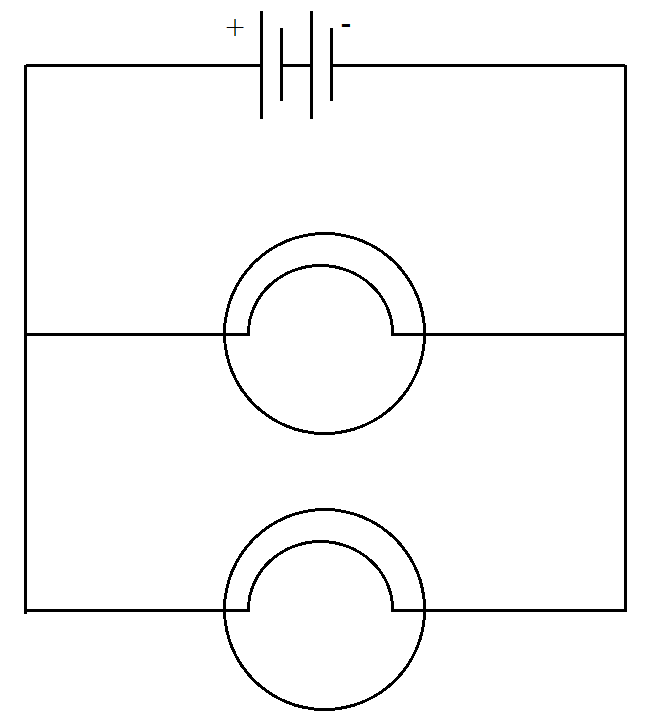
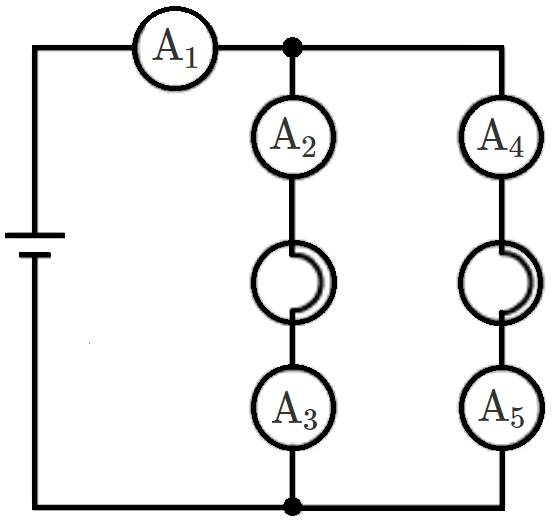
If the lamps are both the same in the figure given below and if $A_1$, reads 0.50 A , what do $A_2, A_3, A_4$ and $A_5$ read?
Answer
The total current of 0.5 A flowing in the circuit distribution equally in the two arms having lamps (since the lamps have same resistances). so the current through each of these arms is 0.25 A . Hence $A _2, A_3, A_4$ and $A _5$ all will read 0.25 A .
View full question & answer
Question 122 Marks
Explain why, tungsten is used for making the filaments of electric bulbs.
Answer
Tungsten is used for making the filaments of electric bulbs because it has a very high melting point. Due to its very high melting point, the tungsten filament can be kept white hot without melting away. Also, tungsten has high flexibility and low rate of evaporation at high temperature.
View full question & answer
Question 132 Marks
Draw a circuit diagram to show how two 4V electric lamps can be lit brightly from two 2V cells.
Answer
The two lamps (of 4V each) should be arranged in parallel with the two 2V cells.
View full question & answer
Question 142 Marks
A radio set draws a current of 0.36A for 15 minutes. Calculate the amount of electric charge that flows through the circuit.
Answer
I = 0.36A, t = 15min = 900 seconds.
Q = I × t
= 0.36 × 900
= 324C.
View full question & answer
Question 152 Marks
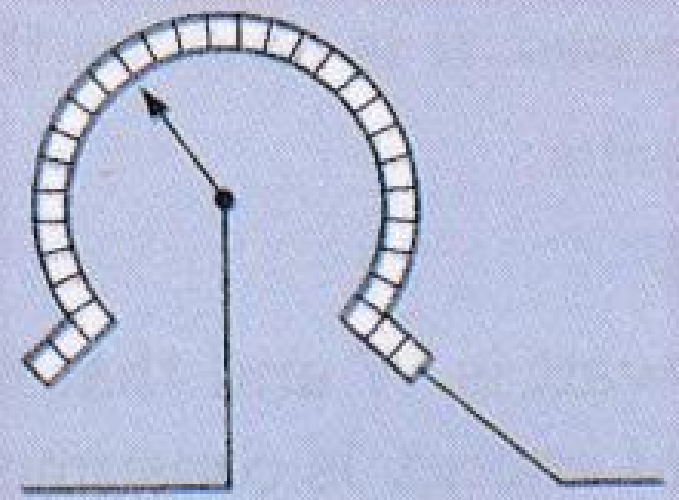
The figure below shows a variable resistor in a dimmer switch.

How would you turn the switch to make the lights: (a) brighter, and(b) dimmer? Explain your answer
Answer
  1. Turn the switch to right side so as the resistance decreases.
  2. Turn the switch to the left side so as the resistace increases.
View full question & answer
Question 162 Marks
A battery of 9 V is connected in series with resistors of $0.2 Ω, 0.3 Ω, 0.4 Ω, 0.5 Ω\ \text{and}\ 12 Ω.$ How much current would flow through the $12 Ω$ resistor?
Answer
$R_1=0.2 ohm , R_2=0.4 ohm , R_3=0.3 ohm , R_4=0.5 ohm , R_5=12 ohm V =9 V$
Resultant resistance $=R_1+R_2+R_3+R_4+R_5$
$R=0.2+0.4+0.3+0.5+12+13.4 \text { ohm }$
Thus the current flows through 12 ohm resistance will be $=\frac{ V }{ R }$
$I=\frac{9}{13.4}$
$I=0.67 amp$
View full question & answer
Question 172 Marks
Give one example to show how the resistance depends on the nature of material of the conductor.
Answer
If we take two similar wires of same length and same diameter, one of copper metal and other of nichrome alloy, we will find that the resistance of nichrome wire is about 60 times more than that of the copper wire. This shows that the resistance depends on the nature of material of the conductor.
View full question & answer
Question 182 Marks
Define the unit of electric current (or Define ampere).
Answer
When 1 coulomb of charge flows through any cross-section of a conductor in 1 second, the electric current flowing through it is said to be 1 ampere.
View full question & answer
Question 192 Marks
The atoms of copper contain electrons and the atoms of rubber also contain electrons. Then why does copper conduct electricity but rubber does not conduct electricity?
Answer
Copper has free electrons that are loosely held by the nuclei of the atoms. These free electrons result in conduction of electricity. The electrons present in rubber are strongly held by the nuclei of its atoms. So, rubber does not have free electrons to conduct electricity.
View full question & answer
Question 202 Marks
Draw a circuit diagram to show how 3 bulbs can be lit from a battery so that 2 bulbs are controlled by the same switch while the third bulb has its own switch.
View full question & answer
Question 212 Marks
Give two examples of substances which are good conductors of electricity. Why do you think they are good conductors of electricity?
Answer
Silver and copper are good conductors of electricity because they have free electrons available for conduction.
View full question & answer
Question 222 Marks
Why are the coils of electric irons and electric toasters made of an alloy rather than a pure metal?
Answer
Because,
  1. Resistivity of an alloy is much higher than that of a pure metal.
  2. An alloy does not undergo oxidation (or burn) easily even at high temperature.
View full question & answer
Question 232 Marks
How many electrons are flowing per second past a point in a circuit in which there is a current of 5 amp?
Answer
I = 5A
t = 1s
$\text{I}=\frac{\text{Q}}{\text{t}}$
Q = 1 × t = 5 × 1 = 5C
No. of electrons comparing $1.6 \times 10^{-19} C -1$
No. of electrons comparing $5\text{C}=\frac{5}{1.6\times10^{-19}}=31.25\times10^{19}$
View full question & answer
Question 242 Marks
A current of 200mA flows through a $4\text{k}\ Ω$ resistor. What is the p.d. across the resistor?
Answer
I = 200mA = 0.2A
R = 4 × 10³ohm = 4000 ohm
We know that
V = IR
V = 0.2 × 4000
V = 800 volt.
View full question & answer
Question 252 Marks
An electric fan runs from the 230V mains. The current flowing through it is 0.4A. At what rate is electrical energy transferred by the fan?
Answer
Given: V = 230V, I = 0.4 amp
Rate at which electric energy is transformed = Power
Power = V × I
= 230 × 0.4
= 92W = 92J/s
View full question & answer
Question 262 Marks
What p.d. is needed to send a current of 6A through an electrical appliance having a resistance of $40\Omega$?
Answer
I = 6 amp, R = 40 ohm
We know that
V=IR
V = 6 × 40 = 240V.
View full question & answer
Question 272 Marks
Define watt-hour. How many joules are equal to 1 watt-hour?
Answer
One watt hour is the amount of electrical energy consumed when an electrical appliance of 1 watt power is used for 1 hour.
1 watt hour = 3600 joules.
View full question & answer
Question 282 Marks
Which is the better way to connect lights and other electrical appliances in domestic wiring: series circuits or parallel circuits? Why?
Answer
Parallel circuits – Because if one electrical appliance stops working due to some defect, then all other appliances in the circuit will keep working properly.
View full question & answer
Question 292 Marks
A resistance of $25Ω$ is connected to a 12V battery. Calculate the heat energy in joules generated per minute.
Answer
Given: $R=25$ ohms, $V=12 V, H =$ ?, $t =60 Sec$
$V=I R$
$12=25 \times I$
$I=0.48 amp$
We have
$H=I^2 R T$
$H=0.48^2 \times 25 \times 60$
$H=345.6 J$
View full question & answer
Question 302 Marks
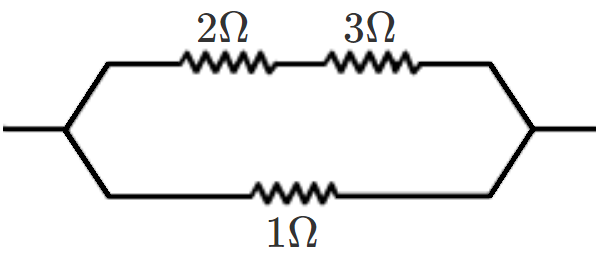
How will you connect three resistors of $2 Ω, 3 Ω$ and $5 Ω$ respectively so as to obtain a resultant resistance of $2.5 Ω$ ? Draw the diagram to show the arrangement.
Answer
Given: Three resistance of 2 ohm, 3 ohms, 5 ohms.
Their resultant, R = 2.5 ohm

Resistance of first line = 2 + 3 = 5 ohm
So, $\frac{1}{\text{R}}=\frac{1}{5}+\frac{1}{5}$
On solving we get that
R = 2.5 ohms.
View full question & answer
Question 312 Marks
How much heat will an instrument of 12W produce in one minute if it is connected to a battery of 12V?
Answer
Given: $P=12 W, V=12 V, t=60 Sec$
$P=VI$
$I=\frac{P}{V}=\frac{12}{12}=1 A$
$V=I$
$R=\frac{V}{I}=\frac{12}{1}=12 \Omega$
$H=I^2 Rt$
$H=1^2 \times 12 \times 60$
$H=720 J$
View full question & answer
Question 322 Marks
What is the conventional direction of the flow of electric current? How does it differ from the direction of flow of electrons?
Answer
Conventional direction of flow of electric current is from positive terminal of a battery to the negative terminal, through the outer circuit. The direction of flow of electrons is opposite to the direction of conventional current, i.e. from negative terminal to positive terminal.
View full question & answer
Question 332 Marks
What is meant by the “resistance of a conductor”? Write the relation between resistance, potential difference and current.
Answer
The property of a conductor due to which it opposes the flow of current through it is called resistance of the conductor.
$\text{R}=\frac{\text{V}}{\text{I}}$
View full question & answer
Question 342 Marks
How does the resistance of a wire vary with its:
  1. Area of cross-section?
  2. Diameter?
Answer
  1. By increasing the area of cross section, the resistance will decrease.
  2. By increasing the diameter, the resistance will decrease.
View full question & answer
Question 352 Marks
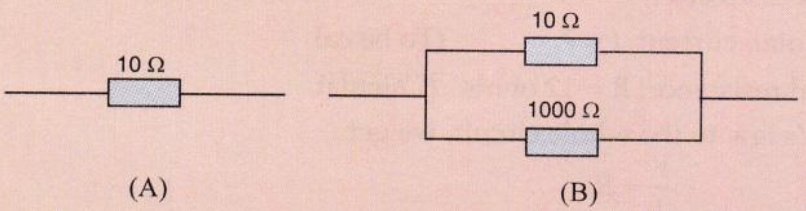
Which of the following resistor arrangement, A or B, has the lower combined resistance?
Answer
Resistance of arrangement A is 10 ohm.
Combined resistance of arrangement B is caculated as follows:
$\frac{1}{\text{R}}=\frac{1}{10}+\frac{1}{1000}=\frac{(100+1)}{1000}$
$\text{R}=\frac{1000}{101}=9.9\ \text{ohm}$
View full question & answer
Question 362 Marks
Keeping the potential difference constant, the resistance of a circuit is doubled. By how much does the current change?
Answer
V = R
$\text{I}=\frac{\text{V}}{\text{R}}$
keeping V constant, $\text{I}\propto\frac{1}{\text{R}}$
So, when R is double I becomes half.
View full question & answer
Question 372 Marks
What do you understand by the term “electric potential”? (or potential) at a point? What is the unit of electric potential?
Answer
The electric potential (or potential) at a point in an electric field is defined as the work done in moving a unit positive charge from infinity to that point.Unit of electric potential is volt.
View full question & answer
Question 382 Marks
An electric motor takes 5 amperes current from a 220 volt supply line. Calculate the power of the motor and electrical energy consumed by it in 2.
Answer
I = 5amp, V = 220 Volt, t = 2h
P = ?, E = ?
P = V × I
= 220 × 5
= 1100 watt
= 1.1KW
Energy consumed, E = P × t
= 1.1 × 2
= 2.2KWh
View full question & answer
Question 392 Marks
What current will be taken by a 920W appliance if the supply voltage is 230V?
Answer
P = 920W, V = 230V, I = ?
We know that
P = V × I,
920 = 230 x II = $\frac{920}{230}$ = 4amp
View full question & answer
Question 402 Marks
Define electric current. What is the SI unit of electric current.
Answer
Electric current is the flow of electric charges (electrons) in a conductor such as a metal wire.
SI unit of electric current is ampere.
View full question & answer
Question 412 Marks
The resistance of a metal wire of length 1m is $26 Ω$ at 20°C. If the diameter of the wire is 0.3mm, what will be the resistivity of the metal at that temperature?
Answer
I = 1m
R = 26 ohm
$\text{r}=\frac{\text{d}}{2}=\frac{0.3}{2}\text{mm}=0.15\text{mm}=0.15\times10^{-3}\text{m}$
$\rho=\frac{\text{R}\times\text{A}}{\text{I}}=\frac{\text{R}\times\pi\text{r}^2}{\text{I}}$
$\frac{26\times3.14\times(0.15\times10^{-3})^2}{1}$
$-1.83\times10^{-6}\Omega\text{m}$
View full question & answer
Question 422 Marks
Which has more resistance:
  1. A long piece of nichrome wire or a short one?
  2. A thick piece of nichrome wire or a thin piece?
Answer
  1. A long piece of nichrome wire.
  2. A thin piece of nichrome wire.
View full question & answer
Question 432 Marks
100 joules of heat is produced per second in a 4 ohm resistor. What is the potential difference across the resistor?
Answer
Given: $H =100 J, t =1 sec , R =4$ ohms,
We know that
$H=I^2 RT$
$100=I^2 \times 4 \times 1$
$\frac{100}{4}=I^2$
$I=5 amp$
$V=IR$
$V=5 \times 4$
$=20 V$
View full question & answer
Question 442 Marks
When a 12V battery is connected across an unknown resistor, there is a current of 2.5mA in the circuit. Calculate the value of the resistance of the resistor.
Answer
V = 12 volt, I = 2.5 × 10 - 3A
We know that
V = IR
$\text{R}=\frac{\text{V}}{\text{I}}$
$\text{R}=\frac{12}{(2.5\times10^{-3})}$
R = 4.8 × 10³ ohm = 4800 ohm.
View full question & answer
Question 452 Marks
Define watt. Write down an equation linking watts, volts and amperes.
Answer
When an electrical appliance consumes electrical energy at the rate of 1 joule per second, its power is said to be 1 watt.
1 watt = 1 volt × 1 ampere.
View full question & answer
Question 462 Marks
Give the law of combination of resistances in series.
Answer
According to the law of combination of resistances in series, the combined resistance of any number of resistances connected in series is equal to the sum of the individual resistances.
View full question & answer
Question 472 Marks
An electric heater of resistance $8Ω,$ takes a current of 15A from the mains supply line. Calculate the rate at which heat is developed in the heater.
Answer
Given: R = 8 ohms, I = 15 amp, t = 1sec
We know that
$H=I^2 R T$
$H=15^2 \times 8 \times 1$
$H = 1800J/ s$
View full question & answer
Question 482 Marks
What is the potential difference between the terminals of a battery if 250 joules of work is required to transfer 20 coulombs of charge from one terminal of battery to the other?
Answer
Given: Work done = 250J, Charge moved = 20C.we know that,Potential difference $= \frac{\text{Work done}}{\text{Charge\ moved}}$
$=\frac{250}{20}=12.5$
View full question & answer
Question 492 Marks
What is meant by “electric power”? Write the formula for electric power in terms of potential difference and current.
Answer
The rate at which electrical work is done or the rate at which electrical energy is consumed is known as electrical power.
It is given by P = VI = Watt
P = VI = Watt
View full question & answer
Question 502 Marks
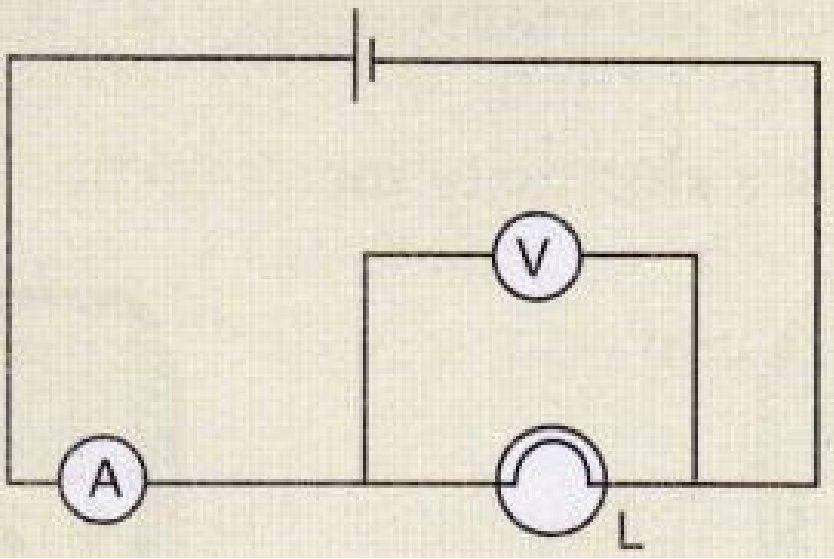
The diagram below shows a circuit containing a lamp L, a voltmeter and an ammeter. The voltmeter reading is 3V and the ammeter reading is 0.5A
  1. What is the resistance of the lamp?
  2. What is the power of the lamp?
Answer
Given: V = 3V, I = 0.5 amp
  1. R = ?
we know that V = IR

3 = 0.5R

R = 6 ohms
  1. Power of lamps = VI
3 × 0.5

= 1.5 watt
View full question & answer
[2 Mark Questions] - Science STD 10 Questions - Vidyadip