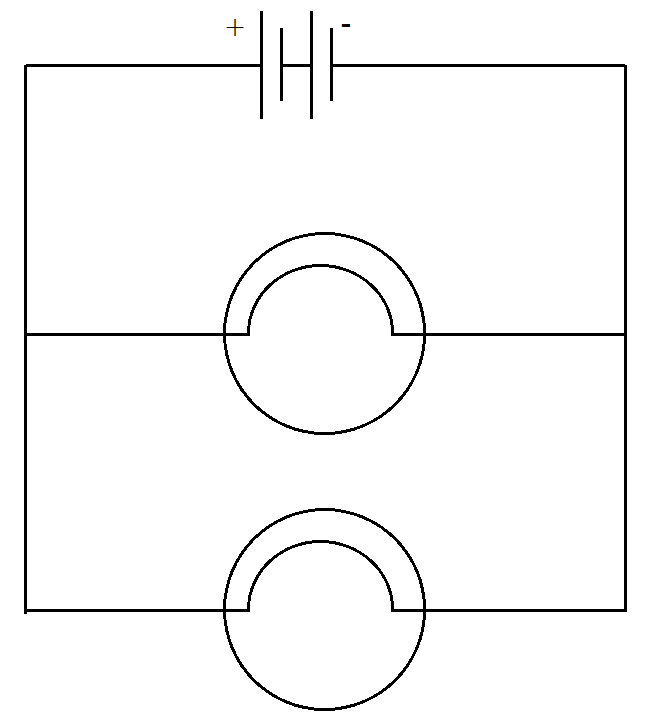
Draw a circuit diagram to show how 3 bulbs can be lit from a battery so that 2 bulbs are controlled by the same switch while the third bulb has its own switch.
Define resistivity. Write an expression for the resistivity of a substance. Give the meaning of each symbol which occurs in it.
Answer
Resistivity, $\rho=\frac{\text{R}\times\text{A}}{\text{I}}$ Where, R is the resistance of the conductor. A is the area of cross section of the conductor. I is the length of the conductor.
Define kilowatt-hour. How many joules are there in one kilowatt-hour?
Answer
One kilowatt hour is the amount of electrical energy consumed when an electrical appliance having a power rating of 1 Kilowatt is used for 1 hour. 1KWh = 3.6 × 10⁶J
Classify the following into good conductors, resistors and insulators: Rubber, Mercury, Nichrome, Polythene, Aluminium, Wood, Manganin, Bakelite, Iron, Paper, Thermocol, Metal coin.
A wire that has resistance R is cut into two equal pieces. The two parts are joined in parallel. What is the resistance of the combination?
Answer
Resistance of each part is $\frac{\text{R}}{2}.$ Resultant resistance R’ is given by $\frac{1}{\text{R}'}=\frac{2}{\text{R}} +\frac{2}{\text{R}}$ $\text{R’}=\frac{\text{R}}{4}.$
An electric room heater draws a current of 2.4A from the 120V supply line. What current will this room heater draw when connected to 240V supply line?
Answer
In first case, I = 2.4 amp, V = 120 volt V = IR 120 = 2.4 × R $\text{R}=\frac{120}{2.4}=50\ \text{ohm}$ In second case, V = 240 volt, R = 50 ohm V = IR 240 = I × 50 I = 4.8amp.
An electric kettle connected to the 230V mains supply draws a current of 10A. Calculate:
The power of the kettle.
The energy transferred in 1 minute.
Answer
Given V = 230V, I = 10 amp P = VI P = 230 × 10 P = 2300 Watt = 2300 J/s Energy consumed in min $=\text{P}\times\text{T}=2300\ \text{J}/\text{s}\times60\text{s}=138000\text{J}$
A battery of 9 V is connected in series with resistors of $0.2 Ω, 0.3 Ω, 0.4 Ω, 0.5 Ω\ \text{and}\ 12 Ω.$ How much current would flow through the $12 Ω$ resistor?
Answer
R1 = 0.2 ohm, R2 = 0.4 ohm, R3 = 0.3 ohm, R4 = 0.5 ohm, R5 = 12 ohm V = 9V Resultant resistance = R1 + R2 + R3 + R4 + R5 R = 0.2 + 0.4 + 0.3 + 0.5 + 12 + 13.4 ohm Thus the current flows through 12 ohm resistance will be $=\frac{\text{V}}{\text{R}}$ $\text{I}=\frac{9}{13.4}$ $\text{I}=0.67\ \text{amp}$