Questions

[2 Mark Questions]

🎯

Test yourself on this topic

31 questions · timed · auto-graded

Question 12 Marks
What is meant by a species? Give two examples of plant species and two of animals.
Answer
A species is a population of organisms consisting of similar individuals which can breed together and produce fertile offspring’s.
Plant species: Wheat, Paddy, Sunflower etc.
Animal species: Cat, Dog, Tiger, etc.
View full question & answer
Question 22 Marks
Name two animals having homologous organs and two having analogous organs. Name these organs.
Answer
Forelimb of humans and forelimb of lizard are the homologous organs and the wing of insect and the wing of bird are analogous organs.
View full question & answer
Question 32 Marks
In what way are homologous organs evidence for evolution?
Answer
The presence of homologous organs in different animals provides evidence for evolution by telling us that they are derived from the same ancestor who had the ‘basic design’ of the organ on which all the homologous organs are based.
View full question & answer
Question 42 Marks
Define ‘natural selection’.
Answer
Natural selection is the process of evolution of a species whereby characteristics which help individual organisms to survive and reproduce are passed on to their offspring, and those characteristics which do not help are not passed on.
View full question & answer
Question 52 Marks
Why are the traits acquired during the lifetime of an individual not inherited?
Answer
For a trait of an organism to be inherited, it should bring about a change in the genes present in the reproductive cells or gametes of that organism. The traits acquired during the life time of a person do not bring about a change in the genes present in its reproductive cells or gametes and hence they are not inherited by the offsprings.
View full question & answer
Question 62 Marks
  1. E is the gene for brown eye colour and and e is the gene for blue eye colour. which gene is:
  1. Recessive.
  2. Dominant.
  1. Both father and mother have the genes Ee in their cells. What colour are their eyes?
  2. Which combination of genes in the zygote will produce children with blue eyes?
  3. Which combination of genes in the zygote will produce children with brown eyes?
Answer
  1.  
  1. E is recessive.
  2. E is dominant.
  1. The colour of their eyes is brown.
  2. Combination ee will produce children with blue eyes.
  3. Combination EE or Ee will produce children with brown eyes.
View full question & answer
Question 72 Marks
Name the various tools of tracing evolutionary relationships which have been used for studying human evolution.
Answer
Human evolution has been studied by using the various tools of tracing evolutionary relationships like excavating (digging earth), carbon-dating, studying fossils and determining DNA sequences.
View full question & answer
Question 82 Marks
A black mouse mates with a brown mouse, and all the offsprings are black.
  1. Why are no brown offsprings produced?
  2. If two of the black offsprings mate with each other what kind of offspring would you expect and in what proportions?
Give reason for your answer.
Answer
  1. No brown off springs are produced because brown colour is recessive, while black is dominant. The recessive trait does not occur in $F_1$ generation.
  2. We would expect black and brown off springs in the ratio 3 : 1. It is because brown colour reappears in $F_2$ generation.
View full question & answer
Question 92 Marks
Give an example of characteristics being used to determine how close two species are in evolutionary terms.
Answer
The changes in DNA during reproduction are mainly responsible for evolution. The changes which take place in the DNA of species go on accumulating from one generation to the next. So, if the changes in the DNA of any two species are less, then the two species are quite close to one another in evolutionary terms. But if the changes in the DNA of two species are much more, then the two species will be far apart from one another in evolutionary terms. Thus, it is the characteristic of the extent of change in the DNA which is being used to determine how close two species are in evolutionary terms.
View full question & answer
Question 102 Marks
A plant has two varieties, one with red petals and the other with white petals. When these two varieties are cross-pollinated, all the offsprings have red petals?
  1. Which gene is dominant?
  2. Choose suitable letters to represent the two genes.
Answer
  1. The gene for red petals is dominant, while the gene for white petals is recessive.
  2. The gene for red petals can be represented by R and the gene for white petals can be represented by r.
View full question & answer
Question 112 Marks
A red-haired woman marries a brown-haired man, and all the children are brown haired. Explain this genetically.
Answer
Brown hair color genes are dominant and the red hair color genes are recessive ; The genotype of brown hair is BB (dominant always represented by capital letter) and that of red hair bb (Recessive represented by small letter)
View full question & answer
Question 122 Marks
What are sex chromosomes? How many sex chromosomes are there? Name them.
Answer
The chromosomes which determine the sex of a person are called sex chromosomes. There are two types of sex chromosomes? X and Y chromosomes.
View full question & answer
Question 132 Marks
Can the wing of a butterfly and the wing of a bat be considered homologous organs? Why or why not?
Answer
The wings of a butterfly and the wings of a bat cannot be considered homologous because though the function of wings in both the cases is same but they have different basic design. The butterfly has a fold of membranes as wings which are associated with few muscles but has no bones whereas the wings of bat are supported by bones.
View full question & answer
Question 142 Marks
State Mendel’s first law of inheritance.
Answer
According to Mendel’s first law of inheritance: The characteristics (or traits) of an organism are determined by internal ‘factors’ which occur in pairs. Only one of a pair of such factors can be present in a single gamete.
View full question & answer
Question 152 Marks
Why are the small numbers of surviving tigers a cause of worry from the point of view of genetics?
Answer
Sometimes a species may completely die out. It may become extinct. Once a species is extinct, its genes are lost forever, it cannot reemerge at all. The small numbers of surviving tigers are a cause of worry because if they all die out and become extinct, their genes will be lost forever. Our coming generations will not be able to see Tigers at all.
View full question & answer
Question 162 Marks
In humans, if gene B gives brown eyes and gene b gives blue eyes. What will be the colour of eyes of the persons having the following combination of genes?
  1. Bb.
  2. bb.
  3. BB.
Answer
  1. Combination Bb will give brown eyes.
  2. Combination bb will give blue eyes.
  3. Combination BB will give brown eyes.
View full question & answer
Question 172 Marks
How do Mendel’s experiments show that traits may be dominant or recessive?
Answer
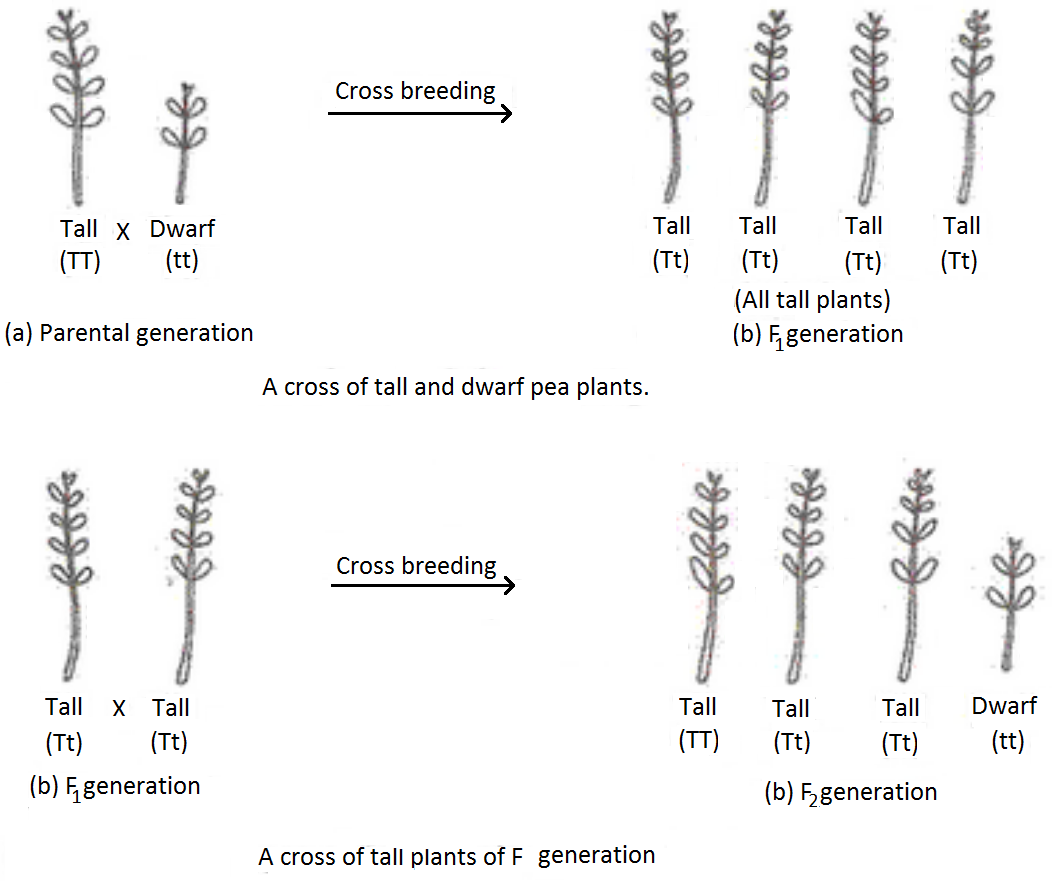
Mendel first crossed pure bred tall pea plants with pure bred dwarf pea plants and found that only tall pea plants were produced in the first generation. No dwarf pea plants were obtained in F1 generation. Mendel concluded that the first generation showed the traits of only one of the parent plants; tallness. The trait of other parent plant, dwarfness, did not show up in the progeny of first generation. Mendel then crossed the tall pea plants of the first generation (F Generation) and found that tall plants and dwarf plants were obtained in the second generation (or F generation) in the ratio of 3 : 1. Mendel noted that the dwarf trait of the parent pea plant which had seemingly disappeared in the first generation progeny reappeared in the second generation. In this way, Mendel’s experiments with tall and dwarf pea plants showed that the traits may be dominant and recessive.
View full question & answer
Question 182 Marks
Does geographical isolation of individuals of a species lead to the formation of a new species? Provide a suitable explanation for your answer.
Answer
Geographical isolation is the major factor in the speciation of sexually reproducing animals because it interrupts the flow of genes between their isolated populations through the gametes.
View full question & answer
Question 192 Marks
Which of the following represent tall plants and which represent short plants (or dwarf plants)? Which of the following represent tall plants and which represent short plants (or dwarf plants)?
  1. Tt
  2. tt
  3. TT
Give reason for your choice (The symbols have their usual meaning).
Answer
  1. Tall: Tt will have tall plants because of the presence of T which is dominant gene and t is recessive gene.
  2. Dwarf plants: It is dwarf due to the presence of both the recessive genes.
  3. Tall plants: These plants are tall due to the presence of both the dominant genes.
View full question & answer
Question 202 Marks
What are genes? Where are they located in our body?
Answer
Genes are the units of heredity which transfer characteristic from parents to their offspring’s during reproduction. Genes are located on the chromosomes.
View full question & answer
Question 212 Marks
Bacteria have a simpler body plan when compared with human beings. Does it mean that human beings are more evolved than bacteria? Explain your answer.
Answer
Bacteria have simpler body plan when compared with human beings. Both of them have evolved differently. Bacteria can inhabit most of the unfavourable habitats such as hot springs, deep- sea thermal vents and the ice in Antarctica.
View full question & answer
Question 222 Marks
Why did Mendel choose pea plants for conducting his experiments on inheritance?
Answer
Mendel choose pea plants for studying inheritance because pea plants had a number of clear cut differences which were easy to tell apart. Another reason for choosing pea plants are they were self pollinating and many generations can be produced in a short time span.
View full question & answer
Question 232 Marks
Does genetic combination of mother play a significant role in determining the sex of a new born baby?
Answer
No, because mother has a pair of X chromosomes. All new born babies will inherit an Xchromosome from mother whether they are baby boys or baby girls.
View full question & answer
Question 242 Marks
Will geographical isolation be a major factor in the speciation of a self-pollinating plant species? Give reason for your answer.
Answer
Geographical isolation will not be a major factor in the speciation of a self pollinating plant because it does not depend on other plants for its process of reproduction to be carried out.
View full question & answer
Question 252 Marks
Give the contrasting traits of the following characters in pea plant and mention which is dominant and which is recessive:
  1. Yellow seed
  2. Round seed
Answer
  1. Green seed: Yellow is dominant: Green is recessive.
  2. Wrinkled seed: round is dominant: wrinkled is recessive.
View full question & answer
Question 262 Marks
Will geographical isolation be a major factor in the speciation of an organism that reproduces asexually? Give reason for your answer.
Answer
Geographical isolation cannot be a major factor in the speciation of an asexually reproducing organism because it does not require any other organism to carry out reproduction.
View full question & answer
Question 272 Marks
Gregor Mendel’s first law of genetics states “Of a pair of contrasted characters", only one can be represented in a gamete by its internal ‘factor’.
Answer
  1. Give the modern name for this ‘factor’.
  2. State where these factors are found in gametes.
View full question & answer
Question 282 Marks
Pure-bred pea plants A are crossed with pure-bred pea plants B. It is found that the plants which look like A do not appear in $F_1$ generation but re-emerge in $F_2$ generation. Which of the plants A and B are:
  1. tall.
  2. dwarf?
Give reason for your answer.
Answer
  1. Pea plants B are the tall ones. It is because these plants carry the trait for tallness, which is dominant.
  2. Pea plants A are dwarfs. It is because these plants carry the trait for dwarfism, which is recessive. A recessive trait remains hidden in $F_1$ generation but reappears in $F_2$ generation.
View full question & answer
Question 292 Marks
Explain the terms ‘analogous organs’ and ‘homologous organs’ with examples.
Answer
Analogous Organs: Organs which performs similar function but are different in structure and origin.
Example: wings of a bird and wings of an insect.
Homologous Organ: Organs which have different functions but similar structure and origin.
Example: fore arm of frog, lizard, bird and human.
View full question & answer
Question 302 Marks
What do the following symbols used in the topic on heredity represent?
  1. TT
  2. tt
  3. XX
  4. XY
Answer
  1. Tall plant.
  2. Dwarf plant.
  3. Female.
  4. Male.
View full question & answer
Question 312 Marks
In what way are analogous organs evidence for evolution?
Answer
The presence of analogous organs indicates that even the organisms having organs with different structures can adapt to perform similar functions for their survival under hostile environmental conditions. Thus, the presence of analogous organs in different animals provide evidence for evolution by telling us that though they are not derived from common ancestors, they can still evolve to perform similar functions to survive, flourish and keep on evolving in the prevailing environment.
View full question & answer
[2 Mark Questions] - Science STD 10 Questions - Vidyadip