Questions · Page 1 of 5

M.C.Q

🎯

Test yourself on this topic

50 questions · timed · auto-graded

MCQ 11 Mark
Assertion: Probability of survival of an organism produced through sexual reproduction is more than that of organism produced through asexual mode.
Reason: Variations provide advantages to individuals for survival.
  • Both A and R are true, and R is the correct explanation of A.
  • B
    Both A and R are true, and R is not the correct explanation of A
  • C
    A is true but R is false.
  • D
    A is false but R is true.
Answer
Correct option: A.
Both A and R are true, and R is the correct explanation of A.
(A).   
View full question & answer
MCQ 21 Mark
A farmer wants to grow banana plants genetically similar enough to the plants already available in his field. Which one of the following methods would you suggest for this purpose?
  • A
    Regeneration
  • B
    Budding
  • Vegetative propagation
  • D
    Sexual reproduction
Answer
Correct option: C.
Vegetative propagation
(C) Vegetative propagation
View full question & answer
MCQ 31 Mark
A student was asked to observe and identify the various parts of an embryo of a red kidney bean seed. He identified the parts and listed them as under:
  1. Tegmen.
  2. Testa.
  3. Cotyledon.
  4. Radicle.
  5. Plumule.
The correctly identified parts among these are:
  • A
    $\ce{I, II}$ and $\ce{III}.$
  • B
    $\ce{II, III}$ and $\ce{IV.}$
  • $\ce{III, IV}$ and $\ce{V.}$
  • D
    $\ce{I, III, IV}$ and $\ce{V.}$
Answer
Correct option: C.
$\ce{III, IV}$ and $\ce{V.}$
Cotyledon an embryonic leaf in seed-bearing plants, one or more of which are the first leaves to appear from a germinating seed.
Radicle the part of a plant embryo that develops into the primary root.
Plumule the rudimentary shoot or stem of an embryo plant.
View full question & answer
MCQ 41 Mark
A student has to focus his compound microscope to observe a prepared slide showing different stages of binary fission in Amoeba. The steps he is likely to follow are listed below in a haphazard manner :
  1. Adjust the diaphragm and the mirror of the microscope so that sufficient light may enter to illuminate the slide.
  2. Fix the slide on the stage carefully.
  3. Adjust the microscope to high power and focus.
  4. Adjust the microscope to low power and focus.
The correct sequence of the above steps to observe the slide under the microscope is:
  • A
    $\ce{I, II, IV, III}$
  • $\ce{II, I, IV, III}$
  • C
    $\ce{II, IV, I, III}$
  • D
    $\ce{I, IV, II, III}$
Answer
Correct option: B.
$\ce{II, I, IV, III}$
First of all we place the slide on the stage and look through the eye piece and then adjust the mirror and diaphragm to get even illumination. Then, we look through the eye piece and move the slide until the object is visible. Again look through the eye piece and raise the objective using coarse adjustment until the object is focused. At last make the focus sharp with the help of fine adjustment.
View full question & answer
MCQ 51 Mark
When you study a slide showing different stages of budding in yeast, you observe the following stages:
  1. The bud may get separated from the parent body and develop into a new individual.
  2. The body of the bud develops and gives rise to another baby bud.
  3. A bud comes out in any direction from the body of the parent cell.
  4. Thus they may form a colony.
The proper sequence of the above stages is :
  • A
    $\ce{II, I, III, IV}$
  • B
    $\ce{II, III, I, IV}$
  • C
    $\ce{III, II, I, IV}$
  • $\ce{III, I, II, IV}$
Answer
Correct option: D.
$\ce{III, I, II, IV}$
Budding is a type of asexual reproduction in which a new organism is formed from a bud of an existing organism. In yeast, the cells divide rapidly at a specific site and develop as an outgrowth called a bud. These buds, while attached to the parent plant, develop into small individuals. When this individual becomes large enough, it detaches itself from the parent body to exist as an independent individual. In this way, they form a colony. Hence, the correct option is $C.$
View full question & answer
MCQ 61 Mark
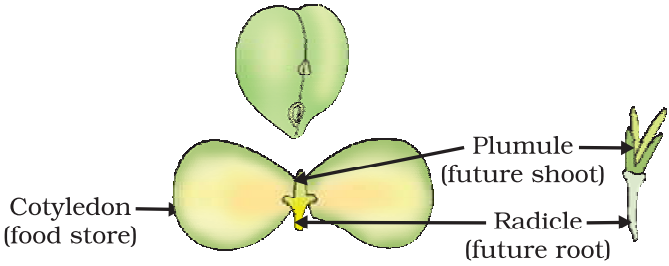
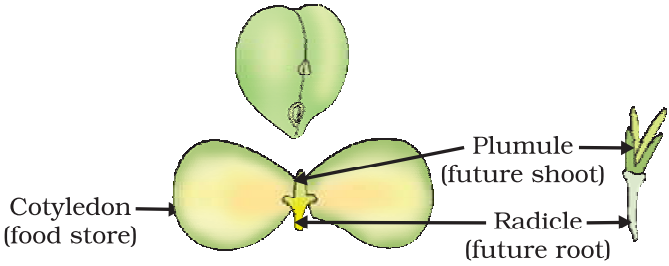
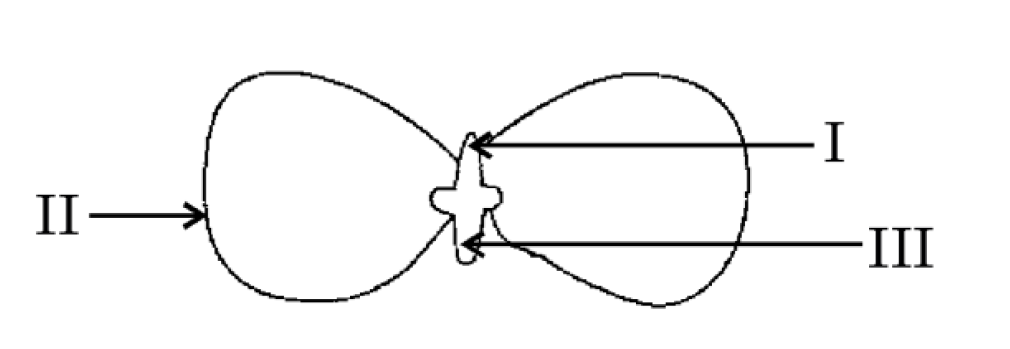
In the following diagram showing the structure of embryo of a dicot seed, what are the parts marked $\ce{I, II}$ and III sequentially?
  • Plumule, Cotyledon, Radicle.
  • B
    Plumule, Radicle, Cotyledon.
  • C
    Cotyledon, Plumule, Radicle.
  • D
    Radicle, Plumule, Cotyledon.
Answer
Correct option: A.
Plumule, Cotyledon, Radicle.
View full question & answer
MCQ 71 Mark
To perform an experiment to identify the different parts of an embryo of a dicot seed, first of all you require a dicot seed. Select dicot seeds from the following group : Wheat, Gram, Maize, Pea, Barley, Ground $-$ nut.
  • A
    Wheat, Gram and Pea.
  • Gram, Pea and Ground-nut.
  • C
    Maize, Pea and Barley.
  • D
    Gram, Maize and Ground-nut.
Answer
Correct option: B.
Gram, Pea and Ground-nut.
The dicot seeds have two cotyledons. Gram, pea and groundnuts have two cotyledons so they are called dicot seeds.
View full question & answer
MCQ 81 Mark
A student while observing an embryo of a pea seed in the laboratory listed various parts of the embryo as given below : Testa, Tegmen, Radicle, Plumule, Micropyle, Cotyledon. On examining the list the teacher remarked that only three parts are correct. Select three correct parts from the above list :
  • A
    Testa, Radicle, Cotyledon.
  • B
    Tegmen, Radicle, Micropyle.
  • C
    Cotyledon, Plumule, Testa.
  • Radicle, Cotyledon, Plumule.
Answer
Correct option: D.
Radicle, Cotyledon, Plumule.
A dicot embryo consists of radicle, plumule and a pair of cotyledons. Testa, tegmen and micropyle are the parts of the seed coat.
View full question & answer
MCQ 91 Mark
A student has to focus his compound microscope to observe a prepared slide showing different stages of binary fission in Amoeba. The steps he is likely to follow are listed below in a haphazard manner :
  1. Adjust the diaphragm and the mirror of the microscope so that sufficient light may enter to illuminate the slide.
  2. Fix the slide on the stage carefully.
  3. Adjust the microscope to high power and focus.
  4. Adjust the microscope to low power and focus.
The correct sequence of the above steps to observe the slide under the microscope is
  • A
    $\ce{I, II, IV, III}$
  • $\ce{II, I, IV, III}$
  • C
    $\ce{II, IV, I, III}$
  • D
    $\ce{I, IV, II, III}$
Answer
Correct option: B.
$\ce{II, I, IV, III}$
First of all we place the slide on the stage and look through the eye piece and then adjust the mirror and diaphragm to get even illumination. Then, we look through the eye piece and move the slide until the object is visible. Again look through the eye piece and raise the objective using coarse adjustment until the object is focused. At last make the focus sharp with the help of fine adjustment.
View full question & answer
MCQ 101 Mark
Slides of binary fission in amoeba and budding in yeast were given for observations to a group of students. Some of the observations reported by the group are given below :
  • Cytokinesis was observed in the yeast cell.
  • A chain of buds were observed due to reproduction in amoeba.
  • Single cell of amoeba and single cell of yeast were undergoing binary fission and budding respectively.
  • Elongated nucleus was dividing to form, two daughter nuclei in amoeba.
The correctly reported observations are :
  • A
    $I$ and $II$
  • B
    $II$ and $III$
  • $III$ and $IV$
  • D
    $I$ and $IV$
Answer
Correct option: C.
$III$ and $IV$
The single cell of Amoeba was undergoing binary fission and the single cell
of yeast was undergoing budding.
The elongated nucleus was dividing to form two daughter nuclei in Amoeba.
Amoeba reproduces by binary fission, wherein a single cell of Amoeba divides
into two equal daughter cells. The mother cell elongates and its nucleus divides into two $($karyokinesis$)$ followed by the division of the cytoplasm $($cytokinesis$).$
Yeast reproduces by budding, wherein outgrowths called buds appear on the
surface of the cells. The nucleus of the parent cell splits into a daughter nucleus and migrates into the daughter cell. The bud detaches from the mother’s body
and gives rise to a new daughter cell.
View full question & answer
MCQ 111 Mark
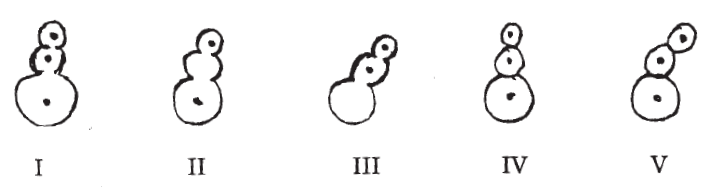
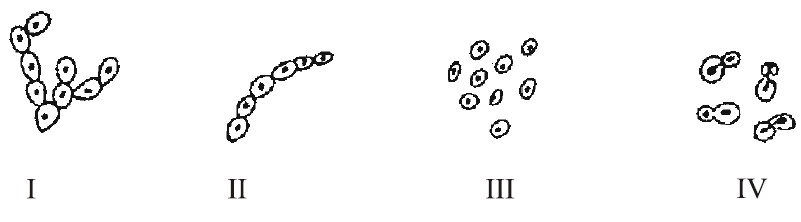
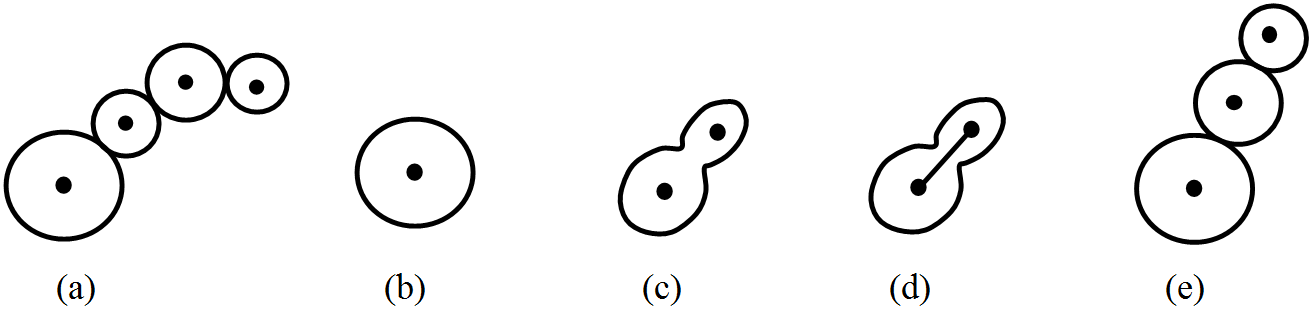
Following diagrams were drawn by different student on having seen prepared slides of budding in yeast.
Correct diagrams are :
  • A
    $\ce{I, II, III}$
  • B
    $\ce{II, III, IV}$
  • C
    $\ce{III, IV, V}$
  • $\ce{I, IV, V}$
Answer
Correct option: D.
$\ce{I, IV, V}$
View full question & answer
MCQ 121 Mark
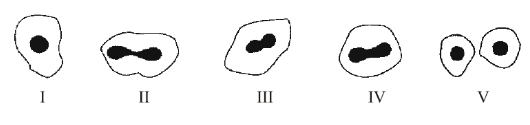
From the following diagrams, select the correct ones showing stages of binary fission in Amoeba :
  • A
    $\ce{I, II, III}$
  • B
    $\ce{IV, II, III}$
  • $\ce{V, II, III}$
  • D
    $\ce{IV, I, III}$
Answer
Correct option: C.
$\ce{V, II, III}$
View full question & answer
MCQ 131 Mark
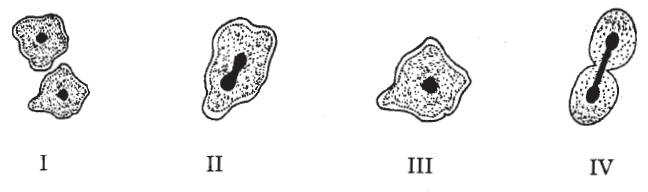
The following figure illustrates binary fission in Amoeba in an incorrect sequence.

The correct sequence is:
  • III, II, IV, I
  • B
    III, IV, II, I
  • C
    II, III, IV, I
  • D
    IV, III, II, I
Answer
Correct option: A.
III, II, IV, I
  1. III, II, IV, I.
View full question & answer
MCQ 151 Mark
The shape of yeast cell is :
  • A
    Only spherical.
  • Only oval.
  • C
    Irregular.
  • D
    Both oval and spherical.
Answer
Correct option: B.
Only oval.
View full question & answer
MCQ 161 Mark
The given figures illustrate binary fission in Amoeba in improper order. The Correct order is :
  • A
    $\ce{III, IV, II, I}$
  • B
    $\ce{IV, III, II, I}$
  • $\ce{II, III, IV, I}$
  • D
    $\ce{I, III, IV, II}$
Answer
Correct option: C.
$\ce{II, III, IV, I}$
View full question & answer
MCQ 171 Mark
Choose the correct statement $(s)$ on budding in yeast from the following :
  1. A parent cell divides into two or more daughter cells and here the parent identity is lost.
  2. In this the elongated nucleus divides to form two or more daughter nuclei.
  3. A bud arises from a particular region on a parent body.
  4. After detaching from the parent body the bud grows into a new independent individual.
  • A
    $\ce{I}$ only
  • B
    $\ce{III}$ only
  • C
    $\ce{II}$ and $\ce{III}$ only
  • $\ce{III}$ and $\ce{IV}$ only
Answer
Correct option: D.
$\ce{III}$ and $\ce{IV}$ only
View full question & answer
MCQ 181 Mark
A student has to perform the experiment “To identify the different parts of an embryo of a dicot seed.” Select from the following an appropriate group of seeds:
  • A
    Pea, gram, wheat.
  • B
    Red kidney bean, maize, gram.
  • C
    Maize, wheat, red kidney bean.
  • Red kidney bean, pea, gram.
Answer
Correct option: D.
Red kidney bean, pea, gram.
d. Red kidney bean, pea, gram.
View full question & answer
MCQ 191 Mark
Study the following diagrams showing various stages of binary fission in Amoeba : The correct sequence of these diagrams should be :
  • A
    $\ce{I, IV, III, II, V}$
  • $\ce{I, III, IV, II, V}$
  • C
    $\ce{I, II, IV, III, V}$
  • D
    $\ce{I, II, III, IV, V}$
Answer
Correct option: B.
$\ce{I, III, IV, II, V}$
View full question & answer
MCQ 201 Mark
You are asked by your teacher to study the different parts of an embryo of a gram seed. Given below are the steps to be followed for the experiment.
  1. Soak the gram seeds in plain water and keep them over might.
  2. Cut open a soaked seed and observe its different parts.
  3. Take some dry gram seeds in a petri dish.
  4. Drain the excess water.
  5. Cover the soaked seed with a wet cotton cloth and leave them for a day.
The correct sequence of these steps is:
  • A
    $\ce{III, I, V, IV, II}$
  • B
    $\ce{III, I, II, IV, V}$
  • C
    $\ce{III, IV, V, I, II}$
  • $\ce{III, I, IV, V, II}$
Answer
Correct option: D.
$\ce{III, I, IV, V, II}$
First of all, take some dry gram seeds in a Petri dish. Now, soak the seeds in plain water and keep them overnight. Drain the excess water. After that, cover the soaked seeds with a wet cotton cloth and leave them for a day. Finally, cut open a soaked seed and observe its different parts.
Hence, the correct option is $D.$
View full question & answer
MCQ 211 Mark
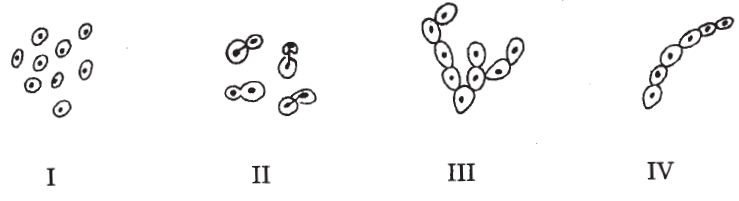
Identify the figures showing the process of budding in yeast.
  • A
    $\ce{I, II}$ and $\ce{III}$
  • B
    $\ce{II, III}$ and $\ce{IV}$
  • C
    $\ce{I, II}$ and $\ce{IV}$
  • $\ce{III, IV}$ and $\ce{I}$
Answer
Correct option: D.
$\ce{III, IV}$ and $\ce{I}$
During budding in yeast, a single cell develops a protrusion wherein the nucleus divides to give rise to two daughter nuclei. One of the daughter nuclei migrates to the protrusion to form a bud. This bud then grows in size and may undergo budding while attached to the parent cell. Thus, budding results in a chain of cells.
View full question & answer
MCQ 221 Mark
A student while observing an embryo of a gram seed listed various parts of the embryo as listed below:
Testa, Micropyle, Cotyledon, Tegmen, Plumule, Radicle. On examining the list the teacher commented that only three parts are correct. Select these three correct parts:
  • A
    Cotyledon, Testa, Plumule.
  • Cotyledon, Plumule, Radicle.
  • C
    Cotyledon, Tegmen, Radicle.
  • D
    Cotyledon, Micropyle, Plumule.
Answer
Correct option: B.
Cotyledon, Plumule, Radicle.
The three correct parts are cotyledon, plumule and radicle. Among the given options, testa and tegmen are parts of the seed coat and micropyle is found in ovule. The parts of dicot embryo include radicle, plumule and a pair of cotyledons.
View full question & answer
MCQ 231 Mark
A student identified the various parts of an embryo of a gram seed and listed them as given below :
  1. Testa.
  2. Plumule.
  3. Radicle.
  4. Cotyledon.
  5. Tegman.
Out of these the actual parts of the embryo are:
  • A
    $\ce{I, II, III}.$
  • $\ce{II, III, IV}.$
  • C
    $\ce{III, IV, V}.$
  • D
    $\ce{II, IV, V}.$
Answer
Correct option: B.
$\ce{II, III, IV}.$
Actual parts of the embryo of a gram seed are plumule, radicle and cotyledon. Testa and tegmen are the parts of the seed coat.
View full question & answer
MCQ 241 Mark
You are asked by your teacher to study the different part of an embryo of a gram seed. Given below are the steps to be followed for the experiment.
  1. Soak the gram seeds in plain water and keep them over might.
  2. Cut open a soaked seed and observe its different parts.
  3. Take some dry gram seeds in a petri dish.
  4. Drain the excess water.
  5. Cover the soaked seed with a wet cotton cloth and leave them for a day.
The correct sequence of these steps is :
  • A
    $\ce{III, I, V, IV, II}$
  • B
    $\ce{III, I, II, IV, V}$
  • C
    $\ce{III, IV, V, I, II}$
  • $\ce{III, I, IV, V, II}$
Answer
Correct option: D.
$\ce{III, I, IV, V, II}$
First of all, take some dry gram seeds in a Petri dish. Now, soak the seeds in plain water and keep them overnight. Drain the excess water. After that, cover the soaked seeds with a wet cotton cloth and leave them for a day. Finally, cut open a soaked seed and observe its different parts.
Hence, the correct option is $D.$
View full question & answer
MCQ 251 Mark
You are asked by your teacher to study the different part of an embryo of a gram seed. Given below are the steps to be followed for the experiment.
  1. Soak the gram seeds in plain water and keep them over might.
  2. Cut open a soaked seed and observe its different parts.
  3. Take some dry gram seeds in a petri dish.
  4. Drain the excess water.
  5. Cover the soaked seed with a wet cotton cloth and leave them for a day.
The correct sequence of these steps is :
  • A
    $\ce{III, I, V, IV, II}.$
  • B
    $\ce{III, I, II, IV, V}.$
  • C
    $\ce{III, IV, V, I, II}.$
  • $\ce{III, I, IV, V, II}.$
Answer
Correct option: D.
$\ce{III, I, IV, V, II}.$
First of all, take some dry gram seeds in a Petri dish. Now, soak the seeds in plain water and keep them overnight. Drain the excess water. After that, cover the soaked seeds with a wet cotton cloth and leave them for a day. Finally, cut open a soaked seed and observe its different parts.
Hence, the correct option is $D.$
View full question & answer
MCQ 261 Mark
In the figure, the parts marked $A, B$ and $C$ are sequentially :
  • A
    Plumule, Radicle and Cotyledon.
  • B
    Radicle, Plumule and Cotyledon.
  • Plumule, Cotyledon and Radicle.
  • D
    Radicle, Cotyledon and Plumule.
Answer
Correct option: C.
Plumule, Cotyledon and Radicle.
A represents the plumule which forms the shoot. $B$ represents the cotyledon and $C$ represents the radicle which forms the roots.
View full question & answer
MCQ 271 Mark
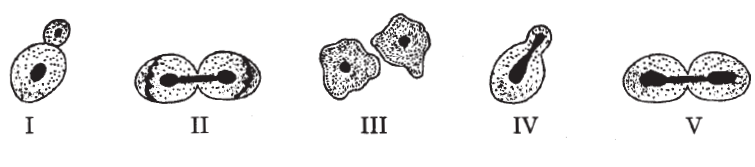
A student after observing a slide showing different stages of binary fission in Amoeba draws the following diagrams. However these diagrams are not in proper sequence :
  • A
    $\ce{I, V, IV, III, II}$
  • B
    $\ce{I, III, IV, V, II}$
  • C
    $\ce{I, V, III, IV, II}$
  • $\ce{I, II, III, IV, V}$
Answer
Correct option: D.
$\ce{I, II, III, IV, V}$
View full question & answer
MCQ 281 Mark
Select the correct statements for the process of budding in yeast:
  1. A bud arises from a particular region on a parent body.
  2. A parent cell divides into two daughter cells, here the parental identity is lost.
  3. Before detaching from the parent body a bud may form another bud.
  4. A bud when detaches from the parent body grows into a new individual.
  • $\ce{I, II}$ and $\ce{III}$
  • B
    $\ce{II, III}$ and $\ce{IV}$
  • C
    $\ce{III, IV}$ and $\ce{I}$
  • D
    $\ce{IV, I}$ and $\ce{II}$
Answer
Correct option: A.
$\ce{I, II}$ and $\ce{III}$
Parental identity is lost in binary fission. Binary fission may cause some change and the daughter cells will be somewhat different from the parent cell and parental identity will be lost. Binary fission $($''division in half''$)$ is a kind of asexual reproduction. It is the most common form of reproduction in prokaryotes and occurs in some single $-$ celled eukaryotes like Amoeba and Paramecium. In binary fission, the fully grown parent cell splits into two halves , producing two new cells.
View full question & answer
MCQ 291 Mark
A student has to observe a permanent slide of binary fission in amoeba. Find the correct sequence of steps given below for focussing the object under a microscope.
  • Place the slide on the stage, look through the eye $-$ piece and adjust the mirror to get proper illumination.
  • Focus the Slide Share using fine adjustment screw.
  • Look through the eye $-$ piece and raise the objective lens using coarse adjustment screw tin the object is focussed.
  • Look through the eye $-$ piece and move the slide till the object is visible.
  • A
    $\ce{d, c, b, a}$
  • B
    $\ce{a, b,d, c}$
  • $\ce{a, d, c, b}$
  • D
    $\ce{a, c, d, b}$
Answer
Correct option: C.
$\ce{a, d, c, b}$
View full question & answer
MCQ 301 Mark
A student after viewing a prepared slide illustrates the budding in yeast in the following order which is not correct :  The correct order shouldbe :
  • A
    $\ce{b, c, d, e, a}$
  • B
    $\ce{b, e, d, c, a}$
  • C
    $\ce{b, d, e, c, a}$
  • $\ce{b, d, c, e, a}$
Answer
Correct option: D.
$\ce{b, d, c, e, a}$
View full question & answer
MCQ 311 Mark
After observing the prepared slides of binary fission in amoeba and budding in yeast following observations were reported :
  • Single cells of amoeba and yeast were undergoing binary fission and budding respectively.
  • Cytokinesis was observed in the yeast cell.
  • Elongated nucleus was dividing to form two daughter nuclei in amoeba.
  • A chain of buds were observed due to reproduction in amoeba.
The correct observation $(s)$ is/ are :
  • $a$ and $c$
  • B
    $b$ only
  • C
    $c$ and $d$
  • D
    $d$ and $c$
Answer
Correct option: A.
$a$ and $c$
Both amoeba and yeast are unicellular organisms and undergo asexual reproduction. In Amoeba, a single cell divides to give rise to two identical daughter cells by the process of binary fission. In yeast, the cells reproduce by the process of budding.
View full question & answer
MCQ 321 Mark
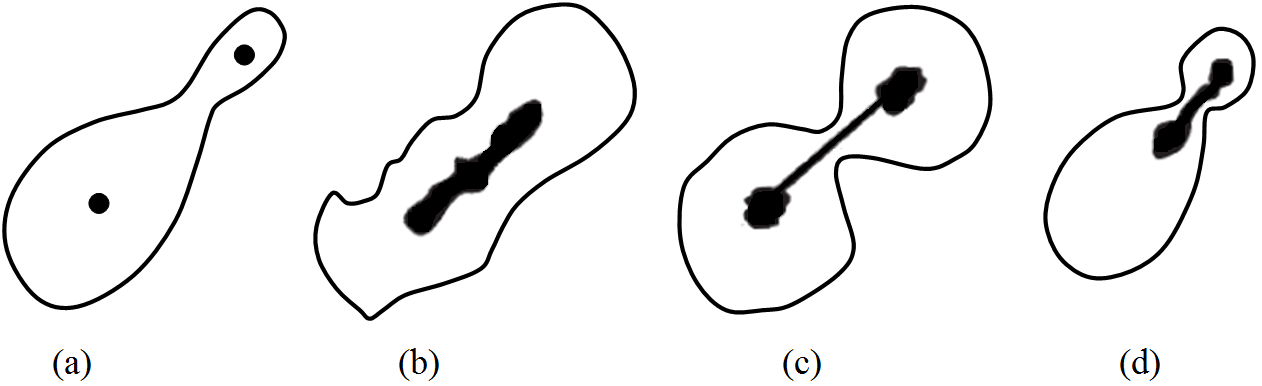
After viewing different slides, a student draws following diagrams. Select the one which depicts binary fission in amoeba.
  • A
    $a$
  • B
    $b$
  • $c$
  • D
    $d$
Answer
Correct option: C.
$c$
View full question & answer
MCQ 331 Mark
A yeast cell in which budding occurs was seen to have :
  • One bud cell.
  • B
    Two bud cells.
  • C
    Three bud cells.
  • D
    A chain of bud cells.
Answer
Correct option: A.
One bud cell.
View full question & answer
MCQ 341 Mark
A student was given two permanent slides, one. of binary fission in amoeba and other of budding in yeast. He was asked to identify anyone difference in the nucleus of the two. One such difference, he identified correctly was :
  • A
    Presence of one nucleus in. amoeba, two in yeast cell and one in bud.
  • Presence of two nuclei in centrally constricted amoeba, one in yeast cell and one in its bud.
  • C
    Presence of two distant nuclei in amoeba, one in yeast cell and two in bud.
  • D
    Presence a single nucleus each in amoeba, yeast of cell and its attached bud.
Answer
Correct option: B.
Presence of two nuclei in centrally constricted amoeba, one in yeast cell and one in its bud.
View full question & answer
MCQ 351 Mark
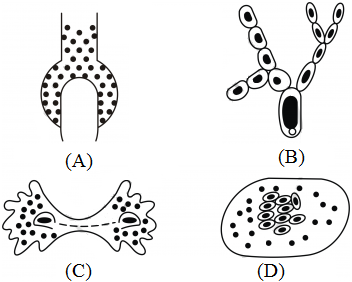
Binary fission is observed in which one of the following figure ?
  • A
    $A$
  • B
    $B$
  • $C$
  • D
    $D$
Answer
Correct option: C.
$C$
View full question & answer
MCQ 361 Mark
In Rhizopus, tubular thread like structures bearing sporangia at their tips are called :
  • A
    Filaments
  • Hyphae
  • C
    Rhizoids
  • D
    Roots
Answer
Correct option: B.
Hyphae
View full question & answer
MCQ 371 Mark
The normal body cell of an organism contains $28$ pairs of chromosomes. The number of chromosomes present in its germ cell will be :
  • A
    $28.$
  • $14.$
  • C
    $56.$
  • D
    $42.$
Answer
Correct option: B.
$14.$
A germ cell has $14$ pairs of chromosomes i.e. half the number of chromosomes present in the normal body cell of an organism.
View full question & answer
MCQ 381 Mark
The offsprings formed by asexual reproduction method have greater similarity among themselves because :
  1. Aexual reproduction involves only one parent.
  2. Aexual reproduction involves two parents.
  3. Aexual reproduction involves gametes.
  4. Axual reproduction does not involve gametes.
  • A
    $(i)$ and $(ii).$
  • B
    $(i)$ and $(iii).$
  • C
    $(ii)$ and $(iv).$
  • $(i)$ and $(iv).$
Answer
Correct option: D.
$(i)$ and $(iv).$
The offsprings formed by the method of asexual reproduction have greater similarity among themselves. This is because asexual reproduction involves only one parent and does not require gametes.
View full question & answer
MCQ 391 Mark
Characters that are transmitted from parents to offspring during reproduction show :
  • A
    Only similarities with parents.
  • B
    Only variations with parents.
  • Both similarities and variations with parents.
  • D
    Neither similarities nor variations.
Answer
Correct option: C.
Both similarities and variations with parents.
A child shows certain similarities and certain variations in characters from parents. This shows characters in a child can be both similar as well as different than parents.
View full question & answer
MCQ 401 Mark
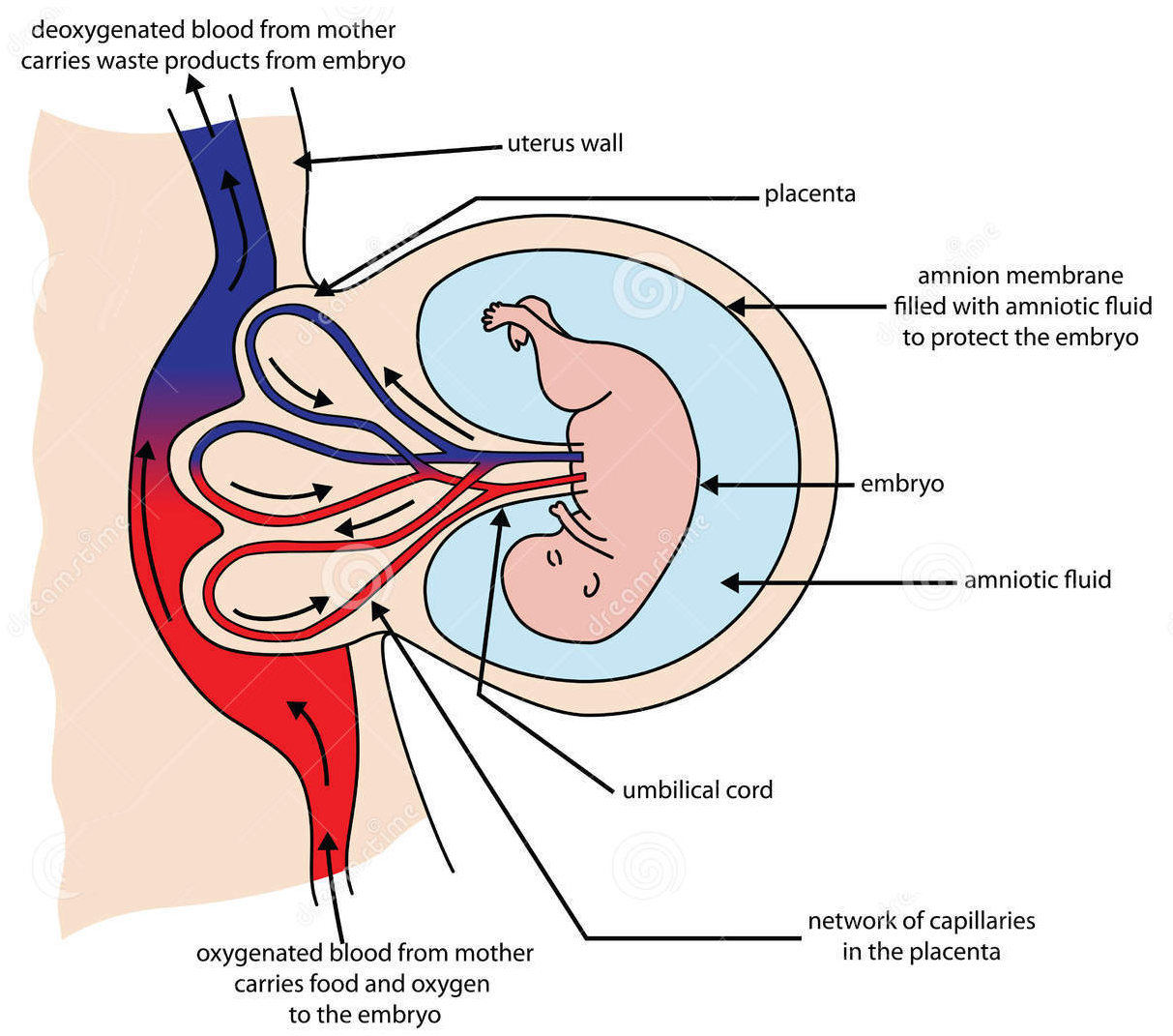
The diagram shows the arrangement of blood vessels in the uterus wall and placenta of pregnant women.
Which of the following will increase in concentration in the blood as it flows from $1$ and $2\ ?$
  • A
    Amino acids.
  • Carbon dioxide.
  • C
    Glucose.
  • D
    Oxygen.
Answer
Correct option: B.
Carbon dioxide.
Placenta functions as a carrier of nutrients from mother to baby. Thus all of amino acids, glucose, and oxygen will decrease in the concentration at $2$ since all of them are transferred to the baby at $1$ because it has a low concentration of all. However, due to metabolic processes and lack of excretory mechanism baby’s blood has a high concentration of carbon dioxide, which will be transferred to mother’s blood because her blood has low $\mathrm{CO}_2$ concentration. Thus at $2$ blood is coming at high $\mathrm{CO}_2$ concentration.
View full question & answer
MCQ 411 Mark
The micro $-$ organism which reproduces by multiple fission is the one which causes the disease known as :
  • A
    Kala $-$ azar.
  • B
    Marasmus.
  • Malaria.
  • D
    Amoebiasis.
Answer
Correct option: C.
Malaria.
Plasmodium reproduces by multiple fission and causes malaria.
View full question & answer
MCQ 421 Mark
Which among the following statements are true for sexual reproduction in flowering plants?
  1. It requires two types of gametes.
  2. Fertilisation is a compulsory event.
  3. It always results in formation of zygote.
  4. Offspring formed are clones.
  • A
    $\ce{(i)}$ and $\ce{(iv)}$
  • B
    $\ce{(i), (ii)}$ and $\ce{(iv)}$
  • C
    $\ce{(i), (ii)}$ and $\ce{(iii)}$
  • $\ce{(i), (ii)}$ and $\ce{(iv)}$
Answer
Correct option: D.
$\ce{(i), (ii)}$ and $\ce{(iv)}$
Sexual reproduction involves fertilization of male and female gamete to produce zygote having genetic variations.
View full question & answer
MCQ 431 Mark
The correct sequence of organs in the reproductive system for transport of sperms is :
  • testis $\rightarrow $ vas deferens $\rightarrow $ urethra.
  • B
    testis $\rightarrow $ ureter $\rightarrow $ urethra.
  • C
    testis $\rightarrow $ urethra $\rightarrow $ ureter.
  • D
    testis $\rightarrow $ vasdeferens $\rightarrow $ ureter.
Answer
Correct option: A.
testis $\rightarrow $ vas deferens $\rightarrow $ urethra.
Sperms are produced in the testis and then carried away by the vas deferens to the urethra.
View full question & answer
MCQ 441 Mark
Which among the following is not the function of testes at puberty?
  1. Formation of germ cells.
  2. Secretion of testosterone.
  3. Development of placenta.
  4. Secretion of estrogen.
  • A
    $(i)$ and $(ii)$
  • B
    $(ii)$ and $(iii)$
  • $(iii)$ and $(iv)$
  • D
    $(i)$ and $(iv)$
Answer
Correct option: C.
$(iii)$ and $(iv)$
These events take place in females and not in males. Testes are present in males.
View full question & answer
MCQ 451 Mark
After drainages are established in tropical peatlanda used for drainage base agriculture, the first stage of subsidence process takes place, it is $.......$
  • A
    Decomposition
  • Consolidation
  • C
    Further decomposition
  • D
    $A$ and $B$
Answer
Correct option: B.
Consolidation
View full question & answer
MCQ 461 Mark
In a flower, the parts that produce male and female gametes are respectively :
  • A
    Sepal and anther.
  • B
    Filament and stigma.
  • Anther and ovary.
  • D
    Stamen and style.
Answer
Correct option: C.
Anther and ovary.
The anther produces pollen grains which are male gametes and the ovary produces ovules which are female gametes.
View full question & answer
MCQ 471 Mark
One of the following occurs in the reproductive system of flowering plants as well as that of humans. This is :
  • A
    Vas deferens.
  • B
    Anther.
  • Ovary.
  • D
    Style.
Answer
Correct option: C.
Ovary.
The ovary of a flower has ovules and the ovary of a human female has eggs.
View full question & answer
MCQ 481 Mark
Which of the following is not a sexually transmitted disease?
  • A
    Gonorrhoea.
  • Hepatitis.
  • C
    Syphilis.
  • D
    $\ce{AIDS}.$
Answer
Correct option: B.
Hepatitis.
Hepatitis is not a sexually transmitted disease.
View full question & answer
MCQ 491 Mark
Factors responsible for the rapid spread of bread mould on slices of bread are :
  1. Large number of spores.
  2. Availability of moisture and nutrients in bread.
  3. Presence of tubular branched hyphae.
  4. Formation of round shaped sporangia.
  • A
    $(i)$ and $(iii)$
  • B
    $(ii)$ and $(iv)$
  • $(i)$ and $(ii)$
  • D
    $(iii)$ and $(iv)$
Answer
Correct option: C.
$(i)$ and $(ii)$
Bread mold prefers damp and warm substratum with ample supply of nutrients on which its air $-$ borne spores land and germinate to produce mycelium.
View full question & answer
MCQ 501 Mark
In a potato, vegetative propagation takes place by :
  • A
    Root
  • B
    Leaf
  • Stem tuber
  • D
    Grafting
Answer
Correct option: C.
Stem tuber
View full question & answer
M.C.Q - Science STD 10 Questions - Vidyadip