Questions

M.C.Q

🎯

Test yourself on this topic

27 questions · timed · auto-graded

MCQ 11 Mark
Characters that are transmitted from parents to offspring during reproduction show:
  • A
    Only similarities with parents.
  • B
    Only variations with parents.
  • Both similarities and variations with parents.
  • D
    Neither similarities nor variations.
Answer
Correct option: C.
Both similarities and variations with parents.

A child shows certain similarities and certain variations in characters from parents. This shows characters in a child can be both similar as well as different than parents.
View full question & answer
MCQ 21 Mark
Which among the following statements are true for sexual reproduction in flowering plants?
  1. It requires two types of gametes.
  2. Fertilisation is a compulsory event.
  3. It always results in formation of zygote.
  4. Offspring formed are clones.
  • A
    $(i)$ and $(iv)$
  • B
    $(i), (ii)$ and $(iv)$
  • C
    $(i), (ii)$ and $(iii)$
  • $(i), (ii)$ and $(iv)$
Answer
Correct option: D.
$(i), (ii)$ and $(iv)$
Sexual reproduction involves fertilization of male and female gamete to produce zygote having genetic variations.
View full question & answer
MCQ 31 Mark
Which among the following is not the function of testes at puberty?
  1. Formation of germ cells.
  2. Secretion of testosterone.
  3. Development of placenta.
  4. Secretion of estrogen.
  • A
    $(i)$ and $(ii)$
  • B
    $(ii)$ and $(iii)$
  • $(iii)$ and $(iv)$
  • D
    $(i)$ and $(iv)$
Answer
Correct option: C.
$(iii)$ and $(iv)$
These events take place in females and not in males. Testes are present in males.
View full question & answer
MCQ 41 Mark
Factors responsible for the rapid spread of bread mould on slices of bread are :
  1. Large number of spores.
  2. Availability of moisture and nutrients in bread.
  3. Presence of tubular branched hyphae.
  4. Formation of round shaped sporangia.
  • A
    $(i)$ and $(iii)$
  • B
    $(ii)$ and $(iv)$
  • $(i)$ and $(ii)$
  • D
    $(iii)$ and $(iv)$
Answer
Correct option: C.
$(i)$ and $(ii)$
Bread mold prefers damp and warm substratum with ample supply of nutrients on which its air $-$ borne spores land and germinate to produce mycelium.
View full question & answer
MCQ 51 Mark
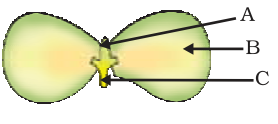
In Figure, the parts A, B and C are sequentially:
  • A
    Cotyledon, plumule and radicle.
  • B
    Plumule, radicle and cotyledon.
  • Plumule, cotyledon and radicle.
  • D
    Radicle, cotyledon and plumule.
Answer
Correct option: C.
Plumule, cotyledon and radicle.
View full question & answer
MCQ 61 Mark
The correct sequence of organs in the male reproductive system for transport of sperms is:
  • Testis → vasdeferens → urethra.
  • B
    Testis → ureter → urethra.
  • C
    Testis → urethra → ureter.
  • D
    Testis → vasdeferens → ureter.
Answer
Correct option: A.
Testis → vasdeferens → urethra.

Vas deferens delivers sperms from testes to urethra coming from the urinary bladder.

View full question & answer
MCQ 71 Mark
Vegetative propagation refers to formation of new plants from:
  • A
    Stem, roots and flowers.
  • Stem, roots and leaves.
  • C
    Stem, flowers and fruits.
  • D
    Stem, leaves and flowers.
Answer
Correct option: B.
Stem, roots and leaves.

Vegetative propagation happens from vegetative parts of a plant. Stem root and leaves are vegetative parts.

View full question & answer
MCQ 81 Mark
A feature of reproduction that is common to Amoeba, Spirogyra and Yeast is that:
  • They reproduce asexually.
  • B
    They are all unicellular.
  • C
    They reproduce only sexually.
  • D
    They are all multicellular.
Answer
Correct option: A.
They reproduce asexually.

All of them reproduce asexually.

View full question & answer
MCQ 91 Mark
The ability of a cell to divide into several cells during reproduction in Plasmodium is called:
  • A
    Budding.
  • B
    Reduction division.
  • C
    Binary fission.
  • Multiple fission.
Answer
Correct option: D.
Multiple fission.
Multiple fission is repeated division of organism to produce many daughter cells simultaneously.
View full question & answer
MCQ 101 Mark
Offspring formed by asexual method of reproduction have greater similarity among themselves because :
  1. Asexual reproduction involves only one parent.
  2. Asexual reproduction does not involve gametes.
  3. Asexual reproduction occurs before sexual reproduction.
  4. Asexual reproduction occurs after sexual reproduction.
  • $(i)$ and $(ii)$
  • B
    $(i)$ and $(iii)$
  • C
    $(ii)$ and $(iv)$
  • D
    $(iii)$ and $(iv)$
Answer
Correct option: A.
$(i)$ and $(ii)$
Asexual reproduction does not involve gamete formation and fertilization.
View full question & answer
MCQ 111 Mark
The correct sequence of reproductive stages seen in flowering plants is:
  • Gametes, zygote, embryo, seedling.
  • B
    Zygote, gametes, embryo, seedling.
  • C
    Seedling, embryo, zygote, gametes.
  • D
    Gametes, embryo, zygote, seedling.
Answer
Correct option: A.
Gametes, zygote, embryo, seedling.

Gametes fuse during fertilization of form zygote. Zygote develops into embryo. Embryo produces seedling after germination of seed.

View full question & answer
MCQ 121 Mark
In human females, an event that reflects onset of reproductive phase is:
  • A
    Growth of body.
  • B
    Changes in hair pattern.
  • C
    Change in voice.
  • Menstruation.
Answer
Correct option: D.
Menstruation.

Other changes; as shown in options happen in boys also.

View full question & answer
MCQ 131 Mark
Reproduction is essential for living organisms in order to:
  • A
    Keep the individual organism alive.
  • B
    Fulfill their energy requirement.
  • C
    Maintain growth.
  • Continue the species generation after generation.
Answer
Correct option: D.
Continue the species generation after generation.

Other life processes are essential for keeping the organism alive. Reproduction is essential to continue the lineage of an organism.

View full question & answer
MCQ 141 Mark
Which among the following diseases is not sexually transmitted?
  • A
    Syphillis.
  • Hepatitis.
  • C
    HIV - AIDS.
  • D
    Gonorrhoea.
Answer
Correct option: B.
Hepatitis.

Hepatitis is water borne viral disease.

View full question & answer
MCQ 151 Mark
Characters transmitted from parents to offspring are present in:
  • A
    Cytoplasm.
  • B
    Ribosome.
  • C
    Golgi bodies.
  • Genes.
Answer
Correct option: D.
Genes.
Genes are the stretch of DNA and determine genetic characters.
View full question & answer
MCQ 161 Mark
Which of the following is the correct sequence of events of sexual reproduction in a flower?
  • A
    Pollination, fertilisation, seedling, embryo.
  • B
    Seedling, embryo, fertilisation, pollination.
  • Pollination, fertilisation, embryo, seedling.
  • D
    Embryo, seedling, pollination, fertilisation.
Answer
Correct option: C.
Pollination, fertilisation, embryo, seedling.

Fertilisation cannot happen without pollination. Embryo is formed after fertilization and seedling comes out of embryo.

View full question & answer
MCQ 171 Mark
Length of pollen tube depends on the distance between:
  • A
    Pollen grain and upper surface of stigma.
  • B
    Pollen grain on upper surface of stigma and ovule.
  • C
    Pollen grain in anther and upper surface of stigma.
  • Upper surface of stigma and lower part of style.
Answer
Correct option: D.
Upper surface of stigma and lower part of style.

To ensure pollination. Pollens should be able to reach the upper surface of stigma. This can be ensured by suitable length of pollen tube.

View full question & answer
MCQ 181 Mark
In the list of organisms given below, those that reproduce by the asexual method are :
  1. Banana.
  2. Dog.
  3. Yeast.
  4. Amoeba.
  • A
    $(ii)$ and $(iv)$
  • $(i), (iii)$ and $(iv)$
  • C
    $(i)$ and $(iv)$
  • D
    $(ii), (iii)$ and $(iv)$
Answer
Correct option: B.
$(i), (iii)$ and $(iv)$
Dog never reproduces asexually. Yeast and amoeba always reproduce asexually. Cultivated varieties of banana always reproduce asexually.
View full question & answer
MCQ 191 Mark
In Spirogyra, asexual reproduction takes place by:
  • Breaking up of filaments into smaller bits.
  • B
    Division of a cell into two cells.
  • C
    Division of a cell into many cells.
  • D
    Formation of young cells from older cells.
Answer
Correct option: A.
Breaking up of filaments into smaller bits.

Spirogyra shows reproduction by fragmentation.

View full question & answer
MCQ 201 Mark
Which of the following statements are true for flowers?
  1. Flowers are always bisexual.
  2. They are the sexual reproductive organs.
  3. They are produced in all groups of plants.
  4. After fertilisation they give rise to fruits.
  • A
    $(i)$ and $(iv)$
  • B
    $(ii)$ and $(iii)$
  • C
    $(i)$ and $(iii)$
  • $(ii)$ and $(iv)$
Answer
Correct option: D.
$(ii)$ and $(iv)$
Flowers are the sexual reproductive organs of a plant and a fertilized flower give rise to fruit.
View full question & answer
MCQ 211 Mark
Offspring formed as a result of sexual reproduction exhibit more variations because:
  • A
    Sexual reproduction is a lengthy process.
  • Genetic material comes from two parents of the same species.
  • C
    Genetic material comes from two parents of different species.
  • D
    Genetic material comes from many parents.
Answer
Correct option: B.
Genetic material comes from two parents of the same species.
Sexual reproduction produces genetic variations by meiosis during gamete formation and fertilization of male and female gametes.
View full question & answer
MCQ 221 Mark
In human males, the testes lie in the scrotum, because it helps in the:
  • A
    Process of mating.
  • Formation of sperm.
  • C
    Easy transfer of gametes.
  • D
    All the above.
Answer
Correct option: B.
Formation of sperm.

Scrotum provides lower temperature needed for sperm formation.

View full question & answer
MCQ 231 Mark
In Rhizopus, tubular thread-like structures bearing sporangia at their tips are called:
  • A
    Filaments.
  • Hyphae.
  • C
    Rhizoids.
  • D
    Roots.
Answer
Correct option: B.
Hyphae.

Thin branched filaments of fungi are called as hyphae.

View full question & answer
MCQ 241 Mark
In a flower, the parts that produce male and female gametes (germ cells) are:
  • A
    Stamen and anther.
  • B
    Filament and stigma.
  • Anther and ovary.
  • D
    Stamen and style.
Answer
Correct option: C.
Anther and ovary.

Anther produce pollen through microsporogenesis and ovary produce egg cell by megasporogenesis.

View full question & answer
MCQ 251 Mark
During adolescence, several changes occur in the human body. Mark one change associated with sexual maturation in boys:
  • A
    Loss of milk teeth.
  • B
    Increase in height.
  • Cracking of voice.
  • D
    Weight gain.
Answer
Correct option: C.
Cracking of voice.

Cracking of voice is one of the secondary sexual characters of human males.

View full question & answer
MCQ 261 Mark
Which among the following statements are true for unisexual flowers?
  1. They possess both stamen and pistil.
  2. They possess either stamen or pistil.
  3. They exhibit cross pollination.
  4. Unisexual flowers possessing only stamens cannot produce fruits.
  • A
    $(i)$ and $(iv)$
  • $(ii), (iii)$ and $(iv)$
  • C
    $(iii)$ and $(iv)$
  • D
    $(i), (iii)$ and $(iv)$
Answer
Correct option: B.
$(ii), (iii)$ and $(iv)$
Since a unisexual flower has either stamen or pistil, hence cross pollination is necessary in them. Fruit is a mature ovary and hence a flower possessing only stamens cannot produce fruit.
View full question & answer
MCQ 271 Mark
The number of chromosomes in parents and offsprings of a particular species remains constant due to:
  • A
    Doubling of chromosomes after zygote formation.
  • Halving of chromosomes during gamete formation.
  • C
    Doubling of chromosomes after gamete formation.
  • D
    Halving of chromosomes after gamete formation.
Answer
Correct option: B.
Halving of chromosomes during gamete formation.
During gamete formation, number of chromosomes becomes half. Due to this, number of chromosomes in zygote becomes same as in somatic cell of the organism. This ensures constant number of chromosomes in a particular species.
View full question & answer
M.C.Q - Science STD 10 Questions - Vidyadip