Questions · Page 4 of 4

M.C.Q

MCQ 1511 Mark
Which is the correct sequence of air passage during inhalation?
  • A
    Nostrils $\rightarrow $ larynx $\rightarrow $ pharynx $\rightarrow $ trachea $\rightarrow $ lungs.
  • B
    Nasal passage $\rightarrow $ trachea $\rightarrow $ pharynx $\rightarrow $ larynx $\rightarrow $ alveoli.
  • C
    larynx $\rightarrow $ nostrils $\rightarrow $ pharynx $\rightarrow $ lungs.
  • Nostrils $\rightarrow $ pharynx $\rightarrow $ larynx $\rightarrow $ trachea $\rightarrow $ alveoli.
Answer
Correct option: D.
Nostrils $\rightarrow $ pharynx $\rightarrow $ larynx $\rightarrow $ trachea $\rightarrow $ alveoli.
During inhalation, the air is drawn through the nostrils into nasal passage. From there, air enters into pharynx, larynx, trachea $($windpipe$),$ bronchi, lungs and finally to the alveoli.
View full question & answer
MCQ 1521 Mark
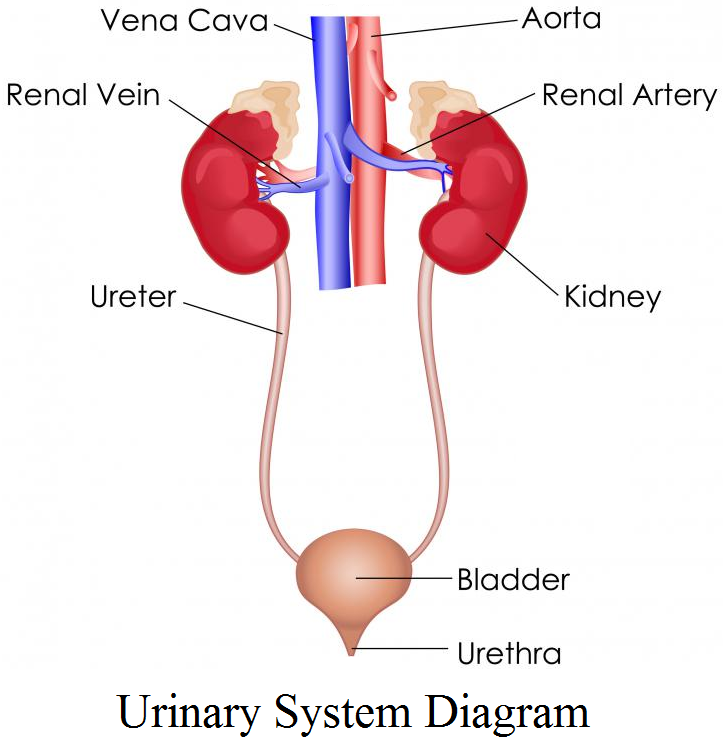
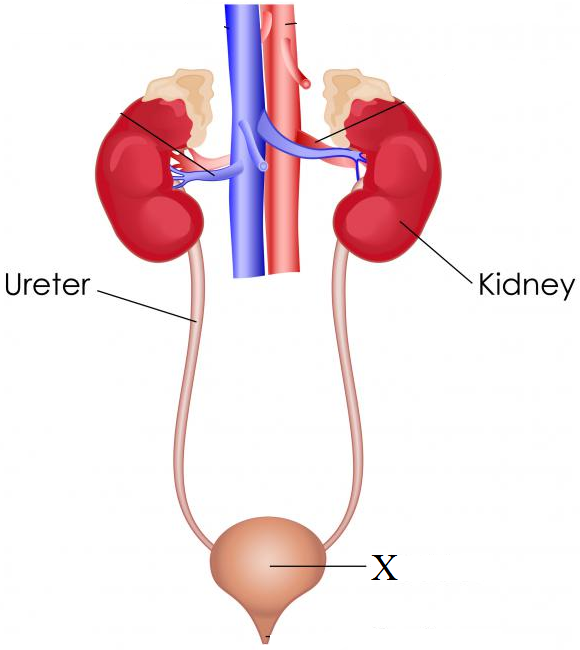
The diagram given below shows the human excretory system.

Identify the function of part labelled as $x$
  • A
    To excrete urea.
  • B
    To produce urea.
  • C
    To produce urine.
  • To store urine.
Answer
Correct option: D.
To store urine.
The function of part labelled as $x$ Urinary Bladder.
View full question & answer
MCQ 1531 Mark
In which part of the alimentary canal food is finally digested?
  • A
    Stomach.
  • B
    Mouth cavity.
  • C
    Large intestine.
  • Small intestine.
Answer
Correct option: D.
Small intestine.
Digestion of food starts in mouth by salivary amylase. From here it enters into the stomach via oesophagus. Gastric juice of stomach digests the protein part of food. Pancreatic amylase, trypsin and lipase as well as intestinal peptidases and maltase carry out the final chemical digestion of food in small intestine. The simpler substances formed by chemical digestion are then absorbed by small intestinal villi.
View full question & answer
MCQ 1541 Mark
The excretory unit in the human excretory system is called :
  • Nephron.
  • B
    Neuron.
  • C
    Nephridia.
  • D
    Kidneyon.
Answer
Correct option: A.
Nephron.
The main excretory unit in the human excretory system is called nephron. It produces urine and maintains the homeostasis of the body.
 
View full question & answer
MCQ 1551 Mark
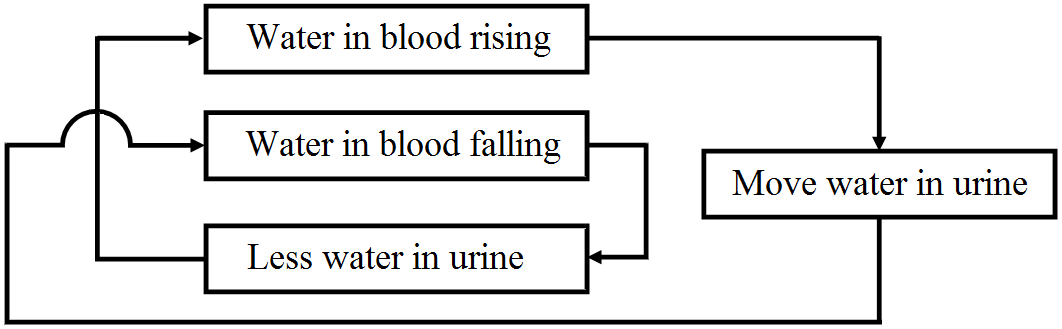
Observe the figure given below which represents the control of water concentration in the blood.

This is a negative feedback.
  • It decreases the amount of water in the blood.
  • B
    It increases any change occurring in the amount of water in the blood.
  • C
    It reverses any change occurring in the amount of water in the blood.
  • D
    It increases the amount of water in the blood.
Answer
Correct option: A.
It decreases the amount of water in the blood.
View full question & answer
MCQ 1561 Mark
Which of the following has the longest small intestine?
  • A
    Carnivore.
  • B
    Omnivore.
  • Herbivore.
  • D
    Autotroph.
Answer
Correct option: C.
Herbivore.
This is because herbivores mainly eat plants. Plants contain cellulose, which is difficult to digest.
Hence, they have the longest small intestine.
View full question & answer
MCQ 1571 Mark
The component of blood which makes chemicals known as antibodies is :
  • A
    Platelets.
  • White blood cell.
  • C
    Red blood cells.
  • D
    Plasma.
Answer
Correct option: B.
White blood cell.
White blood cells make chemicals known as antibodies that help to fight against infection and protect the body from foreign particles.
View full question & answer
MCQ 1581 Mark
In which of the following groups of organisms, food material is broken down outside the body and absorbed?
  • A
    Mushroom, green plants, Amoeba.
  • Yeast, mushroom, bread mould.
  • C
    Paramecium, Amoeba, Cuscuta.
  • D
    Cuscuta, lice, tapeworm.
Answer
Correct option: B.
Yeast, mushroom, bread mould.
All of them are saprotrophs. In saprotrophic mode of nutrition, food material is broken down outside the body and absorbed.
View full question & answer
MCQ 1591 Mark
Which of the following is the correct path taken by urine in our body?
  • A
    Kidney $\rightarrow $ ureter $\rightarrow $ urethra $\rightarrow $ bladder.
  • B
    Kidney $\rightarrow $ bladder $\rightarrow $ urethra $\rightarrow $ ureter.
  • Kidney $\rightarrow $ ureter $\rightarrow $ bladder $\rightarrow $ urethra.
  • D
    Bladder $\rightarrow $ kidney $\rightarrow $ ureter $\rightarrow $ urethra.
Answer
Correct option: C.
Kidney $\rightarrow $ ureter $\rightarrow $ bladder $\rightarrow $ urethra.
During blood circulation, blood passes through the kidneys. This blood contains both useful and waste materials. The kidneys filter the wastes from the blood and produce urine. From the kidneys, the urine goes into the urinary bladder through two narrow tubes called ureters. The urinary bladder stores the urine until it is forced out of the body, through an opening known as the urethra.
View full question & answer
MCQ 1601 Mark
The opening and closing of the stomatal pore depends upon :
  • A
    Oxygen.
  • B
    Temperature.
  • Water in guard cells.
  • D
    Concentration of $\mathrm{CO}_2$ in stomata.
Answer
Correct option: C.
Water in guard cells.
Stomata are the tiny pores present at the leaf surface. Each stomatal pore is surrounded by two guard cells that assist in stomatal opening driven by turgidity of guard cells. When water flows in guard cells from epidermal cells, guard cells become turgid and stomata are opened. Removal of water from guard cells makes them flaccid and stomata are closed.
The only epidermal cells with unevenly thickened walls and chloroplasts are the guard cells; they are kidney shaped in dicots and dumbell shaped in monocots.
View full question & answer
MCQ 1611 Mark
Water absorption through roots can be increased by keeping the potted plants :
  • A
    In the shade.
  • B
    In dim light.
  • Under the fan.
  • D
    Covered with a polythene bag.
Answer
Correct option: C.
Under the fan.
Water absorption through roots can be increased by keeping the potted plants under the fan.
View full question & answer
MCQ 1621 Mark
Which of the following statement $(s)$ is $($are$)$ true about respiration?
  1. During inhalation, ribs move inward and diaphragm is raised.
  2. In the alveoli, exchange of gases takes place i.e., oxygen from alveolar air diffuses into blood and carbon dioxide from blood into alveolar air.
  3. Haemoglobin has greater affinity for carbon dioxide than oxygen.
  4. Alveoli increase surface area for exchange of gases.
  • A
    $(i)$ and $(iv).$
  • B
    $(ii)$ and $(iii)$.
  • C
    $(i)$ and $(iii).$
  • $(ii)$ and $(iv).$
Answer
Correct option: D.
$(ii)$ and $(iv).$
Statement $(i)$ is incorrect. During inhalation, ribs move outward and diaphragm is lowered.
Statement $(iii)$ is incorrect because haemoglobin has greater affinity for oxygen than carbon dioxide.
View full question & answer
MCQ 1631 Mark
The photosynthesis in a plant is not taking place during the day time if the plant is releasing :
  • A
    Water vapour.
  • B
    Oxygen.
  • Carbon $-$ dioxide.
  • D
    All the above.
Answer
Correct option: C.
Carbon $-$ dioxide.
During daytime, the carbon $-$ dioxide produced through respiration is used up in photosynthesis by leaves. In fact, more carbon $-$ dioxide is taken in from the air for this purpose.
So, oxygen is diffused out and carbon $-$ dioxide is diffused in.
Hence, if a plant is releasing carbon-dioxide during the daytime, then photosynthesis is not taking place.
View full question & answer
MCQ 1641 Mark
During deficiency of oxygen in tissues of human beings, pyruvic acid is converted into lactic acid in the :
  • Cytoplasm.
  • B
    Chloroplast.
  • C
    Mitochondria.
  • D
    Golgi body.
Answer
Correct option: A.
Cytoplasm.
Anaerobic respiration takes place in cytoplasm.
View full question & answer
MCQ 1651 Mark
The length of small intestine in a human adult is about :
  • A
    $4.5m.$
  • B
    $1.5m.$
  • C
    $3.5m.$
  • $6.5m.$
Answer
Correct option: D.
$6.5m.$
The length of small intestine in a human adult is around $6.5 m.$
View full question & answer
MCQ 1661 Mark
The process of digestion of food in humans begins in :
  • A
    Stomach.
  • B
    Food pipe.
  • Mouth.
  • D
    Small intestine.
Answer
Correct option: C.
Mouth.
The process of digestion begins in the mouth with the help of the enzymes present in the saliva.
View full question & answer
MCQ 1671 Mark
Which one of the following statements related to capillaries is correct?
  • A
    It acts as connective link between arteries and veins.
  • B
    These are deeply penetrated inside the tissues.
  • C
    Help in exchange of materials between blood and surrounding cells.
  • All of the above.
Answer
Correct option: D.
All of the above.
There are two types of capillaries: true capillaries, which branch from arterioles and provide exchange between tissue and the capillary blood, and metarterioles, found only in the mesenteric circulation. They are short vessels that directly connect the arterioles and venules at opposite ends of the beds.
View full question & answer
MCQ 1681 Mark
The blood vessel which carries oxygenated blood from the lungs to the heart is :
  • A
    Main artery.
  • B
    Pulmonary artery.
  • C
    Main vein.
  • Pulmonary vein
Answer
Correct option: D.
Pulmonary vein
Veins transport deoxygenated blood from various organs of the body towards the heart.
Only pulmonary vein carries the oxygenated blood from the lungs to the heart.
View full question & answer
MCQ 1691 Mark
The procedure used in artificial kidney in place of normal is called :
  • A
    Pacemaker.
  • Dialysis.
  • C
    Osmoregulation.
  • D
    Electrocardiograph.
Answer
Correct option: B.
Dialysis.
In hemodialysis, a dialysis machine and a special filter called an artificial kidney, or a dialyzer.
View full question & answer
MCQ 1701 Mark
One of the following does not have a nucleus. This one is :
  • Red blood cell.
  • B
    White blood cell.
  • C
    Guard cell.
  • D
    Epidermal cell.
Answer
Correct option: A.
Red blood cell.
Red blood cells do not have nuclei.
View full question & answer
MCQ 1711 Mark
Lack of oxygen in muscles often leads of oxygen in muscles often leads to cramps among cricketers. This results due to :
  • A
    Conversion of pyruvate to ethanol.
  • B
    Conversion of pyruvate to glucose.
  • C
    Non conversion of glucose to pyruvate.
  • Conversion of pyruvate to lactic acid.
Answer
Correct option: D.
Conversion of pyruvate to lactic acid.
Break down of pyruvate using oxygen, i.e., aerobic respiration takes place in the mitochondria. Lactic acid is produced in the muscle from the metabolism of carbohydrate in the cells. When muscles work hard.
View full question & answer
MCQ 1721 Mark
The phloem tissue in plants is responsible for the transport of :
  • A
    Water.
  • B
    Water and minerals.
  • Sugar.
  • D
    All of the above.
Answer
Correct option: C.
Sugar.
In plants, the phloem tissue is responsible for the transport of food $($in the form of sugar$)$ from the leaves to different parts of the body.
View full question & answer
MCQ 1731 Mark
If salivary amylase is lacking in the saliva, which of the following events in the mouth cavity will be affected?
  • A
    Proteins breaking down into amino acids.
  • Starch breaking down into sugars.
  • C
    Fats breaking down into fatty acids and glycerol.
  • D
    Absorption of vitamins.
Answer
Correct option: B.
Starch breaking down into sugars.
Salivary amylase converts starch into sugar.
Digestion of proteins and fats does not take place in mouth, hence options $(a)$ and $(c)$ are incorrect.
View full question & answer
MCQ 1741 Mark
The process of obtaining food by Amoeba is known as :
  • A
    Dialysis.
  • B
    Cytokinesis.
  • Phagocytosis.
  • D
    Amoebiasis.
Answer
Correct option: C.
Phagocytosis.
Amoebae obtain food by the process called phagocytosis, which means cell feeding.
View full question & answer
MCQ 1751 Mark
The inner lining of stomach is protected by one of the following from the harmful effect of hydrochloric acid. This is :
  • A
    Pepsin.
  • Mucus.
  • C
    Saliva.
  • D
    Bile.
Answer
Correct option: B.
Mucus.
Mucus protects the inner lining of the stomach from erosion, which can be caused by hydrochloric acid.
View full question & answer
MCQ 1761 Mark
Nitrogenous wastes are formed from the breakdown of :
  • A
    Fat.
  • B
    Water.
  • C
    Amino acids.
  • Ammonia.
Answer
Correct option: D.
Ammonia.
Nitrogenous wastes tend to form toxic ammonia, which raises the $\ce{pH}$ of body fluids.
View full question & answer
MCQ 1771 Mark
Choose the function of the pancreatic juice from the following :
  • A
    Trypsin digests proteins and lipase carbohydrates.
  • B
    Trypsin digests emulsified fats and lipase proteins.
  • C
    Trypsin and lipase digest fats.
  • Trypsin digests proteins and lipase emulsified fats.
Answer
Correct option: D.
Trypsin digests proteins and lipase emulsified fats.
Trypsin completes the digestion of protein. Lipase digests emulsified fat to convert it into fatty acids and glycerol.
View full question & answer
MCQ 1781 Mark
The instrument for measuring blood pressure is called :
  • A
    Manometer.
  • Sphygmomanometer.
  • C
    Barometer.
  • D
    Potentiometer.
Answer
Correct option: B.
Sphygmomanometer.
The device used for measuring blood pressure is called sphygmomanometer.
View full question & answer
MCQ 1791 Mark
Which of the following is the only conducting tissue in non $-$ flowering plants?
  • A
    Xylem vessels.
  • B
    Sieve tubes.
  • C
    Companion cells.
  • Tracheids.
Answer
Correct option: D.
Tracheids.
Tracheids are the only conducting tissue in non $-$ flowering plants.
View full question & answer
MCQ 1801 Mark
Which of the following component of our food is digested by an enzyme which is present in saliva as well as in pancreatic juice?
  • A
    Proteins.
  • B
    Fat.
  • C
    Minerals.
  • Carbohydrate.
Answer
Correct option: D.
Carbohydrate.
Carbohydrates are digested by amylases that are present in the saliva and the pancreatic juice.
View full question & answer
MCQ 1811 Mark
The value of normal systolic and diastolic blood pressure in human is :
  • $120\ mm\ Hg$ and $80\ mm\ Hg,$ respectively.
  • B
    $80\ mm\ Hg$ and $120\ mm\ Hg,$ respectively.
  • C
    $100\ mm\ Hg$ and $90\ mm\ Hg,$ respectively.
  • D
    $130\ mm\ Hg$ and $85\ mm\ Hg,$ respectively.
Answer
Correct option: A.
$120\ mm\ Hg$ and $80\ mm\ Hg,$ respectively.
For a normal reading, your blood pressure needs to show a top number $($systolic pressure$)$ that's between $90$ and less than $120$ and a bottom number $($diastolic pressure$)$ that's between $60$ and less than $80.$
View full question & answer
MCQ 1821 Mark
What are the functions of the Xylem?
Carrying Sugars Carrying water Carrying mineral ions Giving Support
$(a)$ $\checkmark$ $\times$ $\times$ $\checkmark$
$(b)$ $\checkmark$ $\checkmark$ $\times$ $\times$
$(c)$ $\times$ $\checkmark$ $\checkmark$ $\times$
$(d)$ $\times$ $\checkmark$ $\checkmark$ $\checkmark$
Key $â = $ a function of xylem $, X= $ not a function of xylem.
  • A
    $(a)$
  • B
    $(b)$
  • C
    $(c)$
  • $(d)$
Answer
Correct option: D.
$(d)$
Xylem is also responsible for providing mechanical strength to the plant and tissue. The chief role of xylem is to transport water and water soluble nutrients from roots to all the parts of the plant. and it also provides support.
View full question & answer
MCQ 1831 Mark
Which of the following statements about the autotrophs is incorrect?
  • A
    They synthesise carbohydrates from carbon dioxide and water in the presence of sunlight and chlorophyll.
  • B
    They store carbohydrates in the form of starch.
  • They convert carbon dioxide and water into carbohydrates in the absence of sunlight.
  • D
    They constitute the first trophic level in food chains.
Answer
Correct option: C.
They convert carbon dioxide and water into carbohydrates in the absence of sunlight.
Autotrophs obtain the required carbon and energy requirements from carbon dioxide and Sunlight. They combine carbon dioxide and water to form carbohydrates. The main photosynthetic pigment is chlorophyll, which helps to trap the Sunlight to carry out the light reaction of photosynthesis to synthesise carbohydrates.
Since autotrophs are the only organisms that can fix the atmospheric carbon dioxide into organic compounds, these organisms occupy first trophic level in food chain and serve as a source of food and energy for organisms of higher trophic levels.
View full question & answer
MCQ 1841 Mark
The internal energy $($cellular energy$)$ reserve in autotrophs is :
  • A
    Proteins.
  • B
    Fatty acids.
  • C
    Glycogen.
  • Starch.
Answer
Correct option: D.
Starch.
The autotrophs, like plants, store energy in the form of starch.
View full question & answer
MCQ 1851 Mark
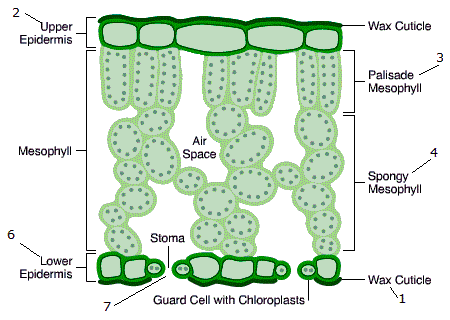
The diagram shows the arrangement of cells inside the leaf of a green plant. $($No cell contents are shown$).$ Which cells normally contain chloroplasts? Which cells normally contain chloroplasts?
  • A
    $1$ and $2$
  • $1$ and $4$
  • C
    $2$ and $3$
  • D
    $2$ and $4$
Answer
Correct option: B.
$1$ and $4$
View full question & answer
M.C.Q - Page 4 - Science STD 10 Questions - Vidyadip