Question 15 Marks
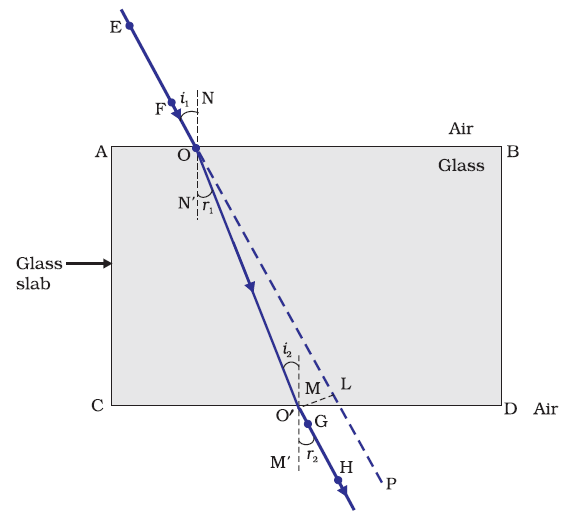
Write laws of refraction. Explain the same with the help of ray diagram, when a ray of light passes through a rectangular glass slab.
Answer
View full question & answer→Laws of refraction of light are:
- The incident ray, the refracted ray and the normal to the interface of two transparent media at the point of incidence, all lie in the same plane.
- The ratio of sine of angle of incidence to the sine of angle of refraction is constant, for the light of a given wavelength and for the given pair of media. This law is also known as Snell’s law of refraction. The constant is also known as refractive index.
The ray diagram is as shown below: